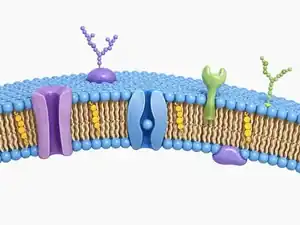
Every cell is separated from the world by a structure only 7–10 nanometres thick. That membrane is not a wall, it's a dynamic, constantly shifting surface that controls everything that enters and leaves.
⏱ 40 min4 dot points5 MC · 3 Short AnswerLesson 6 of 17
🔬
Choose how you work, type your answers below or write in your book.
Think First
Before reading on, make a prediction:
A cell membrane needs to do two contradictory things: keep the cell's contents in, and let essential molecules like glucose and oxygen pass through. Predict: what structural features would a membrane need to achieve both goals simultaneously?
Come back to this at the end of the lesson.
Know
The fluid mosaic model, what fluid and mosaic mean
Components of the membrane: phospholipids, proteins, cholesterol, glycolipids, glycoproteins
Types of membrane transport: diffusion, osmosis, active transport, endocytosis, exocytosis
Understand
Why the phospholipid bilayer is selectively permeable
How cholesterol regulates membrane fluidity
Why active transport requires ATP but diffusion does not
Can Do
Describe and explain the fluid mosaic model
Compare passive and active transport with examples
Explain how membrane structure relates to cardiovascular disease
Core Content
The Problem the Membrane Had to Solve
Every living cell must maintain an internal environment radically different from its surroundings. A neuron maintains a negative internal charge. A cell in your kidney must concentrate urea while keeping glucose in. A red blood cell carries oxygen without oxidising its own machinery.
The solution is a membrane that is selectively permeable not simply a barrier, but a gatekeeper. It must block some molecules absolutely, allow others to pass freely, and actively pump others against their concentration gradient using energy. All of this must happen continuously, simultaneously, in a structure just 7–10 nm thick.
Historical note: The fluid mosaic model was proposed by Singer and Nicolson in 1972. Before this, the dominant model (Davson-Danielli, 1935) imagined the membrane as a rigid sandwich, a static lipid bilayer coated in protein. Singer and Nicolson showed proteins were embedded within and moving through the bilayer, not coating it from outside.
Membrane context view. Use the interactive model below for exact component labels and transport behaviour.
Interactive
The Fluid Mosaic Model, What the Name Means
The model has two words that both carry specific meaning the HSC will test:
Fluid the phospholipid molecules are not fixed in place. They move laterally (sideways) within each layer, and occasionally flip between layers. The membrane is more like a liquid crystal than a solid wall. Temperature affects fluidity: warmer = more fluid; colder = more rigid. Cholesterol buffers this effect.
Mosaic proteins are embedded throughout the bilayer in varying positions, like tiles in a mosaic. Some span the entire bilayer (integral/transmembrane proteins); others sit on the surface (peripheral proteins). This variety of proteins creates the membrane's functional diversity.
Phospholipids
The structural foundation. Each molecule has a hydrophilic (water-loving) phosphate head and two hydrophobic (water-fearing) fatty acid tails. In water they spontaneously arrange into a bilayer, heads facing outward toward water, tails facing inward away from it. This arrangement requires no energy and is thermodynamically stable.
Integral (transmembrane) proteins
Span the entire bilayer. Function as channel proteins (allow specific ions/molecules to pass through), carrier proteins (bind and transport molecules), or receptor proteins (detect signals from outside the cell). Essential for selective permeability.
Peripheral proteins
Attached to the inner or outer surface of the bilayer without penetrating it. Function in cell signalling, structural support, and as enzymes. Easier to remove than integral proteins.
Cholesterol
Interspersed between phospholipids in animal cell membranes. Acts as a fluidity buffer: at high temperatures, cholesterol restricts phospholipid movement (preventing excess fluidity); at low temperatures, it prevents phospholipids from packing too tightly (preventing rigidity). Maintains consistent membrane function across temperatures.
Glycoproteins
Proteins with carbohydrate chains attached, extending from the outer membrane surface. Function in cell recognition (e.g. ABO blood group antigens), immune response, and cell-to-cell communication. The carbohydrate layer on the cell surface is called the glycocalyx.
Glycolipids
Phospholipids with carbohydrate chains attached on the outer surface. Also contribute to the glycocalyx. Function in cell recognition and adhesion, important for tissue formation and immune surveillance.
ApplyBand 3
Activity 01
Apply to an Unfamiliar Context
Pattern B, Apply to unfamiliar context
A researcher places red blood cells into three different solutions:
Solution A: Same solute concentration as the cell cytoplasm (isotonic)
Solution B: Lower solute concentration than the cell cytoplasm (hypotonic)
Solution C: Higher solute concentration than the cell cytoplasm (hypertonic)
Predict what will happen to the red blood cells in each solution. Explain your reasoning using the term "water potential."
In Solution B, the cells swell and may burst (lyse). Explain at the molecular level why water moves into the cell.
A plant cell is placed in Solution C. Unlike the red blood cell, it does not collapse completely. Explain why, referring to a specific structural feature of plant cells.
The researcher adds a drug that blocks all aquaporin channels in the red blood cell membrane. Predict how this would affect the rate of water movement into cells placed in Solution B. Would water movement stop completely? Explain.
Write your responses here or in your book.
Diagram, Phospholipid Structure (Hydrophilic Head & Hydrophobic Tails)
Membrane Transport, Moving Substances Across
The membrane's selective permeability means different substances cross by different mechanisms. The key distinction is whether the process requires energy (ATP) or not.
Simple Diffusion
Direction: High → low concentration (down gradient)
Energy: None (passive)
Mechanism: Small nonpolar molecules (O₂, CO₂, ethanol) dissolve through the lipid bilayer directly
Example: O₂ into respiring cells; CO₂ out
Facilitated Diffusion
Direction: High → low concentration (down gradient)
Energy: None (passive)
Mechanism: Polar or large molecules use channel or carrier proteins to cross, they cannot dissolve through the bilayer
Example: Glucose into cells via GLUT transporters; ions via ion channels
Osmosis
Direction: High water potential → low water potential
Energy: None (passive)
Mechanism: Water moves through aquaporin channel proteins or directly through the bilayer, from dilute to concentrated solution
Example: Water into root hair cells from soil; water into red blood cells in hypotonic solution
Active Transport
Direction: Low → high concentration (against gradient)
Energy: ATP required
Mechanism: Carrier proteins (pumps) use ATP to move substances against their concentration gradient
Example: Na⁺/K⁺ pump in neurons; uptake of mineral ions into root cells
Endocytosis
Direction: Into cell
Energy: ATP required
Mechanism: Cell membrane folds inward, engulfing large particles or fluid into a vesicle. Phagocytosis (solids), pinocytosis (liquids)
Example: White blood cells engulfing pathogens; cells taking up LDL cholesterol
Exocytosis
Direction: Out of cell
Energy: ATP required
Mechanism: Vesicles fuse with the cell membrane and release their contents outside the cell
Example: Neurotransmitter release at synapses; insulin secretion from pancreatic beta cells; mucus secretion
The permeability rule: Small, nonpolar molecules (O₂, CO₂, steroid hormones) cross freely. Small polar molecules (water) cross slowly or via aquaporins. Large polar molecules (glucose, amino acids) and ions (Na⁺, K⁺, Cl⁻) require protein channels or carriers. Nothing large (proteins, polysaccharides) crosses without vesicle-based transport.
AnalyseBand 4
Activity 02
Compare Passive vs Active Transport
Pattern B, Compare and Contrast
In your book, construct a detailed comparison table covering all six transport mechanisms from this lesson. Your table must include columns for: direction of movement relative to concentration gradient, energy requirement, mechanism (how it works structurally), and one specific biological example.
After completing the table, answer the following in two sentences: a neuron uses the Na⁺/K⁺ pump to restore its resting membrane potential after firing. Why must this process use active transport rather than facilitated diffusion?
Write your two sentences here.
Practical Investigation, Modelling Osmosis with Dialysis Tubing
Real red blood cells are too small and fragile to observe fluid movement directly with school equipment. A dialysis (Visking) tubing "artificial cell" lets you model the same osmosis principle at a scale you can actually measure.
Aim
To model the movement of water across a selectively permeable membrane by osmosis, using dialysis tubing as an artificial cell membrane.
Materials
Dialysis (Visking) tubing, pre-soaked in water to soften
String or dialysis tubing clips
Concentrated sucrose solution (e.g. 1 mol L⁻¹)
Distilled water
Two 250 mL beakers
Electronic balance
Stopwatch or timer
Method
Cut two lengths of dialysis tubing (about 15 cm) and tie a tight knot in one end of each, or seal with a clip.
Fill Tube A with concentrated sucrose solution and Tube B with distilled water. Expel excess air, then seal the open end of each tube tightly.
Rinse the outside of each tube to remove any spilled solution, blot dry, and record the initial mass of each tube on the balance.
Submerge Tube A in a beaker of distilled water, and Tube B in a beaker of concentrated sucrose solution. Start the timer.
At 5-minute intervals for 20 minutes, remove each tube, blot dry, re-weigh and immediately return it to its beaker.
Record all masses in a results table and calculate the change in mass from the initial reading at each time point.
Results and Analysis
Plot mass change (y-axis) against time (x-axis) for each tube on the same set of axes. Tube A (sucrose solution in distilled water) should gain mass as water moves in by osmosis, from the high water potential of the surrounding distilled water to the low water potential inside the tubing. Tube B (distilled water in sucrose solution) should lose mass, as water moves out of the tube toward the lower water potential of the surrounding sucrose solution.
Why dialysis tubing works as a model: Dialysis tubing, like a real cell membrane, is selectively permeable, its pores allow small water molecules to pass through but are too small for large sucrose molecules to cross. This makes it a valid physical model of the semi-permeable phospholipid bilayer, even though it lacks the protein channels and active transport systems of a real membrane.
Discussion Questions
Explain, in terms of water potential, why Tube A gained mass while Tube B lost mass.
A red blood cell placed in distilled water behaves like which tube in this investigation? Predict what would eventually happen to the cell, and explain why a cell, unlike the dialysis tube, can rupture (lyse).
Identify one way that dialysis tubing is a good model of a cell membrane, and one way it is a poor model.
Suggest one modification to this method that would improve the reliability of the results.
Why is it essential to blot each tube dry with the same technique before every weighing?
Real World, Cholesterol, Membrane Fluidity & Cardiovascular Disease
Cholesterol is essential for membrane function, without it, membranes become either too rigid (at low temperatures) or too fluid (at high temperatures). But excess LDL cholesterol in the blood leads to a different problem: LDL particles are taken up by arterial wall macrophages via endocytosis. When too much cholesterol accumulates, macrophages become "foam cells", bloated, dysfunctional cells that form the core of atherosclerotic plaques. These plaques narrow arteries and can rupture, triggering heart attacks or strokes. Statins work by inhibiting HMG-CoA reductase, the enzyme cells use to synthesise their own cholesterol, reducing LDL levels in the blood. This is a direct application of membrane biology to cardiovascular medicine. You'll return to this in Short Answer Q3.
Diagram, Membrane Transport Mechanisms Comparison
Common Misconceptions
Misconception: The cell membrane is a solid, rigid barrier.
The membrane is fluid, phospholipids move laterally at rates of about 2 µm per second. Proteins also move within the bilayer. The membrane is better described as a two-dimensional liquid.
Misconception: Osmosis is just diffusion of water, no special rules apply.
Osmosis specifically refers to water movement across a selectively permeable membrane, driven by differences in water potential (solute concentration). Water moves toward the more concentrated solution (lower water potential), which is the opposite direction to solute diffusion.
Misconception: Cholesterol is always harmful to cells.
Cholesterol is an essential membrane component in animal cells, it stabilises membrane fluidity across temperature ranges. The health problems associated with cholesterol relate to excess LDL in the bloodstream leading to plaque formation, not to cholesterol's role in the membrane itself.
Fluid Mosaic Model
Fluid, phospholipids move laterally; not fixed
Mosaic, proteins embedded throughout in varied positions
Proposed by Singer & Nicolson, 1972
Membrane Components
Phospholipid bilayer, structural foundation
Integral proteins, channels, carriers, receptors
Peripheral proteins, signalling, structural
Cholesterol, fluidity buffer
Glycoproteins/glycolipids, cell recognition
Transport, Passive (no ATP)
Simple diffusion, small nonpolar molecules
Facilitated diffusion, via channel/carrier proteins
Osmosis, water, high → low water potential
Transport, Active (ATP required)
Active transport, against concentration gradient
Endocytosis, into cell via vesicle
Exocytosis, out of cell via vesicle
Activities
Assessment
Multiple Choice, 5 marks
RememberBand 1
1. The term "fluid" in the fluid mosaic model refers to which of the following?
A The aqueous environment surrounding the cell
B The water that passes through the membrane via osmosis
C The lateral movement of phospholipids and proteins within the bilayer
D The flow of ions through channel proteins
UnderstandBand 2
2. Glucose cannot cross the cell membrane by simple diffusion despite being a small molecule. The most likely reason is that glucose is:
A Too large to fit through the membrane
B Polar and therefore cannot dissolve through the hydrophobic interior of the bilayer
C Negatively charged and repelled by the membrane
D Always transported against its concentration gradient
ApplyBand 3
3. A cell is placed in a hypertonic solution. Which of the following correctly describes what will happen?
A Water moves into the cell; the cell swells
B Solutes move out of the cell; the cell shrinks
C No net movement occurs; the cell stays the same size
D Water moves out of the cell by osmosis; the cell shrinks
ApplyBand 3
4. Which of the following transport processes requires ATP?
A Simple diffusion of O₂ into a respiring cell
B Osmosis of water into a root hair cell
C Facilitated diffusion of glucose via GLUT transporters
D Uptake of mineral ions into root cells against a concentration gradient
UnderstandBand 2
5. Cholesterol molecules in the cell membrane function primarily to:
A Provide structural rigidity like a plant cell wall
B Regulate membrane fluidity across a range of temperatures
C Act as receptor proteins for hormone signalling
D Transport glucose across the membrane by facilitated diffusion
Short Answer, 9 marks
1. Describe the structure of the phospholipid bilayer and explain how this structure makes the membrane selectively permeable. (3 marks)
1 mark bilayer structure; 1 mark hydrophobic core explanation; 1 mark selective permeability with example
2. Compare simple diffusion and active transport. In your answer, refer to the direction of movement, energy requirements, and give one specific biological example of each. (3 marks)
1 mark direction comparison; 1 mark energy comparison; 1 mark correct example each
3. Explain how the normal membrane function of cholesterol in animal cells relates to the development of atherosclerosis when LDL cholesterol levels in the blood are elevated. (3 marks)
1 mark cholesterol's normal membrane role; 1 mark LDL uptake via endocytosis; 1 mark foam cell/plaque formation
Answers
Q1, C: "Fluid" describes the lateral mobility of phospholipid and protein molecules within the bilayer. The membrane is not a static structure, molecules constantly move sideways within each leaflet of the bilayer.
Q2, B: Glucose is a polar molecule. The interior of the phospholipid bilayer is hydrophobic, it repels polar molecules. Glucose must use carrier proteins (GLUT transporters) via facilitated diffusion to cross.
Q3, D: In a hypertonic solution, the external solute concentration is higher than inside the cell. Water potential is lower outside the cell, so water moves out by osmosis, the cell loses water and shrinks (crenation in animal cells, plasmolysis in plant cells).
Q4, D: Mineral ion uptake into root cells occurs against the concentration gradient, ions move from low concentration in soil water to high concentration inside the cell. This requires energy (ATP) provided by active transport pumps.
Q5, B: Cholesterol acts as a fluidity buffer, it prevents the membrane from becoming too fluid at high temperatures (by restricting phospholipid movement) and too rigid at low temperatures (by preventing tight packing). It maintains consistent membrane function across temperature ranges.
SA1: The phospholipid bilayer consists of two layers of phospholipid molecules arranged with their hydrophilic (phosphate) heads facing outward toward the aqueous environment on each side, and their hydrophobic (fatty acid) tails pointing inward toward each other. The hydrophobic core acts as a barrier to water-soluble (polar and charged) molecules, they cannot dissolve through the fatty acid tails. This makes the membrane selectively permeable: small nonpolar molecules like O₂ and CO₂ dissolve through freely, while polar molecules like glucose and ions like Na⁺ are blocked unless specific protein channels or carriers are present.
SA2: Simple diffusion moves substances down their concentration gradient (from high to low concentration) and requires no energy (ATP). Example: O₂ diffuses from the alveoli into red blood cells along its concentration gradient. Active transport moves substances against their concentration gradient (from low to high concentration) and requires ATP. Example: the Na⁺/K⁺ pump in neurons uses ATP to pump 3 Na⁺ out and 2 K⁺ in against their respective gradients, maintaining the resting membrane potential needed for nerve signal transmission.
SA3: In animal cell membranes, cholesterol molecules are interspersed between phospholipids where they regulate fluidity, preventing membranes from becoming too rigid at low temperatures or too fluid at high temperatures. This is an essential structural function. When LDL cholesterol levels in the blood are elevated, arterial wall macrophages take up LDL particles via endocytosis, a normal cellular uptake mechanism. However, with excess LDL, macrophages become overloaded with cholesterol and transform into dysfunctional "foam cells," which accumulate within the arterial wall and form the fatty core of atherosclerotic plaques. These plaques narrow arteries and, if ruptured, can trigger blood clots leading to heart attacks or strokes, a disease process driven by the hijacking of a normal membrane transport mechanism.
Revisit Your Thinking
You predicted what structural features a membrane would need to keep things in while selectively letting things through. How did your prediction compare?
The answer the fluid mosaic model gives: a hydrophobic phospholipid bilayer blocks most polar molecules by default, while embedded protein channels and carriers provide selective gateways for the specific molecules each cell needs. The dual nature, impermeable by default, permeable by exception, is what makes selective permeability possible.
If you predicted "some kind of gated holes", you were essentially describing channel proteins. If you predicted "a double layer", you were describing the bilayer. Both are right in important ways.