Multiple Choice
1. B Both xylem and arteries have thick, structurally reinforced walls that resist vessel deformation under pressure. The specific reinforcement differs (lignin in xylem, elastic fibres + collagen + smooth muscle in arteries) and they resist opposite pressure signs (negative vs positive), but the shared function, preventing the vessel from changing shape under internal fluid pressure, is the structural similarity. Xylem are dead (arteries are not); neither has valves; xylem pressure is negative not positive.
2. D Phloem direction is not mechanically fixed, it follows the source-to-sink turgor pressure gradient, which changes depending on where sources (photosynthesising leaves) and sinks (growing roots, fruits, meristems) are located. These can be above or below the source leaf simultaneously, driving sap in both directions in different phloem bundles. Venous return is unidirectional because all venous blood must return to the right atrium, the heart creates a single unified pressure gradient pulling blood toward the thorax.
3. C The claim is incorrect for xylem. Xylem transport is driven by transpiration pull, solar energy (not metabolic ATP) evaporates water from leaves. No ATP is consumed at the xylem vessel. The student may be confusing xylem with phloem loading (which does require ATP) or with root pressure (which requires some metabolic energy at root cells to load minerals into xylem). Arterial blood flow does require continuous ATP via cardiac contraction, this part is correct.
4. A Convergent evolution means independent evolution of similar structures or functions in unrelated lineages. Alveoli and leaf mesophyll air spaces evolved in completely separate lineages (animals and plants diverged over 1 billion years ago) but both independently arrived at the same structural solution to gas exchange: large surface area, thin membrane, moist surface, maintained gradient. This is textbook convergent evolution driven by the same physical constraint (Fick's law).
5. C The correct explanation integrates both sides: plants can use free solar energy passively and their cells tolerate slower O₂ delivery; animals cannot because high-metabolism organs (brain, heart muscle, liver) require rapid, uninterrupted O₂ delivery at rates only a pressurised pump can provide. The body size argument (A) fails because some trees are 100m tall, larger than most animals. Cell wall argument (B) is irrelevant to transport pressure. The "lighter contents" argument (D) misunderstands the physics, blood density is not the relevant variable.
Q6, Model Answer
Difference 1, Cell viability: Xylem vessel elements are dead at functional maturity, their cytoplasm, nucleus, and organelles have been removed, leaving a hollow tube. Artery walls consist of living smooth muscle cells, elastic fibres, and endothelial cells. Xylem cell death is necessary because living cytoplasm would obstruct the water column and impose osmotic resistance, slowing bulk flow, the hollow lumen is essential for low-resistance transport. Artery smooth muscle must remain living because its active contraction and relaxation (vasoconstriction/vasodilation) regulates blood distribution to organs in response to demand, a function impossible for dead cells.
Difference 2, Reinforcement material and pressure sign: Xylem walls are impregnated with lignin, a rigid polymer that prevents the vessel from collapsing inward. Artery walls contain elastic fibres, collagen, and smooth muscle that prevent bursting outward and allow elastic recoil. The difference reflects the pressure regime: xylem operates under negative pressure (tension, below atmospheric), so the vessel walls face an inward collapsing force that lignin resists. Arteries operate under high positive pressure (up to ~120 mmHg during systole), so vessel walls face an outward bursting force that elastic fibres and collagen resist. Both solve the same problem, vessel integrity under pressure, but for opposite pressure directions.
Q7, Model Answer
Xylem transport requires no metabolic energy at the vessel because its driving force, transpiration pull, is powered by solar energy rather than ATP. Solar radiation evaporates water from mesophyll cell surfaces in the leaf, creating a water deficit that lowers water potential at the top of the xylem column. This generates tension (negative pressure) that is transmitted through the continuous cohesive water column from leaf to root, drawing water upward. The energy comes from photons of sunlight, not from the plant's own metabolism, the xylem vessel itself is entirely passive.
Animal blood circulation requires continuous cardiac ATP output because there is no equivalent external energy source available to drive fluid through a closed vessel network against flow resistance. The heart must actively contract against the back-pressure of the systemic circuit to maintain blood pressure and flow. If the heart stops, blood pressure immediately collapses, unlike transpiration, which continues as long as sunlight and water are available. Additionally, blood is a dense, viscous fluid in a high-resistance network, requiring substantial force to maintain adequate flow to all organs, especially at the distances involved in large mammals.
The fundamental difference is energy source: solar energy is captured from outside the organism to power plant xylem transport; metabolic energy must be continuously generated internally to power animal circulation.
Q8, Model Answer
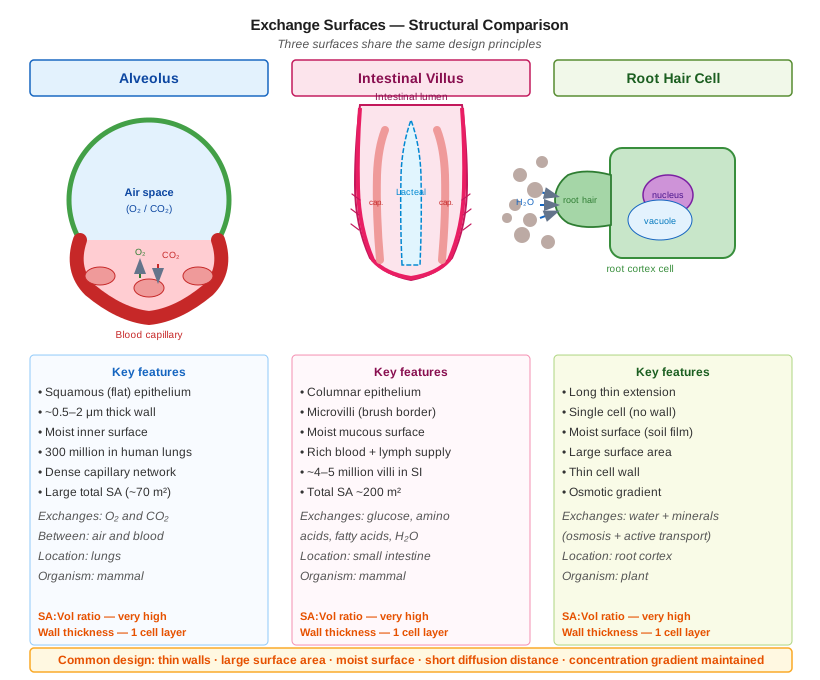
A shared structural feature is large total surface area achieved through extensive internal subdivision, both leaf mesophyll air spaces and alveoli maximise exchange surface within a compact volume through folding and branching.
In plants, the spongy mesophyll layer contains highly irregular cells with large air spaces between them, creating an enormous internal surface area relative to the leaf's external dimensions. In animals, the lung contains approximately 500 million alveoli, tiny air sacs produced by progressive branching of airways, providing approximately 250m² of total exchange surface area within an organ that fits in the thorax.
According to Fick's law, rate of diffusion is directly proportional to surface area: Rate ∝ (SA × concentration gradient) / membrane thickness. A larger surface area means more molecules can diffuse across the membrane simultaneously. For a given concentration gradient and membrane thickness, doubling the surface area doubles the total diffusion rate. Without this large surface area, neither organism could obtain enough O₂ (or expel enough CO₂) by diffusion alone to meet the metabolic demands of their cells, the small surface area of the outer body surface would be wholly inadequate.