Secondary Source Analysis, Photosynthesis and Plant Transport Models
Science doesn't arrive fully formed. The understanding you've built across this module took centuries of contested experiments, flawed models, and gradual revision. This lesson traces that history, and teaches you to evaluate it the way HSC examiners expect.
Practise this lesson
Four printable worksheets that build from the foundations up to exam-style questions, start at whatever level suits you.
Before you begin this lesson, take a moment to think about what you already know about this topic. Jot down your ideas, you will revisit them at the end.
Know
- Trace the historical development of photosynthesis understanding (6 key scientists)
- Evaluate what each experiment revealed AND what it failed to explain
- Describe how cohesion-tension theory was developed and tested
- Apply the skills of evaluating secondary sources: reliability, validity, claims vs evidence
- Explain how scientific models are revised over time with new evidence
Understand
- Interpret secondary-sourced information to evaluate photosynthesis processes
- Evaluate claims and conclusions from secondary sources
- Working Scientifically: reliability, validity, evaluating methods
- Connects: L08 (photosynthesis), L17 (transpiration-cohesion-tension)
Can Do
- Name 5 scientists and state what each experiment revealed about photosynthesis
- For each experiment, identify one question it left unanswered
- Evaluate a secondary source extract using the four-point framework
- Explain how cohesion-tension theory is supported by experimental evidence
- Write a Band 6 response evaluating historical scientific claims
Content from this lesson that appears directly in HSC Biology exams
HSC Section III (20 marks) always contains a secondary source analysis question. Students are given an extract and asked to evaluate the claim, identify limitations, or assess the strength of evidence. This skill is practiced here using real historical photosynthesis experiments.
Naming scientists and their experiments, what was revealed, and what remained unexplained. Tested as 3–5 mark questions in Section II, "Describe how scientific understanding of photosynthesis developed" requires sequential, causally-linked answer with named experiments.
Explaining the process by which scientific models change in response to new evidence. Tested as 2–3 mark "explain how understanding of X developed" questions. Must show the progressive, non-linear nature of model revision, not just list facts.
Distinguishing reliable from unreliable sources; identifying limitations of experimental methods; evaluating whether conclusions are supported by evidence. The four-point framework (source type, author expertise, publication date, consistency) is examinable.
Photosynthesis, A History
Misconceptions to Fix
Wrong: Scientific models are permanent once they are widely accepted.
Right: All scientific models are provisional and subject to revision. The model of photosynthesis evolved from van Helmont's soil-and-water hypothesis to Priestley's gas discovery to Ingenhousz's light requirement, and continues to be refined. A model's acceptance depends on evidence, not permanence.
The History of Photosynthesis, Six Experiments That Changed Everything
Each experiment revealed one piece of the puzzle, and left others wide open
Understanding of photosynthesis was not a single discovery, it accumulated over 300 years, with each experiment revealing something and leaving something unanswered. For HSC, you need to know both what each experiment showed and what it failed to explain.
The Willow Tree Experiment
Van Helmont planted a 2.3 kg willow sapling in a pot of soil weighing 90 kg, watered only with rain or distilled water. After 5 years, the willow weighed 76 kg, but the dried soil had lost less than 60 g. He concluded the plant's mass came almost entirely from water, not from soil.
The Bell Jar and Mint Experiment
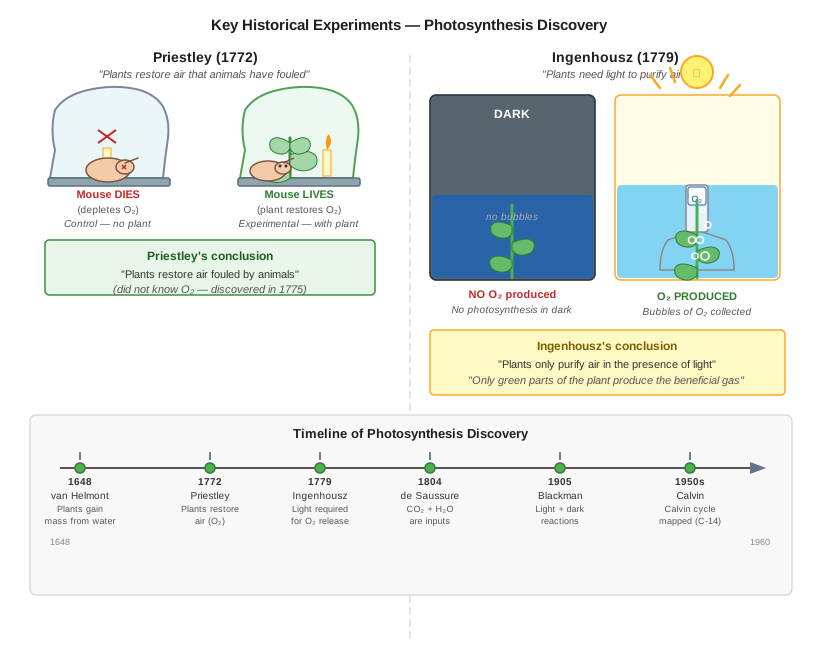
Priestley placed a candle and a mint sprig under a sealed glass jar. The candle extinguished (consuming what he called "dephlogisticated air", later identified as O₂). After 10 days, the mint had "restored" the air, a candle could burn again in it. He concluded that plants could "restore air that had been injured by the burning of candles."
Light is Required for Gas Production
Ingenhousz repeated Priestley's experiments systematically with one crucial addition, he compared plants in sunlight vs darkness. He found that only the parts of the plant in sunlight produced the "beneficial gas" (O₂), and that plants in the dark actually "injured" the air by releasing CO₂.
CO₂ and Water as Raw Materials
De Saussure used careful quantitative measurements, weighing plants and measuring gas volumes. He showed that plants absorbed CO₂ and water, and that the increase in plant mass was roughly proportional to the CO₂ absorbed. He also showed that O₂ released was approximately equal in volume to CO₂ absorbed.
Limiting Factors, Two Stages of Photosynthesis
Blackman measured the rate of photosynthesis at different light intensities and temperatures. At high light intensity, increasing light further had no effect, but increasing temperature did increase rate. He concluded that photosynthesis has two stages: a light-dependent stage (limited only by light) and a temperature-dependent stage (not directly driven by light).
The Calvin Cycle, Carbon Fixation Pathway
Using radioactive ¹⁴C-labelled CO₂ and paper chromatography, Calvin's team traced the path of carbon through the light-independent reactions in algae. By stopping photosynthesis at intervals and analysing the compounds present, they identified the complete cycle of reactions that fix CO₂ into glucose, now called the Calvin cycle.
Figure: Six key experiments in the development of photosynthesis understanding. Coloured year pill matches the HTML timeline above. Each experiment revealed one piece of the mechanism and left others unknown.
How the Model of Photosynthesis Evolved
Three stages, from "plants eat water" to the full two-stage biochemical model
Van Helmont showed it was mostly water. Priestley added: plants also interact with air. Ingenhousz added: light is needed.
Summary equation understood: Water + Light → plant growth + "good air"
Missing: CO₂ role, carbon source for biomass, mechanism entirely unknown.
De Saussure established CO₂ as carbon source. The overall equation: CO₂ + H₂O + light → glucose + O₂ was being assembled.
Blackman revealed two stages existed, light-driven and temperature-driven.
Missing: the biochemical pathway, the two-stage mechanism, the role of chlorophyll at the molecular level.
Light-dependent reactions: chlorophyll absorbs light → water split → ATP + NADPH produced → O₂ released.
Light-independent reactions (Calvin cycle): CO₂ fixed using ATP + NADPH → G3P → glucose.
Still being refined: photorespiration, C4/CAM pathways, photosystem structure at atomic resolution.
Figure: How understanding of photosynthesis changed across three eras. Each new model retained the previous validated evidence and added the new experimental result.
The evolution of this model illustrates a core feature of science: models are provisional. Each new model incorporated the evidence that validated the previous one, added new experimental data, and remained open to further revision. No single scientist "discovered" photosynthesis, the current understanding is a collective construction spanning three centuries.
Check Your Understanding
Write one sentence summarising the main idea of this section.
Cohesion-Tension Evidence
Cohesion-Tension Theory, How It Was Established
A theory built from multiple independent lines of evidence
Cohesion-tension theory (first formally proposed by Dixon and Joly in 1894 and elaborated by Dixon in 1914) was controversial for decades. Critics argued that water under tension would cavitate, form bubbles, making the mechanism impossible for tall trees. The theory was eventually supported by multiple independent lines of evidence, each ruling out alternative explanations.
| Evidence Type | Observation | What It Supports |
|---|---|---|
| Transpiration correlates with ascent | Cut shoots take up water at the same rate they transpire. Covering leaves (blocking transpiration) stops water uptake. Remove the leaves, water stops moving up the stem. | The driving force for upward water movement originates at the leaf surface, consistent with transpiration pull, not root pressure alone. |
| Negative pressure measured directly | Pressure probes inserted into xylem vessels of transpiring plants consistently measure pressures below atmospheric, sometimes −2 MPa or lower in tall trees. Water is genuinely under tension. | Xylem water is under negative pressure as the theory predicts, directly supporting the "tension" component of cohesion-tension theory. |
| Acoustic detection of cavitation | Ultrasonic detectors placed on stems of drought-stressed plants detect clicking sounds, the acoustic signature of xylem cavitation events (air bubbles forming as the water column breaks). | Water in xylem is under sufficient tension to cavitate under stress, confirming cohesion is being overcome at its physical limits, exactly as the theory predicts. |
| Stem diameter changes with transpiration | Highly sensitive dendrometers (measuring instruments) show that tree trunks become slightly thinner during the day (high transpiration, high tension) and expand at night (low transpiration, tension relaxed). | The xylem vessel walls are being pulled inward by tension, so trunks slightly contract. This is direct physical evidence of tension in the xylem consistent with cohesion-tension theory. |
| Isotope tracing | Heavy water (D₂O) added to roots appears at leaves in the same time predicted by cohesion-tension flow rates, not faster (as root pressure would suggest) and not slower (as diffusion alone would produce). | The rate of water movement matches cohesion-tension predictions quantitatively, ruling out both root pressure and diffusion as primary mechanisms for tall-tree water transport. |
Check Your Understanding
Write one sentence summarising the main idea of this section.
Evaluating Secondary Sources, The Four-Point Framework
A systematic approach for any HSC secondary source question
The HSC Biology exam regularly provides an extract from a secondary source (a textbook, review article, popular science article, or historical account) and asks students to evaluate it. The following framework applies to any secondary source question.
| Evaluation Point | What to Assess | What High-Quality Looks Like |
|---|---|---|
| 1. Source type and credibility | Who wrote it? For what audience? In what publication? Is the author an expert in the relevant field? | Peer-reviewed journal article by domain experts → high credibility. Wikipedia / popular press / anonymous blog → lower credibility. Textbook → moderate (consensus view, may lag research). |
| 2. Currency (date) | When was it published? Has knowledge in the field advanced significantly since then? | A 2023 review article reflects current understanding. A 1970s textbook may contain models that have been revised. Historical primary sources (van Helmont, Priestley) are valuable as evidence of what was known at the time, not as statements of current truth. |
| 3. Claim vs evidence match | Does the source's conclusion follow logically from the evidence presented? Are claims broader than the evidence justifies? | Van Helmont's data (tree grew, soil barely changed) is valid. His conclusion (water alone built the tree) goes beyond his evidence, he didn't measure CO₂ or gases. Overgeneralisation is the most common flaw in historical science and student responses. |
| 4. Limitations of the method | What are the controlled variables? What could not be controlled? What alternative explanations exist for the data? | Priestley's bell jar experiment: couldn't control light (key uncontrolled variable); didn't account for microorganisms consuming O₂; no quantitative gas measurement. Each limitation reduces confidence in the conclusion while not invalidating the observation. |
Apply this framework to the source extracts in the Activities section below. The goal is not to dismiss historical sources, they are invaluable, but to interpret them accurately within the context of what was and wasn't known at the time.
Evaluating Secondary Sources, The Cohesion-Tension Debate
Read the following adapted extract from a 1990s biology textbook discussing how water moves to the tops of tall trees:
"The cohesion-tension theory remains the most widely accepted explanation for xylem transport. However, some researchers have questioned whether transpiration alone generates sufficient negative pressure to pull water up the tallest trees. Alternative hypotheses involving active pumping by living cells in the xylem have been proposed, though these remain controversial and lack strong experimental support."
- Identify the origin of this source (type, date, and intended audience).
- Assess the purpose of this source, why was it written?
- Evaluate the objectivity of the source. Does it present a balanced view?
- Assess the reliability of the claims made. Are they supported by evidence mentioned in the text?
- Based on your evaluation, explain whether this source would be useful for an HSC student writing about the history of the cohesion-tension theory.
Type your written response below or write in your book.
Source Extracts, Read and Evaluate
Apply the four-point framework to these adapted historical and modern sources
"I took an earthen vessel, placed therein two hundred pounds of earth dried in a furnace, and watered with rain water. I planted the trunk of a willow tree weighing five pounds. At the end of five years the willow weighed one hundred and sixty-nine pounds and three ounces. Only water was used to wet the earth. The earth was again dried and weighed two hundred pounds minus two ounces. Therefore one hundred and sixty-four pounds of wood, bark and roots arose from water only."
Van Helmont concludes that "one hundred and sixty-four pounds of wood, bark and roots arose from water only."
"The cohesion-tension theory, while not without its critics, is now supported by direct pressure probe measurements showing xylem pressures as low as −1.5 MPa in transpiring trees. The theory proposes that the tensile strength of water, arising from hydrogen bonding between water molecules, is sufficient to maintain a continuous water column under these negative pressures. Acoustic emissions detected during drought stress provide additional evidence that cavitation does occur at the physical limits of the mechanism, exactly as the theory predicts. No alternative mechanism currently explains the full range of observed data."
Cohesion-tension theory is "now supported by direct pressure probe measurements" and "no alternative mechanism currently explains the full range of observed data."
Evaluate both sources in Activity 01 using the four-point framework.
Check Your Understanding
Write one sentence summarising the main idea of this section.
Copy into your books
▼Key Scientists, Photosynthesis
- Van Helmont (1648): mass from water, not soil (missed CO₂).
- Priestley (1771): plants produce "good air" (O₂), light role unknown.
- Ingenhousz (1779): light essential; distinguishes photosynthesis from respiration.
- De Saussure (1804): CO₂ + water → mass + O₂ (quantitative).
- Blackman (1905): two stages, light-dependent and light-independent.
- Calvin (1950s): ¹⁴C tracing → Calvin cycle, full carbon fixation pathway.
Cohesion-Tension Evidence Lines
- Transpiration controls water uptake (covering leaves stops flow).
- Pressure probes: xylem at −2 MPa, genuine negative pressure.
- Acoustic detectors: clicking = cavitation at limits of tension.
- Dendrometers: trunks thinner during day (tension pulling inward).
- Isotope tracing: D₂O arrival time matches cohesion-tension predictions.
Secondary Source Evaluation
- Source type and credibility (peer-reviewed > popular press).
- Currency, is knowledge current or outdated?
- Claim vs evidence, does conclusion follow from data?
- Limitations, uncontrolled variables, alternative explanations.
How Scientific Models Evolve
- Models are provisional, always open to revision with new evidence.
- Technology unlocks new questions (isotopes, pressure probes).
- Progress is collective and cumulative, no single discovery.
- A good model incorporates all existing evidence and makes testable predictions.
Activities
Assessment
Multiple Choice
5 random review questions from a replayable lesson bank
Short Answer
6. Describe how scientific understanding of photosynthesis developed from Van Helmont (1648) to Calvin (1950s). In your answer, identify three scientists, state what each experiment revealed, and explain how each finding built upon or challenged the previous understanding. 5 MARKS
One mark per scientist (3) + two marks for showing how each built on the previous. Must show causally-linked progression, not just a list.
7. Evaluate the reliability and validity of Van Helmont's 1648 willow experiment as a source of evidence about plant nutrition. 4 MARKS
Two marks reliability (source type, replicability, control of variables) + two marks validity (does conclusion logically follow from data; are there alternative explanations).
Blast the Correct Answer
Defend your ship by blasting the correct answers for Secondary Source Analysis, Photosynthesis and Plant Transport Models. Scores count toward the Asteroid Blaster leaderboard.
Play Asteroid Blaster →Mark lesson as complete
Tick when you've finished all activities and checked your answers.
Look back at what you wrote at the start of this lesson. How has your thinking changed? What new connections can you make?