Human Evolution
In 2015, the announcement of 1,550 Homo naledi fossils from South Africa challenged the old idea that bigger brains always came first in human evolution. The hominid record shows something far more interesting: humans are one branch within the great apes, and our history is a branching evolutionary tree reconstructed from fossils, anatomy, tools and molecular evidence.
Download this lesson's worksheet
Use the PDF for classwork, homework or revision. It includes key ideas, activities, questions, an extend task and success-criteria proof.
Think First
Commit to your first interpretation before we build the evidence properly.
1. If humans and chimpanzees share a common ancestor, does that mean humans descended from modern chimpanzees?
2. If brain size increases across some hominid species, does that mean human evolution was a straight line from small brain to big brain?
Write your starting answer now. We will revisit it after the fossil and branching-evidence sections.
Write your initial answer in your book, then return later to compare it with your final explanation.
📚 Know
- Key facts and definitions for Human Evolution
- Relevant terminology and conventions
🔗 Understand
- The concepts and principles underlying Human Evolution
- How to explain the reasoning behind key ideas
✅ Can Do
- Apply concepts from Human Evolution to exam-style questions
- Justify answers using appropriate biological reasoning
Know
- The main hominid species named in the syllabus.
- The key morphological trends in the hominid record.
- The difference between fossil and molecular evidence.
Understand
- Why humans are one great-ape lineage rather than separate from ape evolution.
- Why human evolution is branching rather than linear.
- Why multiple evidence types are needed because the fossil record is incomplete.
Can Do
- Describe bipedalism, brain-size and jaw changes through time.
- Summarise key hominid species accurately.
- Evaluate what fossils and ancient DNA can and cannot tell us.
Misconceptions to Fix
Wrong: Natural selection means organisms change because they want or need to.
Right: Natural selection acts on random genetic variations; organisms do not consciously adapt.
Core Content
Connect this concept to the broader biology framework. Understanding how systems interact is essential for HSC success.
Great Apes, Shared Ancestry and Morphological Change
Humans are one branch of the ape family, not a species that stepped out of evolution separately
Humans are one of the great apes in the family Hominidae. That means humans and chimpanzees share a common ancestor, not that humans descended from modern chimpanzees.
Several morphological trends appear repeatedly in the hominid record. Bipedalism is inferred from a more central foramen magnum, a broader pelvis, an inward-angled femur and the development of a foot arch. Brain size increases overall across many hominid species, although the pathway is not perfectly smooth. Jaw shape becomes less prognathous, canine teeth reduce, and the dental arcade becomes more parabolic in Homo. Tool use also becomes more sophisticated, from Oldowan stone tools to Acheulean hand axes and later modern technologies.
Key Hominid Species and the Branching Timeline
From Australopithecus afarensis to Homo sapiens, with Homo naledi disrupting simple stories
The hominid record is best understood as a branching pattern reconstructed from many fossil discoveries, not as a single neat ladder of progress.
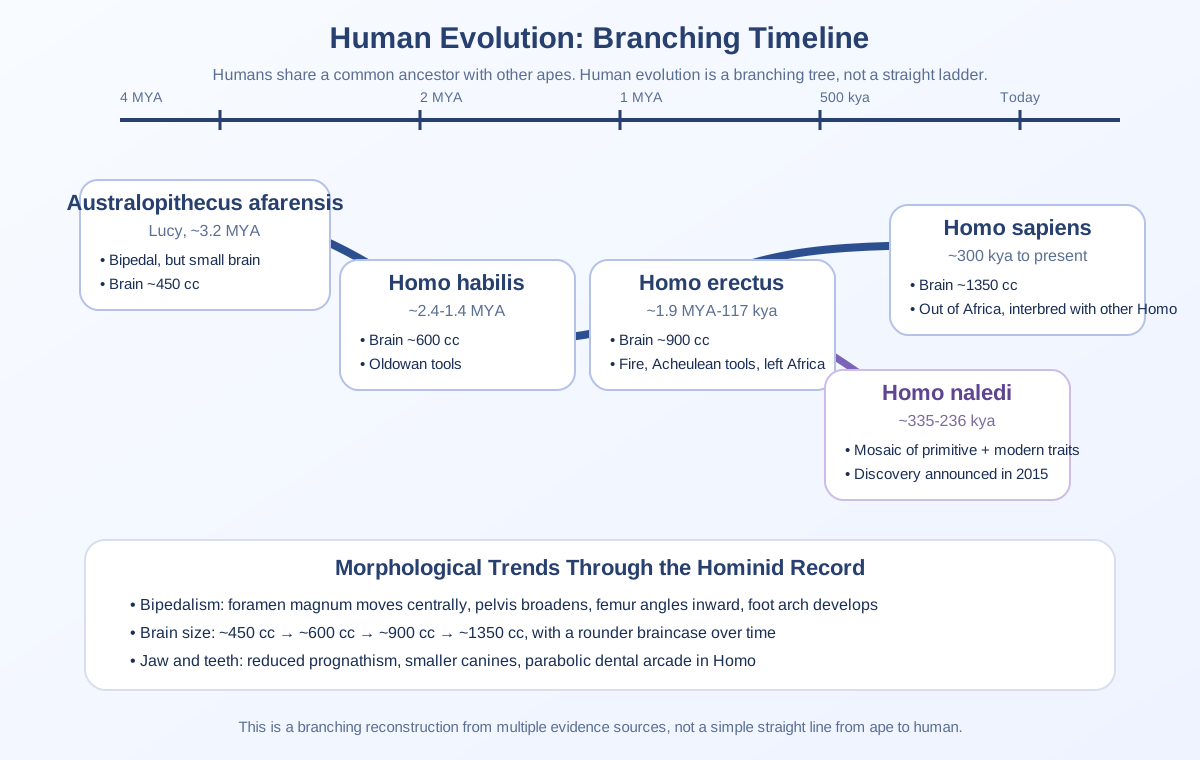
| Species | Approximate Date | Why It Matters |
|---|---|---|
| Australopithecus afarensis | ~3.2 MYA | Lucy; clearly bipedal but still small-brained, showing that upright walking came before large brains. |
| Homo habilis | ~2.4-1.4 MYA | “Handy Man”; associated with regular stone-tool use and a larger brain than Australopithecus. |
| Homo erectus | ~1.9 MYA-117,000 years ago | Used fire, made Acheulean tools, and was the first Homo species to leave Africa. |
| Homo naledi | ~335,000-236,000 years ago | Announced in 2015; mosaic of primitive and modern features, showing human evolution was more complex than a simple brain-size ladder. |
| Homo sapiens | ~300,000 years ago to present | Modern humans; African origin, later Out of Africa dispersal, and interbreeding with Neanderthals and Denisovans. |
Fossils, Ancient DNA and the Quality of Evidence
Why the record is incomplete but still powerful when multiple lines of evidence agree
No single fossil or DNA sample tells the whole story. Human evolution is reconstructed by combining incomplete fossils, anatomical comparisons, archaeological evidence and, where available, molecular data.
| Evidence Type | Strengths | Limitations |
|---|---|---|
| Fossil bones | Show anatomy directly; reveal posture, skull shape, teeth, pelvis and limb structure | Fossil record is incomplete and preservation is uneven |
| Stone tools / archaeology | Show behaviour and technology associated with hominids | Tools do not always identify the exact maker with certainty |
| Ancient DNA | Tests relatedness directly and can reveal interbreeding between lineages | Only survives in some conditions; unavailable for many older fossils |
Ancient DNA from archaic humans is one reason we know modern non-African populations carry Neanderthal and Denisovan ancestry. But DNA cannot be extracted from every fossil, especially very old ones or those from unsuitable environments. That is why converging evidence from multiple sites matters so much. The fossil record is incomplete, yet repeated patterns in anatomy, dates, tools and genetics make the overall reconstruction stronger.
Shared Ancestry
- Humans are one of the great apes.
- Humans and chimpanzees share a common ancestor; humans did not descend from modern chimpanzees.
Morphological Trends
- Bipedalism evidence includes foramen magnum position, pelvis, femur angle and foot structure.
- Brain size generally increases and the jaw becomes less prognathous.
Key Species
- A. afarensis, H. habilis, H. erectus, H. naledi, H. sapiens.
- H. naledi is especially important because it disrupts simple linear stories.
Evidence Quality
- Fossils are incomplete but directly show anatomy.
- Ancient DNA is powerful but not available for every fossil.
- Human evolution is best represented as a branching tree.
Activities
Trait Before Trend
Lucy (Australopithecus afarensis) was bipedal but had a much smaller brain than modern humans. Explain why this is important evidence against the idea that big brains came first in human evolution.
Focus on what Lucy shows about the order of evolutionary changes.
Draft your explanation in your book first, then record the final version here.
Why Homo naledi Matters
Explain why the 2015 announcement of Homo naledi made scientists more cautious about describing human evolution as a simple straight line from primitive to advanced forms.
A strong answer should mention mosaic features and the branching model.
Write the longer evaluation in your book, then summarise it here.
Revisit Your Thinking
The cleanest way to avoid common mistakes here is to separate “common ancestor” from “direct ancestor”, and “overall trend” from “single straight line”. Human evolution contains branching, coexistence and unexpected trait combinations.
If your first answer treated brain size as the whole story, the correction is this: anatomy, behaviour, fossils and molecular evidence all need to be integrated before the pattern makes sense.