Biology • Year 12 • Module 6 • Lesson 4
Chromosomal Mutation, Large-Scale Genetic Change
Lock in the four structural categories, deletion, duplication, inversion, translocation, and the scale logic that separates chromosomal mutation from point mutation.
1. Label the four chromosomal mutation types
The diagram below shows a normal chromosome at the top and the four structural rearrangements below it. Each rearrangement is shown with the original gene-segment order labelled A · B · C · D · E. Write the missing labels into boxes A–H. 8 marks
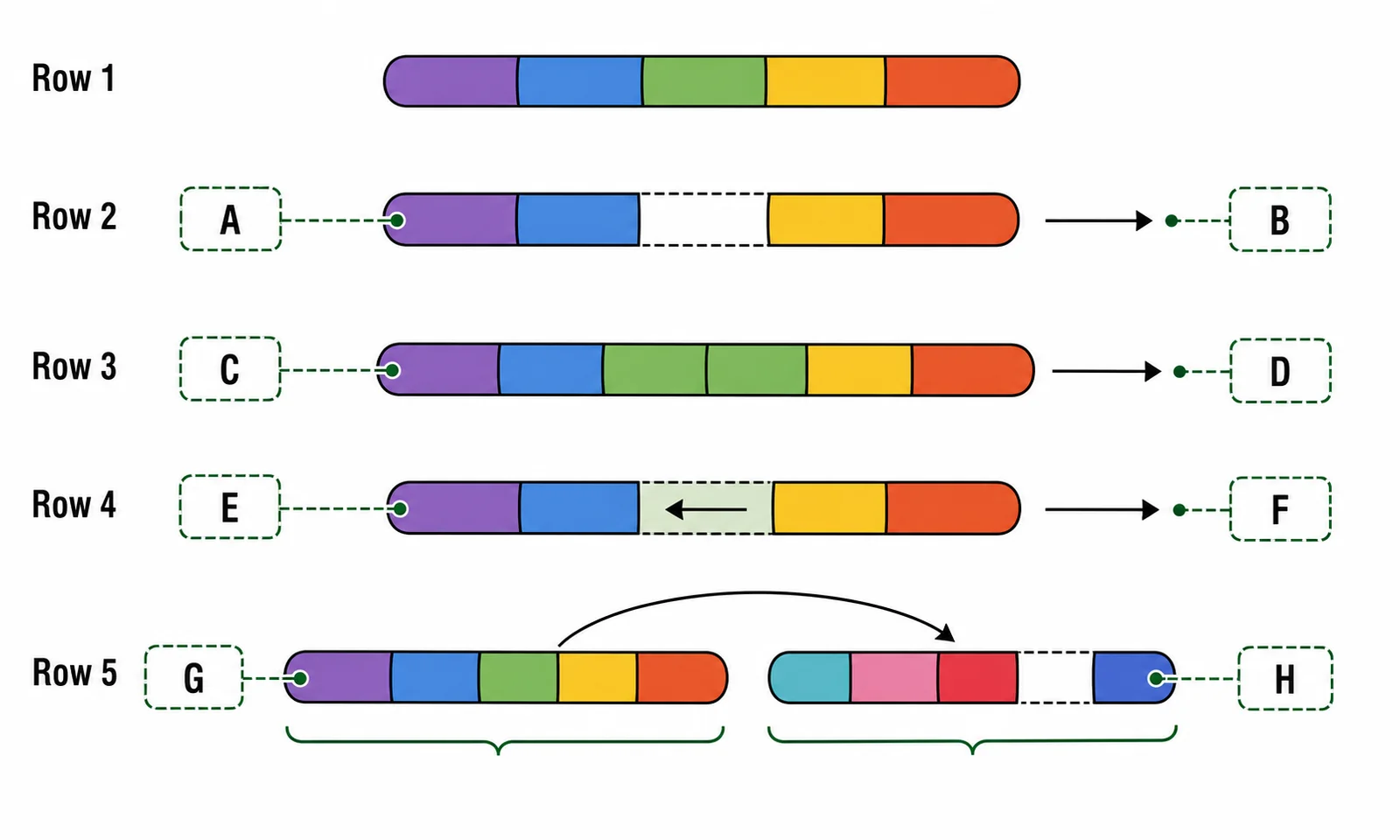
- A, mutation name (segment missing) _______________________
- B, gene-content consequence of A (e.g. genes lost / extra copies / order reversed / moved away) _______________________
- C, mutation name (segment present twice) _______________________
- D, gene-content consequence of C _______________________
- E, mutation name (segment reversed in order) _______________________
- F, gene-content consequence of E _______________________
- G, mutation name (segment moved to another chromosome) _______________________
- H, gene-content consequence of G _______________________
| Box | Your label |
|---|---|
| A | |
| B | |
| C | |
| D | |
| E | |
| F | |
| G | |
| H |
2. Term–definition match
The ten definitions below are shuffled. In the right-hand column write the matching term from this list: chromosomal mutation, deletion, duplication, inversion, translocation, gene dosage, point mutation, chromosome number change, breakpoint, control region. 10 marks
| # | Definition (shuffled) | Matching term |
|---|---|---|
| 2.1 | A large-scale change to the structure of a chromosome segment, and sometimes to chromosome number, rather than a single base sequence. | |
| 2.2 | A chromosomal mutation in which a segment of a chromosome is lost, removing the genes in that region. | |
| 2.3 | A chromosomal mutation in which a chromosome segment is present twice, increasing the copy number of the genes in that region. | |
| 2.4 | A chromosomal mutation in which a segment breaks off and reattaches in the reverse orientation, changing gene order. | |
| 2.5 | A chromosomal mutation in which a segment moves to a different chromosome or new location, often onto a non-homologous chromosome. | |
| 2.6 | The number of copies of a gene present, which can affect how much gene product is made. | |
| 2.7 | A mutation at the level of a single base or a few adjacent bases within one gene, such as a substitution or small indel. | |
| 2.8 | A large-scale mutation class in which gaining or losing whole chromosomes alters the copy number of every gene on those chromosomes. | |
| 2.9 | The exact location on a chromosome where a structural mutation breaks the DNA; a gene or regulatory region sitting across one can be disrupted. | |
| 2.10 | A non-coding DNA sequence near a gene that influences when and where the gene is expressed; can be disrupted if an inversion or translocation breakpoint falls across it. |
3. True or false, with correction
For each statement, circle T or F. If the statement is false, write the corrected version. 8 marks (1 for T/F, 1 for the correction where needed)
3.1 A chromosomal mutation is just a "bigger version" of a point mutation that happens to occur on a chromosome. T / F
3.2 A duplication of a chromosome segment increases the gene dosage of the genes inside that segment. T / F
3.3 Every inversion mutation causes severe disease because gene order is altered. T / F
3.4 Translocation moves a chromosome segment to a different location, sometimes onto a non-homologous chromosome. T / F
4. Effect recall, why does each change matter?
Answer each in 1–2 sentences using precise terms from the lesson. 10 marks (2 each)
4.1 What is the likely cellular effect of a deletion that removes a segment containing several genes?
4.2 What is the likely cellular effect of a duplication that doubles the copy number of a gene that controls cell growth?
4.3 What is the likely effect of an inversion whose breakpoints fall inside a gene's coding sequence?
4.4 What is the likely effect of a translocation that places a growth-control gene next to a strong "always-on" regulatory region from another chromosome?
4.5 Why does the same logic not usually apply to a single missense substitution in one codon of one gene?
5. Cloze paragraph, scale and consequence
Complete the paragraph by writing the missing word from the word bank into each numbered blank. Word bank (use each once): point, chromosomal, many, deletion, duplication, inversion, translocation, dosage, structure, broader. 10 marks (1 per blank)
A 5.1 _______________ mutation changes a single base, or just a few, inside one gene, while a 5.2 _______________ mutation changes the 5.3 _______________ of a chromosome segment, and sometimes chromosome number. Because 5.4 _______________ genes can sit inside one altered region, the biological consequences are usually 5.5 _______________ than those of a point mutation. The four structural categories are 5.6 _______________ (segment lost), 5.7 _______________ (segment present twice), 5.8 _______________ (segment reversed) and 5.9 _______________ (segment moved elsewhere). A duplication is especially likely to alter gene 5.10 _______________, because the extra copies can drive higher levels of gene product.
Q1, Labelled diagram
A: deletion. B: genes inside the lost segment are removed entirely (gene content reduced). C: duplication. D: extra copies of the genes in that segment, gene dosage increased. E: inversion. F: gene order along the chromosome is reversed; if a breakpoint falls inside a gene or its control region, that gene may be disrupted. G: translocation. H: the segment of genes is moved to a new chromosomal context, often onto a non-homologous chromosome, sometimes placing genes next to new regulatory regions.
Q2, Term–definition matches
2.1 chromosomal mutation • 2.2 deletion • 2.3 duplication • 2.4 inversion • 2.5 translocation • 2.6 gene dosage • 2.7 point mutation • 2.8 chromosome number change • 2.9 breakpoint • 2.10 control region.
Q3, True / false with correction
3.1 False. Correction: a chromosomal mutation is not just a bigger point mutation, it is a structural change at the level of a chromosome segment (and sometimes whole chromosome number), so it can simultaneously affect many genes rather than altering one codon in one gene.
3.2 True.
3.3 False. Correction: not every inversion causes severe disease. Many inversions are carried without symptoms, the phenotypic effect depends on whether a breakpoint falls inside a gene or regulatory region.
3.4 True.
Q4.1, Effect of deletion (2 marks)
If the deleted segment contains several genes, those gene products are no longer made [1]. Missing gene products or regulatory elements can disrupt development, cell function or both, and the effect is usually broader than losing one codon's worth of sequence [1].
Q4.2, Effect of duplication (2 marks)
Doubling the gene copy number increases gene dosage, so substantially more growth-control protein may be produced [1]. Over-expression of a growth-control gene can push the cell toward inappropriate division and is a known route to abnormal proliferation in some cancers [1].
Q4.3, Effect of an inversion with breakpoints inside a gene (2 marks)
A breakpoint inside a coding sequence physically cuts the gene, destroying the correct open reading frame [1]. The resulting truncated or fused mRNA usually produces a non-functional or aberrant protein, so that gene's function is lost or altered even though the rest of the chromosome looks intact [1].
Q4.4, Effect of a translocation placing a growth-control gene under a strong promoter (2 marks)
The translocation moves the growth-control gene next to a strong regulatory region from another chromosome, so the gene is now transcribed at much higher levels than normal [1]. Continuous expression of a growth-control gene can drive uncontrolled cell division, this is the logic behind translocation-associated cancers such as the Philadelphia chromosome [1].
Q4.5, Why a single missense substitution differs (2 marks)
A missense substitution changes only one codon and therefore (at most) one amino acid in one protein [1]. The effect is local to that one gene product, it cannot remove, duplicate, reverse or relocate multiple genes at once, so its biological consequences are usually narrower than those of a chromosomal mutation [1].
Q5, Cloze paragraph (10 marks)
5.1 point • 5.2 chromosomal • 5.3 structure • 5.4 many • 5.5 broader • 5.6 deletion • 5.7 duplication • 5.8 inversion • 5.9 translocation • 5.10 dosage.