HIV, influenza, and a tapeworm all cause infectious disease — but an antibiotic cures none of them. Understanding why requires knowing not just what a pathogen does, but what it fundamentally is.
Use the PDF for classwork, homework or revision. It includes key ideas, activities, questions, an extend task and success-criteria proof.
Consider this analogy:
"A locksmith, a carpenter, and a welder all break into buildings — but you wouldn't use the same tools to stop all three."
How does this analogy apply to pathogens and the way we treat infectious diseases? Write your prediction before reading on. What do you think the "different tools" would be in a disease context?
Come back to this at the end of the lesson.
Core Content
Wrong: Common misconception for this lesson.
Right: Correct understanding with explanation.
In 1928, Alexander Fleming noticed that a Penicillium mould was killing bacteria on his culture plates. That observation led to penicillin — one of the most important medical discoveries in history. But penicillin works by disrupting bacterial cell wall synthesis. Viruses have no cell wall. Fungi have a different cell wall composition. Tapeworms have no cell wall at all.
This is the locksmith problem: every pathogen type has a different biological structure, and effective treatment requires a tool that targets that specific structure. Giving antibiotics for a viral infection does not just fail — it actively contributes to antibiotic resistance by selecting for resistant bacteria in the patient's microbiome.
Accurate pathogen classification is therefore not an academic exercise. It is the first step in choosing the correct treatment — and avoiding the wrong one.
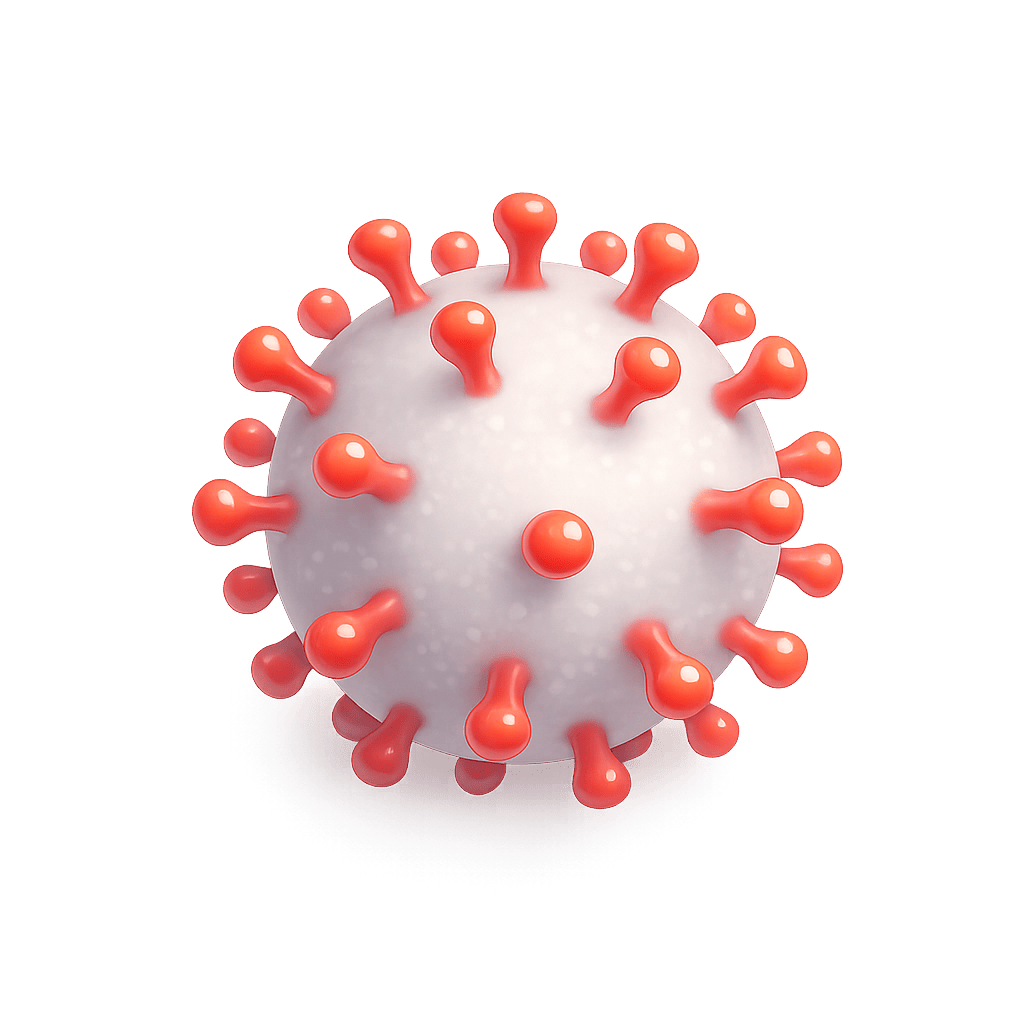
The five types of pathogen and their key characteristics. Accurate classification is the first step in choosing the correct treatment.
The HSC requires you to classify pathogens causing disease in both plants and animals. The same category of pathogen can infect organisms across both kingdoms — the specific pathogen differs, but the classification framework is identical.
| Pathogen Type | Key Features | Plant Disease Example | Animal/Human Disease Example |
|---|---|---|---|
| Bacteria | Prokaryotic; cell wall of peptidoglycan; reproduce by binary fission; some produce toxins | Fire blight (Erwinia amylovora) — damages apple and pear trees | Tuberculosis (Mycobacterium tuberculosis) — infects lung tissue |
| Virus | Non-cellular; DNA or RNA genome; protein coat (capsid); requires host cell to replicate | Tobacco mosaic virus (TMV) — causes mottling and stunted growth | Influenza (Influenza A virus) — infects respiratory epithelium |
| Fungus | Eukaryotic; cell wall of chitin; absorptive nutrition; spreads via spores | Wheat stem rust (Puccinia graminis) — destroys stem tissue | Tinea (Trichophyton spp.) — infects skin, nails, hair |
| Protozoan | Eukaryotic; unicellular; heterotrophic; complex life cycles (often multiple hosts) | Pythium root rot (Pythium spp., an oomycete) — rots seedling roots | Malaria (Plasmodium falciparum) — infects red blood cells and liver |
| Helminth | Multicellular animal (worm); macroorganism; absorb nutrients from host; eggs/larvae spread via faeces or vectors | Root-knot nematode (Meloidogyne spp.) — forms galls on plant roots | Tapeworm (Taenia solium) — attaches to intestinal wall |
| Viroid | Non-cellular; single-stranded circular RNA only — no protein coat; smallest known pathogen; plants only | Potato spindle tuber viroid (PSTVd) — deforms potato tubers | Not known to infect animals |
| Prion | Non-cellular; misfolded protein only — no nucleic acid; induces normal proteins to misfold; animals only | Not known to infect plants | BSE — bovine spongiform encephalopathy; CJD in humans |
A pathogen that cannot enter a host cannot cause disease. Each pathogen type has evolved specific structural and biochemical adaptations that facilitate entry through host barriers — skin, mucous membranes, cell walls, or internal tissues.
Entering one host is only half the challenge — a successful pathogen must also spread to new hosts. Transmission adaptations are often the most important factor in determining how dangerous an outbreak becomes.
| Pathogen | Transmission Route | Key Adaptation | Why It Is Effective |
|---|---|---|---|
| Influenza virus | Respiratory droplets and aerosols | Replicates in upper respiratory epithelium; triggers coughing and sneezing | Coughing expels millions of viral particles; virus survives briefly on surfaces |
| HIV | Direct contact with infected blood or bodily fluids | Targets CD4+ T helper cells — central immune cells; long asymptomatic period | Long latency means host is infectious for years without knowing it |
| Plasmodium (malaria) | Vector transmission via Anopheles mosquito | Develops in mosquito salivary glands; injected during blood meal | Uses vector to bypass host skin barrier entirely; vector feeds repeatedly |
| Tapeworm (Taenia) | Faecal-oral route; ingestion of undercooked meat | Eggs shed in faeces; larvae encyst in muscle of intermediate host (pig/cattle) | Encysted larvae survive cooking at low temperatures; intermediate host broadens transmission |
| TMV (plant virus) | Mechanical contact; contaminated tools or hands | Extremely stable protein coat; survives drying and moderate heat for years | Persists on surfaces and tools long after infected plant material removed |
Misconception: Antibiotics can be used to treat any infectious disease.
Antibiotics specifically target bacterial structures — primarily cell wall synthesis (penicillins) or bacterial ribosomes (aminoglycosides). Viruses, fungi, protozoa, helminths, and prions do not have these structures. Using antibiotics for a viral infection is not just ineffective; it promotes antibiotic resistance in the patient's own bacterial microbiome.
Misconception: A more complex pathogen is always more dangerous.
Complexity does not equal danger. Prions — the simplest "pathogens" (just a misfolded protein, no nucleic acid at all) — cause uniformly fatal neurodegenerative diseases with no treatment. A simple rhinovirus causes a common cold. Danger depends on virulence, immune evasion, and transmission efficiency, not on biological complexity.
Misconception: Viroids and viruses are the same thing.
Viroids are single-stranded circular RNA molecules with no protein coat — they are smaller than any known virus and infect plants only. Viruses have a protein coat (capsid), may have a lipid envelope, contain DNA or RNA, and infect animals, plants, and bacteria. A viroid is not a small virus — it is a fundamentally different type of pathogen.
Pathogen Types — Plants vs Animals
Activities
The table below shows transmission data for three pathogens during separate outbreaks. Analyse the data and answer the questions.
Write your responses here or in your book.
A student submitted the following paragraph as part of an assignment on pathogen classification. The paragraph contains four factual errors. Identify each error, explain why it is wrong, and write the correct information.
"Pathogens can be divided into two main groups: cellular and non-cellular. Cellular pathogens include bacteria, viruses, and fungi. Bacteria are prokaryotic cells treated effectively with antifungal drugs. Non-cellular pathogens include prions and viroids. Prions are small pieces of RNA that cause neurodegenerative disease in animals. Viroids infect both plant and animal hosts using a protein coat to penetrate cell membranes. When comparing adaptations, the influenza virus uses fimbriae to bind to receptors on respiratory cells, while tapeworms use hooks and suckers to attach to the intestinal wall."
Write your responses here or in your book.
You were asked to apply the locksmith analogy — a locksmith, carpenter, and welder all break into buildings, but you need different tools to stop each one.
The analogy maps directly onto pathogens. HIV (the "welder" — it fuses its genome into the host's own DNA), influenza (the "locksmith" — it picks a specific molecular lock on respiratory cells using haemagglutinin), and a tapeworm (the "carpenter" — it physically builds itself into the intestinal wall using hooks and suckers) all cause infectious disease, but they do so through entirely different mechanisms requiring entirely different countermeasures.
The "different tools" are antiretrovirals for HIV, neuraminidase inhibitors for influenza, and anthelmintics for tapeworms. The classification of each pathogen — retrovirus, influenza virus, helminth — directly dictates which tool applies. Getting the classification wrong means reaching for the wrong tool entirely.
If your original prediction identified that different pathogen types need different treatments, you had the right intuition. If you predicted that antibiotics would work for any of these three — you now know why that fails, and why antibiotic misuse is a global public health problem.
Assessment
5 random questions from a replayable lesson bank — feedback shown immediately
1. Classify the following pathogens and justify each classification: (a) Plasmodium falciparum, (b) tobacco mosaic virus, (c) a tapeworm. (3 marks)
1 mark per pathogen: correct classification with a structural or biological justification
2. Compare the adaptations of a named bacterial pathogen and a named viral pathogen for entry into a host. In your answer, identify a specific structural feature of each and explain how it facilitates entry. (3 marks)
1 mark: bacterial adaptation correctly named and explained | 1 mark: viral adaptation correctly named and explained | 1 mark: explicit comparison (similarity or difference)
3. HIV, influenza, and tapeworm (Taenia solium) all cause serious infectious disease, yet treating one with medication effective against another would fail completely. Using the classification of each pathogen and their structural features, explain why a single treatment cannot be effective against all three. (4 marks)
1 mark: HIV classification and relevant structure/treatment | 1 mark: influenza classification and relevant structure/treatment | 1 mark: tapeworm classification and relevant structure/treatment | 1 mark: explicit link between structural differences and treatment specificity
Answers
SA1: (a) Plasmodium falciparum is a protozoan, classified as a microorganism. It is a unicellular eukaryote — it has a nucleus, mitochondria, and a complex life cycle involving both a mosquito vector and a human host. It is not a bacterium (it is eukaryotic) and not a virus (it is a living cell capable of independent metabolism). (b) Tobacco mosaic virus is a non-cellular pathogen (virus). It consists of an RNA genome enclosed in a protein coat (capsid) — it has no cell membrane, no cytoplasm, and cannot replicate without hijacking a host cell's machinery. (c) A tapeworm is a macroorganism — specifically a helminth (parasitic worm). It is a multicellular animal, visible to the naked eye, with a complex body structure including hooks, suckers, and proglottids. It is classified as a macroorganism, not a microorganism.
SA2: The bacterium Staphylococcus aureus uses surface proteins called fimbriae (or adhesins) that bind to fibronectin receptors on host epithelial cells. This molecular attachment prevents the bacterium from being washed away by mucus or fluid flow, allowing it to colonise the tissue surface before invading. The influenza A virus uses a surface glycoprotein called haemagglutinin, which binds specifically to sialic acid receptors on respiratory epithelial cells. This receptor-ligand interaction initiates endocytosis — the cell engulfs the bound virus, bringing it inside. Both pathogens use a surface molecule to bind a specific host cell receptor as the first step in host entry. However, the bacterial adhesin facilitates surface colonisation, while the viral haemagglutinin triggers active internalisation of the virus into the host cell.
SA3: HIV is a retrovirus — a non-cellular pathogen containing RNA and the enzyme reverse transcriptase, which converts its RNA into DNA for insertion into the host cell genome. Antiretroviral drugs (e.g. reverse transcriptase inhibitors) specifically block this enzyme. Antibiotics, antifungals, and anthelmintics do not affect reverse transcriptase — there is no relevant target. Influenza is also a non-cellular pathogen (virus), but it replicates differently — neuraminidase inhibitors (e.g. oseltamivir) block influenza's neuraminidase surface protein, preventing new viral particles from being released from infected cells. This mechanism is specific to influenza's neuraminidase; it has no effect on HIV or on a worm. Taenia solium (tapeworm) is a macroorganism — a multicellular helminth. Anthelmintic drugs (e.g. mebendazole) disrupt tubulin polymerisation in the worm, preventing cell division and glucose uptake. Tubulin-disruption has no relevance to viral replication. A single treatment cannot be effective against all three because each pathogen has fundamentally different biology — different structures, different replication mechanisms, and different metabolic processes — meaning each requires a drug that specifically targets its unique biology.
Sprint through questions on classifying bacteria, viruses, fungi and parasites. Pool: lessons 1–2.