1
You’re here
Orient, explore and apply
Warm up first
Three quick questions from earlier lessons. Pulling old material back to mind before you learn something new makes the new material stick better, so this is not busywork.
Worksheets
Practise this lesson
Four printable worksheets that build from the foundations up to exam-style questions, start at whatever level suits you.
Before You Read
warm-up
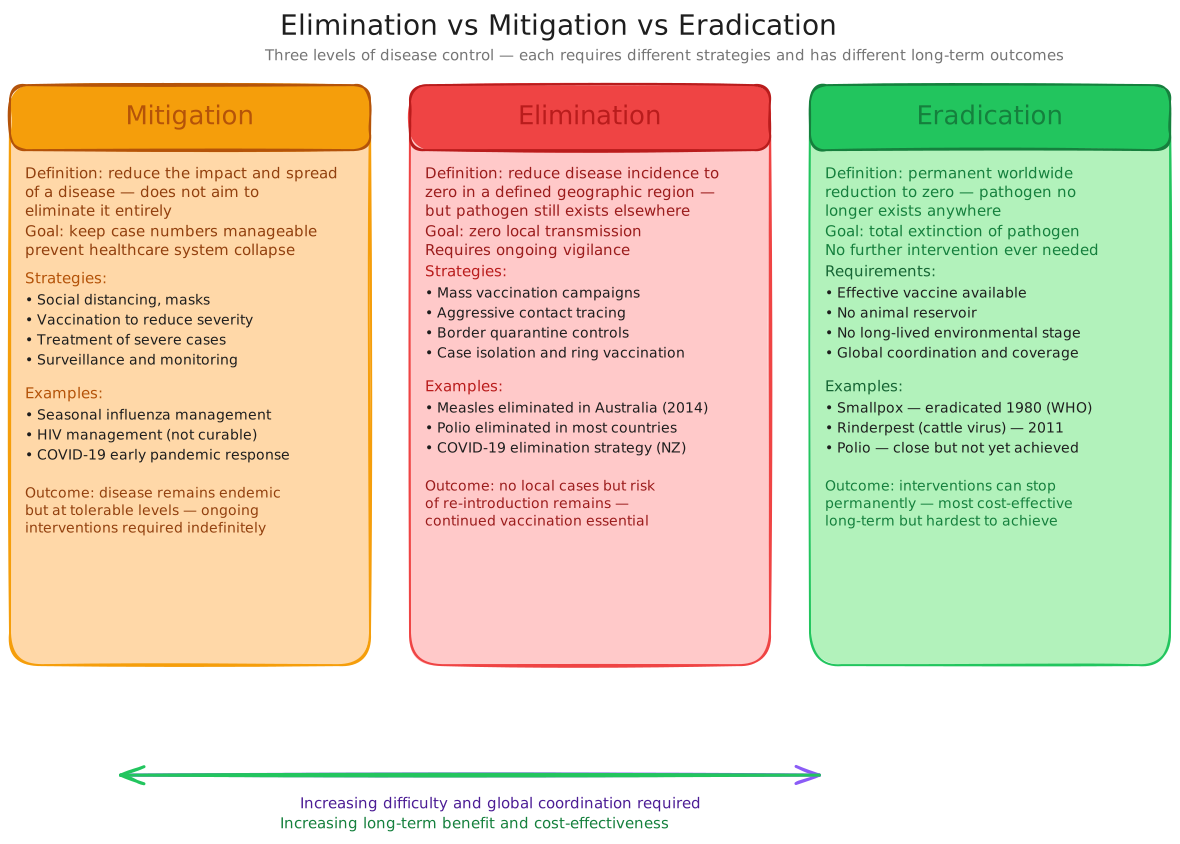
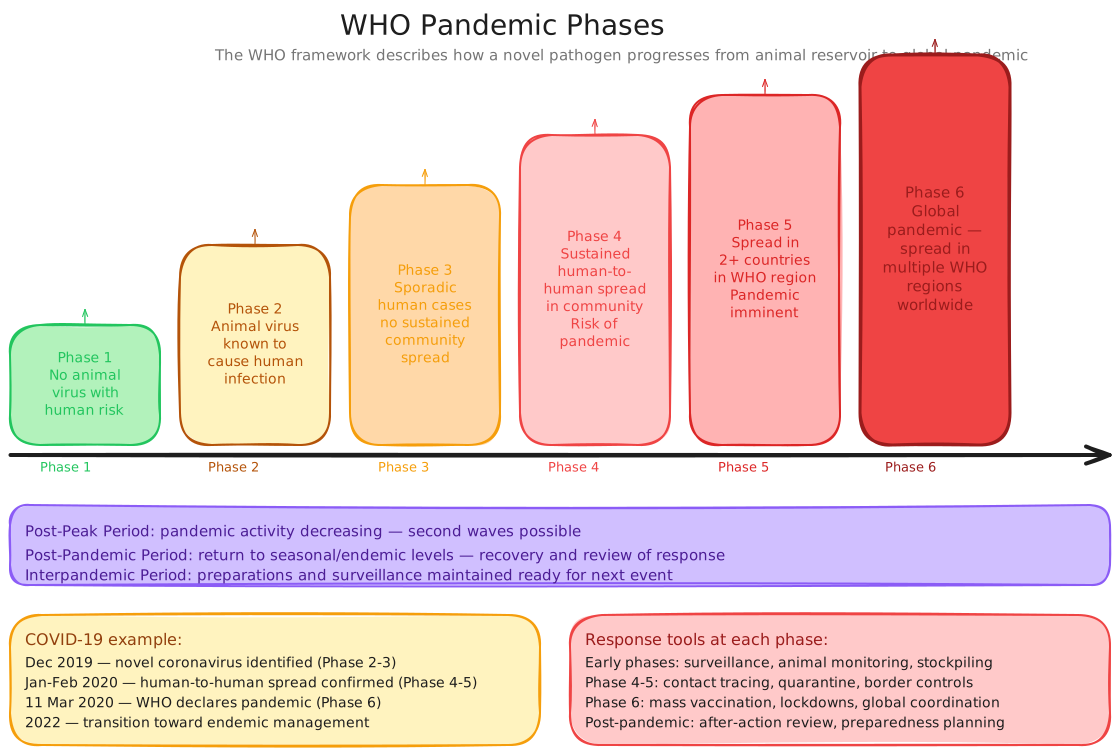
In March 2020, governments around the world had to make decisions about COVID-19 with very limited information, about how transmissible it was, how lethal it was, or whether vaccines would arrive.
Before reading: what factors do you think should determine whether a government pursues pandemic elimination (trying to stop all transmission) vs mitigation (accepting some transmission while limiting harm)? Who should make that decision, and on what basis?
Learning Intentions
goals
Know
- Environmental management strategies for infectious disease control
- The distinction between pandemic elimination and mitigation
- Key non-pharmaceutical interventions (NPIs) used in pandemic response
- The role of One Health in managing zoonotic disease emergence
Understand
- Why environmental management is a first-line defence against zoonotic pandemics
- The epidemiological reasoning behind different pandemic control strategies
- How layers of intervention interact to reduce R number below 1
Can Do
- Evaluate pandemic control strategies using epidemiological data
- Analyse the trade-offs between elimination and mitigation approaches
- Apply the R number concept to assess intervention effectiveness
Scan these before reading
vocab
environmental managementDisease-control strategies that change environmental conditions to reduce pathogen emergence or spread.
zoonosisAn infectious disease that can spread from animals to humans.
One HealthA framework linking human, animal and ecosystem health in disease prevention.
eliminationReducing local disease transmission to zero in a defined area.
mitigationReducing disease harm while accepting some ongoing transmission.
effective reproduction numberThe average number of secondary infections caused by one infected person under current conditions.
Cross-lesson links: L20 examined a historical single-compound success story (Tu Youyou's artemisinin). L21 closes M7 by integrating everything, a pandemic response requires pathogen classification (L02), transmission knowledge (L03), epidemiology (L04), hygiene (L15), antivirals, vaccines (L14), and public policy. The 2020 WHO data comparing Australia, New Zealand, and Sweden is M7's capstone case study.
Misconceptions To Fix
watch out
✗ Wrong: Pandemic control is only about vaccines and medicines after people become infected.
✓ Right: Pandemic control also includes environmental management, surveillance, quarantine, ventilation, masks, distancing and other interventions that reduce exposure and transmission.
✗ Wrong: If R is only slightly above 1, the outbreak is basically stable.
✓ Right: Any sustained R value above 1 means cases grow over generations. Keeping R below 1 is the key epidemiological goal for outbreak decline.