Working Scientifically
Practical Investigations
Knowing the formulas is only half the job. Examiners also ask you to evaluate experiments — identify what went wrong, explain the effect on results, and suggest improvements. This lesson gives you the vocabulary and frameworks to answer those questions precisely.
Know
- Difference between random and systematic errors
- How to describe errors specifically (not "human error")
- Equipment accuracy: burette vs cylinder vs balance
- Valid result = free from systematic error; reliable = consistent/reproducible
Understand
- Why overshooting the endpoint increases the titre and affects concentration
- How parallax error affects burette readings
- Why the first titre (rough) is excluded from calculations
Skills
- Identify a named source of error in titration or gravimetric procedures
- Explain the direction of effect on the result (too high / too low)
- Suggest a specific improvement to reduce the error
Download this lesson's worksheet
Use the PDF for classwork, homework or revision. It includes key ideas, activities, questions, an extend task and success-criteria proof.
When a student gets an unexpected result in a titration — say, the calculated concentration of NaOH comes out 15% higher than expected — what could have gone wrong, and how would you even begin to figure out whether the error happened consistently or just by chance?
Type your initial thoughts below:
Record your ideas in your workbook.
📚 Core Content
Misconceptions to Fix
Wrong: Gases have no mass because they float.
Right: Gases have mass; their density is just much lower than solids and liquids.
Types of Error
~ Random Error
- Varies unpredictably between measurements
- Affects precision (reproducibility)
- Can be reduced by repeating and averaging
- Example: slight variations in eye level when reading a burette
- Cannot be eliminated completely
→ Systematic Error
- Always shifts results in the same direction
- Affects accuracy (closeness to true value)
- NOT reduced by repeating — affects all repeats equally
- Example: an uncalibrated balance reading 0.2 g too high every time
- Must be identified and corrected
"Human error" scores zero marks. Correct answers name the specific source (e.g. "parallax error when reading the burette meniscus"), explain the direction of effect (e.g. "causes the titre to be recorded as too large"), and ideally explain the consequence for the final calculated concentration (e.g. "leading to an overestimate of [HCl]").
Equipment Accuracy — Choosing the Right Tool
| Equipment | Precision | Use for | Avoid using for |
|---|---|---|---|
| Burette (50 mL) | ±0.05 mL | Titrant delivery (precise volumes) | Measuring volumes for initial solution prep |
| Pipette (25 mL) | ±0.05 mL | Transferring exact volume to flask | Measuring different volumes |
| Volumetric flask | ±0.05 mL | Making solutions to exact concentration | Storing or transferring solutions |
| Measuring cylinder | ±0.5–1 mL | Approximate volumes (non-titration) | Titration setup or exact concentrations |
| Analytical balance | ±0.0001 g | Precise mass of primary standard | Rough weighing tasks |
| Top-pan balance | ±0.01 g | General mass measurements | Weighing primary standards (<1 g) |
Validity and Reliability
A valid result accurately measures what it is designed to measure — the method is correct, equipment is appropriate, and systematic errors have been controlled. A reliable result can be reproduced — multiple repeats give consistent results, meaning random errors are small.
Systematic errors reduce validity (accuracy). Random errors reduce reliability (precision/reproducibility). Repeating an experiment improves reliability but does NOT fix a systematic error. Only identifying and correcting the systematic error improves validity.
Errors in Titration — Detailed Examples
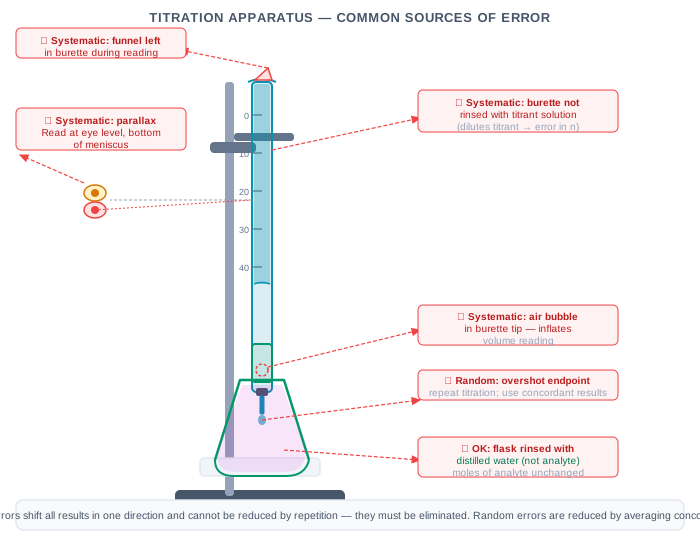
Errors in Gravimetric Analysis
📓 Copy Into Your Books
▼Random vs Systematic
- Random: varies unpredictably — reduces reliability
- Systematic: always same direction — reduces validity
- Repeating helps random; NOT systematic
- Name specific source — never "human error"
Titration Error Effects
- Overshoot endpoint → titre too large → c too high
- Air bubble in burette → titre too large → c too high
- Spill analyte → titre smaller → c too low
- Parallax error → random variation in titre
Gravimetric Error Effects
- Insufficient precipitant → mass low → c too low
- Incomplete drying → mass high → c too high
- Loss during filtering → mass low → c too low
- Contaminated filter → mass high → c too high
HSC Answer Structure
- 1. Name the specific error
- 2. State the direction of effect on titre or mass
- 3. Explain what happens to the calculated concentration
- 4. Suggest a specific improvement
🧪 Activities
Identify → Effect → Fix
Type your analysis for each scenario:
Complete in workbook.
Scenario A: A student forgets to check for air bubbles in the burette before starting. During the titration, the air bubble is pushed out. The titre reads 22.6 mL.
Scenario B: When filtering the gravimetric precipitate, a small amount falls off the filter paper.
Scenario C: Different students read the burette at different angles on different trials.
At the start of this lesson, you thought about why a titration result might come out 15% higher than expected, and whether you could tell if the error was random or systematic.
The key insight is that a consistent overestimate — such as overshooting the endpoint every time or having an air bubble expelled from the burette — is a systematic error that shifts all results in the same direction. Repeating the experiment will not fix it, because the same flaw affects every trial equally. Only identifying and removing the source of error restores validity. Random errors, by contrast, vary unpredictably and can be partially reduced by repeating and averaging.
Reflect: how did your initial thinking compare to what you've learned?
Write a reflection in your workbook.
Multiple Choice
5 random questions from a replayable lesson bank — feedback shown immediately
✍️ Short Answer
Extended Questions
6. A student titrates 25.0 mL of NaOH with 0.100 mol/L HCl. The titres recorded are 18.2, 18.0, and 17.9 mL. (a) Identify the concordant titres and calculate the average titre. (b) The student had an air bubble in the burette that was expelled during the titration. Identify the type of error, explain the effect on the titre, and explain how this affects the calculated concentration of NaOH. 5 MARKS
Type your answer:
Answer in workbook.
7. A student performs a gravimetric analysis to determine [Ba²⁺] in a BaCl₂ solution. They add excess H₂SO₄, filter the BaSO₄ precipitate, and weigh it before it is fully dry. The precipitate mass is recorded as 2.45 g. The true dry mass of BaSO₄ should have been 2.30 g. (a) Identify the type of error and explain its effect on the calculated [Ba²⁺]. (b) Suggest TWO improvements to the procedure to increase both the validity and reliability of the results. 4 MARKS
Type your answer:
Answer in workbook.
8. Two students perform titrations to find the concentration of an NaOH solution. Student A gets titres of 22.3, 22.4, 22.3 mL (concordant). Student B gets titres of 21.8, 22.5, 23.2 mL. (a) Compare the precision of the two students' results. (b) Student A used a burette that was not rinsed with the titrant before filling, so it contained distilled water. Explain how this affects the validity of Student A's results despite high precision. 4 MARKS
Type your answer:
Answer in workbook.
9. A chemistry teacher proposes two different improvements to a titration procedure to reduce error: (i) performing the titration in a temperature-controlled room at exactly 20°C, and (ii) rinsing the burette with the titrant solution before filling. Evaluate which improvement is more likely to have a significant impact on the validity of the results, with reference to specific error types. 4 MARKS
Type your answer:
Answer in workbook.
✅ Comprehensive Answers
▼🔬 Activity 1 Answers
A (air bubble): Systematic error. The volume recorded is larger than the actual volume of titrant dispensed (the air volume is counted as titrant). Titre too large → n(titrant) too high → n(analyte) too high via ratio → c(analyte) overestimated. Fix: flush burette tip before starting to ensure it's completely filled with solution.
B (spilled precipitate): Random error (if accidental). Mass collected is smaller than true mass. n(precipitate) too low → calculated concentration of original solution too low (underestimate). Fix: filter carefully over a pre-weighed filter paper; check for loss during transfer.
C (parallax): Random error. Different angles produce different readings — sometimes above the meniscus, sometimes below. Titre values vary unpredictably. Fix: always read the bottom of the meniscus at eye level; use a burette with a reference mark.
❓ Multiple Choice
1. B — Consistent direction = systematic. Repeating will not fix it.
2. C — Larger titre → more moles of titrant calculated → more moles of analyte via ratio → higher c.
3. A — A calibrated pipette is designed for exact volume delivery. Measuring cylinders have ±0.5–1 mL precision, unsuitable for titration.
4. D — Undried precipitate has extra mass (water). Recorded mass too high → n too high → c too high.
5. B — Validity = free from systematic error, accurately measuring the intended quantity. Option A describes reliability (reproducibility).
6. C — Systematic errors shift all results in the same direction by the same amount. Averaging five results that all contain the same systematic shift produces the same biased mean. Only removing the error source (replacing the contaminated indicator) restores validity.
7. B — This procedure addresses all sources of systematic and random error: analytical balance maximises mass accuracy; volumetric flask gives accurate volume; rough titre prevents overshoot in concordant titrations; averaging concordant titres reduces random error.
📝 Short Answer Model Answers
Q6 (5 marks):
(a) 18.0 and 17.9 mL are concordant (differ by 0.1 mL). Average = (18.0 + 17.9) ÷ 2 = 17.95 mL. (18.2 is excluded.)
(b) Systematic error. The air bubble was expelled during the titration, meaning part of the recorded volume was air, not solution. The titre is recorded as larger than the true volume of HCl dispensed. This leads to n(HCl) being calculated as too large. Via the 1:1 ratio, n(NaOH) appears too large. Therefore c(NaOH) = n ÷ V is an overestimate.
Q7 (4 marks):
(a) Systematic error. The recorded mass (2.45 g) is larger than the true dry mass (2.30 g) because retained water adds to the mass. This gives n(BaSO₄) too high, leading to an overestimate of [Ba²⁺].
(b) Any two: (i) Dry the precipitate in an oven at 150°C and weigh repeatedly until constant mass is achieved — ensures all moisture is removed (improves validity). (ii) Repeat the experiment multiple times and average results — improves reliability by reducing effect of random variation. (iii) Use an analytical balance (±0.0001 g) — reduces measurement uncertainty. (iv) Ensure all precipitate is transferred to the filter without loss — reduces underestimation from sample loss.
Q8 (4 marks):
(a) Student A's results (22.3, 22.4, 22.3 mL) are precise — they are tightly clustered within 0.1 mL. Student B's results (21.8, 22.5, 23.2 mL) are imprecise — they vary by 1.4 mL, indicating poor reproducibility and significant random error.
(b) If the burette was not rinsed with the titrant before filling, residual water dilutes the HCl. The concentration of HCl in the burette is lower than the stated value. A larger volume of HCl is needed to reach the endpoint, making the titre too large. This is a systematic error — it affects all three of Student A's results equally. Despite high precision (tight cluster), the result lacks validity because it does not accurately measure the intended quantity. Precision and validity are independent properties.
Q9 (4 marks):
Improvement (ii) — rinsing the burette with titrant — is more likely to have a significant impact on validity. If the burette is not rinsed, residual water dilutes the titrant solution, causing a systematic error that increases the titre and overestimates the analyte concentration. This is a direct, consistent source of systematic error that undermines validity for every trial.
Improvement (i) — temperature control — addresses a minor source of variation. While temperature affects solution volume slightly, at room temperatures near 20°C the effect on volume (and thus concentration) is typically less than 0.1%, which is far smaller than the error caused by an undiluted titrant. Temperature variation is better described as a minor source of random rather than systematic error in this context.
Therefore, rinsing the burette (improvement ii) has greater impact on validity.