H
hscscience Chem · Y11
0/100daily goal
0
0
0 due
0
L1 · 0 XP
KJ
Your weak spots
Insights load after your first practice round.
Module 4 · L4 of 13 Syllabus requirement · IQ1 ~35 min ⚡ +50 XP in Learn · +25 to complete

Calorimetry, Dissolution of Ionic Substances

In 1959, 3M Corporation chemists developing the first commercial instant cold pack measured the dissolution enthalpy of ammonium nitrate (NH₄NO₃) at +25.7 kJ mol⁻¹, highly endothermic. The product launched in 1961 and could drop the pack temperature to 2°C within 30 seconds using just 35 g of salt and 120 mL of water. Dissolution calorimetry is what made that engineering possible: knowing exactly how much energy is absorbed when the ionic lattice breaks apart.

Today's hook, In 1959, 3M chemists measured the dissolution enthalpy of NH₄NO₃ at +25.7 kJ mol⁻¹ and used it to engineer the first instant cold pack, 35 g of salt, 120 mL of water, temperature drops to 2°C in 30 seconds. That's dissolution calorimetry in action.
0/5QUESTS
1
You're here

Warm up and recall

Warm up first

Three quick questions from earlier lessons. Pulling old material back to mind before you learn something new makes the new material stick better, so this is not busywork.

Worksheets

Practise this lesson

Four printable worksheets that build from the foundations up to exam-style questions, start at whatever level suits you.

Where this lesson fits

00
Where this lesson fits
Syllabus requirement

Lesson question: when an ionic solid dissolves, how can a single temperature change tell you whether it absorbs or releases heat, and how much energy per mole is involved?

  1. 1Set up the calorimeter. Dissolve a weighed ionic solid in a known mass of water in a polystyrene cup and record the temperature change.
  2. 2Read the sign. A temperature drop means endothermic dissolution (ΔHsoln > 0); a rise means exothermic (ΔHsoln < 0).
  3. 3Calculate ΔHsoln. Use q = mcΔT, then ΔHsoln = −q/n, where n is moles of solid dissolved.

Quick prerequisite: dissolving an ionic solid can be exothermic or endothermic, the lattice breaks apart (costs energy) and the ions hydrate (releases energy), while q = mcΔT turns a temperature change into heat. If that feels shaky, start with the Supported route below. Syllabus reference: measure temperature changes in endothermic and exothermic reactions and investigate enthalpy changes using calorimetry (ACSCH037, ACSCH073).

Know what matters most

00
Know what matters most

Must know

  • Dissolution can be endothermic (temperature falls, ΔHsoln > 0) or exothermic (temperature rises, ΔHsoln < 0)
  • q = mcΔT with m = mass of water + dissolved solid; ΔHsoln = −q/n
  • n is the moles of ionic solid dissolved (n = m/M), never moles of water

Should know

  • The two-step model: lattice dissociation (endothermic) + hydration (exothermic); the larger term sets the sign
  • How ‘m’ and ‘n’ differ across combustion, neutralisation and dissolution
  • Why an experimental ΔHsoln differs from the accepted value (heat exchange with surroundings)

Going deeper

  • A Born–Haber dissolution cycle finds lattice energy via Hess's Law (L08)
  • Why some endothermic dissolutions still happen spontaneously (entropy, L11)

Warm up and recall

01
Recall, your gut answer first
+5 XP warm-up

You've seen the ads: an athlete rolls an ankle, a trainer pulls a cold pack from a bag, cracks it, shakes it, and it goes cold instantly. No freezer. No ice. Just a bag of white powder and water mixing together. The powder is ammonium nitrate.

Why does mixing it with water make the pack cold? And why does NaOH dissolved in water do the exact opposite, releasing enough heat to raise the solution temperature by tens of degrees? They're both ionic solids dissolving in water. What's the difference?

auto-saved

What you'll master, and the words for it

03
What you'll master
Know

Key Facts

  • Lattice energy (endothermic) and hydration energy (exothermic) as the two steps of dissolution
  • Endothermic examples: NH₄NO₃, NH₄Cl, KNO₃ (cold packs)
  • Exothermic examples: NaOH, CaCl₂ (warms solution)
Understand

Concepts

  • Why ΔHsoln sign follows from the temperature change direction
  • Why the magnitude of the hydration enthalpy can exceed the lattice dissociation enthalpy, making dissolution exothermic
  • The differences in m and n across combustion, neutralisation, and dissolution
Can Do

Skills

  • Calculate q and ΔHsoln from dissolution calorimetry data
  • Assign correct sign to ΔHsoln from experimental temperature change
  • Identify the correct m and n for all three calorimetry types
04
Key terms
Enthalpy of dissolution (ΔHsoln)
The heat change when one mole of a substance dissolves in water. Its value depends on the final concentration (how much solvent), so tabulated values are quoted for a stated dilution; in this course, school-calorimeter results are treated as estimates for the dilute solution prepared.
Endothermic dissolution
Dissolution that absorbs heat from surroundings; solution temperature falls; ΔHsoln > 0 (e.g., NH₄NO₃ in water).
Exothermic dissolution
Dissolution that releases heat to surroundings; solution temperature rises; ΔHsoln < 0 (e.g., NaOH in water).
Lattice energy
Also called the lattice dissociation enthalpy: the energy required to separate one mole of an ionic solid into its gaseous ions, positive (endothermic) by this convention. The opposite convention, lattice formation enthalpy, has the same magnitude but a negative sign; this lesson uses the dissociation (positive) convention throughout.
Hydration enthalpy
Energy released when gaseous ions are surrounded by water molecules; always negative (exothermic).
Born–Haber cycle for dissolution
ΔHsoln = lattice dissociation enthalpy + hydration enthalpy; dissolution is exothermic when the magnitude of the (negative) hydration enthalpy exceeds the (positive) lattice dissociation enthalpy, i.e. |ΔHhyd| > ΔHlattice,diss.
Cross-lesson links: Dissolution calorimetry is the third measurement application of q = mcΔT in this module, following combustion (L02) and neutralisation (L03). The energy balance in dissolution, lattice energy vs hydration enthalpy, is a real-world Hess's Law cycle (L08): you can't measure lattice energy directly, but you can combine ΔHsoln with hydration enthalpies to find it. This concept returns in L11 when entropy explains why some endothermic dissolutions (like NH₄NO₃) still proceed spontaneously.
2

The Dissolution Calorimeter Setup

05
The Dissolution Calorimeter Setup
Must know core concept

The setup for dissolution calorimetry is very similar to the neutralisation calorimeter from L03, a polystyrene cup holds a known mass of water, and the ionic solid is added directly into it.

A polystyrene cup insulates water as an ionic solid dissolves, so ΔT gives the heat of solution.
Dissolution calorimeter. The ionic solid is added directly to a known mass of water in a polystyrene cup. The total mass used in q = mcΔT includes both water and the dissolved solid.
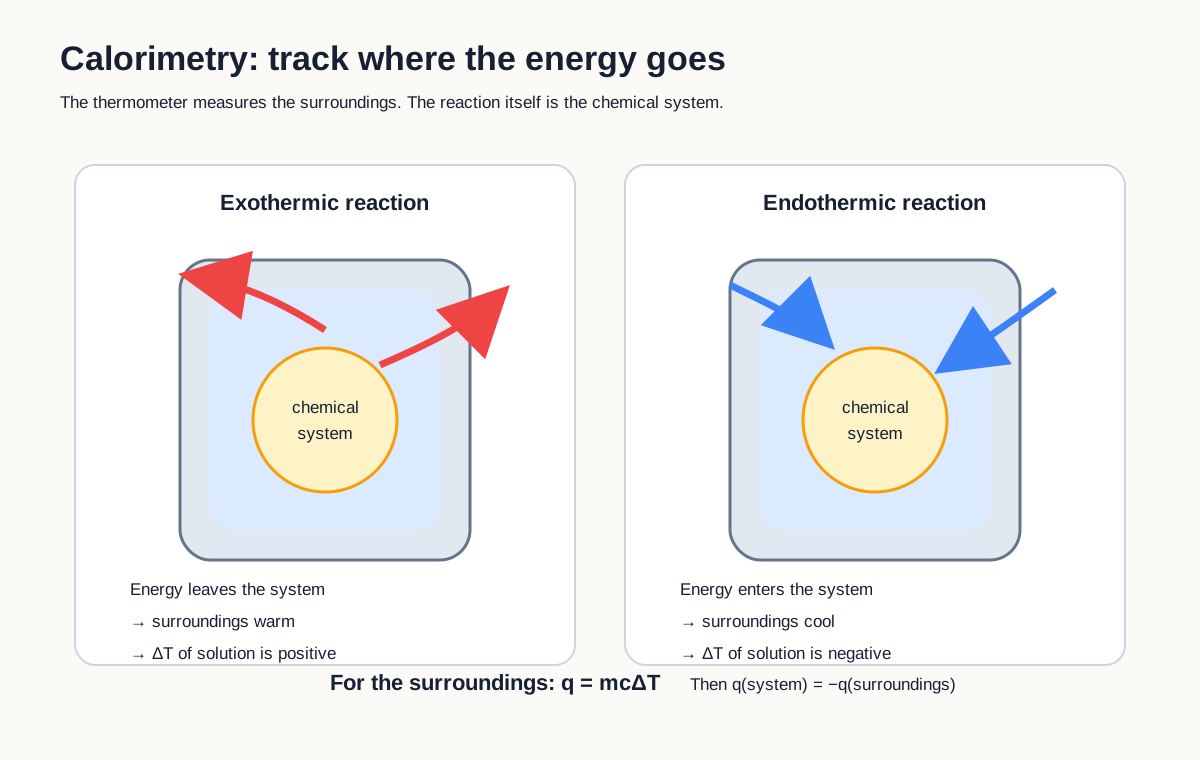
Energy-flow comparison: an exothermic reaction transfers energy from the chemical system to the surrounding solution, while an endothermic reaction transfers energy from the surrounding solution into the system.
The thermometer measures the surroundings. Calculate qsurroundings = mcΔT, then reverse the sign to obtain qsystem.

Procedure:

  1. Measure a known mass of distilled water into a polystyrene cup and record the initial temperature
  2. Weigh the ionic solid accurately on a balance
  3. Add the solid to the water; stir continuously to ensure complete dissolution
  4. Record the maximum (or minimum) temperature reached
  5. Calculate: total mass of solution = mass of water + mass of solid
Safety, supervised school practical only. Run this only in the laboratory under teacher supervision against the school's approved risk assessment, never as a home experiment. Wear safety glasses and gloves. Sodium hydroxide is corrosive and dissolves strongly exothermically, use only a few pellets in plenty of water, add solid to water (never the reverse), and handle the warm solution with care. Ammonium nitrate is an oxidiser, keep it away from heat and combustibles and use only the small quantity specified. Wipe up spills with plenty of water and dispose of solutions as your teacher directs.
Note whether temperature rises or falls before you substitute. This determines the sign of ΔT and, through the −q/n formula, the sign of ΔHsoln. Don't let algebra override your experimental observation. If you measured a temperature drop, your answer must be a positive ΔHsoln.
Going deeper: how this differs from the L03 neutralisation setup
This is the same polystyrene cup calorimeter from neutralisation, with one key difference: the mass used in q = mcΔT is now mass of water + mass of solute (not just the water), and n is moles of the ionic solid (not moles of H₂O formed).

In dissolution calorimetry: q = mcΔT where m = mass of water + dissolved solid; ΔHdiss = −q/n where n = moles of ionic solid dissolved. ΔHdiss can be positive (endothermic, e.g. NH₄NO₃) or negative (exothermic, e.g. NaOH) depending on whether lattice energy or hydration enthalpy dominates.

Pause, copy the highlighted definition into your book before moving on.

Energy-level comparison of exothermic and endothermic ionic dissolution: lattice dissociation raises enthalpy, hydration lowers it, and the larger-magnitude step sets the sign of ΔH of solution.
Trace both paths from ionic solid plus water to hydrated ions. The final level is lower when hydration releases more energy than lattice separation absorbs, and higher when lattice separation requires more energy than hydration releases.

Check the energy balance: cover the sign labels, compare the vertical rise and fall in each panel, then predict whether the solution warms or cools.

Going deeper: why each value is an estimate, not a substance constant
These calculations assume the solution has the density and specific heat capacity of water and neglect the calorimeter's own heat capacity, so each ΔHsoln is an experimental estimate for the dilute solution you prepared, not an exact substance constant. Tabulated values are quoted for a stated dilution.

Explain it: A student forgets to add the mass of the dissolved solid when calculating m in q = mcΔT. Will their calculated ΔHsoln be too high or too low? Explain in 2–3 sentences.

3

Comparing All Three Calorimetry Types

06
Comparing All Three Calorimetry Types
Should know core concept

We just saw the dissolution calorimeter setup and how ΔHdiss is calculated. That raises a question: how does dissolution calorimetry compare with combustion and neutralisation from previous lessons? This card answers it → by systematically comparing ‘m’, ‘n’, and the possible sign of ΔH across all three methods.

By Lesson 4, you have used q = mcΔT in three different experimental contexts. The formula is the same each time, but what 'm' and 'n' represent, and whether ΔH can be positive or negative, differs for each type.

Feature Combustion (L02) Neutralisation (L03) Dissolution (L04)
Apparatus Copper calorimeter, spirit burner Polystyrene cup, thermometer Polystyrene cup, thermometer
'm' in q = mcΔT Mass of water in calorimeter Total mass of combined solutions (acid + base) Total mass of solution (water + dissolved solid)
'n' in ΔH = −q/n Moles of fuel burned (n = m/M) Moles of H₂O formed (= limiting reagent moles) Moles of ionic solid dissolved (n = m/M)
Typical sign of ΔH Always negative (exothermic) Usually negative (exothermic, heat released) Either sign exo (NaOH) or endo (NH₄NO₃)
Main source of error Heat loss to atmosphere and copper Heat loss through cup walls to air Incomplete dissolution; heat exchange with surroundings
In any calorimetry question: identify the type first. Ask: is fuel being burned? → combustion. Is acid reacting with base? → neutralisation. Is a solid dissolving? → dissolution. Then recall the correct m and n for that type before substituting.
Do not confuse n across types. In dissolution, n = moles of the ionic solid dissolved, never moles of water (that belongs to neutralisation). Copying the wrong n will give the wrong ΔH by a factor that can be 50–200 times out.
Comparison of three calorimetry types across m, n, molar enthalpy formula, apparatus and ΔH sign.
CALORIMETRY CALCULATOR, INTERACTIVE Interactive
Select Dissolution tab, adjust parameters to explore endothermic (cold pack) vs exothermic (NaOH) dissolution.

All three calorimetry methods use q = mcΔT, but differ in ‘m’ and ‘n’: combustion (m = water, n = fuel), neutralisation (m = combined solution, n = H₂O formed), dissolution (m = total solution, water + dissolved solid; n = solute). Only dissolution can give positive or negative ΔH, combustion and neutralisation (strong acid + base) are always negative.

Add the highlighted point to your notes before the check below.

Match it: Match each calorimetry type to its correct description of 'n'.

  • Combustion
  • Neutralisation
  • Dissolution
  • mol of H₂O formed
  • mol of fuel burned
  • mol of ionic solid dissolved

Same science, choose your support

06b
Same science, choose your support
pick one

All three routes practise the same Must-Know skill: read a temperature change and describe the sign, and size, of ΔHsoln. Do one; try another if you want more practice.

Supported word bank + sentence frame start here if unsure

Word bank: endothermic · absorbed · positive · surroundings

An ionic solid dissolves and the solution temperature falls from 24.0°C to 19.5°C. Complete the frame:

"Because the temperature fell, heat was ______ from the ______, so the dissolution is ______ and ΔHsoln is ______."

auto-saved
Show a hint
A falling temperature means the dissolving process took heat out of the solution, so it is endothermic and ΔHsoln = −q/n works out positive.
Core independent HSC-standard the exam standard

4.20 g of potassium nitrate (KNO₃, M = 101.1 g mol⁻¹) is dissolved in 120.0 g of water. The temperature falls from 23.8°C to 20.1°C. Calculate ΔHsoln, and state whether the dissolution is exothermic or endothermic.

auto-saved
Stretch reasoning in a new context push yourself

Two different ionic solids are dissolved in identical amounts of water. Solid X warms its solution; solid Y cools its solution. Both build a lattice and both hydrate their ions. Explain, in terms of lattice energy versus hydration energy, which term is larger in each case, and give the sign of ΔHsoln for X and Y.

auto-saved
4

Worked examples

Worked example 1 +5 XP on full reveal

Endothermic Dissolution: Cold Pack (NH₄Cl). 5.35 g of ammonium chloride (NH₄Cl, M = 53.49 g mol⁻¹) is dissolved in 100.0 g of water in a polystyrene cup. The temperature drops from 22.5°C to 18.1°C. Calculate the molar enthalpy of dissolution of NH₄Cl.

1
Find ΔT
ΔT = Tfinal − Tinitial = 18.1 − 22.5 = −4.4°C = −4.4 K
Temperature dropped → endothermic dissolution. ΔT is negative. This must be confirmed from the data before substituting.
2
Find mass of solution
m = m(H₂O) + m(NH₄Cl) = 100.0 + 5.35 = 105.35 g
Include the solute in the total solution mass, this is the key difference from combustion calorimetry.
3
Calculate q
q = mcΔT = 105.35 × 4.18 × (−4.4) = −1934 J = −1.934 kJ
q is negative, the solution lost heat to the dissolving process (dissolution absorbed energy from the water).
4
Find moles of NH₄Cl
n = m ÷ M = 5.35 ÷ 53.49 = 0.1000 mol
Moles of ionic solid dissolved, not moles of water.
5
Calculate ΔHsoln
ΔHsoln = −q ÷ n = −(−1.934) ÷ 0.1000 = +19.3 kJ mol⁻¹
Positive ΔHsoln confirms endothermic dissolution. The accepted value is ≈ +14.8 kJ mol⁻¹; the discrepancy reflects heat exchange with surroundings during the experiment.
Worked example 2 +5 XP on full reveal

Exothermic Dissolution: NaOH Warming. 2.00 g of NaOH (M = 40.00 g mol⁻¹) is dissolved in 200.0 g of water in a polystyrene cup. The temperature rises from 20.0°C to 22.6°C. Calculate ΔHsoln.

1
Find ΔT
ΔT = 22.6 − 20.0 = +2.6 K
Temperature rose → exothermic dissolution. ΔT is positive.
2
Find mass of solution
m = 200.0 + 2.00 = 202.0 g
Include the NaOH mass in the total solution mass.
3
Calculate q
q = mcΔT = 202.0 × 4.18 × 2.6 = 2195.7 J = 2.196 kJ
q is positive, the solution gained heat from the exothermic dissolution.
4
Find moles of NaOH
n = 2.00 ÷ 40.00 = 0.0500 mol
Moles of ionic solid dissolved.
5
Calculate ΔHsoln
ΔHsoln = −q ÷ n = −2.196 ÷ 0.0500 = −43.9 kJ mol⁻¹
Negative ΔHsoln confirms exothermic dissolution. The hydration energy released when Na⁺ and OH⁻ are surrounded by water molecules exceeds the lattice energy required to break the NaOH lattice apart.

Key idea

Predict then reveal +8 XP
1 · Predict
2 · Reveal
3 · Compare

Ammonium nitrate (NH₄NO₃) dissolves in water, you have seen this in instant cold packs. Predict: is the dissolution exothermic or endothermic? Will ΔH be positive or negative?

50%
5

What you'll master, and the words for it

02
Formula reference · this lesson
core formula
📐

Formula Reference, This Lesson

$q = mc\Delta T$
q = heat energy absorbed by solution (J) m = total mass of solution, water plus dissolved solid (g) c = 4.18 J g⁻¹ K⁻¹ (dilute aqueous solutions ≈ water) ΔT = Tfinal − Tinitial (°C or K), can be negative for endothermic dissolution
$\Delta H_{soln} = \dfrac{-q}{n}$
ΔHsoln = molar enthalpy of dissolution (kJ mol⁻¹) q = heat energy in kJ (÷ 1000 from J) n = moles of ionic solid dissolved (NOT moles of water)
$n = \dfrac{m}{M}$
n = moles of ionic solid (mol) m = mass of ionic solid dissolved (g) M = molar mass of ionic solid (g mol⁻¹)
Sign rule:   If temperature rises → ΔT > 0 → q > 0 → ΔHsoln = −q/n is negative (exothermic)  |  If temperature falls → ΔT < 0 → q < 0 → ΔHsoln is positive (endothermic)

Warm up and recall

Printable worksheet

Download this lesson's worksheet

Use the PDF for classwork, homework or revision. Includes key ideas, activities, questions and success-criteria proof.

"n is moles of water, not moles of solid"

1

"n is moles of water, not moles of solid"

Students who just finished L03 (neutralisation) reflexively use n = mol H₂O formed for the dissolution calculation.

Fix: In dissolution, n = moles of the ionic solid dissolved (n = m/M for the solid). Moles of water is never n for dissolution. Using the wrong n will give a ΔHsoln that is 50–200 times off.

2

"m = mass of water only"

Students use only the mass of water (e.g. 100.0 g) and forget to add the mass of the dissolved solid.

Fix: In dissolution calorimetry, m = mass of water + mass of solute. Once dissolved, the solid becomes part of the solution that absorbs or releases heat. Omitting the solute mass underestimates q and therefore underestimates |ΔHsoln|.

3

"Temperature drop must mean negative ΔHsoln"

Students see the solution cool down and assign ΔHsoln a negative value, confusing the direction of energy flow.

Fix: If the solution cools, heat moved from the solution into the dissolving process, the dissolution is endothermic → ΔHsoln > 0 (positive). The −q/n formula handles this automatically: a negative q gives a positive ΔHsoln. Trust the formula but verify with your experimental observation.

6

Drill, then revisit

1

5.00 g of ammonium nitrate (NH₄NO₃, M = 80.05 g mol⁻¹) is dissolved in 95.0 g of water. The temperature falls from 22.5°C to 18.2°C.
(a) State whether this dissolution is exothermic or endothermic. Justify using the temperature change.

2

Using the same NH₄NO₃ scenario: calculate ΔT, the total mass of solution, and q in kJ.

3

Continue: calculate n(NH₄NO₃) and then ΔHsoln. The accepted value is +25.7 kJ mol⁻¹, is your answer an overestimate or underestimate? Why?

4

Classify each ionic substance as causing an endothermic or exothermic dissolution. What sign is ΔHsoln for each?
(a) NH₄NO₃, cold packs go cold  (b) NaOH, solution warms strongly  (c) KNO₃, solution cools  (d) CaCl₂, used in road de-icing with heat release

5

Three-experiment challenge: Identify (i) what 'm' is and (ii) what 'n' is in q = mcΔT and ΔH = −q/n for each:
Exp A, 0.46 g ethanol burned under copper calorimeter with 200 g water
Exp B, 50 mL of 1.00 mol L⁻¹ HCl mixed with 50 mL of 1.00 mol L⁻¹ NaOH
Exp C, 3.74 g NH₄Cl dissolved in 150.0 g water

07
Revisit your thinking

Go back to your Think First response. Now that you've studied dissolution calorimetry, revisit the 3M engineers' 1959 cold pack design using NH₄NO₃ at +25.7 kJ mol⁻¹:

  • The cold pack cools because NH₄NO₃'s lattice energy exceeds its hydration energy more energy is absorbed to pull the lattice apart than is released when ions are surrounded by water. The 3M engineers measured this as ΔHsoln = +25.7 kJ mol⁻¹: endothermic, meaning the solution absorbs energy from your ankle.
  • NaOH warms its solution because the reverse is true, the hydration energy of Na⁺ and OH⁻ exceeds the NaOH lattice energy. The energy difference is released to the solution. NaOH spills are dangerous because the hot solution can burn before you notice.
  • Both are ionic solids dissolving. The difference is entirely in the relative magnitudes of lattice energy vs hydration energy, the same Born–Haber cycle you can construct using Hess's Law (L08).
auto-saved
Interactive Tool, Enthalpy & Calorimetry Open fullscreen ↗
Use the Calorimetry Calculator. Heating 200 g of water by 5.0°C (c = 4.18 J/g·°C) requires how much heat?

Multiple choice

01
Multiple choice
+5 XP per correct · +25 XP all-correct

Pick your answer, then rate your confidence. That tells the system what to drill next.

01b
Misconceptions to fix before short answer

Wrong: Ionic compounds conduct electricity in the solid state because they contain charged ions.

Right: Ionic compounds only conduct electricity when molten or dissolved in water. In the solid state, the ions are locked in a fixed lattice and cannot move. Conductivity requires mobile charge carriers, which are only present when the lattice breaks down.

Wrong: Temperature drop → ΔHsoln is negative.

Right: Temperature drop means heat flowed from the solution into the dissolution process, endothermic → ΔHsoln is positive. The formula handles this: negative ΔT → negative q → −q/n is positive.

Wrong: m = mass of water only (forget to add solute).

Right: m = mass of water + mass of dissolved solid. The entire solution absorbs or releases heat, including the dissolved ions.

02
Short answer
ApplyBand 4

Q6. 8.01 g of NH₄NO₃ (M = 80.05 g mol⁻¹) is dissolved in 100.0 g of water. The temperature falls from 25.0°C to 20.3°C. Calculate the molar enthalpy of dissolution. State whether the dissolution is exothermic or endothermic and explain how the two-step energy model accounts for this. 5 MARKS

auto-saved
ApplyBand 4

Q7. 3.00 g of NaOH (M = 40.00 g mol⁻¹) is dissolved in 150.0 g of water. The temperature rises from 21.0°C to 24.1°C.

(a) Calculate the molar enthalpy of dissolution of NaOH. (3 marks)
(b) State whether the dissolution is exothermic or endothermic and explain in terms of lattice energy and hydration energy. (2 marks) 5 MARKS

auto-saved
EvaluateBand 5

Q8. A student performs three calorimetry experiments:
Experiment A, burns 0.46 g of ethanol (M = 46.07 g mol⁻¹) under a copper calorimeter holding 200 g of water; temperature rises 8.4°C.
Experiment B, mixes 50 mL of 1.00 mol L⁻¹ HCl with 50 mL of 1.00 mol L⁻¹ NaOH; temperature rises 6.6°C.
Experiment C, dissolves 3.74 g of NH₄Cl (M = 53.49 g mol⁻¹) in 150.0 g water; temperature falls 2.2°C.

For each experiment, identify: (i) what 'm' is in q = mcΔT, (ii) what 'n' is in ΔH = −q/n, and (iii) whether the experimental ΔH will be an underestimate or overestimate of the true value, and why. 6 MARKS

auto-saved
03
Short-answer model answers

Multiple-choice feedback appears inline as you answer. Each quick-fire drill above reveals its own answer. Below are the marker-style model answers for the three short-answer questions.

Show model answers ▼

Short Answer Model Answers

Q6 (5 marks): ΔT = 20.3 − 25.0 = −4.7 K [½]; m = 100.0 + 8.01 = 108.01 g [½]; q = 108.01 × 4.18 × (−4.7) = −2122.5 J = −2.123 kJ [1]; n = 8.01 ÷ 80.05 = 0.1001 mol [½]; ΔHsoln = −(−2.123) ÷ 0.1001 = +21.2 kJ mol⁻¹ [½]. Endothermic, ΔT < 0, ΔHsoln positive [1]. Two-step model: Step 1 (lattice dissociation): NH₄NO₃(s) → NH₄⁺(g) + NO₃⁻(g), endothermic, requires input of lattice energy [½]; Step 2 (hydration): ions surrounded by water, exothermic, hydration energy released [½]. Net result: for NH₄NO₃, lattice energy exceeds hydration energy; overall ΔHsoln positive [1].

Q7 (5 marks): (a) ΔT = 24.1 − 21.0 = +3.1 K [½]; m = 150.0 + 3.00 = 153.0 g [½]; q = 153.0 × 4.18 × 3.1 = 1981.7 J = 1.982 kJ [1]; n = 3.00 ÷ 40.00 = 0.0750 mol [½]; ΔHsoln = −1.982 ÷ 0.0750 = −26.4 kJ mol⁻¹ [½]. (b) Exothermic, temperature rose and ΔHsoln negative [1]. NaOH dissolves because the hydration energy released when Na⁺ and OH⁻ ions are surrounded by water molecules exceeds the lattice energy required to separate the NaOH lattice. The net energy is released to the solution [1].

Q8 (6 marks, 2 per experiment):
Exp A (combustion): (i) m = 200 g (water in copper calorimeter, not the ethanol) [½]; (ii) n = 0.46 ÷ 46.07 = 0.00998 mol ethanol burned [½]; (iii) Underestimate of |ΔHc|, the copper calorimeter conducts heat to the surroundings; q measured is less than q actually released, so ΔHc appears less negative than the true value [1].
Exp B (neutralisation): (i) m = (50 + 50) × 1.00 = 100 g (total solution) [½]; (ii) n = 1.00 × 0.0500 = 0.0500 mol H₂O formed [½]; (iii) Underestimate of |ΔHn|, the polystyrene cup loses some heat to the air; the measured temperature rise is less than if no heat escaped, giving a less negative ΔHn [1].
Exp C (dissolution): (i) m = 150.0 + 3.74 = 153.74 g [½]; (ii) n = 3.74 ÷ 53.49 = 0.06993 mol NH₄Cl [½]; (iii) Underestimate of ΔHsoln (positive value appears smaller than true value), heat from the surroundings enters the cup slightly, partially offsetting the temperature drop. The measured ΔT is less negative than the true value, making q less negative and ΔHsoln less positive than the true value [1].