Evidence-Based Argumentation in Physics
In 2023, ARPANSA reviewed 1,200 studies on 5G radiation and found zero evidence of harm, yet 62% of Australians in an ACMA survey still believed it was dangerous.
Two people disagree about how fast a car was travelling before a crash. One says 60 km/h; the other says 90 km/h. What kind of evidence would you want to collect to settle this argument scientifically?
You find two sources about the safety of 5G phone towers, a government health website and a social media post by a celebrity. What makes one more reliable than the other? List the specific features you would check.
● Know
- The three parts of the claim-evidence-reasoning (CER) framework
- Key criteria for evaluating the reliability of a scientific source
- Common forms of bias in scientific communication
● Understand
- Why reasoning must explicitly connect evidence to a claim
- How bias and reliability affect the strength of a scientific argument
- That scientific conclusions are tentative and based on available evidence
● Can do
- Construct a CER argument about a waves or motion question
- Evaluate sources for reliability, currency, authority and purpose
- Communicate a scientific conclusion using appropriate terminology
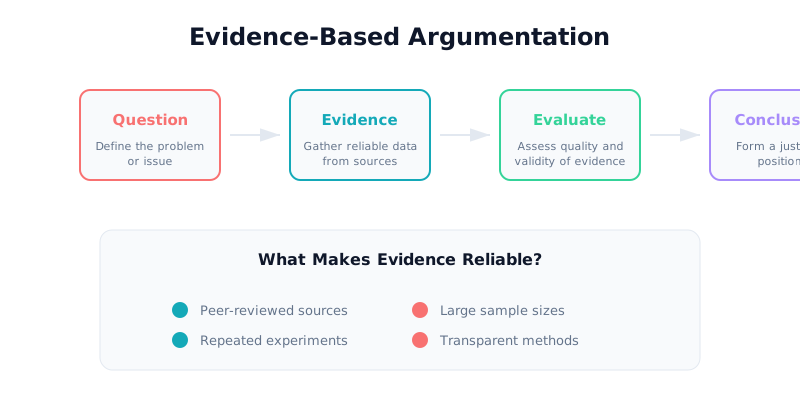
In 2023, ARPANSA reviewed over 1,200 peer-reviewed studies and found no evidence that 5G radio waves at permitted exposure levels cause harm, yet a simultaneous ACMA survey found 62% of Australians believed the opposite, largely because viral social-media claims cited no data. The difference between those two positions is evidence quality. Scientific argumentation in physics uses the same Claim-Evidence-Reasoning (CER) framework as every other science, but places particular emphasis on quantitative measurement: a claim about speed, force, or wave frequency must be supported by numbers, not just words.
Claim: A clear, testable statement. Good claim: "The acceleration of a trolley down a ramp is directly proportional to the sine of the ramp angle, assuming negligible friction." Bad claim: "Ramps make things go faster."
Evidence: Quantitative data with units, uncertainties, and sample sizes. Include raw data, processed results, and graphical analysis. Evidence should be relevant to the claim and sufficient to support it.
Reasoning: Connect evidence to physics principles using equations and logical deduction. Explain why the observed pattern is expected based on theory. Use equations as part of the reasoning, not just as decorations.
Controls: In physics experiments, control variables are crucial. Testing how angle affects acceleration requires constant mass, surface, and starting position. Without controls, confounding variables invalidate conclusions.
Claim: The period of a simple pendulum depends only on length and gravitational acceleration, not on mass.
Evidence: Three pendulums of lengths 0.5 m, 1.0 m, and 1.5 m were tested with masses of 50 g, 100 g, and 200 g. For each length, the period was identical regardless of mass (within measurement uncertainty of 0.05 s). The measured periods were 1.42 s, 2.01 s, and 2.46 s for lengths 0.5 m, 1.0 m, and 1.5 m respectively.
Reasoning: The theoretical period of a simple pendulum is T = 2π√(L/g), which contains no mass term. The experimental data confirms this: identical periods for different masses at the same length, and periods proportional to √L. The slight discrepancies from theoretical values (e.g., 2.01 s vs 2.00 s for L=1.0 m) are consistent with measurement uncertainty and small-angle approximation errors. This evidence strongly supports the claim.
Australian physics education: The Australian Curriculum: Science requires students to construct evidence-based arguments in physics. The Science by Doing program includes structured argumentation activities where students evaluate competing claims about motion, forces, and energy. Physics Olympiad training in Australia emphasises rigorous mathematical reasoning combined with experimental verification. Australian physics teachers use peer instruction and concept inventories (like the Force Concept Inventory) to identify and address misconceptions through evidence-based discussion.
Physics is just about calculating answers; argumentation does not matter. This is false. Calculation is a tool, not the goal. The goal is understanding how the physical world works and being able to justify that understanding with evidence and reasoning. A student who can calculate F=ma but cannot explain why the equation applies in a given situation has not mastered physics. Argumentation forces students to connect calculations to concepts, which is the essence of physics.
A student claims: "Heavier balls roll down slopes faster than light balls." Read the paragraph and highlight the evidence that refutes this.
No measurement is perfectly precise. Understanding and reporting uncertainty is essential for honest science.
Random errors: Unpredictable variations that scatter measurements around the true value. Sources: human reaction time, instrument fluctuations, environmental variations. Reduced by taking more repeats and calculating means. Expressed as standard deviation or range.
Systematic errors: Consistent biases that shift all measurements in the same direction. Sources: miscalibrated instruments, incorrect zeroing, flawed experimental design. Not reduced by repeating measurements. Detected by comparing with independent methods or known standards.
Reporting uncertainty: Results should be reported as value ± uncertainty. The uncertainty indicates the range within which the true value likely lies. Graphs should include error bars showing measurement uncertainty.
Significant figures: The precision of a result should match the precision of the measurements. Reporting 3.14159 m/s from measurements with 1% uncertainty is misleading - 3.14 m/s is more honest.
Measuring gravitational acceleration with a pendulum:
A student measures period T = 2.01 +/- 0.05 s for length L = 1.00 +/- 0.01 m.
From T = 2π√(L/g), g = 4π²L/T² = 4π²(1.00)/(2.01)² = 9.77 m/s².
Uncertainty calculation: percentage uncertainty in L is 1%, in T is 2.5% (0.05/2.01), and since T is squared, its contribution doubles to 5%. Total uncertainty ≈ 1% + 5% = 6%.
Reported result: g = 9.8 +/- 0.6 m/s².
This overlaps with the accepted value of 9.8 m/s², so the experiment is consistent with theory. If the student had reported g = 9.77 m/s² without uncertainty, it would appear more precise than it actually is.
Australian measurement standards: The National Measurement Institute (NMI) maintains Australia primary standards for time, length, mass, temperature, and electrical quantities. Their uncertainty budgets are meticulously documented, ensuring that measurements made anywhere in Australia are traceable and comparable. Australian industries from mining to pharmaceuticals rely on NMI calibration services. The NMI also participates in international comparisons to ensure Australian measurements align with global standards, essential for trade and scientific collaboration.
Uncertainty means the measurement is unreliable. This is false. Uncertainty is not a flaw but a feature of honest measurement reporting. It quantifies the limits of our knowledge. A measurement with well-characterised uncertainty is more valuable than a precise-looking number with unknown reliability. Scientists prefer measurements with stated uncertainty over apparently exact values. Uncertainty allows us to compare results, assess agreement with theory, and plan improvements. It is an essential part of the scientific process, not an admission of failure.
Physics progresses by building, testing, and refining models of reality.
What is a model? A simplified representation that captures essential features while ignoring less important details. Models make predictions that can be tested against observation.
Examples:
- Particle model: Treats objects as point masses. Accurate when size is irrelevant. Fails when rotation or internal structure matters.
- Ideal gas model: Treats gas molecules as non-interacting point particles. Works well at low pressure and high temperature. Fails near condensation.
- Wave model of light: Explains interference and diffraction. Fails to explain the photoelectric effect.
- Newtonian mechanics: Accurate for everyday speeds and scales. Fails near light speed (needs relativity) and atomic scales (needs quantum mechanics).
Model limitations are not failures. Every model has a domain of validity. Knowing when a model applies and when it breaks down is deep physical understanding.
The simple pendulum model (T = 2π√(L/g)) makes several simplifying assumptions:
- String is massless and inextensible.
- Bob is a point mass.
- Amplitude is small (sin θ ≈ θ).
- No air resistance.
- Gravity is uniform.
For a 1 m pendulum with a 100 g metal bob swinging at 5°, these assumptions introduce errors well below 1%. The model is excellent. But for a 10 cm pendulum with a 50 g bob on a heavy chain swinging at 60°, the model fails: the chain mass matters, the bob is not a point mass, and the small-angle approximation is poor. A more complex physical pendulum model is needed. Neither model is wrong - they simply have different domains of validity. Knowing which to use is the mark of a physicist.
Australian theoretical physics: Australia has strong theoretical physics research in cosmology, quantum field theory, and condensed matter physics. The ARC Centre of Excellence for Particle Physics at the Terascale (CoEPP) at the University of Melbourne searches for physics beyond the Standard Model. When experimental results (like the muon g-2 anomaly) do not match theoretical predictions, physicists get excited because model failure often points to new physics. Australian researchers contribute to global efforts to refine and replace existing models, just as Einstein refined Newton mechanics.
Because models are simplifications, they are useless. This is false. Models are essential precisely because reality is too complex to handle directly. A map is a model of terrain - it simplifies by omitting details, but it is incredibly useful for navigation. Similarly, Newton laws are simplifications, but they landed humans on the Moon. Quantum mechanics is a model, but it powers all modern electronics. The power of physics lies in building models that capture enough reality to be useful while remaining tractable. A model does not need to be perfect to be valuable.
Wrong: "If a source is scientific, it must be completely objective." No, all humans have perspectives. What matters is whether the source acknowledges limitations, cites evidence and has been subject to peer review. Objectivity is a process, not a guarantee.
Right: Even scientific sources can contain bias, through funding influences, selective reporting, or researcher assumptions. What distinguishes good scientific sources is transparency: they acknowledge limitations, clearly describe methodology, cite evidence, and have been subjected to peer review. Objectivity is achieved through the process of science, not merely by labelling something "scientific."
Wrong: "More evidence always makes a stronger argument." No, quality matters more than quantity. Ten weak sources do not outweigh one strong, peer-reviewed study with clear methodology.
Right: A single well-designed peer-reviewed study with a large sample size, controlled variables, and clear methodology is far more persuasive than dozens of anecdotes or poorly designed experiments. When evaluating evidence, ask: Was it peer-reviewed? Was the sample size adequate? Were variables controlled? A strong argument needs quality evidence, not just lots of it.
Wrong: "Reasoning is just repeating the claim." No, reasoning explains why the evidence supports the claim. Simply restating the claim in different words is not reasoning.
Right: Reasoning is the explanatory link between evidence and claim. It uses scientific principles (such as Newton's laws or wave theory) to explain WHY the data supports the conclusion. For example: "The car left 30-metre skid marks (evidence), and using F = ma and friction coefficients, we calculate it was travelling at 85 km/h (reasoning), above the 60 km/h speed limit (claim)."
Evidence in Australian Science
Climate and wave research: Australian scientists at the Bureau of Meteorology and CSIRO use evidence from satellite data, buoy measurements and climate models to argue for changes in wave patterns around Australia's coast. Their arguments follow the CER framework: they make specific claims about changing swell patterns, present decades of measured data as evidence, and use physical oceanography reasoning to connect the data to climate drivers such as the Southern Annular Mode.
Road safety and Newton's laws: Transport for NSW uses evidence from crash investigations, computer simulations and international studies to argue for speed limits, seatbelt laws and road-design standards. Their reports explicitly evaluate source reliability, acknowledge limitations in data collection, and use Newton's laws to reason about force, mass and deceleration in collisions.
Aboriginal and Torres Strait Islander knowledge systems: Traditional ecological knowledge is increasingly recognised as a valid, reliable source of evidence in scientific arguments, provided it is documented ethically and with community consent. For example, observations of seismic and tidal patterns passed down through generations provide longitudinal evidence that complements instrument-based records.
✍ Copy Into Your Books
▾Claim-Evidence-Reasoning (CER)
- Claim: a clear, testable statement answering the question
- Evidence: reliable data or observations from credible sources
- Reasoning: the logical bridge explaining why the evidence supports the claim
Evaluating Sources
- Authority: who wrote it and what are their qualifications?
- Currency: is the information up to date?
- Purpose: why was it written?
- Evidence base: are sources cited?
- Peer review: has it been checked by experts?
Communicating Conclusions
- State your claim early and clearly
- Use quantitative evidence where possible
- Qualify your certainty (suggest, support, indicate)
- Define terms using glossary meanings
- Acknowledge limitations to strengthen credibility
Build a CER Argument
Evaluate the Source
At the start of this lesson you were shown Australia's ARPANSA reviewing over 1,000 studies on 5G radiation and finding no evidence of harm at permitted exposure levels, while social media claims the opposite, and how the difference comes down entirely to evidence quality.
Now that you've worked through the lesson, how has your thinking shifted? Can you explain that hook idea more precisely using what you've learned today?
Q1. 1. Explain the three parts of the claim-evidence-reasoning (CER) framework. For each part, give one example related to a waves or motion topic from this unit. 4 MARKS
Q2. 2. You are researching whether mobile phone towers pose health risks. Describe two criteria you would use to evaluate the reliability of a source on this topic, and explain why each criterion matters. 4 MARKS
Q3. 3. A newspaper headline reads: "Scientists Prove Heavier Objects Fall Faster!" The article cites a single experiment where a feather and a hammer were dropped in Earth's atmosphere. Construct a CER argument that evaluates this claim. In your reasoning, identify at least one limitation of the evidence presented. 4 MARKS
Revisit Your Thinking
Go back to your Think First answer. Has your understanding changed?
- Would you now evaluate the seatbelt sources differently using the CER framework?
- Can you identify one source from your own life (news, social media, school) that you now view as more or less reliable?
Model answers (click to reveal)
Answers
▾MCQ 1
C Reasoning explains why the evidence supports the claim by using scientific principles to build a logical bridge between data and conclusion.
MCQ 2
B Peer review by qualified experts in a reputable journal is one of the strongest indicators of reliability. It means the methodology, data and conclusions have been independently scrutinised.
MCQ 3
D A large peer-reviewed study with controlled comparison of outcomes provides the strongest, most generalisable evidence. Personal stories, advertisements and informal polls are weak sources.
MCQ 4
A The claim confuses non-ionising electromagnetic radiation (microwaves) with nuclear (ionising) radiation. This is a scientific error that undermines the argument regardless of the blog's intent.
MCQ 5
B The student has misunderstood the inverse relationship in F = ma. For a constant net force, increasing mass decreases acceleration. The reasoning is flawed because it misapplies the mathematical relationship.
Short Answer 1
Model answer: The CER framework has three parts. Claim is a clear, testable statement answering the question, for example, "Sound travels faster through water than through air because water is denser." Evidence is reliable data supporting the claim, for example, measured values of 343 m/s in air and 1 480 m/s in water at 20 °C. Reasoning explains why the evidence supports the claim using scientific principles, for example, sound is a mechanical wave that propagates through particle collisions; water particles are closer together than air particles, so vibrations transfer more rapidly.
Short Answer 2
Model answer: Criterion 1, Authority: I would check whether the authors are qualified experts in physics, epidemiology or telecommunications, and whether they are affiliated with a recognised research institution. This matters because expertise reduces the risk of factual errors. Criterion 2, Peer review: I would check whether the source has been published in a peer-reviewed journal. This matters because independent expert review catches methodological flaws, biases and unsupported claims that a single author might miss.
Short Answer 3
Model answer: Claim: The headline's claim is misleading and not scientifically valid. Evidence: The experiment cited only compared a feather and a hammer in Earth's atmosphere, where air resistance acts strongly on the feather. Reasoning: In a vacuum, all objects fall at the same rate regardless of mass (Galileo's principle, demonstrated on the Moon). The observed difference in the experiment was caused by air resistance, not by mass itself. Limitation: The evidence lacks a control condition (vacuum) and generalises from a single, uncontrolled demonstration to all falling objects. A valid conclusion would require testing in a vacuum and controlling for air resistance.