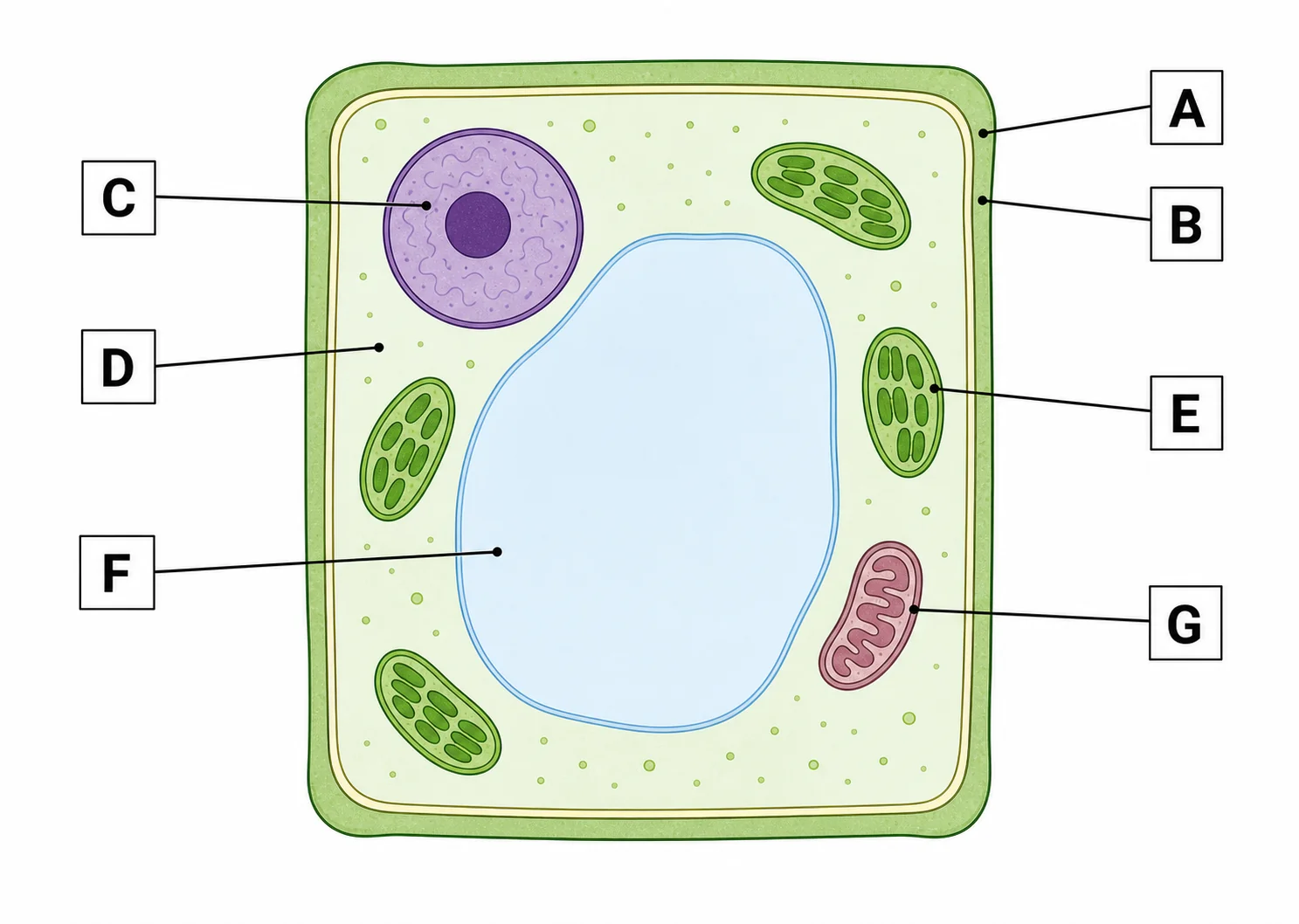
Label the main parts of a plant cell and say what each part does.
Sort the parts of a plant cell by the job they help with.
Use microscope observations of onion skin to name what you see.
Warm Up
Label the diagram
Write the name of each labelled part in the table. Choose from: nucleus, chloroplast, cell wall, mitochondrion, chlorophyll, cytoplasm, large vacuole, plasma membrane. One name is not a part you can point to: leave it out.
Label
Name of part
Label
Name of part
A
E
B
F
C
G
D
Fill the gap
Choose the correct word from the word bank. Each word is used once at most. Two words will not be used.
Plant cells carry out photosynthesis inside a green organelle called the .
It contains a green pigment called , which absorbs energy from
and uses it to turn carbon dioxide and water into glucose.
The rigid outer layer of a plant cell is the cell wall, made of a strong fibre called .
Inside the cell, one large water-filled sac called the presses outwards on the wall and keeps the cell firm, or .
When the cell needs energy, its release it from glucose by respiration.
1. Tom says: “The cell wall and the cell membrane are the same thing.” Give two ways they are different.
Recall2 marks
Your Turn
Sort it
Which job does each item help with? Write each one in the correct box. The boxes do not hold the same number of items.
A group stained a thin layer of onion skin with iodine and viewed it with a light microscope, starting at the lowest magnification.
Table 1. Onion skin cells at three magnifications
Magnification
Cells across the view
What the group could see
×40
40
A grid of box-shaped outlines
×100
15
Outlines, and a dark dot in each box
×400
4
Outline, dark round dot, big pale area in the middle
Source: sample class results.
2. Describe what happens to the number of cells you can see as the magnification goes up. Suggest why the group started at ×40.
Apply2 marks
3. Name the parts the group saw at ×400: (a) the box outline, (b) the dark round dot, (c) the big pale area. Then explain why the group added iodine.
Apply4 marks
Show What You Know
4. The leaves of a gum tree are green, but its roots are not. Explain why, using what you know about the parts of a plant cell.
Analyse5 marks
HSCScience · Year 7 Science · Unit 1 · Lesson 7 · Foundation Worksheet
Answer Key (for teachers)
Label the diagram
A cell wall; B plasma membrane; C nucleus; D cytoplasm; E chloroplast; F large vacuole; G mitochondrion. Not used: chlorophyll (a pigment, not a part).
Any two (1 each): the wall is outside, the membrane just inside it; the wall is thick and rigid, the membrane thin and flexible; the wall (cellulose) holds the shape, the membrane controls what enters and leaves; animal cells have a membrane but no wall. [2 marks]
Sort it
Holding the cell firm and in shape: cell wall; cellulose; large vacuole. Making glucose or releasing energy: chlorophyll; chloroplast; mitochondria. Controlling the cell: nucleus (control centre, DNA); plasma membrane (controls what enters and leaves).
Question 2
As magnification goes up, fewer cells fit in the view (40, then 15, then 4), but each looks bigger (1). Low power shows the most cells, so it is easiest to find a clear area before zooming in (1). [2 marks]
Question 3
(a) cell wall (1); (b) nucleus (1); (c) large vacuole (1). Iodine is a stain that makes the cell parts easier to see (1). [4 marks]
Question 4
Marking guide: leaf cells contain chloroplasts (1); chloroplasts hold chlorophyll, the green pigment (1); chlorophyll absorbs sunlight so the chloroplast can make glucose by photosynthesis (1); root cells grow underground in the dark (1), so chloroplasts would be useless there and the plant does not build them, so roots are not green (1). [5 marks]
Model answer: Gum leaf cells are packed with chloroplasts, which contain the green pigment chlorophyll. Chlorophyll absorbs sunlight so the chloroplast can make glucose. Roots are in the dark, so the plant puts no chloroplasts there, and without chlorophyll they are not green.
Common error: “every plant cell is green”. Only cells with chloroplasts are green; onion skin, root and trunk cells have none or very few.
HSCScience · Year 7 Science · Unit 1 · Lesson 7 · Foundation Worksheet · Answer Key