Sort cell parts into plant only, animal only and both.
Use observations to decide whether a cell came from a plant or an animal.
Warm Up
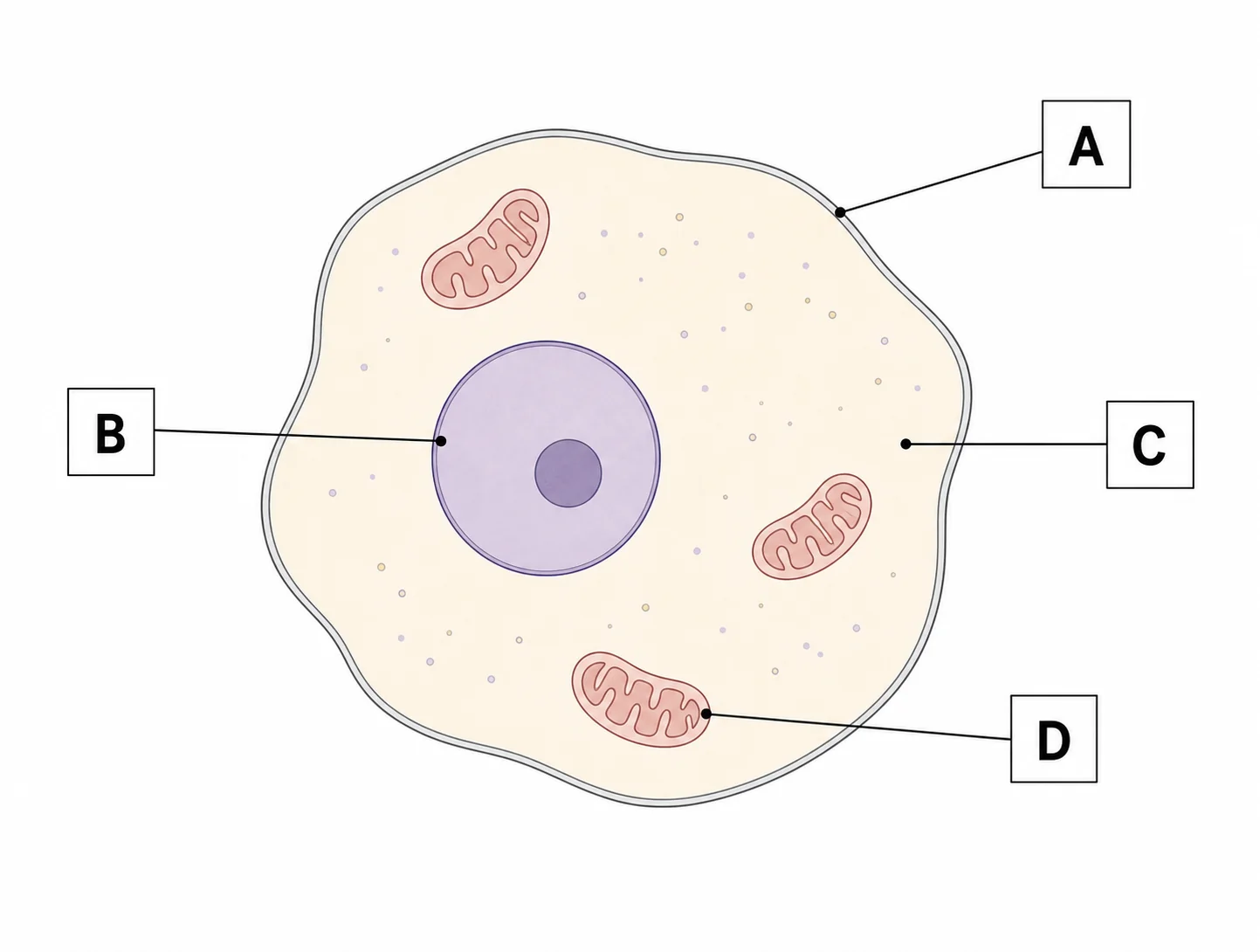
Label the diagram
Name each labelled part. Choose from: nucleus, cell wall, mitochondrion, plasma membrane, cytoplasm. One of these is not found in an animal cell: leave it out.
Label
Name of part
Label
Name of part
A
C
B
D
True or false? Fix the false ones
Circle T or F. If a statement is false, correct it on the line.
1. The nucleus contains the cell’s DNA.
Correct it:
T
F
2. Animal cells have a cell wall made of cellulose.
Correct it:
T
F
3. Animal cells never have any vacuoles.
Correct it:
T
F
4. Both plant cells and animal cells contain mitochondria.
Correct it:
T
F
5. All animal cells have the same regular, box-like shape.
Correct it:
T
F
Your Turn
Sort it
Write each item in the correct box. The boxes do not all hold the same number of items.
nucleuschloroplastsflexible, irregular shapeplasma membranecell wallmitochondriacan squeeze through a narrow gapone large central vacuolecytoplasmrigid, box-like shape
Plant cells only
Animal cells only
Both
1. Which part of an animal cell holds its DNA? Why is this part called the control centre?
Recall2 marks
Go Deeper
Read the data
Scenario: four mystery cells
A lab technician has four slides, but the labels have fallen off. Each slide holds cells from either a plant or an animal. Table 1 shows what she saw under the microscope.
Table 1. Observations of four mystery cells
Slide
Shape
Cell wall?
Chloroplasts?
Vacuole
W
Irregular; changes shape as it moves
No
No
A few small ones
X
Box-like
Yes
Yes
One large one
Y
Box-like
Yes
No
One large one
Z
Round and flexible
No
No
None seen
Source: made-up observations for this worksheet.
2. Decide whether each slide, W, X, Y and Z, shows plant or animal cells. Give one reason from Table 1 for each.
Apply4 marks
3. Slide Y has no chloroplasts. Suggest which part of a plant it might have come from, and explain why it has none.
Analyse2 marks
Show What You Know
4. Humans don’t turn green in the sun or make their own food from sunlight. Explain why. In your answer, name the cell part a human cell would need to do this, say why animal cells don’t have it, and describe how animal cells get their energy instead.
Analyse5 marks
HSCScience · Year 7 Science · Unit 1 · Lesson 8 · Foundation Worksheet
Answer Key (for teachers)
Label the diagram
A plasma membrane; B nucleus; C cytoplasm; D mitochondrion. Not used: cell wall.
True or false
1. True. 2. False: animal cells have no cell wall, only a plasma membrane. 3. False: animal cells can have small vacuoles, but never one large central vacuole. 4. True. 5. False: animal cells are usually irregular and flexible; the box shape belongs to plant cells.
Sort it
Plant cells only: chloroplasts; cell wall; one large central vacuole; rigid, box-like shape. Animal cells only: flexible, irregular shape; can squeeze through a narrow gap. Both: nucleus; plasma membrane; mitochondria; cytoplasm.
Question 1
The nucleus (1). It stores the DNA and decides what the cell makes (1). [2 marks]
Question 2
W animal: no cell wall, and it changes shape (1). X plant: cell wall and chloroplasts (1). Y plant: cell wall and one large vacuole (1). Z animal: no cell wall, flexible (1). [4 marks]
Question 3
A root (or onion skin, or the inside of a stem) (1). Those cells are in the dark, where chloroplasts would be useless, so the plant does not build them there (1). [2 marks]
Question 4
Marking guide: 1 chloroplasts needed; 1 they contain chlorophyll, which absorbs sunlight to make glucose; 1 animals eat other organisms instead, so do not need them; 1 mitochondria release energy from the glucose in food; 1 link: the cell has the parts the animal’s way of life needs. [5 marks]
Model answer: A human cell would need chloroplasts, which contain green chlorophyll. Animals eat other organisms, so they do not need to make food. The glucose from our food goes to our mitochondria, which release its energy. Our cells have the parts that suit the way we live.
Common error: “animal cells have no vacuoles”. They can have small vacuoles; what they never have is one large central vacuole.
HSCScience · Year 7 Science · Unit 1 · Lesson 8 · Foundation Worksheet · Answer Key