Name five specialised cells and state the job of each.
Link a cell’s shape and features to the job it does.
Use class data to compare cells from the top and bottom layers of a leaf.
Warm Up
Label the diagram
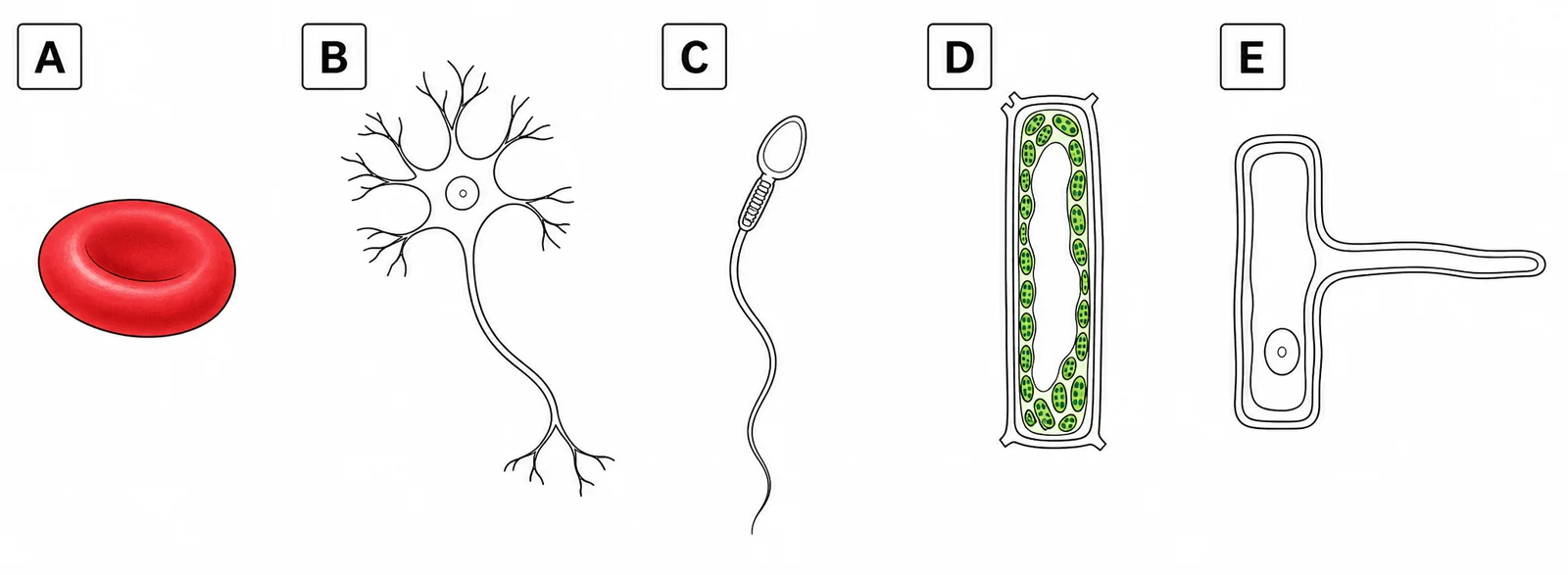
1. The five cells below are labelled A to E. They are not drawn to scale. Write the name of each cell and its job. Choose the names from: neuron, palisade cell, red blood cell, root hair cell, sperm cell.
Recall5 marks
Label
Cell name
Its job
A
B
C
D
E
Fill the gap
Choose the correct word from the word bank. Each word is used at most once. Two words are not needed: cross them out.
A cell has a special shape or features that suit one job. The job of a
red blood cell is to carry around the body. When it finishes growing, it
pushes out its . This leaves more room for ,
the red protein that grabs onto oxygen. Its biconcave shape gives it more
for oxygen to enter and leave, and lets it as it squeezes through narrow
blood vessels. Without a nucleus it cannot repair itself, so it lives for only about
days, and the must keep making new ones.
Your Turn
Sort it
Write each feature in the box for the cell that has it. The boxes do not hold the same number of features.
no nucleuslong tail (flagellum)long thin extension into the soilpacked with haemoglobinvery long axonpacked with chloroplastsmidpiece packed with mitochondriabiconcave disc shape
Red blood cell
Neuron
Sperm cell
Palisade cell
Root hair cell
2. Name two features of a sperm cell and explain how each feature helps it reach and fertilise an egg.
Apply2 marks
Go Deeper
Read the data
Scenario: counting chloroplasts
Aisha’s group counted the chloroplasts in ten cells from one slice of leaf: five from the top layer (palisade cells) and five from the bottom layer.
Table 1. Number of chloroplasts in each cell
Layer of the leaf
Cell 1
Cell 2
Cell 3
Cell 4
Cell 5
Average
Top layer (palisade cells)
42
50
46
38
44
Bottom layer
12
18
15
9
16
Source: sample class results.
3. Calculate the average number of chloroplasts per cell for each layer. Write your answers in Table 1 too.
Apply2 marks
Top layer chloroplasts
Bottom layer chloroplasts
4. Use Table 1 to explain which layer does more photosynthesis, and why the top of a leaf is usually a darker green than the underside.
Analyse2 marks
Show What You Know
5. A neuron and a root hair cell are both long and thin, but for different reasons. Explain how being long and thin helps each cell do its job.
Analyse5 marks
HSCScience · Year 7 Science · Unit 1 · Lesson 9 · Foundation Worksheet
Answer Key (for teachers)
Label the diagram
1. A: red blood cell, carries oxygen around the body. B: neuron (nerve cell), carries electrical signals. C: sperm cell, swims to the egg and fertilises it. D: palisade cell, carries out photosynthesis in the leaf. E: root hair cell, absorbs water and minerals from the soil. 1 mark per row (name and job). [5 marks]
Fill the gap
specialised; oxygen; nucleus; haemoglobin; surface area; bend; 120; bone marrow. Not used: flagellum, chloroplasts.
Sort it
Red blood cell: no nucleus; packed with haemoglobin; biconcave disc shape. Neuron: very long axon. Sperm cell: long tail (flagellum); midpiece packed with mitochondria. Palisade cell: packed with chloroplasts. Root hair cell: long thin extension into the soil.
Question 2
The flagellum (tail) whips to push the cell forward (1); the midpiece’s mitochondria release energy to power the tail on the long swim (1). [2 marks]
The top layer: about three times as many chloroplasts (44 against 14), so more light is trapped for photosynthesis (1). Chloroplasts are green, and the packed palisade cells sit at the top, so the top looks darker green (1). [2 marks]
Question 5
Marking guide: 1 both jobs (signals; water and minerals); 1 the long axon lets one cell carry a signal a long way quickly, with no handover; 1 the root hair’s extension gives a much larger surface area touching the soil; 1 so water and minerals are taken in faster; 1 comparison: length for distance in one, for surface area in the other. [5 marks]
Model answer: A neuron’s long axon lets one cell carry a signal from the spine to the toe quickly. A root hair cell’s long thin extension reaches between soil particles and gives a bigger surface area, so it absorbs water faster.
Common error: saying the root hair is long “to reach water deep underground”. Its value is the extra surface area touching the soil.
HSCScience · Year 7 Science · Unit 1 · Lesson 9 · Foundation Worksheet · Answer Key