Plant Systems as Living Systems
In 2019, CSIRO botanists measured a River Red Gum moving 250 litres of water daily through its trunk using zero mechanical parts.
Printable Worksheets
Print or save as PDF, or build a custom worksheet from any module's questions.
Q1 · Q1: If plants do not have hearts or lungs, in what sense can they still be living systems?
Q2 · Q2: A carrot grows underground and a celery stalk grows above ground. Which one is the root and which is the stem?
● Know
- plants are organised living systems
- roots, stems and leaves are important interacting plant components
- plant structures support transport, support and survival
● Understand
- systems can look different in plants and animals
- plant components do not work alone; they support one another
- the absence of animal organs does not mean the absence of systems
● Can do
- identify the role of roots, stems and leaves
- explain how those roles connect together
- reject the misconception that only animals have systems
A system does not need to look like an animal body. It only needs organised parts that work together in a living organism.
Plants are made of cells, tissues and organs, and their structures interact to keep the organism alive. A plant is not just a stem with leaves attached randomly. Its parts are organised so that the plant can absorb what it needs, remain supported, and interact with the environment.
Roots
- anchor the plant
- absorb water and minerals from the environment
Stems
- support the plant body
- connect roots and leaves
Leaves
- interact strongly with the environment
- support exchange and food-making processes
A plant works because these components are linked. Roots take in materials, stems connect and support, and leaves use their position and structure to interact with light and gases. One part depends on the others.
- Roots
- Stems
- Leaves
- Anchor the plant and absorb water and minerals
- Interact with the environment and support food-making
- Support the plant and connect roots and leaves
Match each plant component to its role: roots, stems, leaves. Then explain how two of those roles connect to each other.
take in water and minerals
support the plant and connect the main parts
interact with light and gases and support food-making processes
You do not need advanced plant transport detail yet. The key point for this lesson is that plant structures work as an interacting system that helps the plant survive. Later lessons can deepen the specific transport and exchange processes.
A student wrote: "Only animals have systems because only animals have organs." Explain why this answer is scientifically weak and rewrite it into a stronger version.
Claim-Evidence-Reasoning Frame
Claim: State whether the student's answer is correct or incorrect.
Evidence: Use the definition of a system and plant examples from the lesson.
Reasoning: Explain why having animal-style organs is not required for a system.
Explore the chloroplast. What two stages of photosynthesis happen inside it?
Wrong: Only animals have systems because only animals have organs like hearts and lungs.
Right: A system is any set of organised interacting components. Plants have roots, stems and leaves that interact to support survival, so plants are living systems too.
Wrong: Roots, stems and leaves are just random plant parts with no connection.
Right: Roots absorb water and minerals, stems connect and support, and leaves interact with the environment. Each role depends on the others for the plant to survive.

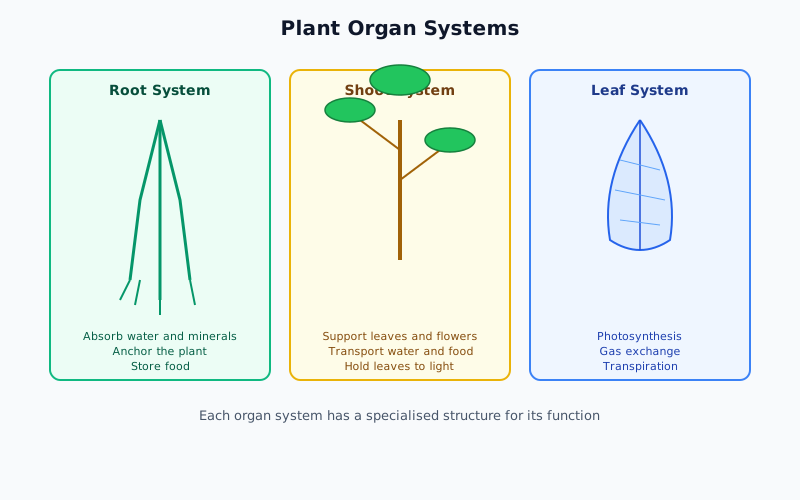
Diagram 2: Cross-Section of a Root, Stem and Leaf
Labelled cross-sections of each plant component showing different tissues inside, reinforcing that even plant parts have internal organisation and are not just "simple" structures.
Today's hook pointed out that a gum tree has no heart, no lungs and no brain, yet it is every bit as organised as you are. It uses roots, stems and leaves as its own version of body systems.
Now that you've worked through the lesson, can you explain in your own words how a gum tree's root system and shoot system give it the same kind of organised living system that animals have? What changed in your thinking about what a "living system" has to look like?
Q1. Explain why plants can be described as living systems.
1 mark for mentioning organised components, 1 mark for mentioning interaction, 1 mark for linking to survival.Q2. Use the terms roots, stems and leaves in one explanation that shows how their roles connect.
1 mark for the role of roots, 1 mark for the role of stems, 1 mark for the role of leaves, 1 mark for showing how the roles connect.Q3. Why is it scientifically stronger to describe roots, stems and leaves as interacting components rather than just listing them as plant parts?
1 mark for explaining what "interacting components" means, 1 mark for explaining why listing alone is weak, 1 mark for linking to system function, 1 mark for a concrete example.Model answers (click to reveal)
Model Answers
+Multiple Choice
1: B. Plants are organised living systems with interacting components.
2: A. Roots are mainly linked to absorbing water and minerals.
3: C. The stem helps connect roots and leaves while supporting the plant.
4: D. Plants have organised components that interact to support survival.
5: B. This is the strongest explanation of how plant components connect.
Short Answer 1 (3 marks)
Plants can be described as living systems because they have organised components that interact to keep the organism alive. Roots, stems and leaves each have roles, and those roles connect to support transport, support and survival.
1 mark for mentioning organised components. 1 mark for mentioning interaction. 1 mark for linking to survival.
Short Answer 2 (4 marks)
Roots absorb water and minerals, stems support the plant and connect the main parts, and leaves interact with the environment and support food-making processes. Together these components help the plant survive as a connected system.
1 mark for the role of roots. 1 mark for the role of stems. 1 mark for the role of leaves. 1 mark for showing how the roles connect.
Short Answer 3 (4 marks)
It is stronger because science explains how structures work together, not just what they are called. Listing parts alone does not show the roles those components play or how they interact to support the whole organism.
1 mark for explaining what "interacting components" means. 1 mark for explaining why listing alone is weak. 1 mark for linking to system function. 1 mark for a concrete example or clear synthesis.
Revisit Your Thinking
Return to the opening question. Can you now explain clearly in what sense plants are living systems?
Model answers (click to reveal)
Model Answers
+Multiple Choice
1: B. Plants are organised living systems with interacting components.
2: A. Roots are mainly linked to absorbing water and minerals.
3: C. The stem helps connect roots and leaves while supporting the plant.
4: D. Plants have organised components that interact to support survival.
5: B. This is the strongest explanation of how plant components connect.
Short Answer 1 (3 marks)
Plants can be described as living systems because they have organised components that interact to keep the organism alive. Roots, stems and leaves each have roles, and those roles connect to support transport, support and survival.
1 mark for mentioning organised components. 1 mark for mentioning interaction. 1 mark for linking to survival.
Short Answer 2 (4 marks)
Roots absorb water and minerals, stems support the plant and connect the main parts, and leaves interact with the environment and support food-making processes. Together these components help the plant survive as a connected system.
1 mark for the role of roots. 1 mark for the role of stems. 1 mark for the role of leaves. 1 mark for showing how the roles connect.
Short Answer 3 (4 marks)
It is stronger because science explains how structures work together, not just what they are called. Listing parts alone does not show the roles those components play or how they interact to support the whole organism.
1 mark for explaining what "interacting components" means. 1 mark for explaining why listing alone is weak. 1 mark for linking to system function. 1 mark for a concrete example or clear synthesis.
● Plants as Systems
Plants are organised living systems, even though they differ from animal systems.
● Roots, Stems, Leaves
These plant components have different roles that connect together.
● Interaction
Plant survival depends on connected component roles rather than isolated parts.
● Bridge Forward
Next lesson pulls the opening block together and prepares for Checkpoint 1.