Why Living Things Need Transport Systems
In 2017, CSIRO cell biologists confirmed that any cell more than 0.2 mm from its nearest blood vessel will die from oxygen starvation within minutes.
Printable Worksheets
Print or save as PDF, or build a custom worksheet from any module's questions.
Q1 · Q2: Imagine watering a large pot plant. Why does the water need to reach all parts of the plant, not just the soil around the roots?
● Know
- multicellular organisms need ways to move substances around
- cells need water, gases and nutrients, and wastes must be removed
- size and complexity increase transport demands
● Understand
- large organisms cannot rely only on exchange at the outside surface
- internal cells are too far from the surroundings for simple direct exchange alone
- transport links to survival because all cells need supply and removal
● Can do
- identify what must be moved in living systems
- explain why size changes transport needs
- prepare for plant and animal transport lessons next
Even in a very large organism, each cell still needs access to resources and a way to get rid of wastes.
Cells do not stop needing materials just because they are part of a bigger organism. They still need water, useful gases and nutrients. They also produce wastes that must be removed. In a one-celled organism, the cell is directly exposed to the surroundings. In a multicellular organism, many cells are buried deep inside, so resources and wastes must be moved through the body or plant.
Water
- needed by cells
- must reach internal tissues
Gases
- oxygen in animals
- carbon dioxide and oxygen in plants
Nutrients
- food molecules or minerals
- must be supplied to cells
Waste Removal
- cells produce wastes
- removal helps cells keep functioning
A student writes: “Only animals need transport systems because plants do not move.” Rewrite this into a stronger scientific explanation.
Claim-Evidence-Reasoning Frame
Claim: State whether the student's explanation is scientifically correct or incomplete.
Evidence: Refer to evidence from the lesson about plant and animal transport needs.
Reasoning: Explain why the evidence supports your claim about transport systems.
Put these steps in the correct logical order to explain why large organisms need transport systems.
- Internal cells are far from the outside environment
- Multicellular organisms develop transport systems
- Substances must travel longer distances in larger organisms
- Cells produce wastes that must be removed
As organisms become larger, many cells are no longer close to the external environment. That means useful substances must travel further to reach those cells, and wastes must travel further to leave. This is why size and complexity create the need for transport systems.
Plants and animals do not transport substances in exactly the same way, but the underlying problem is similar. Cells in both organisms need supply and removal. That is why the next lessons examine plant transport, gas exchange in plants, circulation in animals and gas exchange in animals.
- Transport need
- Distance problem
- Plant transport
- Animal transport
- Movement using heart, blood vessels and blood
- Movement through roots, stems and leaves
- Moving water, nutrients and gases to cells and removing wastes
- Internal cells are far from the outside environment
Choose one multicellular organism. List what its cells need to receive and what needs to be removed. Then explain why internal cells cannot all interact directly with the outside environment.
Explore the mitochondria. What is the main product of cellular respiration that cells use for energy?
Wrong: Only animals need transport systems because they move around.
Right: Plants also need transport because their cells need water, minerals and gas exchange, and they are multicellular organisms too.
Wrong: A single-celled organism has a transport system inside it.
Right: Single-celled organisms rely on direct exchange with their surroundings because they are small enough for substances to diffuse across the cell membrane.
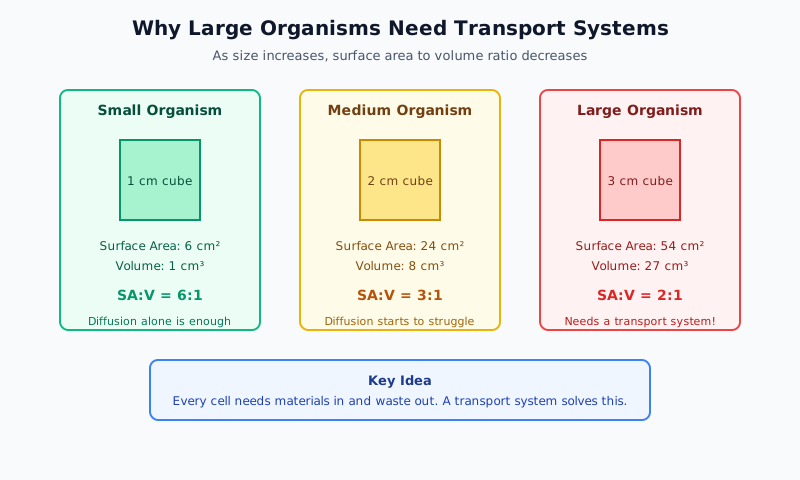
Diagram 2: Transport Structures in Plants and Animals
Comparison illustration showing xylem and phloem in a plant alongside blood vessels in an animal, with colour-coded pathways.
Today's hook told you that a cell more than 0.1 mm from a supply of oxygen will die, and that this tiny limit is why both plants and animals had to evolve transport systems to move materials around. Think back to that idea now.
Now that you've worked through the lesson, can you explain why watering just the soil around a pot plant's roots is not enough? Use what you know about transport systems and cell needs to give a complete answer.
Q1. Explain why cells in a multicellular organism need a transport system.
1 mark for identifying cell needs; 1 mark for explaining the distance problem; 1 mark for linking to transport systems.Q2. Describe what must be moved to cells and what must be moved away from cells in a large living organism.
1 mark for naming substances moved to cells; 1 mark for naming substances moved away; 1 mark for explaining why this matters; 1 mark for mentioning organised transport.Q3. Why is it scientifically stronger to say that plants and animals both need transport systems, rather than saying only animals do?
1 mark for stating both plants and animals need transport; 1 mark for explaining plant transport (e.g. water/minerals); 1 mark for explaining that transport is not only about blood; 1 mark for linking to multicellular organisation.Model answers (click to reveal)
Model Answers
+Multiple Choice
1: B. Many cells are far from the outside environment and still need supply and waste removal.
2: D. Cells need or produce water, gases, nutrients and wastes.
3: A. Large multicellular organisms depend strongly on organised transport.
4: C. Plants also need organised ways to move substances.
5: B. Size increases the distance substances must move.
Short Answer 1 (3 marks)
Cells in a multicellular organism need a transport system because many of them are far from the outside environment. They still need useful substances delivered and wastes removed, so the organism needs organised transport.
1 mark for cell needs. 1 mark for distance/internal cells. 1 mark for transport system.
Short Answer 2 (4 marks)
Cells need useful substances moved to them, including water, gases and nutrients. Wastes must be moved away from cells so they do not build up. This matters because cells cannot function properly without supply and removal.
1 mark for substances to cells. 1 mark for substances away. 1 mark for function. 1 mark for organised transport.
Short Answer 3 (4 marks)
It is stronger because both plants and animals are multicellular organisms whose cells need substances moved in and wastes moved out. Plants do not use blood, but they still need organised transport through their structures, so transport is not an animal-only idea.
1 mark for both need transport. 1 mark for plant example. 1 mark for not only blood. 1 mark for multicellular link.
Revisit Your Thinking
Return to the opening question. Can you now explain clearly how size and internal distance create the need for transport systems?
Model answers (click to reveal)
Model Answers
+Multiple Choice
1: B. Many cells are far from the outside environment and still need supply and waste removal.
2: D. Cells need or produce water, gases, nutrients and wastes.
3: A. Large multicellular organisms depend strongly on organised transport.
4: C. Plants also need organised ways to move substances.
5: B. Size increases the distance substances must move.
Short Answer 1 (3 marks)
Cells in a multicellular organism need a transport system because many of them are far from the outside environment. They still need useful substances delivered and wastes removed, so the organism needs organised transport.
1 mark for cell needs. 1 mark for distance/internal cells. 1 mark for transport system.
Short Answer 2 (4 marks)
Cells need useful substances moved to them, including water, gases and nutrients. Wastes must be moved away from cells so they do not build up. This matters because cells cannot function properly without supply and removal.
1 mark for substances to cells. 1 mark for substances away. 1 mark for function. 1 mark for organised transport.
Short Answer 3 (4 marks)
It is stronger because both plants and animals are multicellular organisms whose cells need substances moved in and wastes moved out. Plants do not use blood, but they still need organised transport through their structures, so transport is not an animal-only idea.
1 mark for both need transport. 1 mark for plant example. 1 mark for not only blood. 1 mark for multicellular link.
● Cell Needs
Every cell still needs supply and waste removal, even inside a large organism.
● Why Size Matters
As organisms get larger, internal distance creates transport challenges.
● Plants and Animals
Both need organised transport, even though the structures involved differ.
● Bridge Forward
Next lesson looks at how roots, stems and leaves help transport substances in plants.