Animal Gas Exchange and System Interaction
In 2021, researchers at the University of Sydney showed that the human body uses about 550 litres of pure oxygen every day, delivered entirely by the linked respiratory and circulatory systems.
Printable Worksheets
Print or save as PDF, or build a custom worksheet from any module's questions.
Q1 · Q2: When you hold your breath, your face goes red and you feel dizzy. Why do you think holding your breath affects more than just your lungs?
● Know
- the respiratory system has a basic gas-exchange role
- oxygen enters and carbon dioxide leaves through gas exchange
- the circulatory system helps move gases around the body
● Understand
- gas exchange and transport are connected processes
- the respiratory and circulatory systems interact
- body systems should be explained as linked rather than isolated
● Can do
- explain the basic role of the respiratory system
- connect gas exchange to circulatory transport
- prepare for Checkpoint 2 with system-interaction reasoning
At this level, the key role of the respiratory system is simple: it helps the body exchange gases with the environment.
Animals need oxygen to enter the body and carbon dioxide to leave it. The respiratory system is the system responsible for this gas exchange. This lesson does not require deep anatomical detail. The important idea is the function: getting useful gases in and removing gases that need to leave.
Respiratory System
- linked to gas exchange
- interacts directly with the environment
Gas Exchange
- oxygen enters
- carbon dioxide leaves
Circulatory Link
- transport system moves gases around body
- systems depend on one another
Gas exchange brings oxygen into the body and removes carbon dioxide, but that alone is not enough. The gases still have to be moved to and from cells around the body. This is where the circulatory system connects to the respiratory system. One system exchanges gases with the environment. The other transports those gases around the body.
Put these events in the correct order to show how respiratory and circulatory systems work together.
- Oxygen enters the body and carbon dioxide leaves
- Cells receive oxygen and wastes can be carried away
- The circulatory system transports these gases around the body
- The respiratory system exchanges gases with the environment
Write a short paragraph explaining how the respiratory system and circulatory system work together to support cells around the body.
- Respiratory system
- Circulatory system
- System interaction
- Transports gases around the body
- When body systems depend on one another
- Exchanges gases with the environment
A common weak idea is that each body system works separately with no overlap. That is not how living systems work. The respiratory system and circulatory system interact because exchange and transport are linked. The same system-interaction idea appears across biology: one system often depends on another to complete a larger function.
A student writes: “The respiratory system works alone because breathing is separate from circulation.” Rewrite this into a stronger scientific explanation.
Claim-Evidence-Reasoning Frame
Claim: State whether the student's explanation is scientifically correct or incomplete.
Evidence: Refer to evidence from the lesson about how the respiratory and circulatory systems interact.
Reasoning: Explain why system interaction is a stronger scientific explanation than isolated systems.
Wrong: The respiratory system works alone because breathing is separate from circulation.
Right: The respiratory and circulatory systems interact. The respiratory system exchanges gases, and the circulatory system transports those gases around the body.
Wrong: Oxygen automatically reaches cells without any transport system.
Right: After gas exchange in the lungs, oxygen must be transported by the circulatory system to cells all over the body.
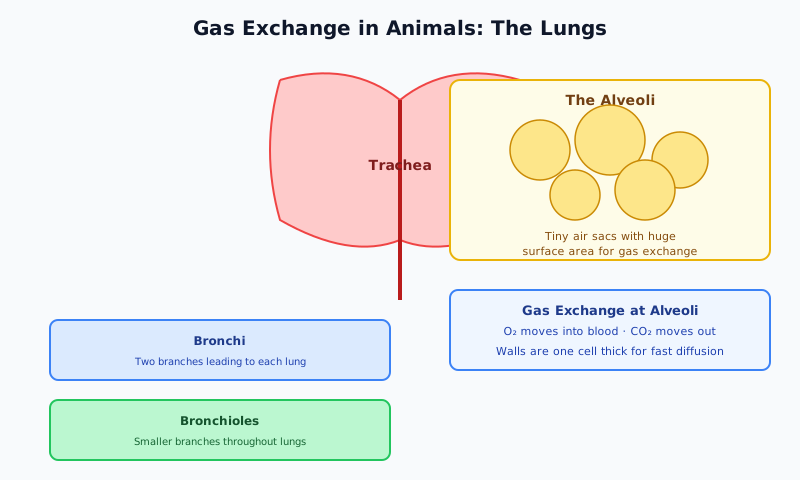
Diagram 2: System Interaction Flowchart
Flowchart connecting the respiratory system (gas exchange) to the circulatory system (transport) and then to body cells.
Today's hook described what happens when you hold your breath, your face flushes red and your brain screams at you to stop. The hook's key insight was that your lungs and circulatory system are one connected machine, not two separate ones.
Now that you've worked through the lesson, can you explain why holding your breath affects more than just your lungs? Trace what happens to the circulatory system and your cells when gas exchange stops. What does this tell you about system interaction?
Q1. Explain the basic role of the respiratory system in gas exchange.
1 mark for stating gas exchange with environment; 1 mark for naming oxygen entering; 1 mark for naming carbon dioxide leaving.Q2. Explain how the respiratory system and circulatory system work together to support cells around the body.
1 mark for respiratory system exchanging gases; 1 mark for circulatory system transporting gases; 1 mark for linking the two systems; 1 mark for explaining whole-body support.Q3. Why is it scientifically stronger to talk about system interaction rather than describing the respiratory system on its own?
1 mark for stating that isolated descriptions are weak; 1 mark for explaining the circulatory transport role; 1 mark for explaining that systems depend on each other; 1 mark for using an example.Model answers (click to reveal)
Model Answers
+Multiple Choice
1: A. The respiratory system exchanges gases with the environment.
2: C. Oxygen enters the body through gas exchange.
3: D. After exchange, gases still need to be transported around the body.
4: B. This is the clearest example of system interaction.
5: C. Larger body functions often depend on systems working together.
Short Answer 1 (3 marks)
The respiratory system helps exchange gases with the environment. Oxygen enters the body and carbon dioxide leaves the body through this process.
1 mark for gas exchange with environment. 1 mark for oxygen entering. 1 mark for carbon dioxide leaving.
Short Answer 2 (4 marks)
The respiratory system exchanges gases with the environment, bringing oxygen in and allowing carbon dioxide to leave. The circulatory system then transports those gases around the body using blood. Together the systems help support cells across the body.
1 mark for respiratory exchange. 1 mark for circulatory transport. 1 mark for linked systems. 1 mark for whole-body support.
Short Answer 3 (4 marks)
It is stronger because it explains the larger function more accurately. Describing only the respiratory system ignores that the circulatory system is needed to transport gases to and from cells around the body.
1 mark for isolated is weak. 1 mark for circulatory role. 1 mark for systems depend. 1 mark for example.
Revisit Your Thinking
Return to the opening prompt. Can you now explain how gas exchange and transport connect across two interacting systems?
Model answers (click to reveal)
Model Answers
+Multiple Choice
1: A. The respiratory system exchanges gases with the environment.
2: C. Oxygen enters the body through gas exchange.
3: D. After exchange, gases still need to be transported around the body.
4: B. This is the clearest example of system interaction.
5: C. Larger body functions often depend on systems working together.
Short Answer 1 (3 marks)
The respiratory system helps exchange gases with the environment. Oxygen enters the body and carbon dioxide leaves the body through this process.
1 mark for gas exchange with environment. 1 mark for oxygen entering. 1 mark for carbon dioxide leaving.
Short Answer 2 (4 marks)
The respiratory system exchanges gases with the environment, bringing oxygen in and allowing carbon dioxide to leave. The circulatory system then transports those gases around the body using blood. Together the systems help support cells across the body.
1 mark for respiratory exchange. 1 mark for circulatory transport. 1 mark for linked systems. 1 mark for whole-body support.
Short Answer 3 (4 marks)
It is stronger because it explains the larger function more accurately. Describing only the respiratory system ignores that the circulatory system is needed to transport gases to and from cells around the body.
1 mark for isolated is weak. 1 mark for circulatory role. 1 mark for systems depend. 1 mark for example.
● Respiratory Role
The respiratory system exchanges gases with the environment.
● Gas Movement
Oxygen enters the body and carbon dioxide leaves the body.
● System Interaction
The circulatory system works with the respiratory system to move gases around the body.
● Checkpoint Ready
Block B is now complete and ready for Checkpoint 2.