Stable Internal Conditions - Entry to Homeostasis
You'll be able to trace a feedback loop from the stimulus to the response.
Your core temperature sits near 37 °C whether you are in a Darwin summer or a Thredbo winter. Something is measuring it and acting on it, all day, without you noticing.
Printable Worksheets
Print or save as PDF, or build a custom worksheet from any module's questions.
Q1 · A thermostat turns a heater off once a room is warm enough. What would a living thing need in order to do the same job with its own temperature?
Q2 · You run around at lunchtime on a hot day and start sweating. Sweating is the body's response — so what was the change that triggered it, and how could the body have detected that change?
● Know
- the five parts of a feedback loop: stimulus, receptor, control centre, effector, response
- the human core temperature set point is about 37 °C
- sweating, shivering and thirst are responses, not causes
● Understand
- why a loop is called negative feedback: the response cancels the change that triggered it
- why enzymes are the reason the range matters at all
- why a broken loop, not an unusual reading, is what makes something a disease
● Can do
- trace a named example through all five parts of the loop
- identify which part has failed when a loop stops correcting
- tell a working loop from a broken one, given a real case
Homeostasis is holding an internal condition inside the range the body can work in, by detecting changes and acting to reverse them. The rest of this lesson is about the second half of that sentence — the detecting and the acting — because that is the part that can break.
First, though, it is worth asking why there is a range at all. Almost everything your cells do is run by enzymes: proteins folded into a particular shape, where the shape is the whole point. An enzyme works because a molecule fits into it, the way a key fits a lock. Heat is molecular movement, so as a cell gets hotter its enzymes vibrate harder, and past a certain point they shake themselves out of shape permanently. A bent key does not open the lock slowly — it does not open it at all.
That is why there is a range at all, and why going outside it gets worse the further and the longer you go. Human core temperature sits near 37 °C, and enzymes are not all equally fussy — there is no single temperature at which they all fail at once. What happens instead is that the hotter you get and the longer you stay there, the more of them lose their shape, and the more cell processes stop working. A fever of 39 °C for an afternoon is a very different amount of damage from 41 °C for an hour, even though both are "above the range". This is also why the treatment for heatstroke is to cool the person down fast: getting the temperature back inside the range stops the damage accumulating. The number 37 is not a rule the body has chosen to follow — it is roughly where this machinery works best.
So a living thing has a problem. The outside world moves — a Darwin summer, a Thredbo winter, a lunchtime sprint — and the inside cannot be allowed to move with it. Something has to notice the drift and push back against it. That something is a feedback loop, and it has the same five parts every time.
Text description
- Set point: 37 °C.
- Too hot: temperature rises too high, so sweating and vasodilation happen; temperature falls, back to 37 °C.
- Too cold: temperature drops too low, so shivering and vasoconstriction happen; temperature rises, back to 37 °C.
The diagram above is that loop drawn twice, once for each direction. The value in the middle, 37 °C, is the set point: the temperature the loop pulls back towards. Read the top path and you are following what happens when you get too hot — your body widens the blood vessels near the skin so that warm blood runs close to the surface and loses heat, which is called vasodilation, and it starts sweating. Read the bottom path and you are following the opposite correction: the same vessels narrow to keep warm blood away from the surface, which is vasoconstriction, and your muscles shiver to generate heat.
Notice what the two paths have in common. Each one produces a change that undoes the change that started it. Getting too hot triggers cooling. Getting too cold triggers warming. Because the response always opposes the original change, biologists call this negative feedback — negative in the sense of opposing, not in the sense of bad. Nearly every loop in your body works this way, and it is the reason you can be measured at roughly 37 °C in two very different places.
Here is a single case followed from start to finish: you are running around at lunchtime in the sun, and your core temperature starts to climb. Every feedback loop in your body has the same five parts, so trace this one carefully and you have the pattern for all of them.
-
Stimulus — your core temperature rises above 37 °C
Working muscles release heat as a by-product, and the sun adds more. The stimulus is the change itself, not the discomfort you feel. Nothing has responded yet.
-
Receptor — thermoreceptors detect the rise
Nerve endings in your skin sense the outside heat, and a set of receptors deep in the brain senses the temperature of the blood flowing past them. This step is easy to skip and it is the one that matters most: a change that nothing detects cannot be corrected. A room with no thermostat still gets cold.
-
Control centre — the hypothalamus compares the reading to the set point
The hypothalamus is a small region at the base of your brain. It holds the set point and does the one job a thermostat does: it compares what is happening to what should be happening, and works out which direction the correction has to go. Because it compares rather than simply reacts, the same centre can trigger opposite responses — cooling if the reading is high, warming if it is low.
-
Effector — sweat glands and skin blood vessels are told to act
The effectors are the parts that actually do something: here, the sweat glands and the muscles in the walls of the skin's blood vessels. The control centre decides; the effector acts. Keeping those two apart is what lets you say exactly where a loop has gone wrong.
-
Response — you sweat, your vessels widen, and your temperature falls
Sweat takes heat with it as it evaporates, and wider vessels bring more warm blood to the surface to lose heat. Your temperature drops back toward 37 °C. And now the important part: that falling temperature is a smaller stimulus. The receptors report less of a rise, the hypothalamus calls for less correction, and the sweating eases off. The loop switches itself off by succeeding.
That last sentence is the whole idea of negative feedback, and it is why the loop does not overshoot into hypothermia. The response feeds back and reduces the very thing that triggered it, so the correction fades as the problem does. A loop that instead made the change bigger would run away from the set point rather than back to it.
The five parts, in order
- Stimulus
- Receptor
- Control centre
- Effector
- Response reduces the stimulus
Learn the five slots rather than the temperature example. Any homeostasis question you meet — in this unit or in Year 11 Biology — is asking you to fill these five slots for a different variable.
The lesson traced what happens when you get too hot. Now do the same job for getting too cold — you have walked out of a pool into the wind and you start to shiver. Name all five parts for that case: the stimulus, the receptor, the control centre, the effector and the response. Then finish with the sentence that makes it negative feedback: what does the response do to the stimulus?
A rise in core temperature is the . Thermoreceptors act as the , and the compares the reading to the set point. Sweat glands are the . The loop is called because the response makes the original change smaller.
One traced example proves the loop exists. A second one proves the loop is a pattern rather than a fact about sweating — so here is water balance, run through the same five slots.
The marathon runner in the last card lost water to protect their temperature, so now their blood is slightly more concentrated than it should be. That concentration is the stimulus. Receptors in the hypothalamus — the same region, doing the same comparing job for a second variable — detect it, and this time there are two effectors rather than one. The pituitary gland releases a hormone that tells the kidneys to return more water to the blood instead of passing it into urine, which is why a dehydrated person produces a small amount of dark urine. At the same time you feel thirsty, and thirst makes you go and find a drink.
Look at what thirst is in this picture. It is not a symptom of anything wrong; it is the response step of a working loop, and it is a slightly unusual one because it runs through your behaviour rather than through an organ. Drinking dilutes the blood, the concentration falls back toward its set point, the receptors report less of a change, and the thirst goes away. Once again the response reduces the stimulus that caused it, and once again the loop turns itself off by working.
Text description
- Axes: time across; body temperature from 35 °C to 40 °C up.
- A dashed line marks the set point, 37 °C, inside a shaded normal range.
- The temperature trace wobbles a few tenths of a degree above and below 37 °C but never leaves the normal range.
The graph above is worth a second look now, because it shows the thing a definition cannot. The line never sits flat on the set point — it wanders above and below it continuously. That wandering is not the loop failing. It is the loop working: a correction can only start after a drift has been detected, so a healthy variable is always a little late and always moving. A perfectly flat line would mean nothing was ever being corrected, because nothing was ever allowed to drift.
Loop 1 · Core temperature
Stimulus: temperature rises above 37 °C.
Receptor: thermoreceptors in skin and brain.
Control centre: hypothalamus.
Effector: sweat glands, skin blood vessels.
Response: sweating and vasodilation lose heat.
Loop 2 · Water balance
Stimulus: blood becomes too concentrated.
Receptor: receptors in the hypothalamus.
Control centre: hypothalamus.
Effector: kidneys, plus your own behaviour.
Response: water returned to the blood; thirst sends you to a tap.
Different variable, different organs, different speed — and the same five slots in the same order. That is the point of running a second case: you are not learning two facts, you are learning one shape twice.
Take one more variable: the amount of glucose in your blood. After lunch it rises, and that rise is the stimulus. Cells in the pancreas detect it — they are acting as receptor and control centre together — and release the hormone insulin into the blood. Insulin reaches the effectors, which are your liver and muscle cells, and tells them to take glucose out of the blood and store it. Blood glucose falls back toward its set point, so less insulin is released. Five slots again.
Now break one slot deliberately and see what follows. In type 1 diabetes, a person's own immune system has destroyed the pancreas cells that make insulin. Trace it through: the stimulus still happens, the glucose still rises. But the signal is never sent, so the effectors are never told to act, so the glucose is never stored — and it stays high. Nothing is wrong with the liver or the muscles. They are waiting for an instruction that no longer arrives.
That is one precise way a disease can impair normal functioning, and it is the reason this lesson sits third in a unit about disease. Lesson 1 defined disease as something that impairs normal functioning without saying how; here is one specific mechanism — a control loop that has lost one of its five parts and can no longer correct itself. It also explains why the treatment is what it is. Injected insulin does not cure anything; it replaces the missing message, so the rest of an intact loop can run.
Be careful how far you take this. A broken loop is not what every disease is. Influenza impairs your functioning badly, and no part of any loop has been lost — in fact the fever it causes is your thermostat being deliberately reset upwards, which is a loop working, not a loop failing. Most of the rest of this unit is about diseases with a cause outside you, and the loop model says nothing about them. What it does explain is the group Lesson 15 calls the non-infectious diseases, which is why it is worth learning now.
Here's a statement with an error in it. Click the part that's wrong.
- A student writes: 'In the temperature loop, the stimulus is sweating. The response then makes the stimulus bigger, which is why it is called feedback. You do not really need the receptor step, because the hypothalamus already knows what to do.' Find the three errors.
Two people are measured on a hot day. Priya has a core temperature of 38.4 °C, is sweating heavily and her skin is flushed. Sam has a core temperature of 38.4 °C, has stopped sweating, and his skin is dry and pale. Their readings are identical. Decide which one is in more danger, and justify it using the loop rather than the number.
Claim-Evidence-Reasoning Frame
Claim: Say which person is in more danger.
Evidence: Name what each person's body is or is not doing, using the five parts of the loop.
Reasoning: Explain why the same reading can mean two different things, and what the reading on its own fails to tell you.
Wrong: "Negative feedback" means the outcome is bad for the body.
Right: Negative here means opposing. The response works against the change that triggered it, which is exactly what returns the variable to its set point. Negative feedback is the loop succeeding.
Wrong: Sweating causes your temperature to rise, because you sweat when you are hot.
Right: The rise came first and is the stimulus; sweating is the response to it. Mixing these up reverses the loop, and it is the single most common error in homeostasis answers. Ask which one the body detected and which one the body chose to do.
Wrong: A reading outside the normal range means the person is ill.
Right: A shivering person and a sprinting person both have readings away from the set point, and both are healthy — the loop is mid-correction. What indicates disease is a loop that has lost a part and cannot bring the reading back at all.
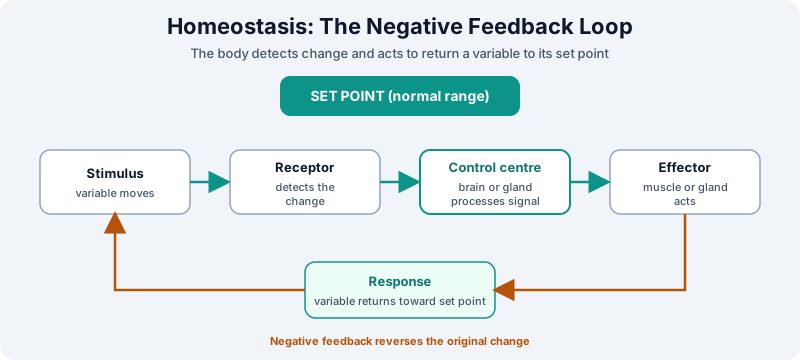
Use this one as a self-test rather than as a picture to look at. Cover the labels and name the five parts in order, then check yourself. If you can do it for temperature, do it again for water and for blood glucose — the diagram is the same shape all three times, which is the reason it is worth learning as a shape.
The hook asked what a system would need in order to hold your core temperature steady: it has to detect something, decide something, and change something. You now have names for all three — receptor, control centre, effector — plus the stimulus that starts it and the response that ends it.
Go back to your first answer and compare. Which of the five parts did you get to on your own, and which one did you not think of? Most people miss the receptor, because detecting a change feels like nothing is happening. Write down which part you missed and why you think you missed it.
Q1. A person walks out of a heated house into a cold Canberra morning and begins to shiver. Trace this through all five parts of the feedback loop, naming each part.
1 mark for each part correctly named and matched to this example: stimulus, receptor, control centre, effector, response.Q2. Explain why the loop is called negative feedback, and why a loop built the opposite way — one whose response made the original change larger — could not hold a variable near a set point.
1 mark for negative meaning opposing, 1 mark for the response reducing the stimulus, 1 mark for explaining that this is what switches the loop off, 1 mark for explaining that an amplifying loop would move further from the set point instead of back to it.Q3. A shivering person and a person with untreated type 1 diabetes both have an internal condition away from its set point. Only one of them is ill. Explain how you can tell them apart, and why the measured reading on its own is not enough to decide.
1 mark for stating that both readings are away from the set point, 1 mark for identifying shivering as a working response, 1 mark for identifying the failed part in the diabetes case, 2 marks for explaining that what distinguishes disease is whether the correction is happening, not how far the reading has moved.Model answers (click to reveal)
Model Answers
-Multiple Choice
1: D. The stimulus is the change the body detects. Sweating and vasodilation are responses to it, and the hypothalamus comparing the reading is the control-centre step.
2: B. Enzymes are proteins whose shape does the work, and heat costs them that shape progressively — the further above the range and the longer, the more of them are affected. Cooling stops the damage accumulating, which is why it is the treatment rather than an afterthought.
3: B. Core temperature is traced in full, then water balance is run through the same five slots to show the loop is a pattern rather than a fact about sweating.
4: D. Correction begins only after a drift has been detected, so a healthy variable is always slightly behind and always moving. A perfectly flat line would mean nothing was ever corrected.
5: A. The control centre compares; the effector acts. Keeping them apart is what lets you say exactly where a loop has failed.
6: C. Negative means opposing, not bad. The response works against the change that triggered it, which is what returns the variable to its set point.
7: A. The kidneys return water to the blood, and thirst drives the behaviour that adds more. Unusually, one effector in this loop runs through what you choose to do.
8: B. The stimulus still happens and the effectors are undamaged. What is missing is the signal, because the insulin-producing cells have been destroyed.
9: A. Injected insulin replaces the missing message so the intact remainder of the loop can act. It does not repair the pancreas, which is why it must be repeated.
10: C. Identical readings, opposite situations: one loop is mid-correction, the other has stopped. Ask whether the correction is happening, not how far the number has moved.
11: D. A broken loop is one way of impairing normal functioning, not the definition of disease. Influenza impairs function with every loop intact, and a fever is a loop working to a reset target. The model earns its place because it explains the non-infectious diseases in Lesson 15.
Short Answer 1 (5 marks)
Sample answer: The stimulus is the fall in core temperature below 37 °C when the person steps into the cold (1 mark). The receptors are thermoreceptors in the skin and in the brain, which detect the fall (1 mark). The control centre is the hypothalamus, which compares the reading to the set point and works out that warming is needed (1 mark). The effectors are the skeletal muscles and the muscles in the walls of the skin's blood vessels (1 mark). The response is shivering, which releases heat, together with vasoconstriction, which keeps warm blood away from the surface; the temperature rises back toward the set point, so the stimulus gets smaller and the shivering eases (1 mark).
1 mark for each of the five parts, correctly named and matched to this example.
Short Answer 2 (4 marks)
Sample answer: Negative here means opposing rather than harmful (1 mark). The response always works against the change that triggered it, so a rise in temperature produces cooling and a fall produces warming (1 mark). Because the response reduces the stimulus, the loop also switches itself off as it succeeds: the receptors report less of a change, so less correction is called for (1 mark). A loop whose response made the original change larger would drive the variable further from the set point each time round, so instead of settling it would run away — which is the opposite of holding a condition steady (1 mark).
1 mark for opposing, 1 mark for the response reducing the stimulus, 1 mark for the loop switching itself off, 1 mark for the consequence of an amplifying loop.
Short Answer 3 (5 marks)
Sample answer: Both people have a reading away from the set point, so the reading by itself does not separate them (1 mark). The shivering person's loop is working: the fall in temperature was detected, the effectors are acting, and shivering is the correction in progress, so the reading is already returning (1 mark). In untreated type 1 diabetes the pancreas cells that detect glucose and release insulin have been destroyed, so the signal is never sent and the effectors are never told to store the glucose (1 mark). Nothing brings that reading back, because a part of the loop is missing rather than merely busy (1 mark). So between these two it is whether the correction is happening at all that separates them, not how far the number has moved — which is why a doctor asks what the body is doing as well as what it measures (1 mark).
1 mark for both readings being off the set point, 1 mark for shivering as a working response, 1 mark for the failed part, 2 marks for the distinction being correction rather than magnitude.
Revisit Your Thinking
Return to your opening response, where you were asked what a system would need in order to hold your temperature steady. Now do the harder version: pick any one of the three loops in this lesson, delete one of its five parts, and write down what would go wrong and what would still work normally. Being able to say what keeps working is the part that shows you have the mechanism rather than the words.
Model answers (click to reveal)
Model Answers
-Multiple Choice
1: D. The stimulus is the change the body detects. Sweating and vasodilation are responses to it, and the hypothalamus comparing the reading is the control-centre step.
2: B. Enzymes are proteins whose shape does the work, and heat costs them that shape progressively — the further above the range and the longer, the more of them are affected. Cooling stops the damage accumulating, which is why it is the treatment rather than an afterthought.
3: B. Core temperature is traced in full, then water balance is run through the same five slots to show the loop is a pattern rather than a fact about sweating.
4: D. Correction begins only after a drift has been detected, so a healthy variable is always slightly behind and always moving. A perfectly flat line would mean nothing was ever corrected.
5: A. The control centre compares; the effector acts. Keeping them apart is what lets you say exactly where a loop has failed.
6: C. Negative means opposing, not bad. The response works against the change that triggered it, which is what returns the variable to its set point.
7: A. The kidneys return water to the blood, and thirst drives the behaviour that adds more. Unusually, one effector in this loop runs through what you choose to do.
8: B. The stimulus still happens and the effectors are undamaged. What is missing is the signal, because the insulin-producing cells have been destroyed.
9: A. Injected insulin replaces the missing message so the intact remainder of the loop can act. It does not repair the pancreas, which is why it must be repeated.
10: C. Identical readings, opposite situations: one loop is mid-correction, the other has stopped. Ask whether the correction is happening, not how far the number has moved.
11: D. A broken loop is one way of impairing normal functioning, not the definition of disease. Influenza impairs function with every loop intact, and a fever is a loop working to a reset target. The model earns its place because it explains the non-infectious diseases in Lesson 15.
Short Answer 1 (5 marks)
Sample answer: The stimulus is the fall in core temperature below 37 °C when the person steps into the cold (1 mark). The receptors are thermoreceptors in the skin and in the brain, which detect the fall (1 mark). The control centre is the hypothalamus, which compares the reading to the set point and works out that warming is needed (1 mark). The effectors are the skeletal muscles and the muscles in the walls of the skin's blood vessels (1 mark). The response is shivering, which releases heat, together with vasoconstriction, which keeps warm blood away from the surface; the temperature rises back toward the set point, so the stimulus gets smaller and the shivering eases (1 mark).
1 mark for each of the five parts, correctly named and matched to this example.
Short Answer 2 (4 marks)
Sample answer: Negative here means opposing rather than harmful (1 mark). The response always works against the change that triggered it, so a rise in temperature produces cooling and a fall produces warming (1 mark). Because the response reduces the stimulus, the loop also switches itself off as it succeeds: the receptors report less of a change, so less correction is called for (1 mark). A loop whose response made the original change larger would drive the variable further from the set point each time round, so instead of settling it would run away — which is the opposite of holding a condition steady (1 mark).
1 mark for opposing, 1 mark for the response reducing the stimulus, 1 mark for the loop switching itself off, 1 mark for the consequence of an amplifying loop.
Short Answer 3 (5 marks)
Sample answer: Both people have a reading away from the set point, so the reading by itself does not separate them (1 mark). The shivering person's loop is working: the fall in temperature was detected, the effectors are acting, and shivering is the correction in progress, so the reading is already returning (1 mark). In untreated type 1 diabetes the pancreas cells that detect glucose and release insulin have been destroyed, so the signal is never sent and the effectors are never told to store the glucose (1 mark). Nothing brings that reading back, because a part of the loop is missing rather than merely busy (1 mark). So between these two it is whether the correction is happening at all that separates them, not how far the number has moved — which is why a doctor asks what the body is doing as well as what it measures (1 mark).
1 mark for both readings being off the set point, 1 mark for shivering as a working response, 1 mark for the failed part, 2 marks for the distinction being correction rather than magnitude.
● The five parts
Stimulus, receptor, control centre, effector, response. Every loop, every variable, same order.
● Why the range exists
Enzymes work by their shape, and heat costs them that shape — more of them the further and longer you are outside the range. The range is set by chemistry, not by preference.
● Negative feedback
The response opposes the change that caused it, so the loop switches itself off by succeeding.
● Bridge Forward
Lesson 3 introduces the nervous and endocrine systems, which are how the control centre actually reaches an effector.