Designing a Disease Investigation
You'll be able to design a controlled disease investigation in the style of John Snow's epidemiology.
Design a disease investigation properly: the question, the variables, the sample, and the ethics.
Printable Worksheets
Print or save as PDF, or build a custom worksheet from any module's questions.
What makes a scientific question 'investigable'? Write one example.
Why is it important to identify controlled variables in an experiment?
● Know
- Identify investigable questions and write testable hypotheses about disease
● Understand
- Distinguish independent, dependent, and controlled variables and explain what makes a test fair and valid
● Can do
- Design a controlled disease investigation in the style of John Snow's epidemiology
A concept map is only as good as the connections it makes. In the Disease unit, the central concept is the chain of infection: pathogen → reservoir → portal of exit → transmission → portal of entry → susceptible host. Every topic in this unit modifies one or more links in that chain. Vaccination makes the host less susceptible. Handwashing blocks transmission. Antibiotics kill the pathogen. Public health addresses reservoirs.
But the chain does not exist in isolation. Antibiotic resistance connects to evolution by natural selection. Social determinants connect to epidemiology and health equity. Global travel connects to pandemic potential. A student who sees these patterns can answer novel questions by reasoning from first principles rather than searching for a memorised fact.
Text description
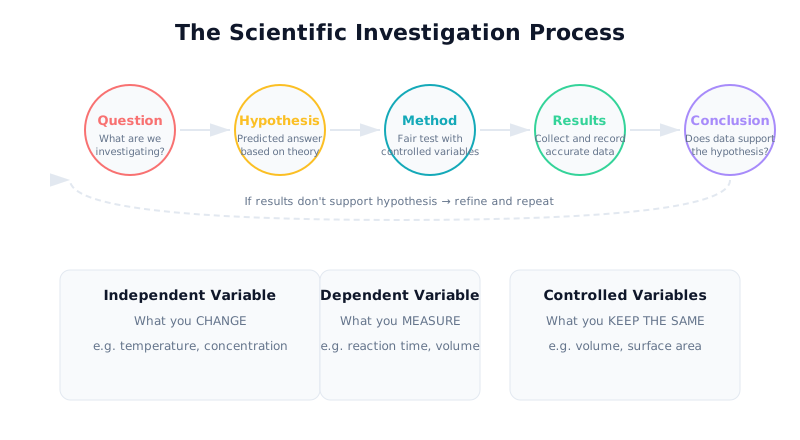
- Independent variable: the one thing you change, e.g. temperature, dose or time.
- Dependent variable: what you measure, e.g. number of colonies or recovery.
- Controlled variables: everything else, kept the same so the test is valid and fair.
Asked to explain why tuberculosis is hard to eliminate, a synthesising student connects multiple concepts: TB has a long latency period (pathogen behaviour), spreads through airborne droplets (transmission), primarily affects immunocompromised people (host susceptibility), and requires a six-month antibiotic course (treatment adherence). No single fact explains it; the pattern does.
The Australian Academy of Science promotes systems thinking in science education, arguing that students who understand connections between concepts are better prepared for complex careers in medicine, research, and public health.
A useful investigation starts with a specific question and a comparison that can answer it. In a controlled experiment or simulation, the independent variable is deliberately changed and the dependent variable is measured. Other relevant conditions are kept the same so they do not provide an alternative explanation for the result. For example, a paper model could compare different numbers of contacts while keeping population size, starting infections, transmission rules and the number of rounds constant.
Not every valid disease investigation is an experiment. In an observational study, investigators record exposures that have already occurred, such as which water source people used, rather than deliberately expose anyone to possible harm. They compare outcomes in suitable groups using the same case definition and time period, while considering other differences that could explain an association. An association can support a hypothesis without proving it is the only possible cause.
Validity asks whether the evidence fairly addresses the question; reliability asks whether the process gives consistent results when repeated appropriately. Rechecking arithmetic helps catch mistakes, but independent observations or repeated model runs provide stronger checks on the pattern. Safe school investigations can use fictional records, existing anonymous public datasets or paper/computer models. They do not require collecting personal health information, growing pathogens or exposing people to infection.
A fictional record review compares illness in people who had already used water source A or B. Use the same case definition and time period in both groups, and compare proportions rather than raw counts if group sizes differ. A higher illness proportion in one group supports an association, but another shared exposure or differences in recording could help explain the pattern. Checking these possibilities makes the conclusion more valid.
Investigation link: An observational study records exposures that have already occurred; it does not assign people to possible harm. A school version can analyse supplied fictional records or an existing anonymous public dataset. Explain what the data show, what other explanations remain, and which additional evidence would help distinguish them.
A depth study is your chance to demonstrate scientific thinking at its best. The difference between a good study and an excellent one often comes down to how well you handle limitations. Every study has flaws: maybe your sample size was small, maybe you could not control room temperature, maybe your measuring tool had limited precision. Acknowledging these limitations honestly does not weaken your study, it strengthens it, because it shows you understand how science really works.
Strong conclusions go beyond yes or no. They evaluate how strongly the evidence supports the hypothesis. They suggest improvements: what would you do differently with more time, better equipment, or a larger sample? They connect back to the scientific concepts that motivated the study in the first place. Science is not about proving you are right; it is about building reliable knowledge through evidence.
A student concludes: My results support the hypothesis that antibacterial soap reduces bacterial growth, but my sample size was only three trials per condition. With more replicates, I would have greater confidence. I would also test more soap brands to see if the effect is general. This conclusion is strong because it is honest, specific, and forward-looking.
The CSIRO Double Helix magazine publishes student depth studies with a special emphasis on honest reporting of limitations, teaching young scientists that failure and uncertainty are normal parts of the scientific process.
Wrong: "A depth study is just a long essay about a disease." No, a depth study is an investigation. It requires you to ask a question, gather evidence, analyse data, and draw conclusions. It is active science, not just research.
Right: A depth study is an active scientific investigation that requires asking a question, gathering evidence, analysing data, and drawing conclusions. It is not just a research essay.
Wrong: "The different topics in this unit have no connection to each other." No, they are deeply connected. Pathogens cause disease, which the immune system fights, which vaccines train, which antibiotics treat, which resistance limits, which public health prevents. Every topic links to others.
Right: All topics in this unit are deeply connected: pathogens cause disease, which the immune system fights, which vaccines train, which antibiotics treat, which resistance limits, which public health prevents.
Wrong: "Once you memorise facts about disease, you understand it." No, true understanding means being able to explain connections, apply concepts to new situations, and evaluate evidence. Facts are tools; understanding is the ability to use them.
Right: True understanding means being able to explain connections between concepts, apply them to new situations, and evaluate evidence. Facts alone are not enough without the ability to use them.
Australian Scientists Fighting Disease
Professor Fiona Stanley (AC): An Australian epidemiologist who founded the Telethon Kids Institute in Perth. Her research on birth defects, Indigenous health, and population health methods transformed Australian public health. She championed the use of population data to guide health policy.
Professor Ian Frazer: Co-developer of the HPV vaccine at the University of Queensland. His work has prevented countless cases of cervical cancer worldwide and put Australia on track to eliminate cervical cancer entirely.
Modern Australian research: Today, Australian scientists at WEHI, the Doherty Institute, CSIRO, and universities across the country continue to fight disease. During COVID-19, Australian researchers contributed to vaccine development, genomic surveillance, and long COVID research. Aboriginal and Torres Strait Islander researchers are increasingly leading health research that addresses community priorities with cultural authority.
✍ Copy Into Your Books
▾Unit Connections
- Pathogen -> Transmission -> Defence -> Treatment
- Infectious vs non-infectious disease
- Local, national, and global perspectives
Key Formulas
- Herd immunity threshold ≈ 1 - 1/R0
- Incidence rate = (new cases/population) × multiplier
- Case fatality rate = (deaths/cases) × 100%
Depth Study Steps
- Choose topic -> Formulate question -> Research -> Hypothesis -> Method -> Data collection -> Analysis -> Conclusions -> Communication
Investigate a Fictional Outbreak
Plan a Safe Disease Investigation
At the start of this lesson, you thought about how every great discovery in disease science, from germ theory to vaccines to cancer treatments, started with one well-designed investigation question.
Now that you've worked through the scientific method, can you explain what makes a question genuinely investigable, and why controlling variables is so important for trusting results? How would you apply this to a disease topic that interests you?
Q1. Explain what makes a scientific question 'investigable'. Rewrite the vague question "Does exercise affect health?" as a properly investigable question. 2 marks
Q2. A student investigates whether soap reduces bacteria on hands. Identify the independent variable, the dependent variable, and two controlled variables for this investigation. 3 marks
Q3. Explain the difference between validity and reliability in an investigation, and describe one ethical consideration a student should think about when designing a disease investigation. 3 marks
Revisit Your Thinking
Go back to your Think First answer. Has your understanding changed?
- How has your understanding of disease and health developed across this entire unit?
- What connections between concepts do you find most powerful or surprising?
Model answers (click to reveal)
Answers
▾MCQ 1
B An investigable question is specific enough to be answered by collecting data. Option B compares two measurable handwashing times against a measurable result (colony count). The others are too vague or are opinion or 'why' questions that cannot be tested directly.
MCQ 2
A In this controlled experiment, the independent variable is the one factor deliberately changed. The dependent variable is measured, and relevant controlled variables are kept the same. In an observational study, an explanatory exposure may instead be recorded without being assigned.
MCQ 3
C Keeping controlled variables the same means any change in the dependent variable can be attributed to the independent variable alone. This keeps the test fair and the results valid.
MCQ 4
D Repeating measurements and averaging reduces the effect of random error, improving reliability. It does not change the variables or the hypothesis.
MCQ 5
B For the stated controlled experiment testing one factor, validity is supported by actually measuring what the question asks, changing the independent variable and keeping relevant other factors constant. Cost, speed, or a hoped-for result do not establish validity. Observational studies can also be valid when their measurements and comparisons appropriately address the question.
Short Answer 1
Model answer: An investigable question is one that is specific, testable by collecting data through observation or measurement, and linked to scientific concepts. "Does exercise affect health?" is too vague because exercise and health are not defined or measurable. A better, investigable version is: "Does 30 minutes of moderate daily walking for four weeks reduce the resting heart rate of Year 9 students?" This is specific (30 minutes of walking), testable (measure resting heart rate before and after), and linked to cardiovascular health.
Short Answer 2
Model answer: Independent variable: whether soap is used when washing hands (for example, soap and water versus water only). Dependent variable: the number of bacterial colonies grown from hand swabs (the amount of bacteria measured). Controlled variables (any two): the same washing time, the same water temperature, the same area of the hand swabbed, the same growth medium, and the same incubation conditions. Keeping these the same makes the test fair so that any difference in bacteria is due to the soap.
Short Answer 3
Model answer: Validity concerns whether the methods, measurements and comparisons fairly address the investigation question. In a controlled experiment this includes changing the intended factor while keeping relevant other factors constant; in an observational study it includes suitable comparison groups and consideration of other explanations. Reliability concerns consistency and repeatability; independent repeated observations or model runs can help assess it. Rechecking the same calculation only checks arithmetic. An investigation can be consistent but invalid if it measures the wrong thing. Ethical consideration (any one): protect privacy, use appropriate consent for any approved study involving people, and avoid exposing people to harm. A school investigation can use fictional records or existing anonymous public data without collecting personal health details or culturing pathogens.
Activity 1: Investigate a Fictional Outbreak
- A suitable question is whether the proportion becoming ill differs between people who used source A and source B during the specified outbreak. A hypothesis might predict a higher proportion among source A users if it carried the disease-causing agent. The proportions are 20/100 × 100 = 20% and 5/100 × 100 = 5%. The observed pattern supports an association between source A use and illness in these records, but does not by itself prove the water caused the illness. Credit a testable, clearly stated alternative hypothesis evaluated honestly against the supplied data.
- The exposure is reported use of source A or B; the outcome is illness meeting the stated definition during the same time period. This is observational: investigators record existing exposures rather than deliberately expose people to possible harm. Age, another shared food/exposure, differences in diagnosis or reporting, or people using both water sources could affect the comparison. The case definition and observation period should be consistent. These factors should be recorded or considered; they were not necessarily controlled by the investigator.
- Repeating arithmetic may reveal a calculation error but does not create independent evidence, remove bias or prove causation. Investigators could check the accuracy of exposure and case records, compare additional suitable groups, examine illness timing, or seek independent laboratory/environmental evidence gathered safely by qualified professionals. Each can test alternative explanations or verify the proposed link. Accept a justified evidence improvement; students should not collect pathogens or sample a suspected unsafe water source themselves.
Activity 2: Plan a Safe Disease Investigation
- Possible model questions compare the number of contacts, the proportion of immune model individuals, or the presence of a model barrier with subsequent model transmission. A public-data question could compare reported new-case proportions across specified groups and a defined period, with appropriate denominators. Credit three specific, measurable questions and a reasoned choice that is feasible and ethical. A prediction should link the chosen explanatory factor to the measured outcome; it need not be confirmed by later results. No use of real health records, deliberate infection or pathogen culture is needed.
- For a contact-number model, change the number of contacts per round and measure new infections after a fixed number of rounds. Keep population size, starting infections, immunity, transmission rule and number of rounds constant. For an observational dataset, record an existing exposure rather than assign it and compare a defined outcome over the same period; consider group size, age mix and ascertainment. Credit variables and two controls/comparison factors that fit the actual chosen question. Do not describe an observational factor as experimentally controlled when it was only recorded.
- A model method should state initial conditions, contact/transmission rules, how one factor varies, what is measured and when, and how comparable runs are repeated. An observational method should define the source, groups, time period, case measure and denominators, check missing data and avoid claiming random allocation. Tables need meaningful headings and units or proportions where relevant. Use fictional identities or already anonymous public data; do not collect classmates’ diagnoses, expose anyone to disease or culture pathogens. Validity concerns whether the method answers the question fairly; reliability concerns consistency and repeatability. Credit a specific limitation linked to an improvement, such as more independently varied model runs or better-matched comparison groups. Recalculating the same figures alone does not supply independent replication.