Investigating Disease
In 1854, London physician Dr John Snow removed a single pump handle in Soho and halted a cholera outbreak that had killed 616 people, using data and mapping rather than any knowledge of the causative bacterium.
Printable Worksheets
Print or save as PDF, or build a custom worksheet from any module's questions.
How did Dr John Snow stop a cholera outbreak, without knowing the cause?
Why is it dangerous to assume that correlation means causation in disease research?
● Know
- The steps in scientific investigation of disease
- What case-control and cohort studies are
- Key ethical principles in medical research
● Understand
- Why controlled experiments are necessary to establish cause and effect
- How bias can affect research results
- The importance of sample size and randomisation
● Can do
- Design a fair test to investigate a disease-related question
- Analyse simple disease data
- Evaluate the ethics of a research proposal
In 1854, a cholera outbreak killed hundreds of people in the Soho district of London. At the time, most doctors believed disease spread through miasma bad smells in the air. Dr John Snow, a physician, suspected cholera was transmitted through contaminated water instead. He investigated by mapping every case and noticed that nearly all victims had drawn water from a single public pump on Broad Street. Snow convinced authorities to remove the pump handle. The outbreak stopped.
Snow did not know about bacteria or the germ theory of disease, that would not be proven for another 30 years. His breakthrough came from careful observation, mapping, and pattern-finding. This is the essence of epidemiology: the study of disease patterns in populations. Epidemiologists do not need to know the microscopic cause to identify the source and stop transmission.
Snow map showed a cluster of deaths around the Broad Street pump. A workhouse nearby had its own well and almost no deaths. A brewery next to the pump also had no deaths because workers drank beer instead of water. These patterns supported Snow water hypothesis and ruled out miasma.
Modern epidemiologists at NSW Health and the Australian National University still use spatial mapping and case clustering, direct descendants of Snow methods, to trace outbreaks of foodborne illness and COVID-19.
Put these steps in the right order to show how John Snow solved the cholera outbreak.
- Convinced authorities to remove the pump handle.
- The outbreak stopped, supporting the hypothesis that cholera spread through water.
- Noticed that people who drank from other sources did not get sick.
- Observed that cholera cases clustered around the Broad Street water pump.
- Mapped every case to identify the geographic pattern of deaths.
Modern epidemiology uses far more sophisticated tools than Snow pencil and paper, but the core principles remain the same. Descriptive epidemiology asks: who is getting sick, where, and when? Analytical epidemiology asks: why are they getting sick, what exposures, behaviours, or environments explain the pattern? Intervention epidemiology asks: what action will stop the outbreak?
Key tools include case-control studies (comparing sick people with healthy people to find differences in exposure), cohort studies (following a group over time to see who gets sick), and randomised controlled trials (testing interventions like vaccines or treatments). Contact tracing, identifying everyone who interacted with an infected person, is a direct descendant of Snow door-to-door interviews.
During a salmonella outbreak, epidemiologists interview all cases about what they ate. If 80% of sick people ate at the same café while only 5% of healthy controls did, the café is the likely source. Health inspectors then test the café food and kitchen practices.
The Australian Department of Health and Aged Care operates OzFoodNet, a network of epidemiologists who investigate foodborne disease outbreaks nationwide using case-control studies and traceback investigations.
Being able to spot errors in reasoning is a crucial scientific skill. Let us examine a flawed argument about disease investigation. A student claims: I proved that ice cream causes food poisoning because everyone who got sick at the party ate ice cream. This reasoning is flawed because it ignores several possibilities. Maybe something else at the party caused the illness. Maybe the ice cream was fine but the topping was contaminated. Maybe only people who ate ice cream also ate the suspect chicken, and chicken was the real cause.
Good epidemiological reasoning requires comparing sick people with healthy people, controlling for alternative explanations, and measuring exposure carefully. A single association, everyone who got sick ate X, is never proof. It is a clue that needs further investigation.
During an outbreak, 10 sick people all ate salads from the same shop. But 8 of them also ate sushi from a different shop. To determine the real source, epidemiologists must compare the salad and sushi exposures among both sick and healthy people, not just note what the sick people ate.
NSW Health runs training programs for disease detectives that specifically teach how to avoid common reasoning errors like confusing correlation with causation, skills essential for outbreak investigation.
Here is a student argument about an outbreak. One line contains a reasoning error, click it.
- Twelve out of 30 students got gastroenteritis.
- All 12 sick students had eaten the chicken salad.
- Therefore, the chicken salad definitely caused the illness.
Modern disease investigation combines traditional epidemiology with powerful new technologies. Genomic sequencing lets scientists read the genetic code of a pathogen and trace its family tree, showing exactly how cases are connected. Digital contact tracing apps use Bluetooth to anonymously record close contacts, speeding up notification. Wastewater surveillance tests sewage for pathogen genetic material, providing early warning of community spread before clinical cases appear.
These tools do not replace human judgment, they augment it. An app can tell you who met whom, but an epidemiologist must still interview people, interpret behaviours, and design interventions. Technology plus trained investigators is the modern formula for outbreak control.
During the COVID-19 pandemic, Victorian health authorities used genomic sequencing to prove that a second wave originated from hotel quarantine breaches, not community transmission. This evidence guided policy decisions about quarantine protocols.
CSIRO researchers developed wastewater testing methods for SARS-CoV-2 that were adopted by state health departments across Australia, providing early warning of outbreaks in university residences and remote towns.
Wrong: "A single study can prove that something causes disease." No, establishing causation requires multiple studies using different methods, consistency across populations, and biological plausibility. A single study can suggest associations but rarely proves causation.
Right: Establishing causation requires multiple studies using different methods, consistency across populations, and biological plausibility. A single study can suggest associations but rarely proves causation on its own.
Wrong: "If two things are correlated, one must cause the other." No, correlation does not imply causation. Many correlated variables are both caused by a third factor, or the correlation may be coincidental.
Right: Correlation does not imply causation. Many correlated variables are both caused by a third factor, or the correlation may be coincidental. Controlled experiments are needed to establish causation.
Wrong: "Research ethics slow down science and prevent important discoveries." No, ethics protect participants from harm and maintain public trust in science. Unethical research (like the Tuskegee syphilis study) caused lasting harm and distrust. Ethical research produces more reliable results.
Right: Ethics protect participants from harm and maintain public trust in science. Unethical research has caused lasting harm and distrust. Ethical research produces more reliable results and stronger public confidence.
Australian Research Ethics
The National Health and Medical Research Council (NHMRC): Australia's peak body for funding health and medical research and developing ethical guidelines. The NHMRC's National Statement on Ethical Conduct in Human Research sets standards for all Australian research involving humans.
Indigenous research ethics: The NHMRC has specific guidelines for research involving Aboriginal and Torres Strait Islander peoples, developed in partnership with Indigenous communities. Key principles include: community engagement, benefit to communities, cultural sensitivity, and Indigenous control over data. Researchers must demonstrate that their work will benefit the communities involved, not just advance scientific knowledge.
Clinical Trials Australia: Australia is a leading destination for clinical trials due to high-quality healthcare, rigorous ethical oversight, and diverse populations. The Therapeutic Goods Administration (TGA) regulates medicines and medical devices, ensuring safety and efficacy before approval. During COVID-19, Australian researchers conducted trials for vaccines and treatments that contributed to global pandemic response.
✍ Copy Into Your Books
▾Study Types
- Case-control: compare cases and controls
- Cohort: follow groups over time
- RCT: random assignment to treatment/control
Key Principles
- Correlation ≠ causation
- Randomisation reduces bias
- Large samples increase reliability
Ethics
- Informed consent
- Beneficence and non-maleficence
- Justice and fair distribution
- Animal research: 3Rs
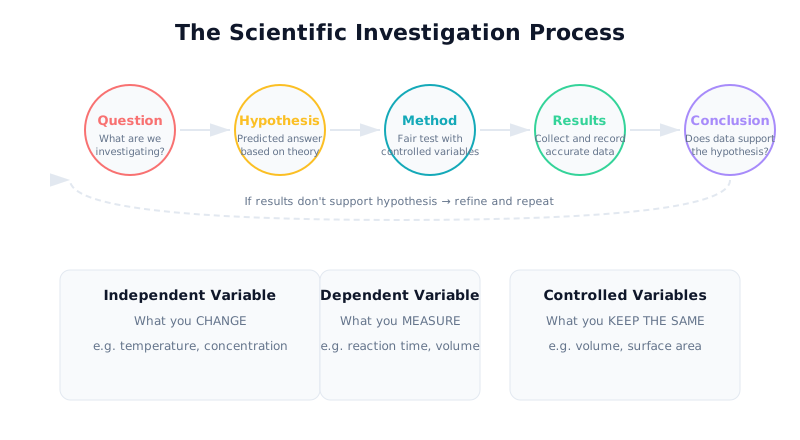
Design an Investigation
Ethics Evaluation
At the start of this lesson, you read about how in 1854, Dr John Snow mapped cholera deaths street by street and traced the outbreak to a single contaminated water pump, 30 years before anyone had even heard of bacteria.
Now that you've worked through the investigation approach, can you explain how careful observation and data analysis allowed Snow to stop the outbreak without knowing the cause? How does that story connect to the way scientists investigate disease today?
Q1. 1. Describe the difference between a case-control study and a randomised controlled trial. Include one advantage and one limitation of each. 4 MARKS
Q2. 2. Explain why "correlation does not imply causation" using a disease-related example. 4 MARKS
Q3. 3. Evaluate the ethics of testing a new vaccine on children before it has been tested on adults. Consider both the potential benefits and the ethical concerns. 4 MARKS
Revisit Your Thinking
Go back to your Think First answer. Has your understanding changed?
- What is the most important principle you have learned about investigating disease scientifically?
- Why are ethics essential in medical research?
Model answers (click to reveal)
Answers
▾MCQ 1
B A hypothesis is a testable prediction about the relationship between variables that can be investigated through observation or experiment.
MCQ 2
B In a case-control study, researchers compare people who have a disease (cases) with similar people who do not (controls) to identify risk factors.
MCQ 3
B Randomised controlled trials eliminate bias by randomly assigning participants to treatment or control groups, ensuring that differences in outcomes are due to the treatment rather than other factors.
MCQ 4
B This means that just because two variables change together does not mean one causes the other. A third factor may cause both, or the relationship may be coincidental.
MCQ 5
C Informed consent is the process by which participants voluntarily agree to participate in research after understanding the risks, benefits, and their right to withdraw.
Short Answer 1
Model answer: A case-control study compares people who have a disease (cases) with similar people who do not (controls) to identify risk factors. Advantage: efficient for studying rare diseases and can examine multiple risk factors simultaneously. Limitation: cannot prove causation because it looks back in time; researchers cannot control exposures, and recall bias may affect results. A randomised controlled trial (RCT) randomly assigns participants to treatment or control groups and compares outcomes. Advantage: randomisation eliminates selection bias, and the control group provides a direct comparison, allowing researchers to establish causation. Limitation: expensive, time-consuming, and ethically constrained, it may be unethical to withhold effective treatments or expose participants to potential harm.
Short Answer 2
Model answer: "Correlation does not imply causation" means that just because two variables are associated does not mean one causes the other. A disease-related example: studies have found that people who consume more red wine have lower rates of heart disease. However, this does not prove red wine prevents heart disease. Red wine drinkers may have higher incomes, better diets, or more exercise, factors that independently reduce heart disease risk. The correlation may reflect these confounding variables rather than a causal effect of wine. Another example: ice cream sales and drowning deaths are correlated because both increase in summer, but ice cream does not cause drowning, hot weather causes both. In disease research, establishing causation requires controlled experiments, biological plausibility, and consistency across multiple studies.
Short Answer 3
Model answer: Testing a new vaccine on children before adult testing raises significant ethical concerns. Potential benefits: Children are vulnerable to infectious diseases and may need vaccine protection urgently. Some diseases (like rotavirus) primarily affect children, so adult testing would not provide relevant data. Early testing in children could lead to faster protection for this vulnerable group. Ethical concerns: Children cannot give fully informed consent, parents must decide on their behalf, creating a vulnerability. Children's immune systems and bodies are still developing, so side effects may differ from adults. The principle of non-maleficence requires protecting vulnerable populations from unnecessary risk. Standard practice: Most vaccine development follows a staged approach, safety testing in adults first, then gradually younger age groups. This balances the need to protect children with the ethical obligation to minimise risk. Exceptions may occur during emergencies (like COVID-19) when the disease poses greater risk to children than the vaccine. Ultimately, the decision requires careful ethical review, parental informed consent, and strong safety monitoring.