Koch and Pasteur, Germ Theory
Between 1859 and 1861, Louis Pasteur ran 11 swan-neck flask experiments. The flasks were never sealed: their curved necks stayed open to the air, so air reached the broth freely while dust and airborne microbes settled in the bend. After 18 months, not one flask showed microbial growth, until the necks were snapped off. Within three days of direct air contact, the broth was cloudy with microbes. In 1862 an Académie des Sciences commission ruled in Pasteur's favour against spontaneous generation, ending a 2,000-year-old belief and directly implying that disease requires a specific, transmissible agent. Koch then turned that insight into a four-step proof still used today.
Orient yourself
Warm up on earlier lessons, commit to a prediction, then scan the goals and vocabulary before the history starts.
Three quick questions from earlier lessons. Pulling old material back to mind before you learn something new makes the new material stick better, so this is not busywork.
Practise this lesson
Four printable worksheets that build from the foundations up to exam-style questions, start at whatever level suits you.
Consider this claim, which was widely accepted by educated physicians in 1850:
"Disease arises spontaneously from within the body or from decaying matter in the environment, there is no external living agent that causes it."
What evidence would you need to collect to prove this claim wrong? Write down at least two specific types of evidence that would challenge this idea, before reading on.
Know
- Pasteur's swan-neck flask experiment and what it proved
- Koch's four postulates in sequence
- How Koch's postulates were applied to identify a specific pathogen
- The historical context, what was believed before germ theory
Understand
- Why Pasteur's experiment was a controlled investigation
- How Koch's postulates establish causation, not just correlation
- The limitations of Koch's postulates in modern microbiology
Can Do
- Describe Pasteur's experiment and explain what each step controlled for
- Apply Koch's postulates to a novel disease scenario
- Evaluate the strength of evidence for germ theory using experimental logic
See what people believed before
Understand miasma theory and spontaneous generation, and why getting the cause wrong cost lives.
Core Content
Miasma theory and spontaneous generation
In 1854, London doctors were telling residents that cholera came from rotting river mud, "bad air" from the Thames. Simultaneously, John Snow was mapping 616 deaths and tracing them to a single water pump on Broad Street. Same epidemic, two completely different beliefs about cause, and only one of them led to an intervention that actually stopped deaths.
For over 1,500 years after the Greek physician Galen, the dominant explanation for disease was miasma theory, the idea that "bad air" from rotting organic matter caused illness. The smell of decay, it was believed, was itself the agent of disease. This is why hospitals were built on hills (better air), why doctors carried aromatic herbs, and why the city of London in 1854 was still dumping raw sewage into the Thames, considered safer than decaying matter on land.
Alongside miasma theory sat spontaneous generation, the belief that living organisms could arise from non-living matter. Maggots appeared in meat; therefore meat generated maggots. Mice appeared in grain stores; therefore grain generated mice. Applied to disease: illness arose spontaneously within the body from corrupted humours or from the environment itself. There was no external agent to transmit.
This mattered enormously for public health. If disease arose from bad air, the solution was ventilation and urban planning. If disease was transmitted by invisible living agents, pathogens, the solution was isolation, sterilisation, and hygiene. Getting the cause right was the difference between useless interventions and effective ones.
Before germ theory, two wrong ideas dominated: miasma theory (disease caused by "bad air") and spontaneous generation (life arising from non-living matter). Getting the cause right changes the response, ventilation gives way to isolation, sterilisation and hygiene.
Pause, copy miasma theory, spontaneous generation, and why the cause matters into your book.
Miasma theory held that disease was caused by:
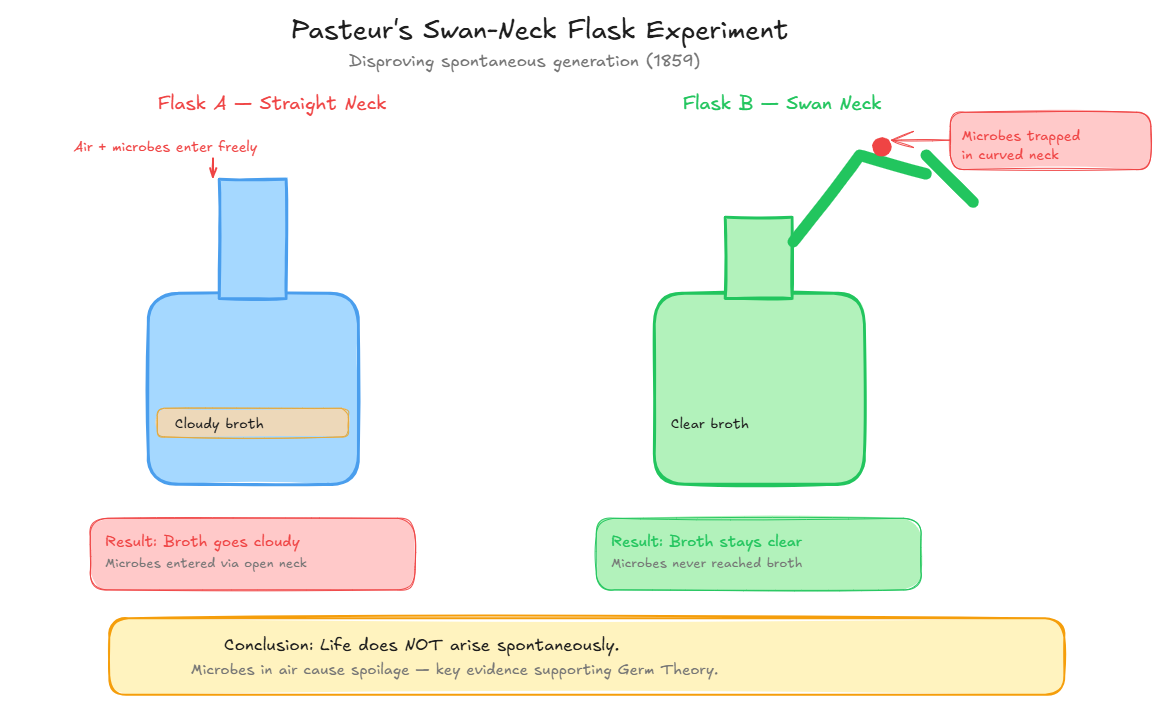
Pasteur's Swan-Neck Flask Experiment
Follow Pasteur's swan-neck experiment
Work through the four steps, and note that the flasks stayed open to the air the whole time.
The swan-neck flask, 1859
We just saw the wrong ideas, miasma and spontaneous generation. That raises a question: how do you actually disprove them? This card answers it → Pasteur's swan-neck flask experiment.
Pasteur suspected that microorganisms in the air, not the liquid itself, were responsible for fermentation and spoilage, and he designed a flask that could prove it.
Louis Pasteur (1822–1895) was a French chemist who became interested in fermentation, the process by which grape juice became wine. He suspected that microorganisms in the air were responsible for fermentation and spoilage, not spontaneous generation from the liquid itself.
His most famous experiment, published in 1859, used specially designed swan-neck flasks, glass flasks with long, curved necks that stayed open to the atmosphere and allowed air to enter freely but prevented airborne particles (and microorganisms) from reaching the broth inside.
Fill flasks with nutrient broth
Identical nutrient broth placed in two sets of flasks, straight-neck (control) and swan-neck (experimental). Both sets sterilised by boiling to kill any existing microorganisms.
Allow to stand open to air
Both sets left open to the atmosphere. Air could enter both. The swan-neck design meant airborne particles settled in the curved neck before reaching the broth, the broth itself was exposed to air but not to particles.
Observe for microbial growth
Straight-neck flasks became turbid (cloudy) within days, microorganisms had entered and grown. Swan-neck flasks remained clear indefinitely, no growth. This directly contradicted spontaneous generation: the broth did not generate microorganisms on its own.
Break the swan-neck (critical step)
When the curved neck was snapped off the swan-neck flasks, exposing the broth directly to unfiltered air and particles, growth appeared within days. This confirmed that microorganisms came from the air, not from the broth itself.
Pasteur's swan-neck flask: air enters but airborne microbes settle in the curve, so the broth stays clear (no spontaneous generation). Straight-neck flasks turn turbid, and breaking the curve makes growth appear, proving the microbes come from the air. IV = whether particles reach the broth; DV = microbial growth (turbidity).
Pause, copy how the swan-neck experiment disproved spontaneous generation (with IV and DV) into your book.
In Pasteur's experiment, the swan-neck flasks stayed clear because air could not enter them at all.
Pasteur's swan-neck flask experiment disproved spontaneous generation by showing that boiled broth remained sterile when air but not dust could enter.
Koch's postulates can be applied to all pathogens, including viruses that cannot be cultured on nutrient agar.
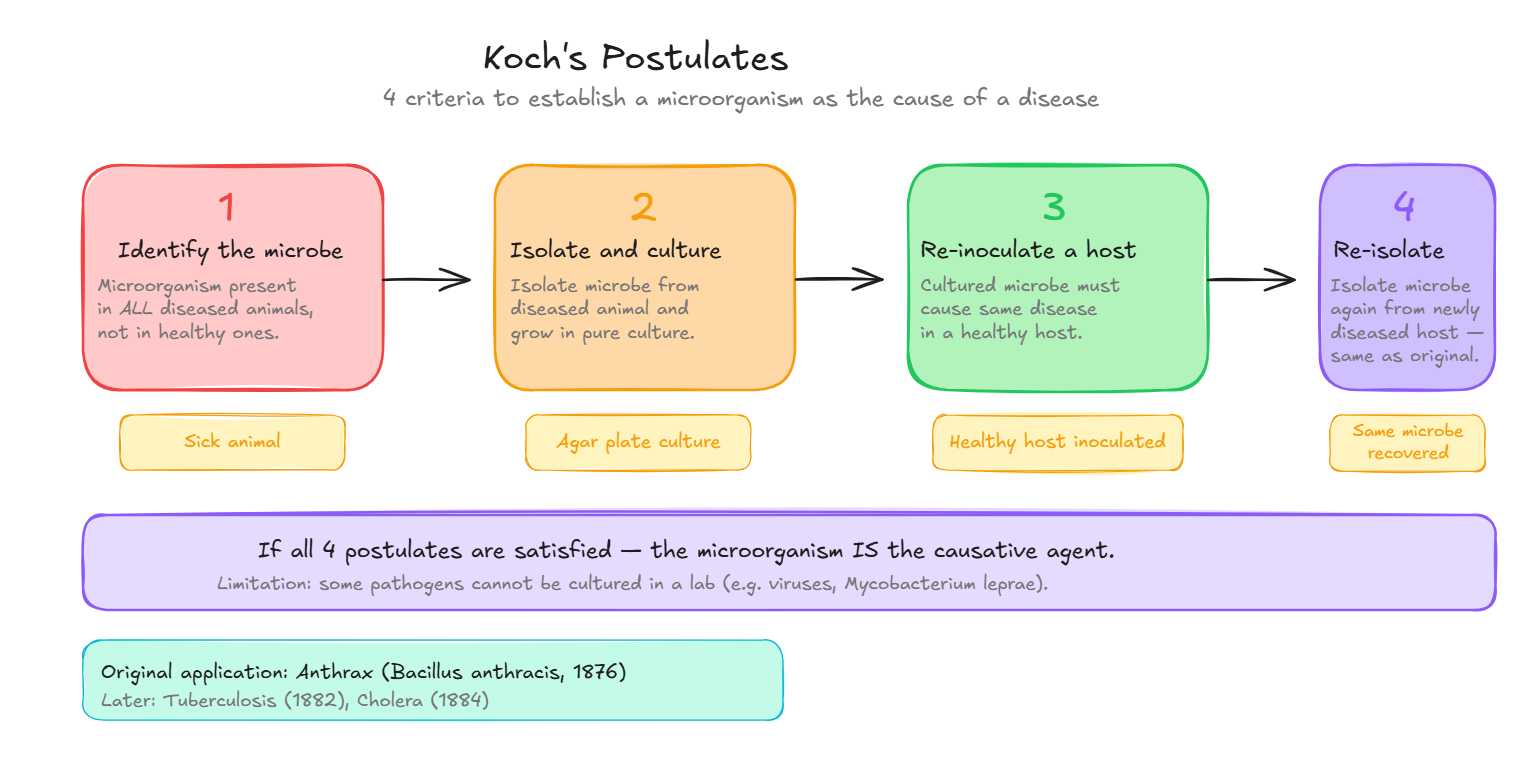
Koch's Postulates, 4 Steps
Learn Koch's four postulates
Trace the logic that turns a correlation into proof that one microbe causes one disease.
Four criteria that prove a microbe causes a disease
We just saw Pasteur link airborne microbes to spoilage. That raises a question: how do you prove a specific microbe causes a specific disease? This card answers it → Koch's four postulates.
Koch took Pasteur's insight and turned it into a rigorous experimental method, four criteria that must all be met before a microorganism can be declared the cause of a disease.
Robert Koch (1843–1910) was a German physician who took Pasteur's insight, that microorganisms cause disease, and transformed it into a rigorous experimental method for proving causation. Working first on anthrax (1876) and then tuberculosis (1882), Koch developed four criteria that must all be satisfied before a microorganism can be declared the cause of a specific disease.
These became known as Koch's postulates.
The microorganism must be found in all organisms suffering from the disease
Examine diseased organisms, the suspected pathogen must be consistently present in all cases. It should not be present in healthy organisms. This establishes association.
The microorganism must be isolated and grown in pure culture
Extract the suspected pathogen and grow it in isolation, separate from the host and from any other organisms. This ensures you are working with a single, identified agent.
The cultured microorganism must cause disease when introduced into a healthy organism
Inoculate a healthy host with the pure culture. The host must develop the same disease. This establishes causation, the organism alone is sufficient to cause the disease.
The microorganism must be re-isolated and shown identical to the original
Extract the pathogen from the newly infected host and confirm it is the same organism as in step 2. This closes the causal loop, the organism introduced is the same one causing the disease.

Koch's four postulates, each step adds a new layer of proof, from association to confirmed causation
Koch's four postulates: (1) Association, the microbe is in every diseased host, absent in healthy ones; (2) Isolation, grown in pure culture; (3) Causation, the pure culture causes the same disease in a healthy host; (4) Confirmation, the same microbe is re-isolated from that host.
Pause, copy all four of Koch's postulates, in order, into your book.
Postulate 3, the cultured microbe causing disease in a healthy host, establishes _____ rather than mere correlation.
Apply the postulates, then find their limits
See Koch prove the cause of tuberculosis in 1882, then work out where the four steps break down today.
Tuberculosis, 1882, and where the postulates break down
We just saw Koch's four postulates. That raises a question: do they always work? This card answers it → Koch proved TB with them, but they have real limits in modern microbiology.
Koch's proof that Mycobacterium tuberculosis caused TB was one of medicine's most important demonstrations, but the postulates have real limits in modern microbiology.
Koch applied his postulates to prove that Mycobacterium tuberculosis caused tuberculosis in 1882, one of the most important demonstrations in medical history. He isolated the bacterium from tuberculosis patients, grew it in pure culture, infected healthy guinea pigs (who developed TB), and re-isolated the same bacterium from those animals.
| Postulate | Koch's TB Investigation, What He Did |
|---|---|
| 1 | Examined lung tissue from TB patients, found the same rod-shaped bacterium in every case. Not found in healthy individuals. |
| 2 | Cultured the bacterium on coagulated blood serum, first successful pure culture of M. tuberculosis. |
| 3 | Injected pure culture into healthy guinea pigs, all developed TB-like disease. |
| 4 | Re-isolated the bacterium from infected guinea pigs, confirmed identical to original isolate. |
However, Koch's postulates have well-recognised limitations in modern microbiology:
- Viruses cannot be grown in pure culture on artificial media, they require living host cells. Koch's postulates were designed for bacteria.
- Some pathogens cannot be cultured at all, Treponema pallidum (syphilis) still cannot be grown reliably outside a living host.
- Asymptomatic carriers, some individuals carry a pathogen (e.g. Vibrio cholerae) without developing disease, violating postulate 1's requirement that healthy organisms are free of the agent.
- Ethical constraints, postulate 3 requires infecting a healthy host. This is not possible in humans, and even animal experimentation is subject to strict ethical oversight.
- Prions and viroids, non-cellular pathogens with no nucleic acid (prions) or no protein (viroids) cannot be "grown in pure culture" in any meaningful sense.
Koch proved M. tuberculosis causes TB (1882) using all four postulates. Limits: viruses and some pathogens can't be grown in pure culture; asymptomatic carriers break postulate 1; infecting healthy humans (postulate 3) is unethical. Molecular Koch's postulates use pathogen DNA instead of culture.
Pause, copy Koch's TB proof and at least two limitations of his postulates into your book.
Why are Koch's original postulates difficult to apply to viruses?
Consolidate the germ theory story
Put Pasteur and Koch on one timeline, settle the last misconception, then copy the summary into your book.
Pasteur's 1859 swan-neck experiment did not just refute spontaneous generation, it dismantled the theoretical foundation of miasma theory and forced medicine to confront a new question: if microorganisms come from the air and cause spoilage, could they also come from the air and cause disease in humans? Pasteur believed so, but he needed Koch to build the proof. When Koch announced in 1882 that he had satisfied all four of his postulates for tuberculosis, then the leading cause of death in Europe, killing one in seven people, the reaction in the Berlin Physiological Society was described as stunned silence followed by a standing ovation. Koch's proof was so methodologically complete that it changed the entire practice of medicine. Within a generation, the germ theory of disease had replaced miasma theory entirely, hand-washing became standard medical practice, and the era of vaccine development and antibiotic discovery had begun. The swan-neck flask experiment is still taught because it is a near-perfect example of experimental design: a simple, elegant manipulation of a single variable that collapsed a 2000-year-old theory. You will apply Koch's postulates to a novel scenario in the practice questions.

Germ Theory, Key Milestones
The two you met at the start are settled. Here is the one this half of the lesson adds.
Recap the two from the start of the lesson
Pasteur did not build germ theory alone. Ignaz Semmelweis (1847) demonstrated that handwashing reduced childbed fever before germ theory was formalised. John Snow mapped cholera transmission in 1854 without knowing the causative organism. Pasteur provided the experimental disproof of spontaneous generation. Koch provided the methodology for proving causation. No single discovery created germ theory.
Correlation is still not causation. A microorganism present during disease might be a secondary opportunistic infection, a normal commensal, or a coincidental finding. Postulate 3, inoculating a healthy host with the pure culture and producing the disease, is what establishes causation. Postulate 1 alone gives you correlation only.
Pasteur's Swan-Neck Experiment
- Disproved spontaneous generation, microorganisms come from air, not broth.
- Swan-neck: air enters but particles cannot, broth stays clear.
- Straight-neck: particles enter freely, broth becomes turbid.
- Breaking the neck: particles enter, growth appears, confirms particles carry microorganisms.
Koch's Four Postulates
- 1. Microorganism found in all diseased, not in healthy organisms.
- 2. Isolated and grown in pure culture.
- 3. Pure culture causes disease in healthy host.
- 4. Microorganism re-isolated from new host, identical to original.
Why Postulates Matter
- Postulate 1: establishes association (correlation).
- Postulate 3: establishes causation (not just presence).
- Postulate 4: confirms reproducibility and identity.
- Together: rule out coincidence, contamination, confounders.
Limitations of Koch's Postulates
- Viruses cannot be grown in pure culture on artificial media.
- Asymptomatic carriers violate postulate 1.
- Ethical constraints on infecting healthy humans (postulate 3).
- Prions and viroids cannot be cultured in the traditional sense.
Practise independently
Attempt at least one response in your own words. Model answers support checking; they do not replace the attempt.
A fresh set drawn from this lesson's question bank, feedback shown immediately. +5 XP per correct · +25 XP all correct
Pick your answer, then rate your confidence, that tells the system what to drill next.
UnderstandBand 3(3 marks) 1. Describe Pasteur's swan-neck flask experiment. In your answer, explain what the experiment was designed to test, what the results showed, and why breaking the swan-neck was a critical step.
1 mark: experimental design and purpose · 1 mark: results of intact vs broken neck flasks · 1 mark: significance of breaking the neck as a control
UnderstandBand 3(3 marks) 2. List Koch's four postulates in order and explain the purpose of each. Why is it important that all four are satisfied, rather than just the first two?
1 mark: all four postulates correctly listed in order · 1 mark: purpose of each briefly explained · 1 mark: explanation of why postulates 3 and 4 are necessary beyond correlation
EvaluateBand 5(4 marks) 3. Pasteur's swan-neck flask experiment and Koch's postulates together established the germ theory of disease as the dominant scientific explanation for infectious disease. Evaluate the contribution of each scientist, explaining what specific evidence they produced and how it addressed the limitations of the miasma theory.
1 mark: Pasteur's specific evidence and what it disproved · 1 mark: Koch's specific evidence/methodology and what it established · 1 mark: how each addressed a specific weakness of miasma theory · 1 mark: overall evaluation of how together they replaced miasma theory
Show all answers
Multiple choice
MC answers and full explanations are shown inline as you complete each question. Use the retry button to attempt a fresh set from the lesson bank.
Short Answer Model Answers
Q1 (3 marks): Pasteur designed the experiment to test whether microorganisms arose spontaneously from nutrient broth (spontaneous generation) or came from pre-existing microorganisms in the environment. He used two types of flasks: straight-neck flasks, which allowed both air and airborne particles to reach the broth, and swan-neck flasks, whose long curved necks allowed air to enter but caused airborne particles to settle in the curve before reaching the broth. Both sets were sterilised by boiling. The straight-neck flasks became turbid (cloudy) within days as microorganisms grew; the swan-neck flasks remained clear indefinitely, showing no spontaneous growth. When the swan-neck was broken off, exposing the broth to unfiltered air and particles, growth appeared. Breaking the neck was a critical internal control, it demonstrated that the same broth, under the same conditions, would readily support growth if exposed to airborne particles. This confirmed that the broth had not spontaneously generated organisms; growth required particles from the air.
Q2 (3 marks): Postulate 1: the microorganism must be found in all diseased organisms but not in healthy ones, purpose: establishes consistent association between the organism and the disease. Postulate 2: the organism must be isolated from the diseased host and grown in pure culture, purpose: ensures you are working with a single, identified agent, free from contaminants. Postulate 3: the pure culture must cause the same disease when introduced into a healthy host, purpose: establishes causation, not just correlation. Postulate 4: the organism must be re-isolated from the newly diseased host and confirmed identical to the original, purpose: confirms reproducibility and rules out contaminants or coincidental organisms. Postulates 1 and 2 alone only show correlation, an organism is present and can be grown. Without postulate 3, there is no proof the organism causes the disease (it might be an opportunistic secondary infection or a harmless commensal). Without postulate 4, contamination during the experiment cannot be ruled out. All four together form a closed causal chain.
Q3 (4 marks): Pasteur's specific contribution was the experimental disproof of spontaneous generation, the swan-neck flask experiment showed that microorganisms come from pre-existing microorganisms in the air, not from non-living matter. This directly addressed miasma theory's central weakness: miasma theory could not explain why some individuals in the same "bad air" environment developed disease and others did not, nor could it explain why disease sometimes appeared suddenly in previously healthy locations. Pasteur showed that the agent of disease (or spoilage) was a particulate, living entity from the environment. Koch's contribution was methodological, he provided a four-step framework (his postulates) that could prove a specific microorganism caused a specific disease, applied first to anthrax (1876) and then tuberculosis (1882). This addressed miasma theory's second major weakness: it could only identify environmental conditions associated with disease (bad air, filth) but had no method for identifying the specific causative agent. Koch's postulates provided that method. Together, Pasteur removed the theoretical basis for spontaneous generation (the idea that disease arose from within), while Koch provided the experimental tools to identify which specific living agent was responsible. By the 1890s, miasma theory had been entirely replaced, not because it was decreed wrong, but because germ theory made specific, testable, and repeatedly confirmed predictions that miasma theory could not.
Retrieve and reflect
Use the Review session first, then compare how your thinking changed.
A full module quiz covering every lesson in this module, not just this one. Set aside a decent block of time and treat it like a real assessment.
Start the module quiz →Defend your ship by blasting the correct answers for Koch and Pasteur, Germ Theory. Scores count toward the Asteroid Blaster leaderboard.
☄️ Play Asteroid Blaster →You were asked what evidence would be needed to disprove the claim that disease arises spontaneously, with no external living agent. Pasteur's 1859 to 1861 swan-neck flask experiments provided exactly that evidence: 11 flasks of nutrient broth showed zero microbial growth for 18 months even though they were open to the air the entire time, because the curved neck trapped airborne dust before it could reach the broth. Snap that neck off and the same broth turned cloudy with microbes within three days. Zero vs millions of microbes, same broth, same air supply, the only variable was whether airborne particles could reach the liquid. In 1862 an Académie des Sciences commission ruled in Pasteur's favour and closed the spontaneous-generation debate.
Pasteur's evidence directly addressed your first requirement: he showed that microbial growth did not occur in sterile broth unless airborne particles were present. The agent came from outside, not from within. Koch's evidence addressed your second requirement: he showed that a specific isolated organism, and only that organism, could reliably produce a specific disease in a healthy host. Together these two lines of evidence, "the agent comes from the environment" and "this specific agent causes this specific disease", constitute the experimental foundation of germ theory.
If you identified something like "show that disease doesn't appear in sterile, isolated conditions" or "show that introducing the suspected agent causes disease", you were thinking like Pasteur and Koch respectively. If your answer was vaguer, the key insight to carry forward is that disproving a scientific claim requires a specific, controlled experimental design, not just a counter-argument.