Classifying Pathogens
You'll be able to classify any given pathogen with justification.
In September 1928, Alexander Fleming returned from holiday to find that a contaminating mould, Penicillium notatum had created a clear, bacteria-free zone on his culture plates. He identified a bactericidal substance, named it penicillin in 1929, and the discovery won him the 1945 Nobel Prize. But penicillin kills only bacteria, it is completely ineffective against viruses, fungi, and parasites. The reason is classification: each pathogen type has a different biology, and treatment must target that specific biology.
Orient yourself
Warm up on earlier material, make a prediction about the locksmith analogy, then scan the goals and vocabulary you will need.
Three quick questions from earlier lessons. Pulling old material back to mind before you learn something new makes the new material stick better, so this is not busywork.
Practise this lesson
Four printable worksheets that build from the foundations up to exam-style questions, start at whatever level suits you.
Consider this analogy:
"A locksmith, a carpenter, and a welder all break into buildings, but you wouldn't use the same tools to stop all three."
How does this analogy apply to pathogens and the way we treat infectious diseases? Write your prediction before reading on. What do you think the "different tools" would be in a disease context?
Know
- How to classify pathogens causing disease in plants and animals
- The key structural and biological features of each pathogen type
- Specific adaptations of pathogens for host entry and transmission
Understand
- Why pathogen classification determines treatment strategy
- How structural adaptations relate to transmission success
- Why the same pathogen type can infect both plants and animals
Can Do
- Classify any given pathogen with justification
- Compare adaptations of two different pathogens for transmission
- Explain why a treatment effective against one pathogen type fails against another
See why classification decides treatment
Use Fleming's 1928 discovery to work out why one drug cannot kill every pathogen.
Core Content
Each pathogen type needs a tool that targets its specific structure
In September 1928, Alexander Fleming observed a clear, bacteria-free ring around a contaminating mould on his Petri dish. The mould, Penicillium notatum was producing something that killed bacteria. Penicillin worked beautifully against bacterial patients admitted to Oxford in 1941. But patients with viral infections, fungal infections, or parasitic worms were completely unaffected by it. The same antibiotic. Completely different outcomes. The reason is pathogen classification.
In 1928, Alexander Fleming noticed that a Penicillium mould was killing bacteria on his culture plates. That observation led to penicillin, one of the most important medical discoveries in history. But penicillin works by disrupting bacterial cell wall synthesis. Viruses have no cell wall. Fungi build their cell wall from chitin, not peptidoglycan. Tapeworms have no cell wall at all.
This is the locksmith problem: every pathogen type has a different biological structure, so effective treatment requires a tool that targets that specific structure. Giving antibiotics for a viral infection does not just fail, it actively promotes antibiotic resistance by selecting for resistant bacteria in the patient's microbiome.
Accurate pathogen classification is therefore not an academic exercise. It is the first step in choosing the correct treatment, and avoiding the wrong one.
Pause, copy the highlighted points on why classification determines treatment (and why antibiotics fail against viruses) into your book.
Why do antibiotics fail to treat a viral infection?

Five of the seven pathogen types and their key characteristics. The next card completes the seven-type framework by adding helminths and viroids. Accurate classification is the first step in choosing the correct treatment.
Classify the seven pathogen types
Learn the plant and animal examples for each type, then use the error-spotting task to prove you can tell viroids from prions.
The same framework, the same seven types, across both kingdoms
We just saw that classification decides treatment. That raises a question: what exactly are the types we're classifying? This card answers it → the seven pathogen types and their key features, across both plant and animal disease.
The same category of pathogen can infect organisms across both plant and animal kingdoms, the specific organism differs, but the classification framework is identical.
The HSC requires you to classify pathogens causing disease in both plants and animals.
| Pathogen Type | Key Features | Plant Disease Example | Animal/Human Disease Example |
|---|---|---|---|
| Bacteria | Prokaryotic; cell wall of peptidoglycan; reproduce by binary fission; some produce toxins | Fire blight (Erwinia amylovora), damages apple and pear trees | Tuberculosis (Mycobacterium tuberculosis), infects lung tissue |
| Virus | Non-cellular; DNA or RNA genome; protein coat (capsid); requires host cell to replicate | Tobacco mosaic virus (TMV), causes mottling and stunted growth | Influenza (Influenza A virus), infects respiratory epithelium |
| Fungus | Eukaryotic; cell wall of chitin; absorptive nutrition; spreads via spores | Wheat stem rust (Puccinia graminis), destroys stem tissue | Tinea (Trichophyton spp.), infects skin, nails, hair |
| Protozoan | Eukaryotic; unicellular; heterotrophic; complex life cycles (often multiple hosts) | Pythium root rot (Pythium spp., an oomycete), rots seedling roots | Malaria (Plasmodium falciparum), infects red blood cells and liver |
| Helminth | Multicellular animal (worm); macroorganism; absorb nutrients from host; eggs/larvae spread via faeces or vectors | Root-knot nematode (Meloidogyne spp.), forms galls on plant roots | Tapeworm (Taenia solium), attaches to intestinal wall |
| Viroid | Non-cellular; single-stranded circular RNA only, no protein coat; smallest known pathogen; plants only | Potato spindle tuber viroid (PSTVd), deforms potato tubers | Not known to infect animals |
| Prion | Non-cellular; misfolded protein only, no nucleic acid; induces normal proteins to misfold; animals only | Not known to infect plants | BSE, bovine spongiform encephalopathy; CJD in humans |
Viroid = circular single-stranded RNA only, no protein coat, plants only (PSTVd). Prion = misfolded protein only, no nucleic acid, animals only (BSE/CJD). Neither is a cell; neither has both nucleic acid and protein.
Pause, copy the viroid vs prion distinction into your book (a classic exam trap).
A viroid is just a very small type of virus.
Prions are infectious proteins that contain no nucleic acid and cause neurodegenerative diseases.
Viruses are classified as microorganisms because they can reproduce independently outside host cells.
Error Spotting, Pathogen Classification Report
Pattern B, Error Spotting
A student submitted the following paragraph as part of an assignment on pathogen classification. The paragraph contains four factual errors. Identify each error, explain why it is wrong, and write the correct information.
- List each of the four errors.
- For each error, write one sentence explaining exactly what is wrong.
- Write a corrected version of the full paragraph in your own words.
Get inside the host
Compare the structures each pathogen type uses to breach skin, mucous membranes and cell walls.
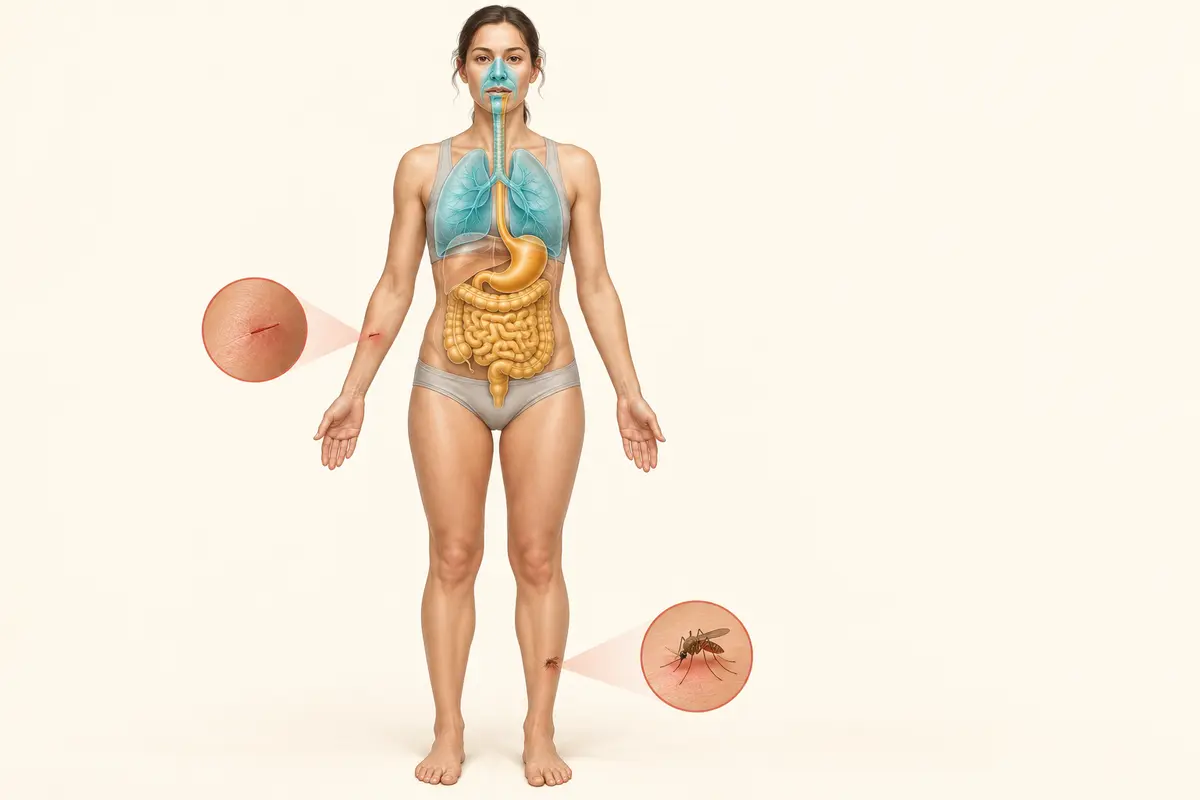
- Inhalation: respiratory mucosa.
- Ingestion: gut lining.
- Broken skin: a cut or puncture.
- Vector bite: a skin puncture during feeding.
A pathogen must cross a body barrier before infection can begin: respiratory mucosa during inhalation, the gut lining after ingestion, or skin via a cut, puncture or vector bite.
A pathogen that cannot enter a host cannot cause disease
We just saw the seven pathogen types. That raises a question: how do they actually get into a host? This card answers it → each type has structural and biochemical adaptations for breaching host barriers.
Each pathogen type has evolved specific structural and biochemical adaptations that get it past host barriers, skin, mucous membranes, cell walls, or internal tissues.
Bacteria
- Fimbriae and pili: hair-like projections that attach to host cell surface receptors
- Capsule: polysaccharide layer that resists phagocytosis by immune cells
- Toxin production: exotoxins damage host tissue to create entry points
- Enzymes: hyaluronidase breaks down connective tissue; spreads infection
Viruses
- Surface proteins (e.g. spike protein): bind to specific receptor molecules on host cell surface, highly specific, determines which cells can be infected
- Envelope: lipid bilayer (derived from host cell membrane) helps virus fuse with host cell membrane
- Injection mechanism: bacteriophages inject DNA directly through bacterial cell wall
Fungi
- Keratinases: enzymes that digest keratin in skin, nails, and hair, allow fungi to penetrate surface barriers
- Spores: airborne dispersal allows inhalation directly into lung tissue
- Hyphae: penetrate between cells mechanically, secreting enzymes as they grow
Helminths
- Hooks and suckers: attach to intestinal wall to resist being expelled
- Larval skin penetration: hookworm larvae actively burrow through bare skin (e.g. feet)
- Immune evasion: coat surface with host proteins to avoid immune recognition
- Resistant eggs: thick-walled eggs survive in soil for months before ingestion
Host-entry adaptations: bacteria use fimbriae/pili to attach and capsules to evade immunity; viruses use surface proteins to bind specific host receptors; fungi use keratinases to digest skin and spores to spread; helminths use hooks/suckers to anchor and larvae that burrow through skin.
Pause, copy one host-entry adaptation for each pathogen type into your book.
Fimbriae and pili are host-entry adaptations used by:
Reach the next host
Compare how influenza, HIV, malaria and tapeworm each spread, then see why three different pathogens need three different drugs.
Spreading to new hosts decides how dangerous an outbreak becomes
We just saw how pathogens get into a host. That raises a question: how do they reach new hosts? This card answers it → transmission adaptations, which often decide how dangerous an outbreak becomes.
Entering one host is only half the challenge, a successful pathogen must also spread to new hosts, and transmission adaptations often decide how dangerous an outbreak becomes.
| Pathogen | Transmission Route | Key Adaptation | Why It Is Effective |
|---|---|---|---|
| Influenza virus | Respiratory droplets and aerosols | Replicates in upper respiratory epithelium; triggers coughing and sneezing | Coughing expels millions of viral particles; virus survives briefly on surfaces |
| HIV | Direct contact with infected blood or bodily fluids | Targets CD4+ T helper cells, central immune cells; long asymptomatic period | Long latency means host is infectious for years without knowing it |
| Plasmodium (malaria) | Vector transmission via Anopheles mosquito | Develops in mosquito salivary glands; injected during blood meal | Uses vector to bypass host skin barrier entirely; vector feeds repeatedly |
| Tapeworm (Taenia) | Faecal-oral route; ingestion of undercooked meat | Eggs shed in faeces; larvae encyst in muscle of intermediate host (pig/cattle) | Encysted larvae survive cooking at low temperatures; intermediate host broadens transmission |
| TMV (plant virus) | Mechanical contact; contaminated tools or hands | Extremely stable protein coat; survives drying and moderate heat for years | Persists on surfaces and tools long after infected plant material removed |
Transmission adaptations: influenza spreads in respiratory droplets (coughing); HIV has a long asymptomatic period (host infectious for years unknowingly); malaria uses a mosquito vector to bypass the skin barrier; tapeworm sheds eggs in faeces and encysts larvae in an intermediate host.
Pause, copy one transmission adaptation for each of the four pathogens into your book.
Malaria uses the Anopheles mosquito as a _____ to transmit between hosts, bypassing the skin barrier.
These three pathogens illustrate why classification is clinically essential. HIV is a retrovirus that inserts its RNA genome into the host's DNA using reverse transcriptase, an enzyme targeted by antiretroviral drugs. Antiretroviral drugs block this enzyme; no antibiotic touches it. Influenza is an RNA virus with haemagglutinin surface proteins that bind to sialic acid receptors on respiratory cells, the antiviral oseltamivir (Tamiflu) blocks neuraminidase, preventing new viral particles from leaving infected cells. Again, no antibiotic helps. A tapeworm (Taenia solium) is a multicellular animal living in the intestine, absorbing digested nutrients through its body wall. The anthelmintic drug mebendazole disrupts tubulin polymerisation in the worm, a mechanism irrelevant to viruses or bacteria. Treating a tapeworm infection with an antiviral would fail just as completely as treating HIV with an anthelmintic. You will apply this reasoning in Activity 1 and Short Answer Q3.

Pathogen Types, Plants vs Animals. This summary shows five of the seven types; use the Card 2 table for the two it omits, root-knot nematode as the plant helminth and BSE/CJD prions as the animal-only case.
Lock in the classification
Clear the four traps that cost marks, then copy the four summary boxes into your book.
Pathogen Classification Summary
- Bacteria: prokaryotic, peptidoglycan cell wall, binary fission, treated with antibiotics.
- Viruses: non-cellular, DNA/RNA + capsid, replicates in host cell, treated with antivirals.
- Fungi: eukaryotic, chitin cell wall, spreads by spores, treated with antifungals.
- Protozoa: eukaryotic, unicellular, complex life cycles, treated with antiprotozoals.
Viroids and Prions
- Viroid: circular ssRNA only, no protein coat, plants only (e.g. PSTVd).
- Prion: misfolded protein, no nucleic acid, animals only (e.g. BSE, CJD).
- Neither is a living cell. Neither can be treated with antibiotics or antivirals.
- Prions: no effective treatment; cannot be inactivated by standard sterilisation.
Adaptations for Host Entry
- Bacteria: fimbriae (attachment), capsule (immune evasion), toxins (tissue damage).
- Viruses: surface proteins bind specific host cell receptors (e.g. spike protein to ACE2).
- Fungi: keratinases digest keratin barriers; hyphae penetrate mechanically.
- Helminths: hooks/suckers attach; larvae penetrate skin; resistant eggs survive in soil.
Adaptations for Transmission
- Influenza: replicates in respiratory tract; coughing spreads aerosols.
- HIV: long asymptomatic period; host infectious for years unknowingly.
- Malaria: vector transmission via mosquito salivary glands bypasses host skin.
- Tapeworm: eggs in faeces; larvae encyst in intermediate host muscle.
Distinguish between cellular and non-cellular pathogens, and between prokaryotic and eukaryotic cellular pathogens.
The dot point's word is classifying, and classify is not in the accepted verb set. What the dot point asks for is telling pathogen groups apart, which NESA examines as Distinguish — classify → distinguish.
Plan: state the first criterion and apply it, then the second criterion and apply it, then say why the classification matters.
The first point of difference is whether the pathogen is made of cells. A cellular pathogen is a living organism with a cell membrane, its own metabolism and the ability to reproduce independently. A non-cellular pathogen has none of these — it has no cell membrane, carries out no metabolism of its own, and can only replicate using a host cell's machinery.
Bacteria, protozoans and fungi are cellular: each is a living cell that grows and divides on its own given nutrients, which is why they can be cultured on agar. Viruses and prions are non-cellular: a virus is genetic material in a protein coat that must enter a cell to replicate, and a prion is only a misfolded protein with no genetic material at all — so neither can be grown on a plate without host cells.
Within the cellular pathogens the second point of difference is whether the cell has a nucleus. Prokaryotic pathogens — the bacteria — have no nucleus and no membrane-bound organelles, carrying a single circular chromosome free in the cytoplasm, and they have distinctive cell walls containing peptidoglycan. Eukaryotic pathogens — protozoans such as Plasmodium, and fungi such as Trichophyton — have a nucleus, membrane-bound organelles, and cellular machinery much more similar to our own.
The distinction determines treatment, which is why it is more than bookkeeping. Antibiotics work by attacking structures prokaryotes have and human cells do not, peptidoglycan cell walls among them, so they are useless against viruses, which have no such structures, and dangerous to rely on against eukaryotic pathogens, whose cellular machinery resembles ours closely enough that a drug harming them often harms us. Prescribing an antibiotic for a viral infection therefore cannot work, and it accelerates resistance in the bacteria the patient does carry.
The first point of difference is whether the pathogen is made of cells: a cellular pathogen is a living organism with a cell membrane, its own metabolism and independent reproduction, while a non-cellular pathogen has none of these, carrying out no metabolism of its own and replicating only with a host cell's machinery. Bacteria, protozoans and fungi are cellular, each a living cell that grows and divides given nutrients, which is why they can be cultured on agar; viruses and prions are non-cellular, a virus being genetic material in a protein coat that must enter a cell to replicate and a prion only a misfolded protein with no genetic material, so neither grows on a plate without host cells. Within the cellular pathogens the second point of difference is whether the cell has a nucleus: prokaryotic pathogens, the bacteria, have no nucleus or membrane-bound organelles, carry a single circular chromosome free in the cytoplasm, and have cell walls containing peptidoglycan, whereas eukaryotic pathogens such as the protozoan Plasmodium and the fungus Trichophyton have a nucleus, membrane-bound organelles and machinery much more similar to our own. The distinction determines treatment and is therefore more than bookkeeping: antibiotics attack structures prokaryotes have and human cells do not, peptidoglycan walls among them, so they are useless against viruses, which have no such structures, and unreliable against eukaryotic pathogens whose machinery resembles ours closely enough that a drug harming them often harms us — which is why prescribing an antibiotic for a viral infection cannot work and accelerates resistance in the bacteria the patient does carry.
Compare bacteria and viruses as pathogens, in terms of their structure, replication and the treatments available.
Compare requires similarities and differences against stated criteria, and the question supplies three — structure, replication and treatment. Those are the criteria; use them by name.
Plan: state the criteria and the shared ground, compare on each, then close on what the comparison predicts.
Both are transmissible agents that cause disease, both can enter through the same routes, and both provoke an immune response, so the body's initial reaction to each is similar. They will be compared on structure, on how each replicates, and on the treatments available.
A bacterium is a complete prokaryotic cell — cell membrane, cytoplasm, ribosomes, a circular chromosome and usually a peptidoglycan cell wall — and it is typically a few micrometres across. A virus is not a cell: it is genetic material, DNA or RNA, enclosed in a protein capsid, sometimes with a lipid envelope taken from a host membrane, and it is typically a hundred times smaller, small enough to pass filters that retain bacteria.
The difference in replication follows from the difference in structure. A bacterium reproduces itself by binary fission, copying its chromosome and dividing, and it can do this anywhere nutrients allow, including outside a host. A virus cannot reproduce at all on its own: it attaches to a specific receptor, inserts its genetic material, and redirects the host cell's ribosomes and enzymes to make viral components, which assemble and leave — often destroying the cell. Because attachment depends on a specific receptor, a virus's host range is usually much narrower than a bacterium's.
Treatment differs because the targets differ. Antibiotics work against bacteria by attacking prokaryote-specific structures such as the peptidoglycan wall, the bacterial ribosome or bacterial DNA replication, all of which a virus lacks entirely — so antibiotics are ineffective against viral infection. Antiviral drugs must instead target the few steps a virus performs distinctly, such as entry, reverse transcription or assembly, which is a narrower set of targets, so antivirals are more specific and harder to develop. Vaccination works against both, because it acts on the immune response rather than the pathogen.
The comparison predicts why the two behave differently in a population. A bacterium that can survive outside a host persists on surfaces and in water, so control targets sanitation, while a virus dependent on living cells spreads mainly by direct contact and short-range aerosol, so control targets contact and ventilation. Knowing which kind of pathogen is involved therefore predicts both the treatment and the control measure.
Both are transmissible agents that cause disease, both enter by similar routes, and both provoke an immune response, so they will be compared on structure, replication and treatment. A bacterium is a complete prokaryotic cell with membrane, cytoplasm, ribosomes, a circular chromosome and usually a peptidoglycan wall, typically a few micrometres across, while a virus is not a cell at all — genetic material, DNA or RNA, in a protein capsid, sometimes with a lipid envelope from a host membrane, and about a hundred times smaller, small enough to pass filters that retain bacteria. Replication follows from that structure: a bacterium reproduces by binary fission wherever nutrients allow, including outside a host, whereas a virus cannot reproduce on its own but attaches to a specific receptor, inserts its genetic material and redirects the host cell's ribosomes and enzymes to make viral components, which assemble and leave, often destroying the cell — and because attachment depends on a specific receptor, a virus's host range is usually much narrower. Treatment differs because the targets differ: antibiotics attack prokaryote-specific structures such as the peptidoglycan wall, the bacterial ribosome or bacterial DNA replication, none of which a virus has, so they are ineffective against viral infection, while antivirals must target the few steps a virus performs distinctly, such as entry, reverse transcription or assembly — a narrower set of targets, making them more specific and harder to develop. Vaccination works against both, because it acts on the immune response rather than the pathogen. The comparison also predicts population behaviour: a bacterium surviving outside a host persists on surfaces and in water so control targets sanitation, while a virus dependent on living cells spreads mainly by contact and short-range aerosol so control targets contact and ventilation — so knowing which kind of pathogen is involved predicts both the treatment and the control measure.
Practise independently
Attempt at least one response in your own words. Model answers support checking; they do not replace the attempt.
A fresh set drawn from this lesson's question bank, feedback shown immediately. +5 XP per correct · +25 XP all correct
Pick your answer, then rate your confidence, that tells the system what to drill next.
UnderstandBand 3(3 marks) 1. Classify the following pathogens and justify each classification: (a) Plasmodium falciparum, (b) tobacco mosaic virus, (c) a tapeworm.
1 mark per pathogen: correct classification with a structural or biological justification
ApplyBand 4(3 marks) 2. Compare the adaptations of a named bacterial pathogen and a named viral pathogen for entry into a host. In your answer, identify a specific structural feature of each and explain how it facilitates entry.
1 mark: bacterial adaptation correctly named and explained · 1 mark: viral adaptation correctly named and explained · 1 mark: explicit comparison (similarity or difference)
EvaluateBand 5(4 marks) 3. HIV, influenza, and tapeworm (Taenia solium) all cause serious infectious disease, yet treating one with medication effective against another would fail completely. Using the classification of each pathogen and their structural features, explain why a single treatment cannot be effective against all three.
1 mark: HIV classification and relevant structure/treatment · 1 mark: influenza classification and relevant structure/treatment · 1 mark: tapeworm classification and relevant structure/treatment · 1 mark: explicit link between structural differences and treatment specificity
Show all answers
Multiple choice
MC answers and full explanations are shown inline as you complete each question. Use the retry button to attempt a fresh set from the lesson bank.
Short Answer Model Answers
Q1 (3 marks): (a) Plasmodium falciparum is a protozoan, classified as a microorganism. It is a unicellular eukaryote, it has a nucleus, mitochondria, and a complex life cycle involving both a mosquito vector and a human host. It is not a bacterium (it is eukaryotic) and not a virus (it is a living cell capable of independent metabolism). (b) Tobacco mosaic virus is a non-cellular pathogen (virus). It consists of an RNA genome enclosed in a protein coat (capsid), it has no cell membrane, no cytoplasm, and cannot replicate without hijacking a host cell's machinery. (c) A tapeworm is a macroorganism, specifically a helminth (parasitic worm). It is a multicellular animal, visible to the naked eye, with a complex body structure including hooks, suckers, and proglottids. It is classified as a macroorganism, not a microorganism.
Q2 (3 marks): The bacterium Staphylococcus aureus uses surface proteins called fimbriae (or adhesins) that bind to fibronectin receptors on host epithelial cells. This molecular attachment prevents the bacterium from being washed away by mucus or fluid flow, allowing it to colonise the tissue surface before invading. The influenza A virus uses a surface glycoprotein called haemagglutinin, which binds specifically to sialic acid receptors on respiratory epithelial cells. This receptor-ligand interaction initiates endocytosis, the cell engulfs the bound virus, bringing it inside. Both pathogens use a surface molecule to bind a specific host cell receptor as the first step in host entry. However, the bacterial adhesin facilitates surface colonisation, while the viral haemagglutinin triggers active internalisation of the virus into the host cell.
Q3 (4 marks): HIV is a retrovirus, a non-cellular pathogen containing RNA and the enzyme reverse transcriptase, which converts its RNA into DNA for insertion into the host cell genome. Antiretroviral drugs (e.g. reverse transcriptase inhibitors) specifically block this enzyme. Antibiotics, antifungals, and anthelmintics do not affect reverse transcriptase, there is no relevant target. Influenza is also a non-cellular pathogen (virus), but it replicates differently, neuraminidase inhibitors (e.g. oseltamivir) block influenza's neuraminidase surface protein, preventing new viral particles from being released from infected cells. This mechanism is specific to influenza's neuraminidase; it has no effect on HIV or on a worm. Taenia solium (tapeworm) is a macroorganism, a multicellular helminth. Anthelmintic drugs (e.g. mebendazole) disrupt tubulin polymerisation in the worm, preventing cell division and glucose uptake. Tubulin-disruption has no relevance to viral replication. A single treatment cannot be effective against all three because each pathogen has fundamentally different biology, different structures, different replication mechanisms, and different metabolic processes, meaning each requires a drug that specifically targets its unique biology.
Retrieve and reflect
Use the Review session first, then compare how your thinking about one-drug-fits-all changed.
A full module quiz covering every lesson in this module, not just this one. Set aside a decent block of time and treat it like a real assessment.
Start the module quiz →Sprint through questions on classifying bacteria, viruses, fungi and parasites. Pool: lessons 1–2.
You were asked why one drug cannot kill all pathogens, the question Fleming's 1928 penicillin discovery makes concrete. Fleming found that Penicillium notatum mould produced a substance that killed bacteria within a bacteria-free ring on his culture plate. Named penicillin in 1929, it works by blocking bacterial cell wall synthesis. That mechanism explains everything: bacteria have a peptidoglycan cell wall; viruses have no cell wall; fungi have a chitin cell wall and an ergosterol-containing cell membrane, neither of which penicillin recognises; tapeworms have no cell wall at all. Penicillin can only target what exists.
The analogy maps directly onto pathogens. HIV (a retrovirus, requires antiretrovirals targeting reverse transcriptase), influenza (an RNA virus, requires neuraminidase inhibitors), and a tapeworm (a helminth, requires anthelmintics). The classification of each pathogen directly dictates which tool applies. Getting the classification wrong means reaching for the wrong tool entirely, and if that tool is an antibiotic, it actively promotes antibiotic resistance by selecting for resistant bacteria in the patient's microbiome.
If your original prediction identified that different pathogen types need different treatments, you had the right intuition. Fleming's 1928 observation is the clearest illustration of why.