Year 12 BiologyModule 7⏱ ~30 min5 MC · 3 Short AnswerLesson 6 of 21
Disease in Agriculture, Plants
You'll be able to classify a plant pathogen and describe its mechanism of damage.
In April 2010, Plant Health Australia confirmed the first detection of myrtle rust (Austropuccinia psidii) at a nursery in Gosford, NSW. Within three years it had spread along the whole eastern seaboard, from far north Queensland to Victoria, and it has since been recorded in Tasmania and the Northern Territory. It now infects over 350 species in the Myrtaceae family, eucalypts, melaleuca and bottlebrush among them, and threatens 14 EPBC-listed species. No commercial fungicide has proven fully effective. The annual horticultural industry impact is estimated at $300 million.
Today's hook: In April 2010, Plant Health Australia confirmed myrtle rust (Austropuccinia psidii) at a single nursery in Gosford, NSW. Within three years it had spread the length of the east coast, from far north Queensland to Victoria, infecting 350+ Myrtaceae species and threatening 14 EPBC-listed species, with an estimated $300 million annual horticultural impact and no fully effective fungicide. How does one microscopic fungus outrun a continent?
0/5TASKS
Recommended pathGuided, never locked
1
Start here
Orient yourself
Warm up on earlier lessons, make a prediction about myrtle rust, then scan the goals and vocabulary before you read.
Warm up first
Three quick questions from earlier lessons. Pulling old material back to mind before you learn something new makes the new material stick better, so this is not busywork.
Worksheets
Practise this lesson
Four printable worksheets that build from the foundations up to exam-style questions, start at whatever level suits you.
A single fungal pathogen introduced to Australia in 2010 has already infected over 350 plant species, many of them found nowhere else on Earth.
Before reading: predict two ways a fungal plant pathogen could spread so rapidly across a continent, and one reason why Australian native plants might be particularly vulnerable compared to plants in regions where the fungus naturally occurs.
Learning Intentions
goals
Know
The main types of plant pathogens: fungal, bacterial, viral, nematode
Named examples of each causing agricultural disease
The economic and ecological effects of plant disease
How plant diseases spread within and between crops
Understand
Why introduced pathogens can be especially devastating
How pathogen type influences disease management strategies
The relationship between plant disease and food security
Can Do
Classify a plant pathogen and describe its mechanism of damage
Assess the economic effects of a named plant disease
Explain why biosecurity measures are critical for plant disease control
Scan these before reading
vocab
Plant pathogenA microorganism, virus, nematode or other agent that causes disease in plants.
BiosecurityMeasures used to prevent the introduction and spread of pests and diseases.
Myrtle rustA fungal disease that infects plants in the Myrtaceae family, including many Australian natives.
Crop lossReduction in yield, quality or market value caused by disease or other stressors.
SporesReproductive structures produced by fungi that can spread through air, water or contact.
Host resistanceThe ability of a plant variety to reduce infection or damage caused by a pathogen.
Cross-lesson links: L05 examined water-borne pathogen testing. L06 shifts to plant pathogens, plants face the same pathogen categories (fungi, bacteria, viruses, nematodes) as animals but without a mobile immune system. The myrtle rust case (Plant Health Australia, 2010) shows how quickly an exotic pathogen can devastate a native ecosystem. L07 extends this to animal pathogens, and L08 examines how plants defend themselves against pathogens like myrtle rust without any equivalent of white blood cells.
Misconceptions To Fix
watch out
✗ Wrong: Plant diseases only matter if they reduce food production.
✓ Right: Plant diseases can also damage native ecosystems, reduce biodiversity, disrupt habitats and affect industries such as forestry, nurseries and bush foods.
✗ Wrong: Once an introduced plant pathogen arrives, farmers can usually remove it quickly with chemicals.
✓ Right: Many plant pathogens spread rapidly and persist in soil, plant material or the environment. Prevention through biosecurity is usually far cheaper and more effective than eradication after establishment.
2
Weigh what is actually at stake
Put numbers on crop losses and ecological damage, then start your own classification diagram.
Core Content
1
Why Plant Disease Matters Beyond the Farm
+5 XP
10–16% of global crop losses, plus ecological devastation
In April 2010, a single nursery in Gosford, NSW received a plant infected with myrtle rust (Austropuccinia psidii). By 2013, the fungus had spread the length of the east coast, from far north Queensland to Victoria, infecting eucalypts, melaleuca and bottlebrush, species that had evolved for 65 million years with no exposure to this pathogen. Crop plants and wild native species alike: when a novel pathogen arrives, there is no distinction.
Plant diseases caused by pathogens are responsible for approximately 10–16% of global crop losses each year, representing hundreds of billions of dollars in lost production and a direct threat to food security for billions of people. In Australia, where agriculture contributes over $60 billion annually to the economy, plant disease is one of the most significant and ongoing threats to both production and export markets.
Beyond agriculture, plant diseases can devastate native ecosystems. The loss of a dominant tree species, such as what myrtle rust is doing to Myrtaceae family plants across Australia, can trigger cascading ecological consequences: loss of habitat for dependent fauna, altered soil chemistry, changed water cycles, and reduced biodiversity.
Key concept
When assessing the causes and effects of plant disease, the HSC expects you to address both the pathogen (cause) and the consequences for agricultural production, including economic losses, reduced yield and quality, loss of export markets, and costs of control measures.
Plant disease causes ~10–16% of global crop losses each year, threatening food security and Australia's >$60 billion agricultural economy. It also devastates native ecosystems, loss of a dominant species (e.g. myrtle rust on Myrtaceae) cascades into lost habitat, altered soil and water cycles, and reduced biodiversity. Always assess both the cause (pathogen) and the effects (economic and ecological).
Pause, copy why plant disease matters beyond yield (economic + ecological) into your book.
Why does plant disease matter beyond simply reducing food yield?
Activity 1
ApplyBand 3
Plant Disease Classification Diagram
Pattern A, Draw and Annotate
In your book, create a classification diagram for plant pathogens covered in this lesson. Your diagram must:
Show four branches from a central "Plant Pathogens" node: fungal, bacterial, viral, and nematode.
Place at least two named disease examples on each branch, with the crop or plant affected.
For each branch, annotate the primary spread route (e.g. airborne spores, insect vector, soil).
For three diseases of your choice, add a second annotation describing the key economic effect on agricultural production.
Circle any pathogens where no chemical treatment is effective once infection is established, and note why.
Interactive · Spore Dispersal Simulator
Adjust the conditions and run it to see how plant pathogens spread between crops.
3
Sort the four plant pathogen types
Match each pathogen group to its damage mechanism, its named diseases and the route it travels.
2
Types of Plant Pathogens and Their Effects
+5 XP
Fungal · bacterial · viral · nematode
We just saw that disease causes huge economic and ecological losses. That raises a question: what actually causes those losses? This card answers it → the four pathogen types and the characteristic damage each one does.
Plant pathogens span all major categories, each type causes characteristic symptoms and demands a different management approach.
True Fungal Pathogens
Mechanism: Hyphae penetrate plant tissue; produce enzymes that break down cell walls; absorb nutrients. Spread via airborne spores, water splash, contaminated soil and equipment. Fungal spores need a film of free water on the plant surface before they will germinate, so rain, heavy dew, high humidity and overhead irrigation all sharply raise the risk of infection, while dry canopies and drip irrigation lower it.
Wheat stem rust (Puccinia graminis): destroys stem vascular tissue; reduces grain fill; can eliminate entire crops. Estimated to destroy 5–10% of global wheat annually.
Myrtle rust (Austropuccinia psidii): infects new growth of Myrtaceae; causes leaf distortion, necrosis, and death of young tissue. No known resistance in many Australian species.
Bacterial Pathogens
Mechanism: Enter through wounds, stomata, or insect feeding sites; produce toxins and enzymes; block vascular tissue or cause cell death. Spread via water, insects, contaminated tools.
Fire blight (Erwinia amylovora): causes wilting and blackening of blossoms and shoots in apple and pear trees; spreads rapidly in wet conditions; can kill entire orchards.
Crown gall (Agrobacterium tumefaciens): causes tumour-like growths on roots and stems; disrupts nutrient uptake; infects grapevines, stone fruits, roses.
Bacterial wilt (Ralstonia solanacearum): blocks xylem in tomatoes, potatoes, and bananas; causes rapid wilting and death.
Viral Pathogens
Mechanism: Replicate inside plant cells; disrupt normal cell function and gene expression; cannot be cured once infection is established. Spread primarily by insect vectors (aphids, whitefly, thrips) or contaminated tools/hands.
Tobacco mosaic virus (TMV): causes mosaic mottling, leaf distortion, reduced photosynthesis in tobacco, tomatoes, capsicum. Extremely stable, survives for years in dried plant material.
Barley yellow dwarf virus: transmitted by aphids; causes yellowing and stunted growth in cereals; significant yield losses in wheat and barley.
Banana bunchy top virus: transmitted by banana aphid; causes stunted leaves, striped foliage, and death; threatens banana production in Queensland.
Nematode Pathogens
Mechanism: Microscopic soil-dwelling roundworms (macroorganisms). Second-stage juveniles hatch in the soil and penetrate the young root just behind the tip, then inject secretions that force nearby root cells to enlarge and fuse into "giant cells" that feed the worm. The surrounding tissue swells into galls (knots), and these galls distort and block the xylem and phloem inside the root, so water and dissolved minerals can no longer move freely up to the shoot. The plant wilts, yellows and is stunted even when the soil is moist, and the roots can no longer support a full crop.
Root-knot nematode (Meloidogyne spp.): galls on roots of vegetables, cotton and grains; feeding sites also open the root to secondary bacterial and fungal infection.
Persistence and spread: Eggs survive in soil for years, so an infested paddock stays infested. Spread by contaminated soil, irrigation water, machinery and infected planting material, which is why control relies on crop rotation, resistant rootstocks, fallowing and soil treatment rather than a spray-on cure.
Taxonomy note: Downy mildews are caused by oomycetes. Oomycetes are fungus-like and were historically grouped broadly with fungal diseases, but they are distinct from true fungi and can differ in biology and management.
Pathogen Type
Named Disease
Crop/Plant Affected
Key Effect on Production
Primary Spread Route
Fungus
Wheat stem rust (Puccinia graminis)
Wheat, barley
Up to 100% yield loss in severe outbreaks; grain quality reduced
Airborne spores, can travel thousands of km
True fungus
Myrtle rust (Austropuccinia psidii)
Myrtaceae (350+ species)
Death of new growth; threatens tea tree, paperbark, lilly pilly industries
Wind-dispersed spores; movement of infected plant material
Oomycete (separate from the four classes)
Downy mildew (various oomycetes)
Vegetables, grapevines
Yellowing, wilting and rotting; major disease threat
Varies by oomycete and host
Bacterium
Fire blight (Erwinia amylovora)
Apples, pears
Shoot and blossom death; entire orchard loss possible; major export risk
Insects, rain splash, contaminated pruning tools
Bacterium
Crown gall (Agrobacterium tumefaciens)
Grapevines, stone fruits
Reduced vigour; premature death; replanting costs
Soil, contaminated equipment, root wounds
Virus
Banana bunchy top virus
Bananas
Plant death; no fruit produced; Queensland industry threatened
Banana aphid vector; infected planting material
Virus
Barley yellow dwarf virus
Wheat, barley, oats
Yield losses of 10–70% depending on infection timing
Aphid vectors (multiple species)
Nematode
Root-knot nematode (Meloidogyne spp.)
Vegetables, cotton, grains
Root galling, nutrient uptake failure, stunted growth; estimated $80 billion global annual loss
Contaminated soil, water, infected plant material
Four pathogen classes compared here are true fungi (wheat stem rust, myrtle rust), bacteria (fire blight, crown gall), viruses (TMV, banana bunchy top virus) and nematodes (root-knot nematode). Downy mildew is a separate oomycete disease, not a true fungal disease.
Pause, copy the four pathogen classes with one named disease and spread route for each into your book.
A plant viral infection can be cured with fungicide once the plant is already infected.
Fungal diseases in plants can spread rapidly through spores carried by wind, water, or contaminated equipment.
Plant diseases only affect crop plants and do not threaten native ecosystems or biodiversity.
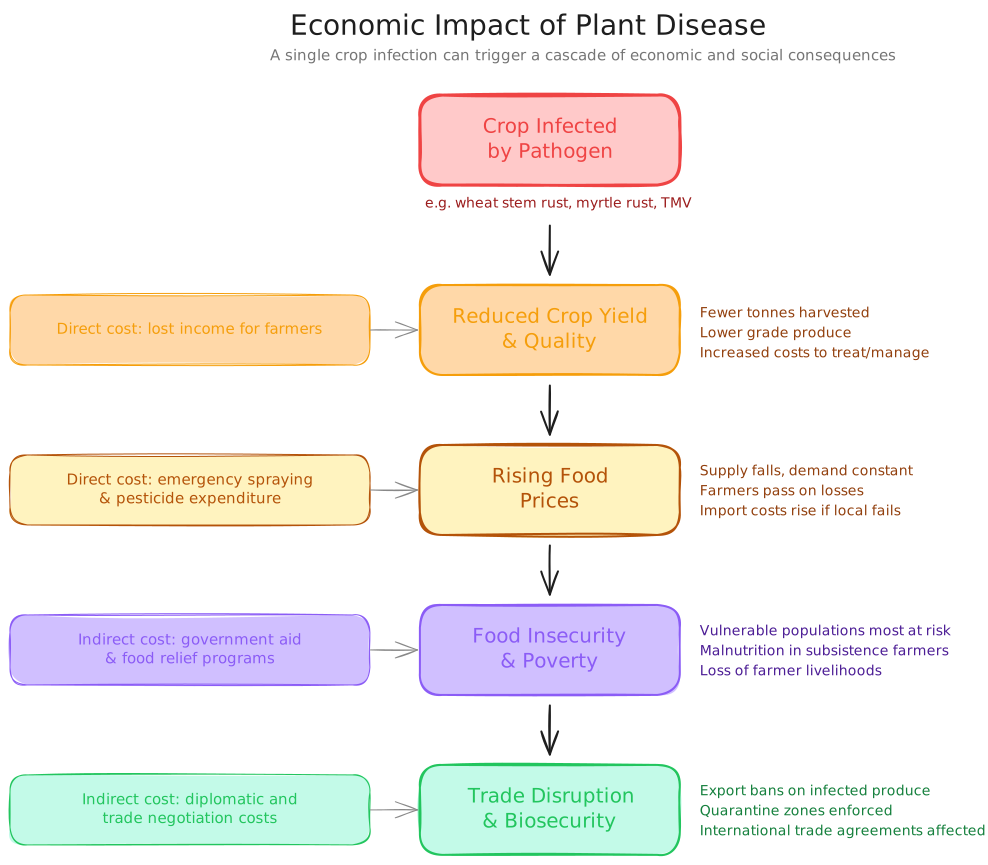
Economic Impact Pathway of Plant Disease
4
Assess the effects, then argue for prevention
Separate economic from ecological consequences, and see why biosecurity beats eradication.
3
Economic and Ecological Effects of Plant Disease
+5 XP
Direct production losses and broader consequences
We just saw the four pathogen types and the symptoms they cause. That raises a question: how do those symptoms translate into real-world cost? This card answers it → the chain from yield loss to economic and ecological consequences, and why prevention beats cure.
The effects of plant disease extend far beyond the visible symptoms, assessing them means weighing direct production losses against broader economic and ecological consequences.
Description
Fewer harvestable units per hectare due to plant death, stunting, or fruit/grain failure
Produce meets lower grade standards; may be unsaleable even if quantity is maintained
Costs of fungicides, bactericides, resistant varieties, quarantine measures, replanting
Importing countries may ban produce from regions with active disease outbreaks
Loss of dominant native species alters habitat and ecosystem function
Some pathogens persist in soil for years, preventing replanting with susceptible crops
Example
Wheat stem rust can reduce yield by 70% in a severe season
TMV-infected tomatoes show cosmetic damage reducing market value
Australian grape growers spend >$100 million annually on downy mildew control
Fire blight detection can trigger export bans on Australian apple exports
Myrtle rust threatening paperbark and tea tree affects wetland ecosystems and dependent fauna
Crown gall in vineyard soils persists for decades; Fusarium wilt in banana plantations
Biosecurity as prevention
Many of Australia's most damaging plant diseases are introduced, myrtle rust, banana bunchy top virus, and fire blight all entered Australia at different times. Australia's strict biosecurity laws (enforced by the Department of Agriculture) exist because preventing entry of a pathogen is far cheaper than managing it once established. The economic argument for biosecurity is one of the strongest in agricultural policy.
Economic effects: reduced yield, reduced quality/grade, control costs (chemicals, resistant varieties, quarantine, replanting), and lost export markets. Ecological effects: loss of dominant native species, soil persistence for years, and altered habitat. Many of Australia's worst plant diseases are introduced, so biosecurity (prevention) is far cheaper than managing a pathogen once established.
Pause, copy the economic vs ecological effects and the biosecurity argument into your book.
Preventing a pathogen's entry through _____ is far cheaper than eradicating it after establishment.
Interactive · Plant Disease Classifier
Sort each plant disease into its correct group, then check your answers.
Myrtle rust completes its cycle in as little as 7–10 days under warm, humid conditions, explaining its rapid spread across eastern Australia
5
Consolidate with the myrtle rust case
Pull the whole lesson together on one case study, clear the last misconceptions, then copy the summary into your book.
Myrtle Rust: An Invasion With No Precedent
Read the case as a cause-and-consequence story
Arrival · 2010
One infected nursery
Myrtle rust (Austropuccinia psidii) was first detected in Australia at a plant nursery on the New South Wales Central Coast in April 2010. It had almost certainly arrived on contaminated plant material from South America, where it co-evolved with Myrtaceae hosts and where many species have developed some resistance.
Why it spread
No co-evolved resistance
In Australia, it found something unprecedented: a continent whose entire Myrtaceae flora, comprising around 2,500 species including eucalypts, paperbarks, tea trees, bottlebrush, and lilly pilly, had never been exposed to this pathogen in their evolutionary history.
Spread · 2010–2023
From one site to most of Australia
Within months it had spread to Queensland. By 2023, it had been detected across all mainland states east of the Nullarbor, as well as in Tasmania and the Northern Territory; Western Australia remains free of it.
Production impact
Industry and management costs
The economic impacts include direct losses to the nursery industry (valued at over $900 million annually), losses to the bush food industry (which uses native Myrtaceae fruits), and ongoing costs of research and management.
Ecological impact
Common shrubs pushed towards extinction
The ecological stakes are higher still: two species, the scrub turpentine (Rhodamnia rubescens) and the native guava (Rhodomyrtus psidioides), were listed as critically endangered under the EPBC Act as a direct result of myrtle rust, both having crashed from common rainforest-edge shrubs to species that can barely set seed.
Current response
Manage rather than cure
No cure exists. Management focuses on identifying naturally resistant individuals and using selective fungicides to protect high-value specimens. You will assess these effects in the practice questions.
Common Misconceptions
watch out
✗ Misconception: Plant viruses can be treated with antiviral drugs.
✓ Once a plant is infected with a virus, there is no cure. Unlike bacterial plant diseases (which can sometimes be managed with bactericides) or fungal diseases (which can be managed with fungicides), plant viral infections cannot be treated. Management relies entirely on prevention: controlling insect vectors, using certified virus-free planting material, removing and destroying infected plants, and breeding resistant varieties. This is why virus-free certification of planting material is so important for industries like bananas and grapevines.
✗ Misconception: Introduced plant pathogens are more dangerous simply because they are foreign.
✓ Introduced pathogens are often more damaging because the host plants have had no evolutionary exposure to them and therefore no natural resistance. In the pathogen's native range, host plants and the pathogen have co-evolved over thousands of generations, producing a balance where many host plants survive. Australian Myrtaceae have had zero evolutionary exposure to myrtle rust, leaving them with no pre-existing defence mechanisms. The danger is not the pathogen's origin, it is the absence of co-evolutionary history in the host population.
✗ Misconception: Plant disease only affects the infected plant, not the surrounding environment.
✓ Plant diseases can have cascading ecological effects far beyond the individual infected plant. The loss of a keystone plant species, a dominant tree in a forest, for example, can reduce habitat availability for animals that depend on it, alter soil chemistry, change water cycling, and allow invasive species to fill the gap. Myrtle rust threatening paperbark wetlands in coastal NSW is not just a horticultural problem; paperbarks provide nesting habitat for numerous bird species and their loss would alter entire wetland ecosystems.
Plant Pathogen Types
Fungal: spreads via airborne spores; treated with fungicides. E.g. wheat stem rust, myrtle rust.
Bacterial: spreads via water, insects, tools; sometimes treated with bactericides. E.g. fire blight, crown gall.
Viral: spread by insect vectors or contaminated tools; no cure once infected. E.g. TMV, banana bunchy top virus.
Nematode (macroorganism): soil-dwelling juveniles invade roots and induce galls that block xylem and phloem, so water and minerals cannot reach the shoot. Eggs persist in soil for years. E.g. root-knot nematode.
Economic Effects of Plant Disease
Reduced yield, fewer harvestable units per hectare.
Reduced quality, lower market grade or unsaleable produce.
No evolutionary resistance in Australian natives; no cure.
Why Biosecurity Matters
Many of Australia's worst plant diseases are introduced.
Prevention (border control) is far cheaper than management.
Introduced pathogens are more dangerous due to absence of co-evolutionary history in host plants.
Australia's biosecurity laws enforced by DAFF.
Key Plant Diseases in Agriculture
Assess7 marks
Assess the causes and effects of plant diseases on agricultural production, using a named example.
1
Unpack the verb
Assess is this dot point's own verb — assess the causes and effects of diseases on agricultural production. It asks for a judgement about how much the effects matter, not a description of them.
Plan: state the criteria, assess the causes, assess the effects at each level, then reach a verdict and qualify it.
The dot point names causes AND effects, so both need assessing. An answer that only describes a disease has answered neither.
2
State your criteria
The causes and effects will be assessed on the scale of production loss, on whether the loss is recoverable, and on how far the effects extend beyond the farm gate.
Recoverability is the criterion that separates a bad season from a permanent change to what can be grown, and it drives the verdict.
3
Assess the causes
Plant disease is caused by fungi, bacteria, viruses and nematodes, and fungi dominate — they cause the large majority of plant disease, because fungal spores are produced in enormous numbers, travel on wind and water, and survive in soil and plant debris between seasons. Agricultural practice amplifies all of this: monoculture places a genetically uniform, susceptible host over a vast area with no barrier to spread, and international movement of plant material introduces pathogens to regions whose plants have no evolved resistance. So the causes are biological and agricultural together, and the agricultural half is the part that can be changed.
Identifying monoculture as an amplifier rather than a cause is the assessment, and it connects to what prevention can act on.
4
Assess the direct effects
The direct effect is loss of yield and of quality, and it is substantial: plant disease is estimated to destroy in the region of ten to twenty per cent of global crop production annually, which is food that is grown and not eaten. Effects also differ in kind — a disease reducing yield costs a season, while one killing perennial plantings costs the years of growth invested in them, so the same percentage loss is far more serious in an orchard than in a wheat crop.
The annual-versus-perennial distinction is what makes this an assessment rather than a figure, and it follows from the recoverability criterion.
5
Assess the wider effects with a named case
Myrtle rust shows how far the effects extend. Caused by the fungus Austropuccinia psidii and detected in Australia in 2010, it spread from a single New South Wales nursery along the east coast within a few years, carried on wind and on moved plant material. It attacks the Myrtaceae, which includes eucalypts, tea trees, lilly pillies and bottlebrushes, so the effects run past agriculture into native ecosystems, with several species now assessed as threatened. Its economic effects extend to nursery businesses, tea tree oil production and the cost of surveillance and quarantine — and because it cannot be eradicated once established, those costs are permanent rather than one-off.
A case that crosses from agriculture into conservation is the strongest available, and the permanence of the cost is the assessment's key point.
6
Weigh it — reach a verdict
The effects of plant disease on agricultural production are severe and unevenly distributed, and their seriousness tracks recoverability rather than immediate loss. A disease reducing yield in an annual crop is a cost absorbed within a season; one that establishes permanently in a perennial or native host changes what can be grown in a region indefinitely. The causes are correspondingly two-sided — the pathogens are given, and the practices that amplify them are chosen — which is why prevention concentrates on quarantine, crop rotation and resistant varieties rather than on treating disease once present.
A verdict that grades by recoverability and then explains why prevention is structured as it is answers both halves of the dot point.
7
Qualify, then link back
The qualification is that the figures are estimates with wide uncertainty, since losses are measured against a hypothetical disease-free yield that is never observed. That does not undermine the conclusion — the direction and rough magnitude are consistent across methods — but it means precise comparisons between diseases or between regions should be treated with caution.
Naming that the counterfactual is unobservable is an honest limitation on the quantitative half of the assessment.
8
What a full-mark answer looks like
The causes and effects will be assessed on the scale of production loss, on whether the loss is recoverable, and on how far effects extend beyond the farm gate. Plant disease is caused by fungi, bacteria, viruses and nematodes, with fungi dominating because their spores are produced in enormous numbers, travel on wind and water, and survive in soil and debris between seasons — and agricultural practice amplifies this, since monoculture places a genetically uniform susceptible host over a vast area with no barrier to spread, while international movement of plant material introduces pathogens to regions whose plants have no evolved resistance, so the causes are biological and agricultural together and the agricultural half is what can be changed. The direct effect is loss of yield and quality, estimated at roughly ten to twenty per cent of global crop production annually, and effects differ in kind, since a disease reducing yield costs a season while one killing perennial plantings costs the years of growth invested — the same percentage loss being far more serious in an orchard than a wheat crop. Myrtle rust shows how far effects extend: caused by the fungus Austropuccinia psidii and detected in Australia in 2010, it spread from a single New South Wales nursery along the east coast within a few years on wind and moved plant material, and because it attacks the Myrtaceae — eucalypts, tea trees, lilly pillies, bottlebrushes — its effects run past agriculture into native ecosystems, with several species now assessed as threatened, while its economic effects reach nursery businesses, tea tree oil production and the permanent cost of surveillance and quarantine, since it cannot be eradicated once established. The effects are therefore severe and unevenly distributed, their seriousness tracking recoverability rather than immediate loss: a yield reduction in an annual crop is absorbed within a season, while permanent establishment in a perennial or native host changes what can be grown in a region indefinitely — and since the causes are two-sided, the pathogens given and the amplifying practices chosen, prevention concentrates on quarantine, rotation and resistant varieties rather than treatment. The qualification is that loss figures are estimates measured against a disease-free yield never observed, so the direction and rough magnitude are sound while precise comparisons should be treated with caution.
Recoverability as the leading criterion, causes split into given and chosen, effects graded by crop type, a named case crossing into conservation, and a qualification about the unobservable counterfactual.
Analyse6 marks
Analyse why a single infected nursery was able to spread a plant pathogen across an entire coastline.
1
Unpack the verb
Analyse asks for the parts of the process and how they relate. The question describes a specific outcome, so the analysis must identify what made that outcome possible rather than describe the disease.
Plan: identify the components, state what links them, relate them across the actual spread, then draw the implication and the limits.
The interesting question is not what myrtle rust is but why containment failed. The components are biological and human together.
2
Identify the components
Four things had to coincide: a pathogen able to disperse widely, a susceptible host present continuously across the region, a human distribution network moving infected material faster than natural spread, and a detection delay during which all of this occurred unobserved.
Naming detection delay as a component rather than as a failure is what makes the analysis structural rather than a search for blame.
3
State the constraint linking them
They are linked multiplicatively: removing any one would have contained the outbreak. A pathogen with the same dispersal but no continuous host would have died out at the first gap; the same host with no nursery trade would have been reached only at the speed of wind dispersal; and detection at the nursery before dispatch would have made the other three irrelevant. Containment fails only when every link holds.
The multiplicative constraint is the analytical core and it explains why containment is attempted at several points at once.
4
Relate them across the actual spread
Each link held. Austropuccinia psidii produces spores small and numerous enough to travel on wind, on clothing, on equipment and on insects, so it disperses by many routes at once. The Myrtaceae are among the most widespread plant families on the Australian east coast, in gardens, plantations and native bushland alike, so there was no gap in the host distribution to stop it. Nursery plants are dispatched over hundreds of kilometres within days, so infected material arrived in distant regions before wind dispersal could have reached them. And because early infection appears as small yellow pustules easily mistaken for other damage, the pathogen was distributed for some time before it was identified.
Working all four components through the actual case is the analysis, and the detection point explains the timeline rather than merely noting it.
5
Apply the limiting case
The limits show where the account stops. Not every nursery outbreak spreads this way: a pathogen with a narrow host range, or one whose symptoms appear quickly and unmistakably, is contained at the first inspection. And the analysis explains the speed of spread rather than the establishment — whether the pathogen persists in each new region depends on climate and host susceptibility there, which is why myrtle rust has established along the humid east coast and not uniformly across the continent.
Distinguishing spread from establishment is the sharpest limit, and it explains the actual geographic pattern.
6
Draw out the implication
It follows that biosecurity is most effective at the point where the human network concentrates, because that is the link where one intervention covers many destinations. Inspecting plants at the nursery before dispatch protects every region that nursery supplies, whereas surveillance at destinations must be repeated everywhere and always arrives after the material does. This is why plant biosecurity targets movement rather than presence.
Identifying the highest-leverage link is what makes the analysis usable, and it explains the structure of real biosecurity systems.
7
What a full-mark answer looks like
Four things had to coincide: a pathogen able to disperse widely, a susceptible host present continuously across the region, a human distribution network moving infected material faster than natural spread, and a detection delay during which all of this occurred unobserved. They are linked multiplicatively, since removing any one would have contained the outbreak — a pathogen with the same dispersal but no continuous host would have died out at the first gap, the same host with no nursery trade would have been reached only at wind speed, and detection before dispatch would have made the rest irrelevant. Each link held: Austropuccinia psidii produces spores small and numerous enough to travel on wind, clothing, equipment and insects, dispersing by many routes at once; the Myrtaceae are among the most widespread plant families on the Australian east coast, in gardens, plantations and bushland alike, so there was no gap in host distribution; nursery plants are dispatched over hundreds of kilometres within days, so infected material arrived in distant regions before wind dispersal could have reached them; and because early infection appears as small yellow pustules easily mistaken for other damage, the pathogen was distributed for some time before identification. The limits show where this stops — not every nursery outbreak spreads this way, since a pathogen with a narrow host range or unmistakable early symptoms is contained at the first inspection, and the account explains the speed of spread rather than establishment, which depends on climate and host susceptibility in each new region, as shown by myrtle rust establishing along the humid east coast rather than uniformly across the continent. Biosecurity is therefore most effective where the human network concentrates, because one intervention there covers many destinations: inspecting plants at the nursery before dispatch protects every region that nursery supplies, whereas surveillance at destinations must be repeated everywhere and always arrives after the material does — which is why plant biosecurity targets movement rather than presence.
Four components including detection delay, a multiplicative constraint, all four traced through the real case, spread distinguished from establishment, and an implication identifying the highest-leverage intervention point.
Recommended pathAnswer before revealing
6
Do this next
Practise independently
Attempt at least one response in your own words. Model answers support checking; they do not replace the attempt.
01
Multiple Choice
+5 XP
A fresh set drawn from this lesson's question bank, feedback shown immediately. +5 XP per correct · +25 XP all correct
Pick your answer, then rate your confidence, that tells the system what to drill next.
02
Short Answer, 10 marks
+5 XP
ApplyBand 3(3 marks) 1. Compare the spread and management of a named fungal plant disease with a named viral plant disease. In your answer, describe how each spreads and explain why their management strategies differ.
1 mark: fungal spread and management · 1 mark: viral spread and management · 1 mark: explanation of why strategies differ based on pathogen biology
UnderstandBand 4(3 marks) 2. Explain how root-knot nematodes (Meloidogyne spp.) cause disease in plants and assess two economic effects of nematode infection on agricultural production.
1 mark: mechanism of nematode damage · 1 mark: first economic effect with explanation · 1 mark: second economic effect with explanation
EvaluateBand 5(4 marks) 3. Myrtle rust (Austropuccinia psidii) was introduced to Australia in 2010 and has since spread to infect over 350 Myrtaceae species. Assess the causes and effects of myrtle rust on Australian production, referring to both agricultural and ecological consequences.
1 mark: cause (the true fungus Austropuccinia psidii) and infection mechanism · 1 mark: agricultural production effects with examples · 1 mark: ecological effects beyond agriculture · 1 mark: evaluative statement linking pathogen characteristics to severity
Show all answers
Multiple choice
MC answers and full explanations are shown inline as you complete each question. Use the retry button to attempt a fresh set from the lesson bank.
Short Answer Model Answers
Q1 (3 marks): Wheat stem rust (Puccinia graminis) spreads via airborne urediniospores that can travel thousands of kilometres on wind currents, infecting new wheat plants when spores land on susceptible tissue in appropriate humidity conditions. Management involves fungicide applications during susceptible growth stages, planting rust-resistant wheat varieties, and monitoring for new rust strains that may overcome existing resistance. Banana bunchy top virus spreads via the banana aphid (Pentalonia nigronervosa), which acquires the virus when feeding on infected plants and transmits it to healthy plants. Management focuses on controlling aphid populations with insecticides, immediate removal and destruction of infected plants, using certified virus-free planting material, and establishing quarantine zones. The management strategies differ fundamentally because fungal diseases can be treated after infection with fungicides that target fungal cell biology, whereas viral infections cannot be treated once established because viruses replicate inside plant cells using the plant's own machinery, viral management is therefore entirely preventive.
Q2 (3 marks): Root-knot nematodes (Meloidogyne spp.) are parasitic roundworms that penetrate plant roots as second-stage juveniles. They migrate to vascular tissue near the root tip and inject secretions that cause plant cells to enlarge abnormally, forming characteristic swellings called galls or knots. These galls disrupt the plant's vascular system, blocking the movement of water and nutrients from roots to shoots, resulting in wilting, yellowing, stunted growth, and reduced fruit or seed production. Economic effect 1: Reduced crop yield, infected plants cannot absorb adequate water and nutrients, directly reducing the quantity and size of harvestable produce, lowering profitability per hectare. Economic effect 2: Long-term soil contamination, nematode eggs can remain viable in soil for years, meaning infected paddocks cannot be replanted with susceptible crops without significant risk, forcing growers to undertake expensive soil fumigation, fallow periods, or rotation with non-host crops.
Q3 (4 marks): Myrtle rust is caused by the fungus Austropuccinia psidii. It infects plants by landing wind-dispersed urediniospores on young, actively growing tissue of Myrtaceae plants; the spores germinate, penetrating the leaf surface; hyphae grow through the tissue causing cell death; orange-yellow pustules develop and produce millions of new spores, perpetuating the cycle. Agricultural effects include direct losses to the nursery industry, valued at approximately $900 million annually, with many lines consisting of Myrtaceae species such as lilly pilly and tea tree, and losses to the bush food industry which uses native Myrtaceae fruits. Ecological effects extend beyond agriculture: myrtle rust threatens dominant native Myrtaceae such as paperbarks and bottlebrush, which provide critical habitat for birds and other fauna, and two species have been listed as critically endangered as a direct result. The severity of impact is explained by the combination of two factors: the pathogen's highly efficient wind-dispersal mechanism (enabling rapid continental spread) and the complete absence of co-evolved resistance in Australian Myrtaceae hosts, meaning the pathogen encounters no natural barriers to infection across its potential host range.
Recommended pathCheck retention
7
Finish strong
Retrieve and reflect
Use the Review session first, then compare how your thinking changed.
Check what actually stuck
Take the full module quiz
quiz
A full module quiz covering every lesson in this module, not just this one. Set aside a decent block of time and treat it like a real assessment.
You were asked to predict how a fungal pathogen could spread rapidly across a continent, and why Australian native plants might be particularly vulnerable. Myrtle rust (Austropuccinia psidii) confirms both predictions, Plant Health Australia detected it at a Gosford nursery in April 2010, and within three years it had spread the length of the east coast, from far north Queensland to Victoria, reaching Tasmania and the Northern Territory later. It now infects 350+ Myrtaceae species and threatens 14 EPBC-listed species, with an estimated $300 million annual horticultural impact.
For spread: the two main mechanisms for myrtle rust are wind-dispersed spores (which can travel hundreds of kilometres) and human movement of infected plant material (nursery stock, cut branches, soil on shoes or equipment). Both mechanisms were likely in your prediction, if you identified either or both, you were correct.
For vulnerability: the key reason is evolutionary, Australian Myrtaceae evolved in complete isolation from this pathogen for tens of millions of years. There was no selection pressure for resistance, so no resistance traits developed. This is fundamentally different from saying Australian plants are "weaker", they are simply naive to a pathogen they have never encountered. South American Myrtaceae have had millennia of co-evolution with this rust, and many have developed at least partial resistance. The same logic explains why introduced animal diseases (like rabbit haemorrhagic disease) can be devastatingly effective: the host population has no evolutionary history with the pathogen.