Disease in Agriculture, Animals
Australia has been free of foot-and-mouth disease (FMD) since 1872. ABARES estimated in 2013 that a single FMD outbreak would cost Australia $52 billion over 10 years through livestock losses, trade bans, and eradication programs. The Australian Quarantine Inspection Service (AQIS) intercepts more than 100,000 prohibited items per year at Australian borders, each interception representing a potential outbreak that never happened.
Orient yourself
Warm up on earlier lessons, predict how far the damage from one outbreak can reach, then scan the goals and vocabulary.
Three quick questions from earlier lessons. Pulling old material back to mind before you learn something new makes the new material stick better, so this is not busywork.
Practise this lesson
Four printable worksheets that build from the foundations up to exam-style questions, start at whatever level suits you.
Australia exports over $30 billion in livestock products annually, beef, lamb, wool, dairy, and live animals, to over 100 countries. Many of these importing countries have strict disease-free requirements.
Before reading: predict two ways a single animal disease outbreak in Australia could cause economic damage far beyond the cost of treating or destroying infected animals. Think beyond the farm.
Know
- Named examples of animal diseases caused by different pathogen types
- The direct and indirect economic effects of animal disease
- How animal diseases spread within and between populations
- Australia's disease-free status and its economic value
Understand
- Why export market loss is often more damaging than direct production loss
- How pathogen type affects management strategy in livestock
- Why biosecurity at farm and national level is economically justified
Can Do
- Classify a named animal disease by pathogen type
- Assess the economic effects of a named animal disease with specific examples
- Apply knowledge of animal disease effects to a novel scenario
Meet the diseases that matter
Work through the major Australian livestock diseases, their pathogen types, and how each one hits production.
Core Content
Direct effects, indirect effects, and disease-free status
In 2001, foot-and-mouth disease spread through UK livestock and 6.5 million animals were slaughtered. The countryside was closed. Export markets were suspended. The final cost exceeded £8 billion, far more than the value of culled animals. Australia has been free of FMD since 1872; ABARES estimated in 2013 that a single outbreak would cost $52 billion over 10 years. The biological event, infected animals, is only the beginning of the economic story.
Animal diseases caused by pathogens reduce agricultural production through direct effects (animal death, reduced productivity) and indirect effects (trade restrictions, control costs, loss of market access).
Australia's competitive advantage in international livestock markets rests substantially on its disease-free status for several high-priority pathogens. Maintaining this status requires constant surveillance, strict biosecurity at borders, rapid response capability, and extensive livestock identification and movement controls.
That advantage matters so much because Australian livestock industries sell most of what they produce overseas rather than at home. Australia exports roughly $30 billion of livestock products a year (beef, lamb, wool, dairy and live animals) to more than 100 countries, and beef is the clearest case: about 70% of Australian beef production is exported (Meat & Livestock Australia industry statistics). A country that eats almost everything it produces can absorb an export ban; Australia cannot. That export dependence is what turns a single detection of a notifiable disease into an economy-scale event rather than a farm-scale one.
| Disease | Pathogen Type | Animals Affected | Cause / Mechanism | Key Economic Effect |
|---|---|---|---|---|
| Foot-and-mouth disease (FMD) | Virus (Aphthovirus, Picornaviridae) | Cattle, pigs, sheep, goats, deer, all cloven-hoofed animals | Highly contagious; causes painful blisters on feet and mouth; spreads via direct contact, aerosol, contaminated feed, vehicles, and people | Immediate export bans; mass culling; modelled total cost to the Australian economy of $50–80 billion over about a decade if introduced (ABARES 2013 estimate: $52 billion over 10 years) |
| Bovine tuberculosis (bTB) | Bacterium (Mycobacterium bovis) | Cattle, deer; can infect humans | Respiratory transmission; causes progressive lung disease; spreads through herd contact and contaminated pasture | Australia was declared free of bovine TB in 1997 after the BTEC eradication campaign; freedom is maintained for market access; test-and-cull programs cost millions |
| Avian influenza (bird flu) | Virus (Influenza A, H5N1, H7N9 etc.) | Poultry; wild birds; occasionally humans | Spreads via respiratory secretions and faeces of infected birds; highly pathogenic strains cause near 100% mortality in flocks | Mass culling of entire flocks; trade bans; 2020 Victorian outbreak cost >$20 million |
| Newcastle disease | Virus (Avian paramyxovirus type 1) | Poultry (chickens, turkeys) | Respiratory and nervous system infection; spreads via infected birds, faeces, contaminated equipment | Up to 100% mortality in unvaccinated flocks; vaccine programs are the primary control |
| Salmonellosis | Bacterium (Salmonella enterica) | Poultry, pigs, cattle | Faecal-oral transmission; causes diarrhoea, weight loss, septicaemia; food safety risk to humans | Reduced growth rates; treatment costs; product recalls; human health liability |
| Bovine viral diarrhoea (BVD) | Virus (Pestivirus) | Cattle | Spreads via persistently infected (PI) cattle, animals infected in utero that shed virus for life; causes reproductive failure and immunosuppression | Estimated >$100 million annually in Australia through reproductive losses, increased susceptibility to other diseases |
| Hydatid disease | Parasitic tapeworm (Echinococcus granulosus) | Sheep, cattle (intermediate hosts); dogs (definitive host) | Larvae form cysts in liver and lungs of livestock; spread via dog faeces containing tapeworm eggs ingested by livestock | Condemned organ and carcass losses at slaughter; estimated $100+ million annually in Australia |
Animal disease reduces production through direct effects (death, lost productivity, treatment + culling costs) and indirect effects (trade bans, lost market access). For an exporter like Australia the indirect effects usually dominate. Key examples: FMD (virus, cloven-hoofed animals, biggest threat is export bans, not animal loss), bovine TB (bacterium), avian influenza, Newcastle disease, BVD (Pestivirus), hydatid (tapeworm). Australia's disease-free status underpins premium market access and is maintained by surveillance, border biosecurity, traceability and rapid response. Australia exports about $30 billion of livestock products a year and roughly 70% of its beef production, so an export ban removes most of the market, not a slice of it.
Pause, copy the direct vs indirect framing, the export-dependence figures, and 2–3 named diseases into your book.
For Australia, the largest economic impact of a foot-and-mouth disease outbreak would most likely be:
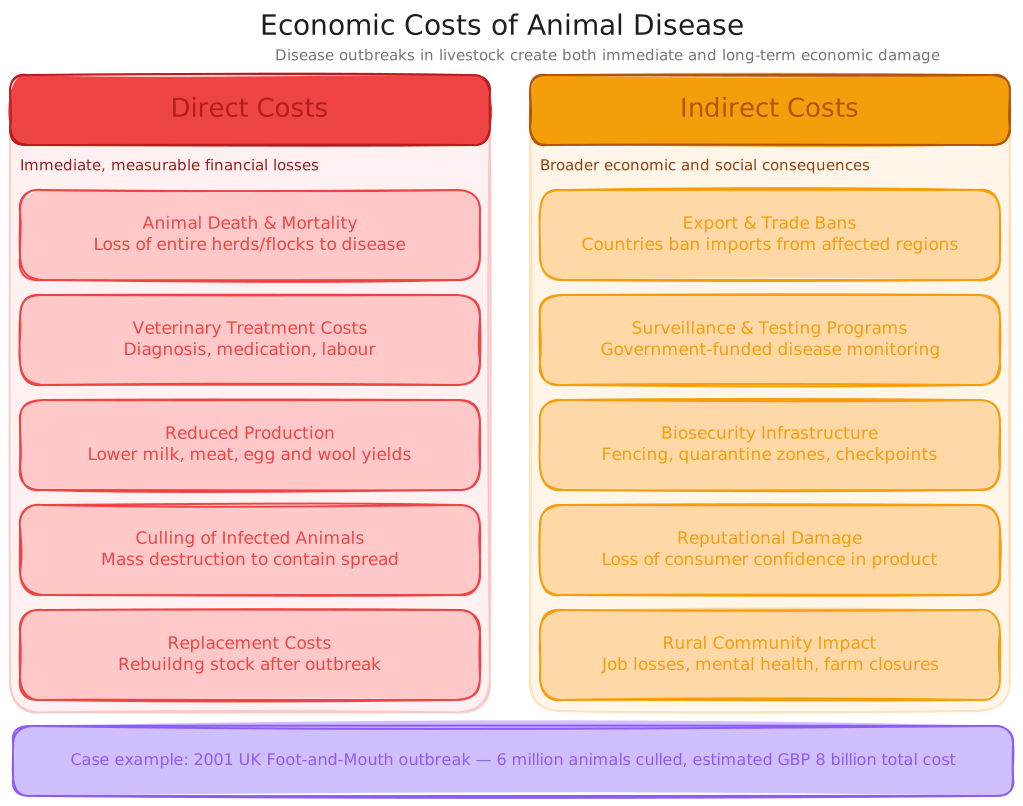
Direct vs Indirect Economic Costs
Separate direct from indirect effects
Split an outbreak's cost into the two categories the HSC asks for, and work out why the indirect side dominates for an exporter.
Why the dead animals are often the smaller part of the bill
We just saw the major livestock diseases and Australia's disease-free status. That raises a question: exactly how does an outbreak hurt production financially? This card answers it → splitting the cost into direct and indirect effects, and showing why the indirect side dominates for an exporter.
When assessing the effects of animal disease on production, the HSC requires you to distinguish direct consequences from indirect ones, and for an exporter, the indirect ones dominate.
Direct Effects
Animal death: loss of productive animals, breeding stock, meat animals, dairy cows, represents direct capital loss.
Reduced productivity: sick animals produce less milk, gain weight more slowly, have lower reproduction rates.
Treatment costs: veterinary fees, vaccines, antibiotics, ongoing costs of managing endemic disease.
Culling costs: emergency destruction of infected and at-risk animals; disposal and decontamination.
Indirect Effects
Export market loss: importing countries impose bans when notifiable diseases are detected, often the largest economic impact.
Movement restrictions: livestock cannot be sold or transported during outbreak investigations, market disruption.
Consumer confidence loss: domestic market demand falls even for unaffected produce (e.g. "chicken flu scare" reducing all chicken sales).
Surveillance and response costs: government emergency response, testing, tracing, compensation for farmers.
Biosecurity Value
Disease-free status as an asset: Australia's freedom from FMD, BSE, and other diseases is a competitive advantage in premium markets (Japan, South Korea, China).
Prevention vs management: preventing entry is exponentially cheaper, FMD eradication in the UK 2001 outbreak cost an estimated £8 billion.
Market premium: disease-free status justifies price premiums, Australian beef commands higher prices in many Asian markets precisely because of disease status.
Direct effects = animal death, reduced productivity, treatment and culling costs. Indirect effects = export bans, movement restrictions, lost consumer confidence, and surveillance/response costs. For Australia the indirect effects (especially lost exports) usually exceed the direct ones, because disease-free status is an economic asset that commands market premiums, so prevention is far cheaper than management.
Pause, copy the direct vs indirect effects lists and why indirect dominates for Australia into your book.
For Australia, the direct cost of culled animals is usually larger than the indirect cost of lost export markets.
Australia's disease-free status for foot-and-mouth disease is maintained through strict quarantine, biosecurity, and surveillance programs.
Hydatid disease is caused by a virus and can be treated effectively with antiviral medications.
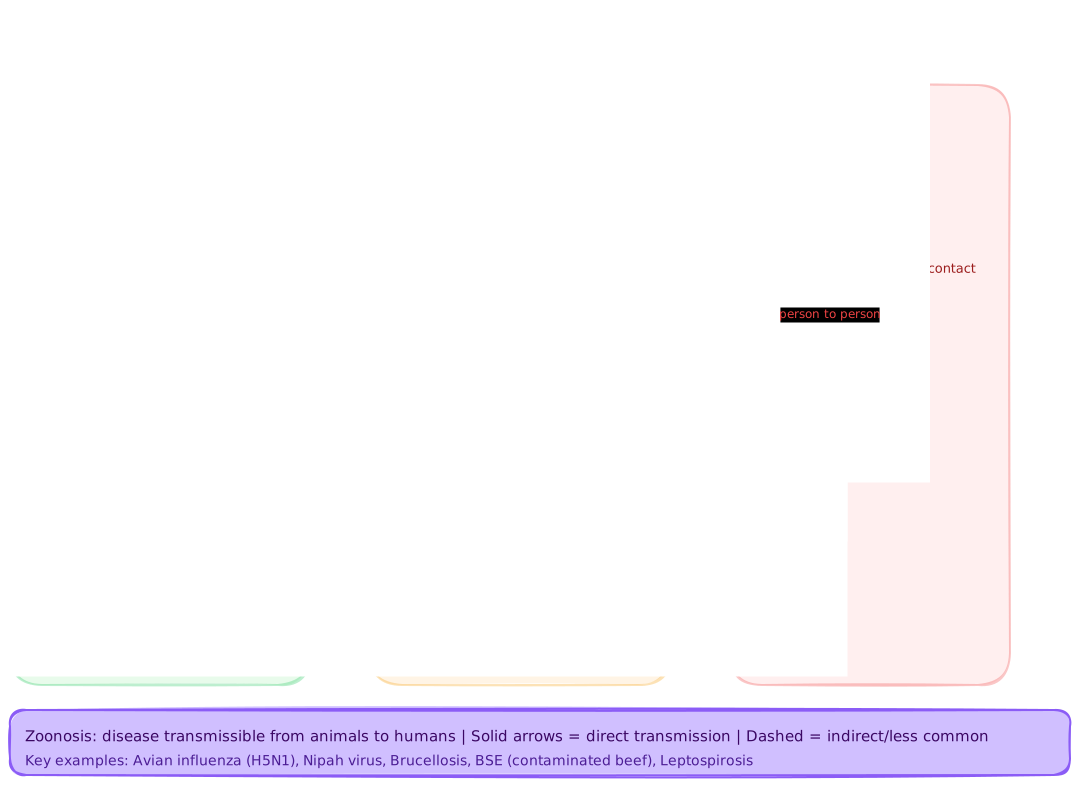
Animal Disease Transmission Network
Cost a real outbreak
Follow the 2001 UK foot-and-mouth outbreak from £2.7 billion of direct agricultural loss to £8 billion of total economic cost, and get the Australian figures straight.
In February 2001, foot-and-mouth disease was detected in pigs at an abattoir in Essex, England. Within weeks it had spread to farms across the country. The response was catastrophic in scale: over 6 million animals were culled, not just infected animals, but all animals on infected premises and many on adjacent farms under a preemptive "contiguous cull" policy. The direct agricultural cost was approximately £2.7 billion. But the total economic cost, including lost tourism (countryside access was closed for months), disrupted rural businesses, emergency government response, and long-term market disruption, was estimated at £8 billion. The UK lost market access in numerous export destinations for years. Some farming families never recovered financially. Australia has not had FMD since 1872. Keep the two numbers separate when you write about that status. The annual value at risk is the roughly $30 billion of livestock products Australia exports each year, which is the trade that import bans would close. The modelled cost of an incursion is a separate, one-off figure spread over the recovery period: ABARES estimated in 2013 that a single large FMD outbreak would cost Australia about $52 billion over 10 years, with the wider modelled range for a severe multi-state outbreak reaching $50 to $80 billion. So when a traveller is stopped at an Australian airport for undeclared meat products, the officer is protecting a $30 billion-a-year export trade and heading off a cost measured in tens of billions over a decade. You will assess these effects in the practice questions.
Consolidate before you practise
Clear the three misconceptions that cost marks, then copy the four summary panels into your book.
Key Animal Diseases
- FMD: virus, cloven-hoofed animals, highly contagious, blisters on feet/mouth.
- Bovine TB: bacterium (M. bovis), respiratory, cattle/deer, test-and-cull.
- Avian influenza: virus, poultry, near 100% mortality in HPAI strains.
- Hydatid disease: tapeworm (Echinococcus), sheep/cattle/dogs, cyst formation in organs.
Direct vs Indirect Economic Effects
- Direct: animal death, reduced productivity, treatment/culling costs.
- Indirect: export bans, movement restrictions, consumer confidence loss, government response costs.
- For Australia, indirect effects (especially export market loss) typically exceed direct effects.
FMD Key Facts
- Australia free since 1872; protects about $30 billion a year of livestock exports (roughly 70% of beef production is exported).
- Cost if it got in: ABARES (2013) modelled about $52 billion over 10 years, with severe scenarios modelled at $50 to $80 billion. That is a total outbreak cost, not an annual export value.
- Spreads via direct contact, aerosol, contaminated vehicles, feed, people.
- 2001 UK outbreak: £8 billion total cost; 6 million animals culled.
- No vaccine routinely used in disease-free countries, vaccination indicates exposure risk.
Biosecurity Value
- Disease-free status = competitive advantage = market premiums.
- Prevention is far cheaper than eradication once established.
- Active biosecurity required, geography alone is insufficient.
- Livestock traceability (NLIS) enables rapid outbreak response.

Animal Disease Comparison
Practise independently
Attempt at least one response in your own words. Model answers support checking; they do not replace the attempt.
A fresh set drawn from this lesson's question bank, feedback shown immediately. +5 XP per correct · +25 XP all correct
Pick your answer, then rate your confidence, that tells the system what to drill next.
ApplyBand 3(3 marks) 1. Compare the economic effects of foot-and-mouth disease (FMD) and hydatid disease on Australian agricultural production. In your answer, classify each pathogen and explain why their economic impacts differ in nature.
1 mark: FMD classification and primary economic effect · 1 mark: hydatid disease classification and primary economic effect · 1 mark: explanation of why the nature of impact differs
UnderstandBand 4(3 marks) 2. Explain why maintaining disease-free status for foot-and-mouth disease is worth more to Australia than the cost of all FMD control measures combined. In your answer, refer to both direct and indirect economic consequences of an FMD outbreak.
1 mark: direct consequences · 1 mark: indirect consequences (particularly export market loss) · 1 mark: evaluative statement linking disease-free status to economic value
EvaluateBand 5(4 marks) 3. Assess the causes and effects of foot-and-mouth disease on Australian agricultural production. In your answer, describe the pathogen, its transmission, the direct and indirect effects of an outbreak, and explain why the economic risk to Australia is particularly high.
1 mark: pathogen and transmission · 1 mark: direct effects · 1 mark: indirect effects with reference to export markets · 1 mark: why Australia's risk is particularly high
Show all answers
Multiple choice
MC answers and full explanations are shown inline as you complete each question. Use the retry button to attempt a fresh set from the lesson bank.
Short Answer Model Answers
Q1 (3 marks): FMD is caused by a virus (Aphthovirus), a non-cellular pathogen. Its primary economic effect is the loss of export market access: importing countries immediately ban livestock and livestock products from countries where FMD is detected, which for Australia would put at risk the roughly $30 billion of livestock exports earned each year and, on the ABARES 2013 modelling, cost the economy about $52 billion over 10 years, far exceeding the direct cost of the infected animals themselves. Hydatid disease is caused by a parasitic tapeworm (Echinococcus granulosus), a macroorganism helminth. Its primary economic effect is direct production loss: larvae form cysts in the liver and lungs of sheep and cattle that are condemned at slaughter, reducing the value of the carcass and costing the industry over $100 million annually in condemned product. The nature of impact differs fundamentally: FMD's greatest impact is indirect (market access), while hydatid disease causes ongoing direct production losses through condemned product. FMD represents a catastrophic but preventable event; hydatid disease is a chronic, lower-profile drain on production that occurs regardless of trading conditions.
Q2 (3 marks): If FMD were introduced to Australia, direct consequences would include the culling of millions of infected and at-risk livestock, loss of animal capital, decontamination and disposal costs, and emergency government expenditure. The 2001 UK outbreak required culling over 6 million animals at a direct agricultural cost of approximately £2.7 billion. However, the indirect consequences would be far more severe for Australia: the immediate suspension of Australian livestock product exports to most major markets, including Japan, South Korea, China, and the United States, which together represent over $30 billion in annual exports. Market restoration after an FMD outbreak takes years even after the disease is eradicated, as importing countries require extended disease-free periods before lifting bans. Australia's competitive advantage in premium Asian markets rests specifically on its FMD-free status, which commands price premiums not available to FMD-affected exporters. The estimated total economic cost of a single FMD incursion exceeds $50–80 billion, making even substantial ongoing biosecurity investment economically rational.
Q3 (4 marks): Foot-and-mouth disease is caused by Aphthovirus (family Picornaviridae), a highly contagious non-cellular pathogen (virus). It spreads via multiple routes: direct contact between animals, short-range aerosol (virus can travel several kilometres in favourable wind conditions), contaminated feed and water, and importantly via fomites, including vehicles, equipment, and people's clothing and footwear. Direct effects of an Australian outbreak would include widespread culling of infected and at-risk animals (FMD affects all cloven-hoofed livestock), loss of productive breeding and meat animals, veterinary and decontamination costs, and significant disruption to livestock movements nationwide. Indirect effects would be devastating: Australia's major beef, sheep, and dairy export markets would immediately impose import bans on all Australian livestock products. These markets collectively represent over $30 billion in annual export revenue. Restoration of market access after eradication typically takes years. Australia's economic risk is particularly high for two reasons: first, its agricultural economy is disproportionately export-dependent compared to most other developed nations, with over 70% of beef production exported; second, Australia currently commands significant price premiums in Asian markets specifically because of its disease-free status, premiums that would be lost permanently in markets that shifted to alternative suppliers during any ban period.
Retrieve and reflect
Use the Review session first, then compare how your thinking about indirect costs changed.
A full module quiz covering every lesson in this module, not just this one. Set aside a decent block of time and treat it like a real assessment.
Start the module quiz →Answer questions on disease in agricultural animals and livestock. Pool: lessons 1–7.
You were asked to predict two ways an animal disease outbreak could cause economic damage far beyond treating or destroying infected animals. The ABARES 2013 estimate for a single foot-and-mouth disease outbreak in Australia, $52 billion over 10 years, shows exactly how: livestock losses are only one component. The bulk of the damage comes from export market closures (Australia has been FMD-free since 1872, commanding premium prices in Japan and South Korea based on that status), eradication costs, and long-term trade ban duration.
The two main indirect mechanisms are export market loss and consumer confidence collapse. The biological damage (sick or dead animals) is, counterintuitively, often the smaller part of the economic story. A disease that kills 2% of a herd but triggers a 12-month export ban on the entire industry causes orders of magnitude more economic damage than the dead animals represent.
The deeper insight: Australia's livestock industries sell two things simultaneously, the product and the guarantee of disease-free status. The AQIS interception of 100,000+ prohibited items per year at borders is the practical expression of that guarantee: it protects the roughly $30 billion of livestock products exported each year, and keeps the modelled $52 billion, over 10 years, cost of an incursion from ever being incurred.