Multiple choice
Idea tested: Human cells are eukaryotic, they have no cell wall at all. Penicillin targets peptidoglycan synthesis, a structure unique to bacterial cell walls. With no cell wall to inhibit, penicillin has no target in human cells. (B) is wrong, human cells have no cell wall, not a different one. (A) and (D) are biologically incorrect.
Idea tested: Viruses use host cell machinery, they have no cell wall, no independent ribosomes, and no DNA gyrase. Antibiotics cannot affect viral replication because their targets do not exist in viral particles or in the intracellular environment where viruses replicate. (A) is irrelevant to the mechanism. (C) is incorrect, antibiotics do not destroy the immune system, though they can alter the microbiome. (D) is a misconception, "resistance" in the virological sense does not apply here; the issue is the complete absence of antibiotic targets.
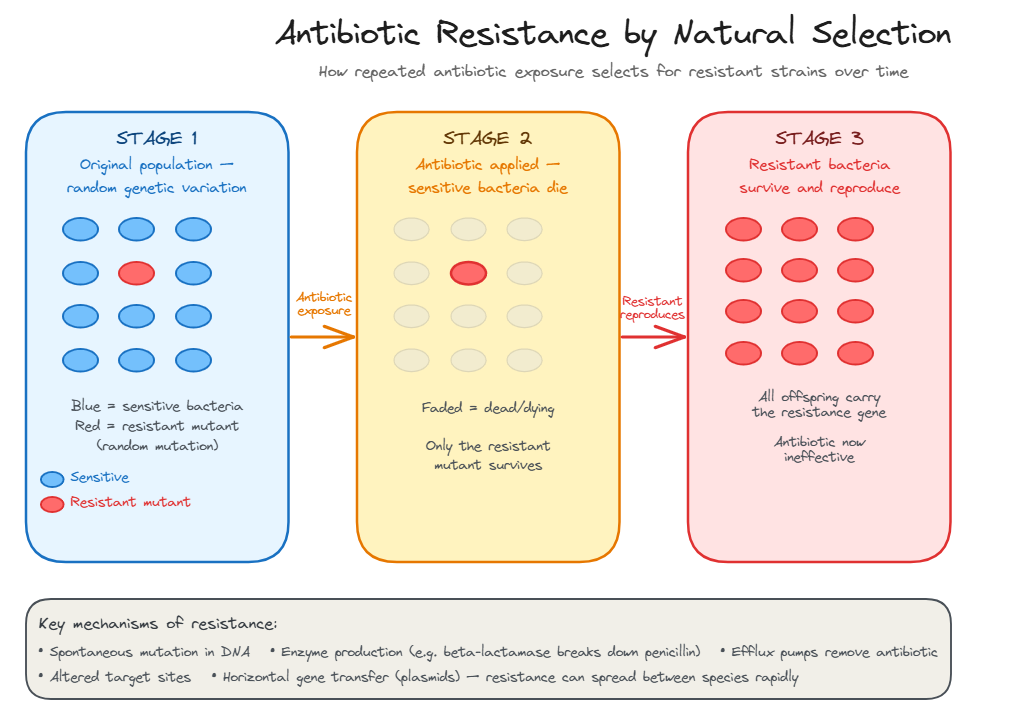
Idea tested: Resistance evolves through natural selection, pre-existing resistant variants survive the antibiotic and reproduce. Bacteria do not deliberately mutate in response to exposure (A), mutations are random and pre-exist. Antibiotics do not chemically modify DNA (B). Humans do not become immune to antibiotics (C).
Idea tested: Neuraminidase cleaves sialic acid residues that tether newly assembled influenza virions to the host cell surface. Without neuraminidase, newly formed virus particles cannot escape the infected cell and are trapped, preventing spread to new cells. (B) describes RNA polymerase inhibitors (e.g. baloxavir). (C) describes haemagglutinin function, which neuraminidase inhibitors do not target. (D) describes protease inhibitors.
Idea tested: HIV mutates rapidly, and resistance to a single drug can emerge during treatment. Triple therapy dramatically reduces the probability of resistance because a single viral particle would need to simultaneously acquire resistance mutations for three different drugs, a statistically very unlikely event. (B) is partially correct (each drug does target a different step) but does not give the primary reason for combination therapy, which is resistance prevention. (A) is a secondary consideration, not the primary rationale. (D) is partially true for some drugs but not the main reason.
Short Answer Model Answers
SA1: Antibiotics are effective against bacterial infections because they target structures or processes that are essential to bacteria but absent in (or structurally different from) human cells, this selective toxicity allows the drug to kill bacteria without harming the patient. Viruses lack these targets because they are not cells; they use the host cell's own machinery for most functions, leaving very few virus-specific targets for drugs to act on. Target 1, cell wall synthesis: antibiotics such as penicillins and vancomycin inhibit the synthesis of peptidoglycan, the structural polymer of the bacterial cell wall. Viruses have no cell wall and contain no peptidoglycan. A viral particle entering a cell does not need to maintain a cell wall, so this target simply does not exist in any stage of the viral life cycle. Target 2, bacterial ribosomes: antibiotics such as tetracyclines (30S subunit) and macrolides (50S subunit) inhibit the bacterial 70S ribosome. Viruses do not have their own ribosomes, they commandeer the host cell's 80S ribosomes to translate viral proteins. Antibiotic ribosomal inhibitors bind specifically to the 70S bacterial ribosome structure; they do not bind effectively to the 80S human ribosome, and since there are no viral ribosomes to target, these drugs have no effect on viral protein synthesis.
SA2: Before any antibiotic is introduced, random mutations during bacterial replication occasionally produce variants with characteristics that confer resistance to that antibiotic, for example, mutations that alter the antibiotic's target site or produce enzymes that inactivate the drug. These resistant variants arise spontaneously and are rare in the bacterial population, but they exist before the antibiotic is ever applied. When the antibiotic is introduced, it acts as a selection pressure: susceptible bacteria, those without the resistance mutation, cannot survive at therapeutic antibiotic concentrations and are killed or prevented from reproducing. Resistant variants are not affected by the antibiotic and continue to survive and reproduce normally. Over successive generations, the antibiotic-susceptible bacteria are progressively eliminated from the population while the resistant variants multiply. Because resistance genes are heritable, passed to daughter cells during binary fission, the offspring of resistant variants also carry the resistance gene. The result is that the bacterial population is increasingly dominated by resistant individuals. The antibiotic has not created the resistance: it has selected for pre-existing variants that happened to carry a useful trait. This is natural selection operating within a bacterial population, the same fundamental process that drives all evolutionary change.
SA3: Antibiotic resistance is one of the most serious global public health threats of the 21st century. Antimicrobial resistance (AMR) was estimated to have directly caused approximately 1.27 million deaths globally in 2019, exceeding deaths from HIV/AIDS (860,000) or malaria (640,000) in the same year. Without effective antibiotics, routine surgeries (appendectomies, caesarean sections, joint replacements), cancer chemotherapy, and organ transplantation, all of which rely on antibiotics to prevent and treat infections, would become significantly more dangerous. The drivers of resistance are multiple and interconnected. Overprescribing of antibiotics, particularly for viral respiratory infections where they have no effect, exposes bacteria in the patient's microbiome to unnecessary selection pressure. Incomplete antibiotic courses allow the most resistant bacteria in a treated population to survive and repopulate. Agricultural use of antibiotics as growth promoters in livestock exposes large bacterial populations to sub-therapeutic concentrations, one of the most significant drivers of resistance globally. Horizontal gene transfer allows resistance genes to spread between bacterial species far faster than mutation alone would permit. Management strategies include antibiotic stewardship programs in hospitals and primary care, guidelines that reduce inappropriate prescribing, reserve certain antibiotics as last-line treatments, and promote narrow-spectrum over broad-spectrum agents where possible. Patient education about completing prescribed courses and not sharing antibiotics addresses the incomplete course and self-medication problems. Investment in new antibiotic development and alternative treatments, such as bacteriophage therapy, antimicrobial peptides, and monoclonal antibodies against bacterial targets, is critical, though the commercial pipeline remains inadequate. Overall, antibiotic resistance is a serious, worsening, and potentially catastrophic threat that is directly driven by human behaviour, overuse, misuse, and agricultural application. It is manageable if sustained, coordinated global action is taken, but the trajectory of resistance data suggests the window for effective action is narrowing.