Year 12 BiologyModule 7⏱ ~25 min5 MC · 3 Short AnswerLesson 15 of 21
Hygiene, Quarantine and Public Health
You'll be able to classify public health strategies by the transmission route they interrupt.
In 1847, Ignaz Semmelweis discovered that doctors washing their hands before delivering babies could cut the death rate from 10% to under 2%. The medical establishment mocked him, dismissed him, and had him committed to an asylum. He died of the same infection he had spent his life trying to prevent. He was right.
Today's hook: In 1847, Ignaz Semmelweis ordered doctors to wash their hands with chlorine solution, and maternity ward deaths dropped by 90%. His colleagues fired him for the suggestion. Why do simple public health measures meet such resistance?
0/5TASKS
1
You’re here
Orient, explore and apply
Warm up first
Three quick questions from earlier lessons. Pulling old material back to mind before you learn something new makes the new material stick better, so this is not busywork.
Worksheets
Practise this lesson
Four printable worksheets that build from the foundations up to exam-style questions, start at whatever level suits you.
Before antibiotics, before vaccines, before germ theory was even accepted, hand-washing alone cut maternal mortality by 80% in Vienna's maternity wards.
Before reading: what other non-pharmaceutical, non-vaccine public health measures do you think have had the largest impact on reducing infectious disease transmission? Predict at least three, and for each, explain the mechanism by which they reduce transmission.
Learning Intentions
goals
Know
The key public health strategies for controlling infectious disease
How quarantine and isolation differ
The role of sanitation, clean water, and food safety
Contact tracing and its role in outbreak control
Understand
Why multiple overlapping strategies (layered defence) are more effective than any single measure
Why hygiene interventions often outperform medical treatments in mortality reduction
The tensions between individual rights and public health necessity
Can Do
Classify public health strategies by the transmission route they interrupt
Evaluate the effectiveness of hygiene and quarantine measures using data
Apply the "chain of infection" model to analyse an outbreak scenario
Scan these before reading
vocab
HygienePractices that reduce pathogen transmission through hands, surfaces, food, water or respiratory droplets.
IsolationSeparating confirmed infectious cases from others to prevent transmission.
QuarantineSeparating exposed people during the incubation period before infection is confirmed.
Contact tracingIdentifying and following up people who may have been exposed to an infectious case.
Notifiable diseaseA disease that must be reported to public health authorities.
Chain of infectionThe sequence of links required for a pathogen to spread to a susceptible host.
Cross-lesson links: L14 examined the mechanism of vaccine protection. L15 examines the simplest intervention that ever saved lives, handwashing. Semmelweis's 1847 Vienna data (mortality from about 9.5% to 1.27% after the intervention) is one of the most powerful natural experiments in medicine, demonstrating L03's transmission interruption principle before germ theory was accepted. L15 connects back to L04 (Snow's pump handle removal) as parallel pre-germ-theory evidence that breaking transmission routes works regardless of knowing the pathogen's identity.
Misconceptions To Fix
watch out
✗ Wrong: Quarantine and isolation mean the same thing.
✓ Right: Isolation applies to confirmed infectious cases. Quarantine applies to exposed people who may still be in the incubation period.
✗ Wrong: Hygiene only matters once scientists understand germ theory.
✓ Right: Hygiene can reduce transmission even before the mechanism is understood, because it breaks links in the chain of infection.
2
The Chain of Infection, Where Interventions Work
Core Content
1
The Chain of Infection, Where Interventions Work
+5 XP
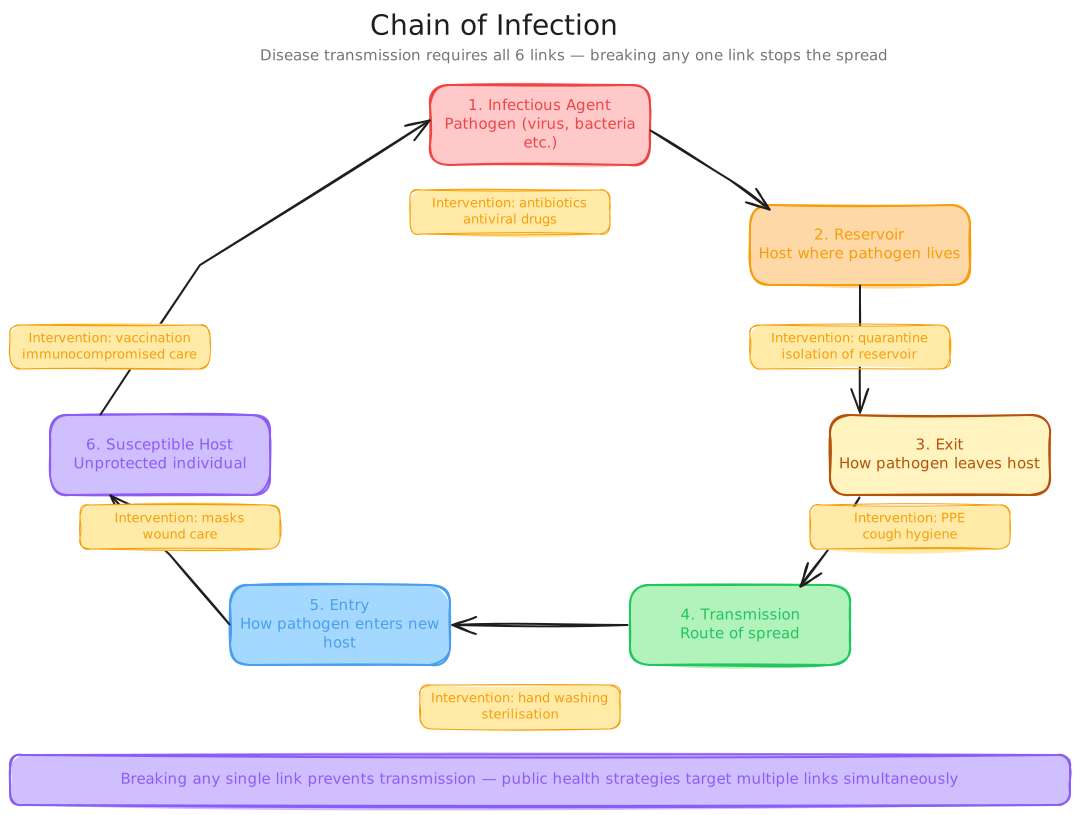
Break any link to stop the spread
In 1847, doctors at Vienna's First Obstetric Clinic were moving directly from autopsy rooms to the maternity ward, hands unwashed. Maternal mortality before the intervention was about 9.5%. At the adjacent Second Clinic, staffed only by midwives who did no autopsies, mortality was 1–2%. Ignaz Semmelweis identified the difference: a transmission link existed in one clinic and not the other. His chlorinated lime handwashing protocol broke that link. Mortality dropped to 1.3%. The chain of infection had a missing link, and he found it.
Public health interventions target different links, the more links broken simultaneously, the more effective the overall response
The chain of infection: agent → reservoir → portal of exit → mode of transmission → portal of entry → susceptible host. Breaking ANY link stops the spread. Break the reservoir (sanitation, clean water, food safety, isolation); break transmission (handwashing, PPE, quarantine, distancing); protect the host (vaccination, PPE, chemoprophylaxis). Layered strategies break several links at once.
Pause, copy the six links of the chain of infection and one intervention for each into your book.
Public health interventions work by breaking one or more links in the _____ of infection.
Interactive · Contact Tracing Simulator
Trace each contact to see how quickly an outbreak can be identified and contained.
We just saw that interventions work by breaking a link in the chain of infection. That raises a question: what are the actual real-world strategies, and which link does each one break? This card answers it → the key public health strategies, mapped to where they act.
Each strategy interrupts the chain of infection at a specific point, and layering several together is far more powerful than any one alone.
Hygiene
Hygiene refers to practices that reduce the transmission of pathogens between individuals or from environmental sources. It is the most broadly effective and cost-efficient public health intervention, Semmelweis's handwashing data demonstrated this in 1847, decades before anyone understood how germs caused disease.
Respiratory hygiene, airborne and droplet pathogens (influenza, COVID-19, TB)
Food safety, foodborne pathogens (Salmonella, E. coli, Listeria, Campylobacter)
Water treatment, waterborne pathogens (cholera, typhoid, Giardia, hepatitis A)
Healthcare hygiene, HAIs: MRSA, C. difficile, VRE
Mechanism
Soap and rubbing mechanically remove pathogens from skin; soap also disrupts the lipid envelopes of enveloped viruses
Reduces large droplet and aerosol transmission; source control, reduces what the infected person emits
Prevents contamination during preparation; temperature control prevents multiplication; cooking destroys pathogens
Removes or kills pathogens from drinking water; chlorination, filtration, UV treatment
Breaks transmission chains between patients via contaminated surfaces, instruments, and hands
Quarantine and Isolation
These terms are often confused but refer to distinct measures targeting different populations.
Term
Applied To
Purpose
Example
Isolation
People who are confirmed infected and infectious
Prevent transmission from known cases to susceptible individuals
COVID-positive patient isolated at home or hospital; TB patient in negative-pressure room
Quarantine
People who have been exposed but are not yet known to be infected (incubation period)
Prevent potential transmission during the incubation period, before symptoms appear
Close contacts of Ebola case quarantined for 21 days; international travellers during pandemic
Cohorting
Groups of infected patients housed together
Reduce spread to uninfected patients while managing multiple cases with limited resources
COVID ward in hospital
Why quarantine matches incubation period
Quarantine must last at least as long as the maximum incubation period of the disease. For COVID-19, the original incubation was up to 14 days, hence 14-day quarantine requirements. For Ebola, up to 21 days. If a quarantined person develops symptoms, they transition from quarantine to isolation. If they pass the incubation period without symptoms, they are released.
Contact Tracing
Contact tracing is the systematic identification and follow-up of individuals who may have been exposed to a confirmed case. It works by locating potential secondary cases during their incubation period, before they become infectious, and placing them in quarantine before they can transmit further. Effective contact tracing requires rapid case identification, thorough interviewing, timely notification, and resources to support quarantine.
Surveillance and Notification
Certain diseases are notifiable in Australia, healthcare providers are legally required to report confirmed or suspected cases to public health authorities. This creates a surveillance network that detects outbreaks early and triggers a public health response. Notifiable diseases include measles, tuberculosis, meningococcal disease, hepatitis A and B, and salmonellosis.
Sanitation and Safe Water
Access to safe drinking water and adequate sanitation has had a larger impact on infectious disease mortality than any medical intervention in history, including antibiotics and vaccines. The epidemiological transition that dramatically reduced deaths from typhoid, cholera, dysentery, and typhus in Europe and North America in the late 19th and early 20th centuries was driven primarily by clean water infrastructure and sewage systems, not by medicine.
Key public health strategies: hygiene, soap disrupts membranes and physically removes pathogens (the most cost-efficient measure); isolation = confirmed cases vs quarantine = exposed/unconfirmed (duration = maximum incubation period); contact tracing = find and quarantine contacts before they become infectious; surveillance/notifiable diseases = early outbreak detection; sanitation and clean water = the single greatest historical reducer of infectious-disease mortality.
Pause, copy the isolation vs quarantine distinction and the main strategies into your book.
Quarantine (as opposed to isolation) is applied to people who are:
4
Apply it: Semmelweis and the evidence for hygiene
Activity 1
AnalyseBand 4
Error Spotting, Public Health Measures
Pattern B, Error Spotting
A student wrote the following passage about public health strategies. It contains four factual errors. Identify each, explain what is wrong, and write the correction.
Student's passage (contains 4 errors)
"Public health strategies for controlling infectious disease include hygiene, quarantine, and vaccination. Quarantine is applied to individuals who are confirmed cases of a disease, they are separated from others to prevent transmission while they are infectious. Isolation, by contrast, is applied to people who have been exposed but have not yet developed symptoms, they are monitored during their incubation period. Handwashing with alcohol-based sanitiser is always more effective than soap and water for removing all types of pathogens. The major reductions in infectious disease mortality seen in the 19th and 20th centuries were primarily driven by the development of antibiotics and vaccines, rather than improvements in sanitation and clean water. Contact tracing involves identifying individuals who have been exposed to a confirmed case and placing them in isolation to prevent further spread."
List the four errors in the passage.
For each, write one sentence explaining what is wrong and what the correct information is.
Rewrite the passage correctly in your own words.
Interactive · Chain of Infection Stepper
Click through each link in the chain of infection and see where it can be broken.
Semmelweis: Dismissed, Ridiculed, Vindicated
In 1847, Ignaz Semmelweis was working at the Vienna General Hospital's maternity wards. He noticed a striking discrepancy: Ward 1, staffed by medical students and doctors who came directly from performing autopsies, had a maternal mortality rate of ~10%. Ward 2, staffed by midwives who did not perform autopsies, had a rate of ~4%. When his colleague Jakob Kolletschka died from a wound infection after a student's scalpel slipped during an autopsy, Semmelweis recognised the similarity between Kolletschka's symptoms and those of the dying mothers.
1847Semmelweis introduces chlorinated lime handwashing for all doctors and students before deliveries. Ward 1 mortality falls from ~10% to ~1.27%, below Ward 2's rate.
1848Semmelweis publishes his findings. The medical establishment rejects them, his data challenges the prevailing "miasma" theory and implies doctors themselves were killing patients. No one wants to hear it.
1865Semmelweis, increasingly erratic and despairing at the rejection of his work, is committed to a mental asylum. He dies 14 days later, most likely from Streptococcal sepsis, the same infection he had spent his career trying to prevent.
1867Joseph Lister, building on Pasteur's germ theory, introduces antiseptic surgical technique. Handwashing and antisepsis become standard practice, Semmelweis's core insight finally accepted, two years after his death.
Semmelweis's story is not just a historical tragedy, it is a case study in how strong evidence can be rejected when it challenges professional identity and existing paradigms. You will analyse his data in Activity 1 and Short Answer Q3.
5
Misconceptions, summary and practice
Common Misconceptions
watch out
✗ Misconception: Quarantine and isolation mean the same thing.
✓ These are distinct public health measures. Isolation applies to confirmed cases, people known to be infected and infectious. Quarantine applies to exposed individuals who may be in their incubation period, they are not yet confirmed as infected but could become infectious. A person in quarantine is separated as a precaution; a person in isolation is separated because they are a confirmed transmission risk.
✗ Misconception: Antibiotics and vaccines are the primary reason death rates from infectious disease fell dramatically in the 20th century.
✓ The largest reductions in infectious disease mortality, particularly from typhoid, cholera, tuberculosis, dysentery, and diarrhoeal diseases, occurred before the widespread use of antibiotics (1940s) and before vaccines for most of these diseases. The primary driver was improved sanitation: clean water supply, sewage systems, improved nutrition, and housing. Antibiotics and vaccines then accelerated the decline.
✗ Misconception: Hand sanitiser is always more effective than handwashing with soap.
✓ Alcohol-based hand sanitiser is highly effective against most enveloped viruses (influenza, COVID-19) and many bacteria. However, soap and water is superior for removing certain pathogens: Clostridioides difficile (C. diff) spores are resistant to alcohol and must be physically removed by washing; norovirus and some other non-enveloped viruses are also better removed by soap and water. For visibly soiled hands, soap and water is always the correct choice.
Ward 1 (doctors from autopsies): ~10% mortality → ~1.27% after handwashing.
Ward 2 (midwives, no autopsies): ~4% throughout.
Rejected because it implied doctors caused deaths, professional identity barrier.
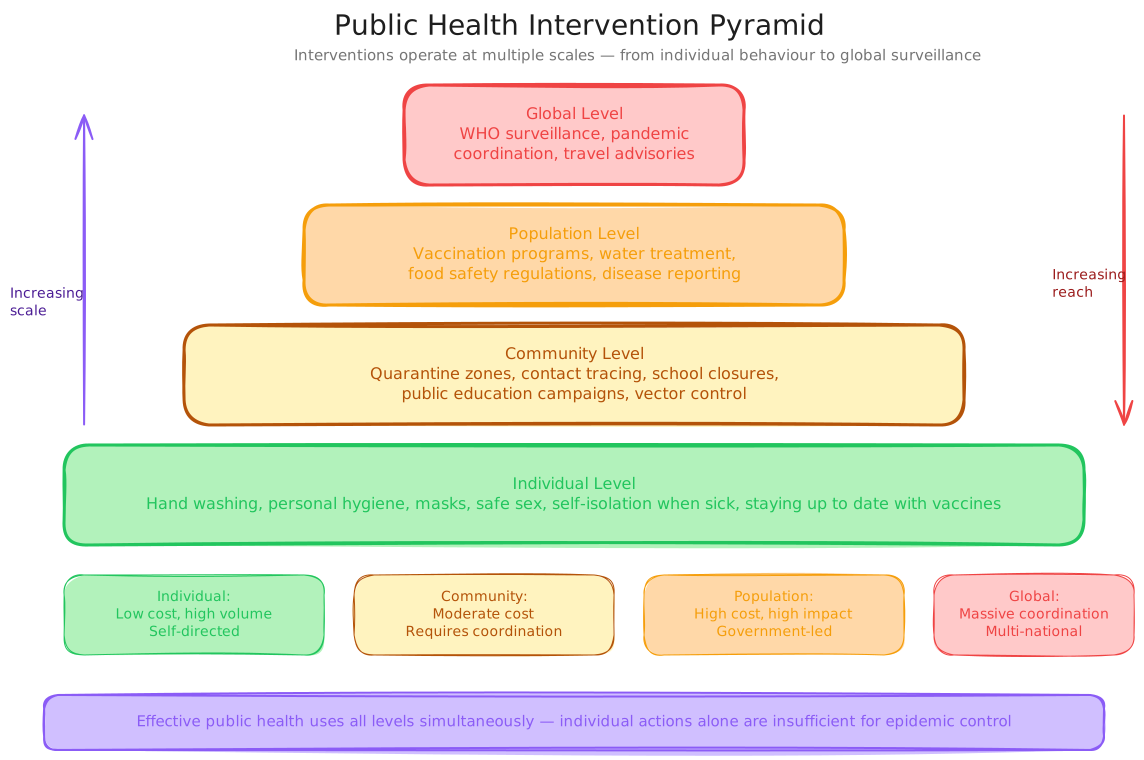
Public Health Intervention Pyramid
Disease Control Strategy, Decision Guide
Explain6 marks
Explain how hygiene and quarantine procedures interrupt the chain of infection.
1
Unpack the verb
The dot point instructs you to investigate procedures that prevent the spread of disease — a scoping instruction — so it is examined with Explain: investigate → explain. The mechanism is what must be explained, not the list of procedures.
Plan: name the principle, take each link and the procedure that breaks it as a linked pair, then close on why several are used together.
Naming procedures earns little. The marks are for saying which link each one breaks and why breaking that link stops transmission.
2
Name the governing principle
Transmission requires an unbroken chain: a pathogen, a reservoir where it survives, a portal of exit, a mode of transmission, a portal of entry, and a susceptible host. Because every link is necessary, breaking any one of them stops that transmission event — so control does not require eliminating the pathogen, only interrupting the chain.
The chain framing is what turns a list of measures into an explanation, because each measure can then be located at a link.
3
Linked pair 1 — hand hygiene breaks the mode of transmission
Hands are the commonest vehicle for indirect contact transmission, picking up pathogens from one surface or person and depositing them on another. Washing with soap works physically rather than chemically for much of its effect: soap molecules lift oils and the microorganisms held in them from the skin, and running water carries them away. Alcohol-based rubs instead denature proteins and dissolve lipid envelopes — which is why they are effective against enveloped viruses such as influenza and much less so against non-enveloped ones such as norovirus, where washing is required.
Distinguishing removal from killing explains why the two methods are not interchangeable, which is a genuinely useful piece of understanding.
4
Linked pair 2 — disinfection and sterilisation break the reservoir
Cleaning and disinfecting surfaces removes the environmental reservoir that indirect transmission depends on, and sterilisation of instruments — by autoclaving, which uses steam under pressure to reach temperatures above one hundred degrees — destroys even bacterial endospores, which ordinary disinfection does not. This matters because an instrument entering tissue bypasses every physical barrier the first line of defence provides.
Naming endospores explains why sterilisation is a different requirement from disinfection rather than a stronger version of it.
5
Linked pair 3 — isolation and quarantine break exit and entry
These two are distinct and the distinction is examinable. Isolation separates people who are known to be infected, removing the portal of exit from the population. Quarantine separates people who have been exposed but are not yet known to be infected, and it works because many pathogens are transmissible before symptoms appear — so quarantine addresses the period in which isolation would not yet have been triggered. Its duration is set by the incubation period, since a person who does not develop disease within it was not infected.
Explaining why quarantine's duration equals the incubation period shows the measure is derived rather than arbitrary.
6
Close on why several are used together
No single procedure is complete, because each addresses one link and pathogens differ in which links they use. A waterborne pathogen is unaffected by hand hygiene between people but stopped by treating the supply, while an airborne one is unaffected by surface disinfection but reduced by ventilation and distancing. Layering procedures therefore covers the links a single measure leaves open, and it also provides redundancy — if one measure is applied imperfectly, another still interrupts the chain.
Redundancy is the argument for layering, and it is the reason public health uses several imperfect measures rather than one.
7
What a full-mark answer looks like
Transmission requires an unbroken chain — a pathogen, a reservoir, a portal of exit, a mode of transmission, a portal of entry, and a susceptible host — and because every link is necessary, breaking any one stops that transmission event, so control does not require eliminating the pathogen, only interrupting the chain. Hands are the commonest vehicle for indirect contact transmission, and washing with soap works physically for much of its effect, since soap lifts oils and the microorganisms held in them from the skin and running water carries them away, whereas alcohol-based rubs denature proteins and dissolve lipid envelopes — which is why they work well against enveloped viruses such as influenza and poorly against non-enveloped ones such as norovirus, where washing is required. Cleaning and disinfecting surfaces removes the environmental reservoir indirect transmission depends on, while sterilisation by autoclaving, using steam under pressure above one hundred degrees, destroys even bacterial endospores that ordinary disinfection does not — which matters because an instrument entering tissue bypasses every barrier the first line of defence provides. Isolation and quarantine are distinct: isolation separates people known to be infected, removing the portal of exit, while quarantine separates people who have been exposed but are not yet known to be infected, working because many pathogens are transmissible before symptoms appear, so it addresses the period in which isolation would not yet be triggered — and its duration is set by the incubation period, since a person who does not develop disease within it was not infected. No single procedure is complete, since each addresses one link and pathogens differ in which links they use: a waterborne pathogen is unaffected by hand hygiene but stopped by treating the supply, while an airborne one is unaffected by surface disinfection but reduced by ventilation and distancing — so layering covers the links a single measure leaves open and provides redundancy when one is applied imperfectly.
The chain as the organising principle, each procedure located at a link with its physical mechanism, isolation and quarantine properly distinguished, and layering justified by coverage and redundancy.
Assess6 marks
Assess the strength of Semmelweis's evidence that handwashing reduces the spread of disease.
1
Unpack the verb
Assess asks how strong the evidence was, judged against criteria. The conclusion is now known to be correct, so the interesting judgement is whether the evidence available at the time justified it.
Plan: state the criteria, assess what the evidence delivered, assess its weaknesses, then reach a verdict and qualify it.
Judging by hindsight is not assessing evidence. The question is what the data supported in 1847, before germ theory existed to explain it.
2
State your criteria
The evidence will be judged on whether it included a valid comparison, on the size and consistency of the effect, on whether alternative explanations were excluded, and on whether a mechanism was available to explain it.
Including mechanism as a criterion is essential here, because its absence is the main reason the evidence was rejected at the time.
3
Assess the comparison and the effect size
The comparison was unusually good for its era and effectively natural. Two maternity clinics in the same hospital admitted women on alternating days, so the populations were similar, yet the clinic staffed by doctors had a maternal mortality from puerperal fever several times that of the clinic staffed by midwives — around ten per cent against three to four. Semmelweis identified that the doctors came from performing autopsies and the midwives did not, introduced handwashing in chlorinated lime, and mortality in the doctors' clinic fell to approximately that of the midwives' within months. A large effect, in a comparison with a plausible control, reversed by an intervention aimed at the suspected cause, is strong evidence.
Naming the alternating-day admission is what makes this a natural experiment rather than an observation, and it is the strongest feature of the evidence.
4
Assess the exclusion of alternatives
Semmelweis also tested competing explanations rather than assuming his own. Prevailing accounts blamed overcrowding, ventilation and the presence of a priest, and he addressed them — the clinics did not differ in the ways those explanations required, and altering the priest's route changed nothing. He was further supported by a tragic natural experiment: a colleague cut during an autopsy died with the same clinical picture as the women, indicating that something transmitted from cadavers was responsible rather than anything peculiar to childbirth.
The colleague's death is the observation that connects the cause across contexts and it is what makes the inference more than correlational.
5
Assess the weaknesses
The evidence had real gaps. There was no randomisation and no blinding, the comparison was between clinics rather than within one, and the before-and-after component is vulnerable to other changes occurring at the same time. Data recording was inconsistent between the clinics. Most importantly, Semmelweis could offer no mechanism — germ theory was two decades away — so his conclusion required accepting that an invisible something was carried on hands, which conflicted with the miasma theory then dominant. He also published late and argued poorly, which affected the reception rather than the evidence.
Separating the quality of the evidence from the quality of its advocacy is a discriminating point and it explains the historical outcome fairly.
6
Weigh it — reach a verdict
The evidence was strong enough to justify acting on and not strong enough to compel belief in a scientific community without a mechanism. Judged by the criteria available at the time it satisfies comparison, effect size and exclusion of alternatives, and fails only on mechanism — which was not a defect of his work but of the state of knowledge. The rejection of his findings is therefore a case of a correct conclusion being resisted for the absence of an explanation rather than for weakness in the data.
A verdict separating what the evidence supported from why it was rejected is the accurate judgement and it answers the question precisely.
7
Qualify, then link back
The qualification is that demanding a mechanism is not unreasonable in general — it is one of the criteria by which causal claims are properly judged, and it protects against acting on spurious correlations. Semmelweis's case shows the cost of applying that requirement absolutely: where an intervention is cheap and safe, the strength of the association can justify acting before the mechanism is known, as John Snow's removal of the Broad Street pump handle also demonstrates.
Defending the criterion while showing when it should yield is more sophisticated than dismissing his critics, and the Snow parallel connects to lesson03.
8
What a full-mark answer looks like
The evidence will be judged on whether it included a valid comparison, the size and consistency of the effect, whether alternatives were excluded, and whether a mechanism was available. The comparison was unusually good for its era and effectively natural: two maternity clinics in the same hospital admitted women on alternating days, so the populations were similar, yet the doctors' clinic had maternal mortality from puerperal fever of around ten per cent against three to four in the midwives' clinic — and Semmelweis, identifying that the doctors came from performing autopsies, introduced handwashing in chlorinated lime, after which mortality fell to approximately the midwives' level within months, so a large effect in a controlled comparison, reversed by an intervention aimed at the suspected cause, is strong evidence. He also tested competing explanations rather than assuming his own, addressing overcrowding, ventilation and the presence of a priest, none of which distinguished the clinics, and was supported by a tragic natural experiment when a colleague cut during an autopsy died with the same clinical picture as the women, indicating transmission from cadavers rather than anything peculiar to childbirth. The evidence nonetheless had gaps: no randomisation or blinding, a comparison between clinics rather than within one, a before-and-after component vulnerable to concurrent changes, inconsistent record-keeping, and — most importantly — no mechanism, since germ theory was two decades away, so his conclusion required accepting that an invisible something was carried on hands against the dominant miasma theory, while his late publication and poor advocacy affected the reception rather than the evidence. It was therefore strong enough to justify acting on and not strong enough to compel belief without a mechanism: judged by the criteria of the time it satisfies comparison, effect size and exclusion of alternatives and fails only on mechanism, which was a defect of the state of knowledge rather than of his work — so its rejection is a case of a correct conclusion resisted for want of an explanation rather than for weakness in the data. The qualification is that requiring a mechanism is not unreasonable in general, being one of the proper criteria for causal claims and a protection against spurious correlations — but Semmelweis shows the cost of applying it absolutely, since where an intervention is cheap and safe the strength of an association can justify acting before the mechanism is known, as Snow's removal of the Broad Street pump handle also demonstrates.
Four criteria, the natural experiment and effect size, alternatives tested rather than assumed, gaps including the missing mechanism, a verdict distinguishing evidential strength from persuasive failure, and a qualification defending the criterion while showing when it should yield.
✓
Independent practice
01
Multiple Choice
+5 XP
A fresh set drawn from this lesson's question bank, feedback shown immediately. +5 XP per correct · +25 XP all correct
Pick your answer, then rate your confidence, that tells the system what to drill next.
02
Short Answer, 10 marks
+5 XP
ApplyBand 3(3 marks) 1. Describe two public health strategies that target different links in the chain of infection. For each, identify which link it targets, explain the mechanism by which it reduces transmission, and give a specific example.
1 mark: strategy 1, link, mechanism, example · 1 mark: strategy 2, different link, mechanism, example · 1 mark: explicit statement that the two target different links
UnderstandBand 4(3 marks) 2. Explain the difference between quarantine and isolation, including who each is applied to, the purpose of each, and why the duration of quarantine is specifically set to match the incubation period of the disease.
EvaluateBand 5(4 marks) 3. Using Semmelweis's handwashing data, evaluate the effectiveness of hygiene as a public health strategy. In your answer, describe the evidence Semmelweis presented, explain why it was initially rejected, and assess what it demonstrates about the relationship between hygiene and infectious disease control.
1 mark: evidence (Ward 1 ~9.5%→~1.27%; vs Ward 2) · 1 mark: rejection reason (professional identity / miasma / no mechanism) · 1 mark: assessment, dramatic reduction; predated germ theory · 1 mark: broader implication (sanitation/hygiene historically more impactful)
Show all answers
Multiple choice
MC answers and full explanations are shown inline as you complete each question. Use the retry button to attempt a fresh set from the lesson bank.
Short Answer Model Answers
Q1 (3 marks): Strategy 1, Clean water supply and sewage treatment target the reservoir link. The reservoir for waterborne diseases such as cholera (Vibrio cholerae) and typhoid is contaminated water, both source and vehicle of transmission. By treating drinking water (chlorination, filtration, UV) and safely disposing of sewage away from water supplies, the pathogen is removed from the reservoir before it can reach susceptible hosts, regardless of their immune status. Strategy 2, Handwashing with soap targets the transmission link. Soap disrupts the lipid membranes of enveloped pathogens and the mechanical action physically removes pathogen particles from the skin, interrupting hand-to-mouth, hand-to-surface, and direct contact transmission, for example, preventing faecal-oral transmission of rotavirus. These two strategies target different links: clean water acts on the environmental reservoir, while handwashing acts on the transmission route.
Q2 (3 marks): Quarantine is applied to individuals who have been exposed to a confirmed case but are not yet known to be infected. Its purpose is to prevent potential transmission during the incubation period, when an individual may not yet show symptoms but could already transmit the pathogen. Isolation is applied to individuals confirmed to be infected and infectious; its purpose is to prevent transmission from known cases to susceptible individuals. The key distinction is certainty of infection: quarantine manages uncertainty (might be infected), isolation manages confirmed risk (is infected). Quarantine duration is set to match the maximum incubation period because if a quarantined person has not developed symptoms by the end of the maximum incubation period, it is very unlikely they are infected; releasing them earlier risks releasing a person still in the pre-symptomatic phase who may become infectious after release.
Q3 (4 marks): Semmelweis's evidence was quantitative and systematic: he compared maternal mortality in two wards of the same hospital over years. Ward 1 (medical students/doctors coming from autopsies) had mortality of ~6–11%; Ward 2 (midwives, no autopsies) had ~2–4%. After he introduced chlorinated lime handwashing in May 1847, Ward 1 mortality fell from ~9.5% (Jan–May 1847) to 1.27% (Jun–Dec 1847), an ~87% reduction, and stayed below 2%. Despite this, the findings were rejected for reasons unrelated to data quality: accepting them meant accepting that doctors were transmitting lethal infection from autopsied bodies to patients, an intolerable challenge to professional identity; and Semmelweis had no mechanism compatible with the prevailing miasma theory (germ theory came later). The data demonstrates that hygiene, interrupting transmission via contaminated hands, is a highly effective, independently powerful intervention that predated microbiology by ~20 years. More broadly, it illustrates the historical pattern that sanitation, clean water, and hygiene reduced infectious disease mortality more dramatically than specific medical interventions; the great mortality declines from cholera, typhoid, and dysentery largely preceded effective antibiotics or vaccines.
★
Retrieve and reflect
Check what actually stuck
Take the full module quiz
quiz
A full module quiz covering every lesson in this module, not just this one. Set aside a decent block of time and treat it like a real assessment.
You were asked to predict three non-pharmaceutical, non-vaccine public health measures and explain their transmission-interruption mechanisms. Ignaz Semmelweis's 1847 Vienna handwashing intervention is the archetypal example: when he required doctors at Vienna General Hospital's First Obstetric Clinic to wash with chlorinated lime solution before deliveries, maternal mortality from puerperal fever dropped from 18.3% to 1.3% within months, a near-complete elimination of one of the most lethal childbirth complications of the era, achieved without vaccines, without antibiotics, and without any understanding of germ theory.
The strongest candidates from history: clean water and sanitation (eliminated cholera and typhoid in Europe, far more lives saved than any antibiotic), handwashing (Semmelweis; dramatically reduced maternal mortality), food safety regulations (eliminated most foodborne outbreak chains at source), and respiratory hygiene (mask use, covering coughs, reduces droplet transmission of influenza, TB, COVID-19).
If you predicted handwashing, the data speaks for itself. If you predicted quarantine or isolation, correct, but note these manage cases and contacts rather than the environmental reservoir. If you predicted clean water, this is arguably the single greatest public health intervention in human history.
The key insight this lesson: most of the dramatic gains in life expectancy over the last 150 years came not from medicine, but from engineering, pipes, drains, and water treatment. Medicine then accelerated gains that infrastructure had started. The chain of infection framework explains why: removing the reservoir (clean water) permanently breaks transmission, regardless of individual immunity.