Multiple choice
Idea tested: Plasmodium is a eukaryotic parasite, so the structures standard antibacterial antibiotics target, such as the peptidoglycan cell wall, are not present in it; antivirals target viral replication machinery (Plasmodium is not a virus). Specific antimalarial drugs target parasite-unique processes. (C) is wrong, Plasmodium does express surface antigens; vaccines targeting them are now approved. (D) is wrong, malaria always requires the mosquito vector.
Idea tested: The liver stage is asymptomatic, creating an important window to eliminate parasites before illness begins. Primaquine kills liver-stage parasites; RTS,S/R21 vaccines block sporozoite invasion of liver cells. (A) is wrong, symptoms occur in the blood stage. (B) is wrong, sexual reproduction occurs in the mosquito gut, not the liver.
Idea tested: ADE occurs when pre-existing antibodies from a first serotype bind but cannot neutralise the second serotype, instead facilitating its entry into Fc receptor-bearing immune cells, dramatically amplifying infection. (A) is the opposite of ADE. (B) describes a different evasion mechanism. (C) is incorrect.
Idea tested: ITNs work via physical barrier (prevents bites during sleep) and pyrethroid coating (kills mosquitoes landing on the net). (B), (C), and (D) are all biologically incorrect descriptions of how ITNs function.
Idea tested: Wolbachia does not kill mosquitoes, it reduces their vector competence (ability to transmit dengue). No lethal selection pressure means there is no mechanism for insecticide-style resistance to evolve. (A) is wrong, mosquito population is maintained. (B) is wrong, Wolbachia competes intracellularly with the virus, not via a toxin. (D) misunderstands the mechanism.
Short Answer Model Answers
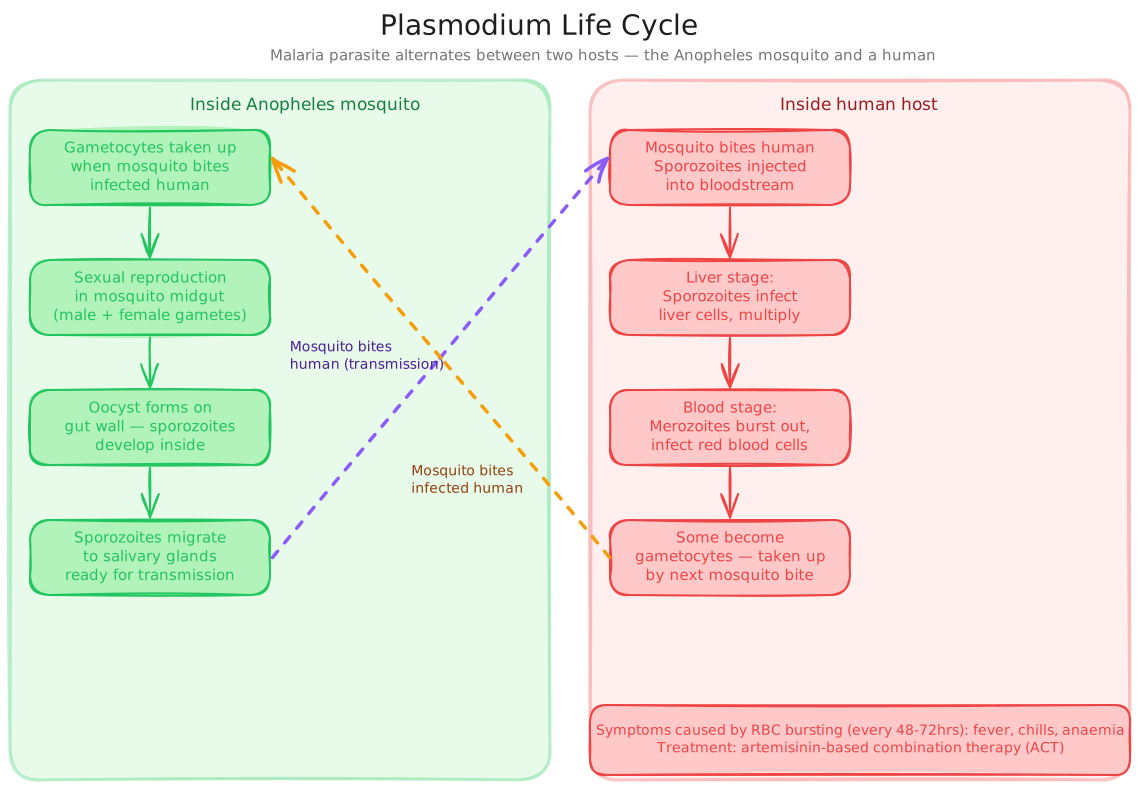
SA1: The Plasmodium falciparum life cycle alternates between mosquito and human hosts. Stage 1, the mosquito stage: sporozoites develop in the mosquito's salivary glands after sexual reproduction in the mosquito gut. This stage is targeted by vector control, insecticide-treated bed nets and indoor residual spraying kill or repel Anopheles mosquitoes before they can deliver sporozoites in an infected bite. Stage 2, the liver stage: sporozoites injected during a bite rapidly migrate to the liver, invading hepatocytes and multiplying asexually to produce thousands of merozoites. No symptoms occur. The drug primaquine kills liver-stage parasites. The RTS,S and R21 vaccines block sporozoite invasion of liver cells by stimulating antibodies against the circumsporozoite protein, eliminating parasites before the symptomatic blood stage begins. Stage 3, the blood stage: merozoites released from the liver invade red blood cells, multiply, rupture the cells (causing the characteristic fever and anaemia of malaria), and release more merozoites. ACT (artemisinin combination therapy) kills blood-stage parasites rapidly, treating illness and reducing transmission by limiting gametocyte production.
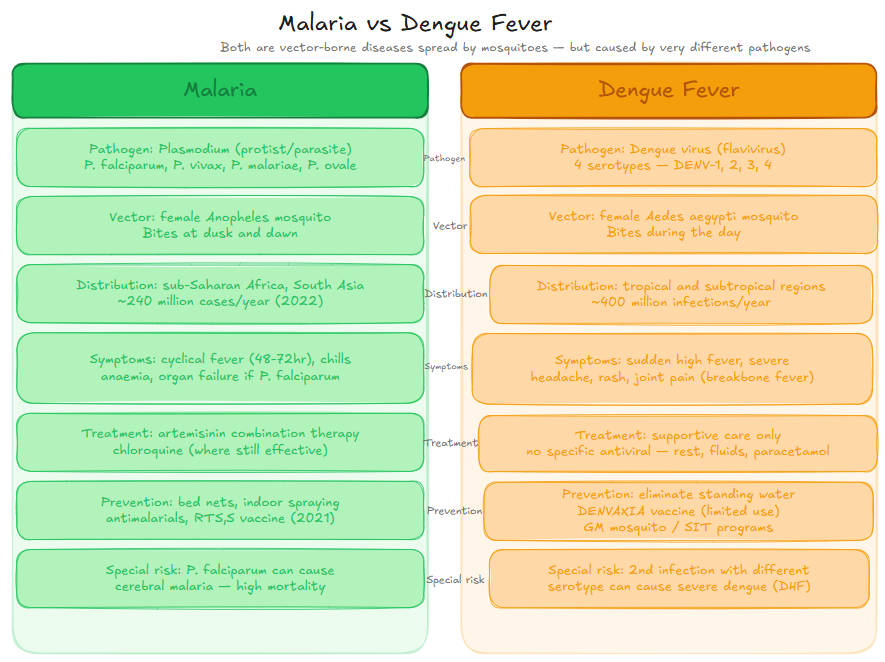
SA2: Dengue is more difficult to vaccinate against than malaria for three interconnected reasons. First, dengue virus has four antigenically distinct serotypes (DENV-1, 2, 3, 4). A vaccine must provide strong, balanced, lasting immunity against all four simultaneously, a far more complex immunological target than the relatively stable sporozoite protein targeted by the malaria vaccines. Second, the phenomenon of antibody-dependent enhancement (ADE) creates a paradoxical risk. If a vaccine provides immunity against some serotypes but not others, vaccinated individuals may be worse off than unvaccinated, pre-existing antibodies from the vaccine-induced response can facilitate entry of unprotected serotypes into Fc receptor-bearing immune cells, amplifying the infection and potentially causing severe dengue haemorrhagic fever. Third, the Dengvaxia program in the Philippines demonstrated this risk in practice. Given to over 800,000 schoolchildren in 2016, including many who had never previously had dengue (seronegative), subsequent analysis showed seronegative recipients were at higher risk of severe dengue after vaccination, exactly the ADE effect. The program was halted, criminal investigations were launched, and Dengvaxia is now recommended only for seropositive individuals, the opposite of the original target population.
SA3: Between 2000 and 2015, integrated malaria control programs in sub-Saharan Africa achieved substantial progress. Malaria deaths per 100,000 fell from 121 to 51, a reduction of approximately 58%, as insecticide-treated bed net coverage increased from 2% to 65% of households and ACT became widely available. Case numbers also fell from ~370 to ~218 per 100,000. This represented millions of lives saved and one of global health's most significant achievements in the early 21st century. Since 2015, however, progress has stalled. Death rates stabilised in the 51–62 range rather than continuing to decline. ITN coverage plateaued at approximately 62–65% of households, logistical, funding, and population growth constraints appear to have limited further scale-up. Pyrethroid resistance in Anopheles populations is progressively reducing the killing effectiveness of treated nets in many areas. Artemisinin partial resistance, first detected in Southeast Asia, is increasingly found in African P. falciparum populations, threatening the gold-standard treatment. The COVID-19 pandemic in 2020 severely disrupted malaria service delivery, the data show a notable spike in both cases (238 per 100,000) and deaths (62 per 100,000) in that year, despite ACT nominally remaining available. The R21/Matrix-M vaccine, with approximately 75–80% efficacy approved by the WHO in 2023, has the potential to significantly accelerate malaria control beyond what bed nets and drugs alone can achieve. If deployed at scale, particularly to children under five, who bear 76% of malaria deaths, it could drive substantial further reductions in mortality even in areas where insecticide and drug resistance is limiting existing tools. Cold chain requirements, healthcare system capacity, and sustained funding remain constraints on deployment. Overall, the 2000–2015 period demonstrates what sustained, scaled investment in integrated malaria control can achieve. The post-2015 stall is a serious warning: without new tools, continued investment, and strategies to address resistance, the gains of the previous decade risk being eroded by biology and demography.