Standard Solutions & Dilutions
A forensic toxicologist testing a blood sample can't use a vague "roughly 1 mol/L" acid — the result has to stand up in court. A pharmaceutical lab dissolving a drug standard can't afford to be off by 0.1%. This is why primary standards and volumetric flasks exist: chemistry where precision is not optional.
Download this lesson's worksheet
Use the PDF for classwork, homework or revision. It includes key ideas, activities, questions, an extend task and success-criteria proof.
When you make a cup of cordial, you start with a concentrated syrup and add water to dilute it. If you have 50 mL of cordial syrup that is 10× strength, and you want to make a normal-strength drink, how much water would you need to add? What principle governs the relationship between the concentrated and diluted versions?
Type your initial thoughts below:
Record your ideas in your workbook.
From L06 — still needed
n = moles of solute (mol)
V = volume of solution (L)
New this lesson — dilution
V₁ = initial volume (L or mL)
c₂ = final concentration (mol L⁻¹)
V₂ = final volume (L or mL)
Know
- Definition of a primary standard
- Four properties a primary standard must have
- Examples: Na₂CO₃, KIO₃, oxalic acid
- The dilution formula c₁V₁ = c₂V₂
Understand
- Why moles of solute are conserved during dilution
- Why most reagents can't be used as primary standards
- The role of a volumetric flask in accurate preparation
Can Do
- Describe the preparation of a standard solution
- Identify whether a substance qualifies as a primary standard
- Use c₁V₁ = c₂V₂ to solve dilution problems
📚 Core Content
Misconceptions to Fix
Wrong: A catalyst increases the yield of products in an equilibrium reaction.
Right: A catalyst speeds up both forward and reverse reactions equally; it does not change equilibrium yield.
Primary Standards
A standard solution is one whose concentration is known precisely. You can make a standard solution from scratch only if you start with a substance that meets strict criteria — a primary standard.
Most chemicals you'd find in a lab cannot be used as primary standards. Concentrated HCl, for example, is a liquid of variable concentration that absorbs water from air — you could never weigh out a precise amount. NaOH absorbs both CO₂ and water from air, changing its mass continuously.
The Four Properties of a Primary Standard
A primary standard must satisfy all four of the following:
| Property | Why it matters | Example failure |
|---|---|---|
| High purity | If the substance contains impurities, the actual moles present will differ from the calculated value — the concentration will be wrong from the start. | NaOH absorbs CO₂ — not pure NaOH |
| Stable (doesn't react with air) | If the substance reacts with O₂, CO₂, or H₂O in the atmosphere, its composition changes between weighing and dissolving. The mass you weighed no longer represents the same number of moles. | Na reacts violently with moisture |
| High molar mass | A higher molar mass means you need to weigh out more grams per mole. This reduces the percentage error from the balance — a 0.001 g weighing error matters far less when you're weighing 200 g than when you're weighing 4 g. | HCl (MM = 36.46) — tiny masses, huge % error |
| Readily soluble in water | The substance must dissolve completely and quickly to form a homogeneous solution. An undissolved residue means not all the solute is in solution — the concentration is undefined. | BaSO₄ is insoluble — can't make a solution |
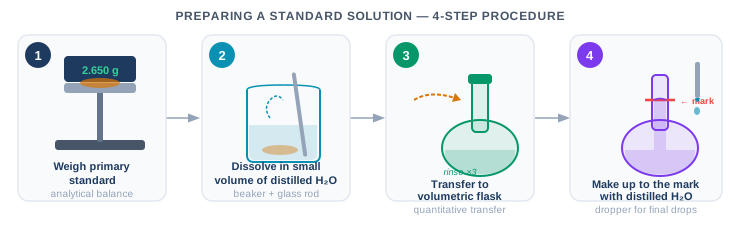
Preparing a Standard Solution — Step by Step
This procedure is examinable. You may be asked to describe it and justify each step.
Dilution — c₁V₁ = c₂V₂
When you add water to a solution, you increase its volume but the number of moles of solute stays the same. This is the key insight behind dilution. The concentration must decrease to keep the moles constant.
c₁V₁ = c₂V₂ (because n = cV for both)
Important: V₁ and V₂ must be in the same units (both L or both mL) — but they don't have to be litres, because they appear on both sides and the units cancel.
Serial Dilution
A serial dilution is a repeated sequence of dilutions, each reducing the concentration by the same factor. It's used to produce a range of very low concentrations from a concentrated stock — for example, when preparing calibration standards for spectroscopy.
Step 1: 10 mL of stock → 100 mL → 0.100 mol L⁻¹
Step 2: 10 mL of Step 1 → 100 mL → 0.0100 mol L⁻¹
Step 3: 10 mL of Step 2 → 100 mL → 0.00100 mol L⁻¹
Each step multiplies the concentration by ×0.1 (or ÷10).
🧮 Worked Examples
Worked Example 1 — Preparing a standard solution
Stepwise-
1Calculate molar massMM(Na₂CO₃) = 2(22.990) + 12.011 + 3(15.999) = 105.989 g mol⁻¹
-
2Convert mass to molesn = m ÷ MM = 2.650 ÷ 105.989 = 0.025003 mol
-
3Convert volume and calculate concentrationV = 250.0 mL ÷ 1000 = 0.2500 Lc = n ÷ V = 0.025003 ÷ 0.2500 = 0.1000 mol L⁻¹
Worked Example 2 — Basic dilution calculation
Stepwise-
1Identify variablesc₁ = 2.00 mol L⁻¹ | V₁ = 100 mL | V₂ = 500 mL | c₂ = ?Units match (both mL) — no conversion needed here.
-
2Apply and rearrangec₁V₁ = c₂V₂c₂ = c₁V₁ ÷ V₂ = (2.00 × 100) ÷ 500c₂ = 200 ÷ 500 = 0.400 mol L⁻¹
Worked Example 3 — Finding volume needed for dilution
Stepwise-
1Identify variablesc₁ = 6.00 mol L⁻¹ | V₁ = ? | c₂ = 0.500 mol L⁻¹ | V₂ = 250 mL
-
2Rearrange and solveV₁ = c₂V₂ ÷ c₁ = (0.500 × 250) ÷ 6.00V₁ = 125 ÷ 6.00 = 20.8 mL
Common Mistakes
📓 Copy Into Your Books
▼📖 Primary Standard — 4 Properties
- High purity — impurities change the actual moles present
- Stable in air — reacting with O₂/CO₂/H₂O changes composition
- High molar mass — reduces % weighing error
- Readily soluble in water — must dissolve completely
🧪 Standard Solution Preparation
- 1. Weigh accurately on analytical balance
- 2. Dissolve in small volume of distilled water
- 3. Transfer quantitatively to volumetric flask (rinse ×3)
- 4. Make up to mark — use dropper for last drops
💧 Dilution Formula
- c₁V₁ = c₂V₂
- V₁ = volume of concentrated solution used
- V₂ = total final volume of diluted solution
- Units must match on both sides
- c₂ must always be less than c₁
⚠️ Key Distinctions
- Standard solution: concentration known precisely
- Non-standard: concentration approximate (e.g. NaOH)
- V₂ = total volume, NOT volume of water added
- Moles conserved on dilution: n₁ = n₂
🧪 Activities
Applying c₁V₁ = c₂V₂
-
1 50.0 mL of 3.00 mol L⁻¹ NaOH is diluted to 300 mL. Calculate the final concentration.
c₁ = 3.00, V₁ = 50.0 mL, V₂ = 300 mL c₂ = c₁V₁ ÷ V₂ = (3.00 × 50.0) ÷ 300 = 0.500 mol L⁻¹ -
2 What volume of 12.0 mol L⁻¹ HCl must be diluted to 1.00 L to give 0.250 mol L⁻¹ HCl?
c₁ = 12.0, V₂ = 1000 mL, c₂ = 0.250 V₁ = c₂V₂ ÷ c₁ = (0.250 × 1000) ÷ 12.0 = 20.8 mL -
3 25.0 mL of a 0.400 mol L⁻¹ solution is diluted by adding 75.0 mL of water. What is the new concentration?
V₂ = 25.0 + 75.0 = 100.0 mL (total final volume) c₂ = (0.400 × 25.0) ÷ 100.0 = 0.100 mol L⁻¹ -
4 A student dilutes 10.0 mL of stock solution to 500 mL and measures the final concentration as 0.0200 mol L⁻¹. What was the concentration of the original stock solution?
V₁ = 10.0 mL, V₂ = 500 mL, c₂ = 0.0200 c₁ = c₂V₂ ÷ V₁ = (0.0200 × 500) ÷ 10.0 = 1.00 mol L⁻¹
Type your working for all four problems:
Complete in your workbook.
Would These Work as Primary Standards?
A. Sodium hydroxide (NaOH, MM = 40.00 g mol⁻¹) — solid, but absorbs both CO₂ and water vapour from the air.
B. Potassium hydrogen phthalate (KHP, MM = 204.22 g mol⁻¹) — high-purity solid, stable in air at room temperature, soluble in water.
C. Hydrochloric acid (HCl gas dissolved in water, MM = 36.46 g mol⁻¹) — concentrated HCl is a liquid with a concentration that varies with temperature and storage.
D. Barium sulfate (BaSO₄, MM = 233.39 g mol⁻¹) — high purity, stable solid, does not react with air, high molar mass.
Write your evaluation for A, B, C, and D below:
Answer in your workbook.
At the start of this lesson, you used cordial dilution to think about the relationship between concentrated and diluted solutions.
The answer: add 450 mL of water (making 500 mL total). The principle is that moles of solute are conserved — c₁V₁ = c₂V₂. If c₁ = 10×, c₂ = 1×, V₁ = 50 mL, then V₂ = (10 × 50) ÷ 1 = 500 mL. The same formula applies to all chemical dilutions, and it's the foundation of the standard solution and dilution calculations in this lesson.
Reflect: how close was your prediction to the formula c₁V₁ = c₂V₂?
Write a reflection in your workbook.
Multiple Choice
5 random questions from a replayable lesson bank — feedback shown immediately
✍️ Short Answer
Extended Questions
6. A student prepares a standard solution of potassium iodate (KIO₃) by dissolving 1.070 g of KIO₃ in distilled water and making up to 250.0 mL in a volumetric flask. (a) Calculate the concentration of the standard solution. (b) State two properties of KIO₃ that make it suitable as a primary standard. (K = 39.098, I = 126.90, O = 15.999) 4 MARKS
Type your answer:
Answer in workbook.
7. A laboratory technician needs to prepare 500 mL of 0.0500 mol L⁻¹ sulfuric acid from a concentrated stock solution of 9.80 mol L⁻¹. (a) Calculate the volume of concentrated acid needed. (b) Describe the procedure the technician should follow, identifying the key piece of equipment used to ensure accuracy. 5 MARKS
Type your answer:
Answer in workbook.
8. A student performs a 1:5 serial dilution of a 1.00 mol L⁻¹ glucose solution — that is, at each step they take 10.0 mL of the current solution and make it up to 50.0 mL. (a) Calculate the concentration after the first dilution. (b) Calculate the concentration after the third dilution. (c) How many moles of glucose are present in 25.0 mL of the third dilution? 4 MARKS
Type your answer:
Answer in workbook.
9. A student standardises a NaOH solution using KHP (potassium hydrogen phthalate, MM = 204.22 g mol⁻¹). They dissolve 0.408 g of KHP in water and titrate it with the NaOH solution, using 20.00 mL of NaOH to reach the endpoint. They calculate the NaOH concentration as 0.100 mol L⁻¹. A second student checks their working and says: "Your calculation is wrong — you forgot to account for the 1:1 mole ratio." Evaluate the original student's calculation and the second student's criticism. (KHP reacts with NaOH in a 1:1 mole ratio) 5 MARKS
Type your answer below:
Answer in your workbook.
10. A chemist needs to prepare a series of standard solutions of Na₂CO₃ at concentrations of 0.100, 0.0500, 0.0250, and 0.0125 mol L⁻¹, each in 100 mL volumes. They have a 0.200 mol L⁻¹ stock solution of Na₂CO₃ available. Design the most efficient procedure to prepare all four solutions using serial dilution, showing all calculations for each step. 6 MARKS
Type your answer below:
Answer in your workbook.
✅ Comprehensive Answers
▼🔍 Activity 2 — Primary Standard Evaluation
A. NaOH — Fails: stability in air. NaOH absorbs both CO₂ (reacting to form Na₂CO₃) and water vapour from the atmosphere. The mass you weigh out is therefore not pure NaOH — it contains Na₂CO₃ and adsorbed water. The moles of NaOH present are unknown, so an accurate concentration cannot be calculated.
B. KHP — Passes all four criteria. It is available in high purity, is stable at room temperature in dry air, has a high molar mass (204.22 g mol⁻¹) that minimises weighing error, and is freely soluble in water. KHP is one of the most widely used primary standards in titrimetric analysis.
C. HCl — Fails: purity and stability. Concentrated HCl is a solution of HCl gas in water — its concentration varies with temperature, age, and storage conditions. You cannot weigh out a precise number of moles. It is also volatile, losing HCl gas when opened. Fails both purity and stability criteria.
D. BaSO₄ — Fails: solubility. Although BaSO₄ meets the first three criteria (pure, stable, high MM = 233.39 g mol⁻¹), it is essentially insoluble in water (Ksp ≈ 1.1 × 10⁻¹⁰). You cannot make a homogeneous solution of a known concentration from an insoluble substance.
❓ Multiple Choice
1. C — High molar mass means more grams per mole — a weighing error of 0.001 g is a smaller percentage of 204 g than of 40 g.
2. B — NaOH reacts with atmospheric CO₂ and absorbs water vapour, changing its composition and mass over time.
3. D — c₂ = (1.50 × 200) ÷ 600 = 300 ÷ 600 = 0.500 mol L⁻¹.
4. A — Adding water increases volume but adds no solute — moles are conserved, so n₁ = n₂, giving c₁V₁ = c₂V₂.
5. C — V₁ = (0.100 × 250) ÷ 2.00 = 25.0 ÷ 2.00 = 12.5 mL.
📝 Short Answer Model Answers
Q6 (4 marks):
(a) MM(KIO₃) = 39.098 + 126.90 + 3(15.999) = 39.098 + 126.90 + 47.997 = 213.995 g mol⁻¹ n = m ÷ MM = 1.070 ÷ 213.995 = 0.005000 mol V = 0.2500 L; c = 0.005000 ÷ 0.2500 = 0.02000 mol L⁻¹(b) Any two of: high purity (available in reagent-grade form); stable in air (does not absorb CO₂ or water); high molar mass (214 g mol⁻¹ — minimises % weighing error); readily soluble in water.
Q7 (5 marks):
(a) V₁ = c₂V₂ ÷ c₁ = (0.0500 × 500) ÷ 9.80 = 25.0 ÷ 9.80 = 2.55 mL(b) Using a pipette (or measuring cylinder), measure out 2.55 mL of concentrated H₂SO₄. Add this slowly to approximately 400 mL of distilled water in a large beaker — always add acid to water. Stir to mix and allow to cool. Transfer to a 500 mL volumetric flask, rinsing the beaker 3 times with distilled water. Make up to the calibration mark with distilled water using a dropper pipette. Stopper and invert to mix. The key piece of equipment is the volumetric flask, which ensures the volume is accurate to ±0.1 mL.
Q8 (4 marks):
(a) c₂ = (1.00 × 10.0) ÷ 50.0 = 0.200 mol L⁻¹ (b) After step 2: (0.200 × 10.0) ÷ 50.0 = 0.0400 mol L⁻¹ After step 3: (0.0400 × 10.0) ÷ 50.0 = 8.00 × 10⁻³ mol L⁻¹ (c) n = c × V = 8.00 × 10⁻³ × 0.0250 = 2.00 × 10⁻⁴ mol❓ MC — Q6 & Q7
6. C — NaOH is not a primary standard because it absorbs CO₂ from air (forming Na₂CO₃) and water vapour, changing its actual purity. A mass of 4.00 g labelled NaOH may contain some Na₂CO₃, making the true concentration less than 0.100 mol L⁻¹. The solution must be standardised against a primary standard (e.g. KHP) before the concentration is known accurately.
7. B — MM(Na₂CO₃) = 2(22.990) + 12.011 + 3(15.999) = 105.988 g mol⁻¹. n = 0.0200 × 1.00 = 0.0200 mol. m = 0.0200 × 105.988 = 2.12 g. The most accurate procedure: dry the Na₂CO₃ to remove moisture, weigh accurately, dissolve in a beaker, quantitatively transfer to a 1000 mL volumetric flask, and make up to the mark. Option A is wrong (measuring cylinder is inaccurate); Option D is dangerous and inaccurate (never dissolve in the flask directly).
📝 Short Answer — Q9 & Q10
Q9 (5 marks):
n(KHP) = m ÷ MM = 0.408 ÷ 204.22 = 1.998 × 10⁻³ mol ≈ 2.00 × 10⁻³ mol [1]Since the mole ratio KHP:NaOH = 1:1 [1]: n(NaOH) = 2.00 × 10⁻³ mol [1]
c(NaOH) = n ÷ V = 2.00 × 10⁻³ ÷ 0.02000 = 0.100 mol L⁻¹ [1]The original student's calculation is correct — the 1:1 mole ratio WAS used (n(NaOH) = n(KHP)). The second student's criticism is wrong [1].
Q10 (6 marks):
Using serial dilution where each step halves the concentration (take 50.0 mL from each and make up to 100 mL): [1 for identifying the pattern]
Step 1: V₁ = (0.100 × 100) ÷ 0.200 = 50.0 mL of stock → make to 100 mL → 0.100 mol L⁻¹ [1] Step 2: Take 50.0 mL of 0.100 mol L⁻¹ → make to 100 mL → 0.0500 mol L⁻¹ [1] Step 3: Take 50.0 mL of 0.0500 mol L⁻¹ → make to 100 mL → 0.0250 mol L⁻¹ [1] Step 4: Take 50.0 mL of 0.0250 mol L⁻¹ → make to 100 mL → 0.0125 mol L⁻¹ [1]Each step: use a 50 mL pipette to transfer to a 100 mL volumetric flask, add distilled water to the mark, stopper and invert. This serial halving is efficient — only one calculation type is used at each step [1].
Speed Race — Standard Solutions & Dilutions
Answer questions on standard solutions, dilution calculations and the dilution formula before your opponents cross the line. Fast answers = faster car. Pool: lessons 1–7.
Mark lesson as complete
Tick when you've finished all activities and checked your answers.