Forces and Interactions
Every force you have ever felt had a source — and that source felt something back.
Download this lesson's worksheet
Use the PDF for classwork, homework or revision. It includes key ideas, activities, questions, an extend task and success-criteria proof.
A skateboarder pushes backwards against a wall and rolls forwards. The wall did not move. Where did the skateboarder's motion come from?
Type your initial response below — you will revisit this at the end of the lesson.
Write your initial response in your book. You will revisit it at the end of the lesson.
Come back to this at the end of the lesson.
Key Relationships — This Lesson
Formula Reference — Forces and Interactions
▼Know
- What a force is and its SI unit
- The difference between contact and field-mediated forces
- Newton's First Law — qualitative statement
- Newton's Third Law — qualitative statement
- What a free body diagram is
Understand
- Why forces always act in pairs on different objects
- Why Newton's Third Law pairs do not cancel
- The difference between static and dynamic equilibrium
- Why the skateboarder moved even though the wall did not
Can Do
- Draw a free body diagram for a static scenario
- Classify forces as contact or field-mediated
- Identify Newton's Third Law pairs in a scenario
- Apply the Vector Protocol checklist
Misconceptions to Fix
Wrong: Heavier objects fall faster than lighter ones.
Right: In a vacuum, all objects fall at the same rate regardless of mass; air resistance causes differences in real situations.
📚 Core Content
What is a Force?
A force is a push or a pull — it always involves two objects, and it always has a direction.
Forces are vector quantities — they have both magnitude (size) and direction. The SI unit of force is the Newton (N). One Newton is the force required to accelerate a 1 kg object at 1 m/s².
Forces cause objects to accelerate, decelerate, change direction, or deform. Importantly, a force always requires a source — something must be exerting it on something else.
Two Categories of Force
Contact Forces
Field-Mediated Forces
Newton's First Law — Inertia
An object that is not being pushed stays put — and one that is moving keeps moving — unless something pushes back.
Formal statement: An object will remain at rest or continue moving at constant velocity in a straight line unless acted upon by a net external force.
The property that causes this behaviour is called inertia — the tendency of an object to resist changes to its state of motion. Inertia is directly proportional to mass: a more massive object has more inertia and is harder to accelerate or stop.
Static vs Dynamic Equilibrium
Newton's Third Law — Action and Reaction
Every force has a twin — equal in size, opposite in direction, and acting on the other object.
Formal statement: For every action force exerted by object A on object B, there is an equal and opposite reaction force exerted by object B on object A.
The two forces in a Newton's Third Law pair are always:
- Equal in magnitude
- Opposite in direction
- The same type of force (both contact, or both gravitational, etc.)
- Acting on different objects
Why the Pairs Never Cancel
Students often ask: if the forces are equal and opposite, why doesn't everything cancel out and nothing move? The answer is that Newton's Third Law pairs act on different objects. When you add forces to find a net force, you can only add forces acting on the same object. Forces on different objects never cancel each other.
| Scenario | Action Force | Reaction Force | Genuine Pair? |
|---|---|---|---|
| Skateboarder pushes wall | Skateboarder pushes wall backward (contact) | Wall pushes skateboarder forward (contact) | Yes — same type, different objects |
| Earth pulls ball down | Earth pulls ball down (gravitational) | Ball pulls Earth up (gravitational) | Yes — same type, different objects |
| Book on table | Weight pulls book down (gravitational) | Normal force pushes book up (contact) | No — different types, not a Third Law pair |
Common Misconceptions
✏️ Worked Example
Problem Setup
Problem type identified: Type 1 — Static Equilibrium. The object is stationary, so net force = 0.
Scenario: A 5 kg textbook rests on a horizontal table. Identify all forces acting on the book, draw the free body diagram, and identify the Newton's Third Law pairs.
- Mass of book: m = 5 kg
- g = 9.8 m/s²
- Book is stationary — net force = 0
- Positive direction: upward
Solution — every step shown
What would change if...
What if the book were resting on a slope instead of a flat table? Would the normal force still equal the weight? If not, what would it equal? (Hint: think about the direction the normal force acts relative to gravity.)
Visual Break
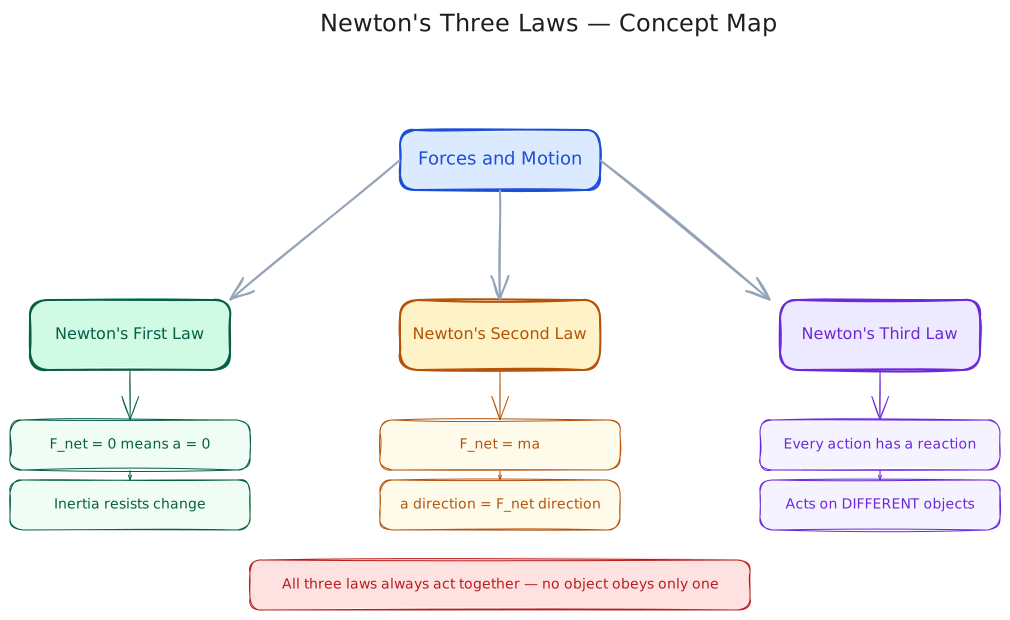
Copy into your books
▼Types of Force
- Contact forces: normal, friction, tension, applied
- Field-mediated: gravitational, magnetic, electrostatic
- All forces are vectors — magnitude and direction
- SI unit: Newton (N)
Newton's First Law
- An object remains at rest or constant velocity unless acted on by a net force
- Inertia: resistance to change in motion — increases with mass
- Static equilibrium: at rest, net force = 0
- Dynamic equilibrium: constant velocity, net force = 0
Newton's Third Law
- Every action force has an equal and opposite reaction force
- Pairs act on DIFFERENT objects — they never cancel
- Same force type, equal magnitude, opposite direction
- Weight and normal force are NOT a Third Law pair
Key Vocabulary
- Force: a push or pull between two objects (N)
- Inertia: resistance to change in state of motion
- Equilibrium: net force equals zero
- Free body diagram showing all forces on one object
🏃 Activities
Free Body Diagrams and Force Classification
For each scenario, apply all three steps of the Vector Protocol before drawing. Label each force with its name, type (contact or field), and direction.
- A 3 kg book resting on a horizontal desk.
- A person standing still inside a lift moving upward at constant speed.
- Two magnets repelling each other across a 2 cm gap — neither is touching anything.
For each scenario, answer: Is the object in equilibrium? How do you know?
Type any notes here — draw your diagrams in your book.
Complete this activity in your book using the Vector Protocol checklist.
Newton's Third Law Pair Classification
For each pair below, apply the flowchart. Write your answer as: Genuine pair / Not a pair, then give one reason.
| # | Force Pair | Your Classification + Reason |
|---|---|---|
| 1 | Weight of a book (down) and normal force on the book (up) | Write in book |
| 2 | Earth pulls the Moon toward it / Moon pulls Earth toward it | Write in book |
| 3 | Friction on a sliding box (backward) / Friction on the floor from the box (forward) | Write in book |
| 4 | A rocket pushes exhaust gases down / Exhaust gases push the rocket up | Write in book |
| 5 | Tension pulls a hanging object up / Weight pulls it down | Write in book |
| 6 | A swimmer pushes water backward / Water pushes swimmer forward | Write in book |
| 7 | A magnet attracts a nail toward it / Nail attracts the magnet toward it | Write in book |
| 8 | Normal force on a box from a wall / Applied force pushing the box into the wall | Write in book |
✅ Check Your Understanding
Earlier you were asked: A skateboarder pushes backwards against a wall and rolls forwards. The wall did not move. Where did the skateboarder's motion come from?
The full answer: The skateboarder exerted a contact force on the wall — the wall pushed back with an equal and opposite force (Newton's Third Law). This reaction force acted on the skateboarder only. Because there was no other horizontal force opposing it (the skateboarder was free to roll), this became the net horizontal force on the skateboarder — causing them to accelerate forward (Newton's Second Law). The wall did not move because it is attached to Earth, and the combined mass of wall plus Earth is so large that the same force produces an acceleration too small to measure.
The key insight: forces always come in pairs acting on different objects. The wall's reaction force acted on the skateboarder — not on the wall itself — which is why the skateboarder moved and the wall did not.
Now revisit your initial response. What did you get right? What was missing?
Look back at your initial response in your book. Annotate it with what you now understand differently.
Look back at what you wrote in the Think First section. What has changed? What did you get right? What surprised you?