Year 11 Physics Module 2: Dynamics 35 min Lesson 2 of 15

Vector Forces — Resolution and Equilibrium

Forces do not just add up — they add up in the direction they point. Getting the direction wrong means getting the answer wrong.

Printable worksheet

Download this lesson's worksheet

Use the PDF for classwork, homework or revision. It includes key ideas, activities, questions, an extend task and success-criteria proof.

Think First

Two pit crew members push a V8 Supercar from different angles. Will the car move in the direction either person is pushing? Predict what direction the car will actually move, and why.

Type your prediction below — you will revisit it at the end of the lesson.

Write your prediction in your book. You will revisit it at the end of the lesson.

Write your prediction in your book
Saved

Come back to this at the end of the lesson.

📐

Formula Reference — This Lesson

$F_x = F\cos\theta$  |  $F_y = F\sin\theta$
F = force magnitude (N) θ = angle from horizontal (°) Fx = horizontal component (N)  |  Fy = vertical component (N)
Resultant: $R = \sqrt{F_x^2 + F_y^2}$   |   Direction: $\theta = \tan^{-1}(F_y/F_x)$   |   Equilibrium: $\Sigma F_x = 0$ AND $\Sigma F_y = 0$

Fx
Formula Reference — Vector Components and Equilibrium

$F_x = F\cos\theta$
Horizontal Component
F = force magnitude (N) | θ = angle measured from the horizontal reference axis (degrees) | Fx = horizontal component (N)
Applies when: a force acts at an angle θ to a defined horizontal reference direction
Common trap: θ must be measured from the reference axis. If the angle is given from vertical, use sin instead of cos for the horizontal component.
$F_y = F\sin\theta$
Vertical Component
F = force magnitude (N) | θ = angle from horizontal (degrees) | Fy = vertical component (N)
Applies when: same conditions as above — resolving a force into its perpendicular components
Common trap: Forgetting sign conventions — components pointing left or downward are negative when right and upward are defined as positive.
$F_{net} = \sum F$
Net Force (1D)
Algebraic sum of all forces in one dimension. Forces opposing the positive direction are subtracted.
Applies when: all forces are parallel (acting along the same line)
Common trap: Cannot use simple algebraic addition when forces act at angles — must resolve into components first.
$\Sigma F_x = 0,\quad \Sigma F_y = 0$
2D Equilibrium Conditions
Both conditions must hold simultaneously for an object to be in 2D equilibrium.
Applies when: an object is stationary or moving at constant velocity in 2D
Common trap: Checking only one direction. An object is NOT in equilibrium if net force is zero in x but not in y — both must equal zero.
$F = \sqrt{F_x^2 + F_y^2}$
Resultant Magnitude from Components
Use Pythagoras once you have the total x and y components to find resultant magnitude.
Applies when: reconstructing a resultant vector from its components
Common trap: Adding Fx + Fy directly instead of using Pythagoras — this gives the wrong answer unless the components are at 90 degrees to each other.

Know

  • What a resultant force is
  • How to add forces in 1D algebraically
  • What Fx = F cos θ and Fy = F sin θ mean
  • The 2D equilibrium conditions: ΣFx = 0 and ΣFy = 0

Understand

  • Why vector addition is not the same as scalar addition
  • Why equilibrium requires net force = 0 in every direction
  • How component resolution simplifies any 2D force problem
  • Why the angle used in the formula matters critically

Can Do

  • Add forces algebraically in 1D with sign convention
  • Draw a tip-to-tail vector addition diagram
  • Resolve a force into x and y components using the formulae
  • Determine if a 2D system is in equilibrium

Choose how you work — type your answers below or write in your book.

Misconceptions to Fix

Wrong: Action and reaction forces cancel each other out on the same object.

Right: Action-reaction pairs act on DIFFERENT objects, so they never cancel; this is why motion occurs.

Net Force and 1D Vector Addition

When forces act along the same line, you can add them like numbers — but direction matters, so some forces subtract.

The net force (or resultant force) is the single force that has the same effect as all individual forces acting together. In one dimension, we find it by algebraic addition — choosing a positive direction and assigning signs accordingly.

Back in the pit garage: if two crew members both push the V8 directly backwards (same direction) with 300 N each, the net force is simply 600 N backward. But if one pushes backward and one pushes forward, the forces partially cancel.

Vector Protocol — apply before every calculation
Step 1 — Define positive direction explicitly (e.g. rightward = positive, or forward = positive)
Step 2 — Draw free body diagram with all forces labelled
Step 3 — Write net force equation before substituting numbers
ScenarioForcesNet ForceResult
Both crew push backward300 N + 300 N (same direction)600 N backwardCar accelerates backward
Crew push in opposite directions300 N backward, 200 N forward100 N backwardCar accelerates slowly backward
Three forces balance exactly300 N backward, 200 N forward, 100 N forward0 NEquilibrium — no acceleration

2D Vector Addition — The Tip-to-Tail Method

When forces act at angles, drawing them nose-to-tail reveals the resultant — the single force that replaces all of them.

In two dimensions, we cannot simply add force magnitudes. A 40 N force east and a 30 N force north do not produce a 70 N resultant — they produce a 50 N resultant pointing northeast at 37° above the horizontal.

The Tip-to-Tail Construction

  1. Draw the first force vector as an arrow (length proportional to magnitude, direction correct).
  2. Place the tail of the second vector at the tip of the first.
  3. Continue for all remaining forces.
  4. The resultant is the arrow drawn from the tail of the first vector to the tip of the last.
  5. Use Pythagoras (for right-angle cases) or trigonometry to find the resultant's magnitude and direction.
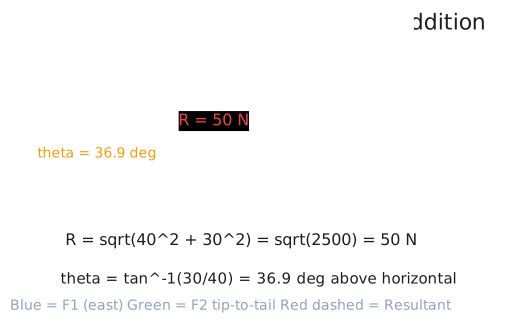
Tip-to-Tail Vector Addition — 40 N East + 30 N North
Vector Protocol
Step 1 — Positive direction defined: east = +x, north = +y
Step 2 — Both vectors drawn tip-to-tail with correct proportions
Step 3 — Resultant drawn and magnitude calculated using Pythagoras
Real-World Anchor — V8 Supercar Pit Push: When two pit crew members push the Supercar at 30° to each other, the car moves in the direction of the resultant — not the direction either person is pushing. The team that can calculate and predict the resultant direction gets the car into position faster. This is why race engineers understand vector addition.

Component Resolution — Fx = F cos θ and Fy = F sin θ

Any force at an angle can be split into a horizontal part and a vertical part — and those two parts together have exactly the same effect as the original force.

The tip-to-tail method works visually, but for calculation we use component resolution. Every force at angle θ can be replaced by two perpendicular components: a horizontal component Fx and a vertical component Fy.

Deriving the Components

Consider a force F acting at angle θ above the horizontal. This forms a right-angle triangle with the horizontal and vertical components as the two shorter sides. Basic trigonometry gives:

$$F_x = F\cos\theta \qquad F_y = F\sin\theta$$ $$F = \sqrt{F_x^2 + F_y^2} \qquad \theta = \tan^{-1}\!\left(\frac{F_y}{F_x}\right)$$

The component in the reference direction uses $\cos\theta$; the perpendicular component uses $\sin\theta$. Reconstruct the resultant with Pythagoras.
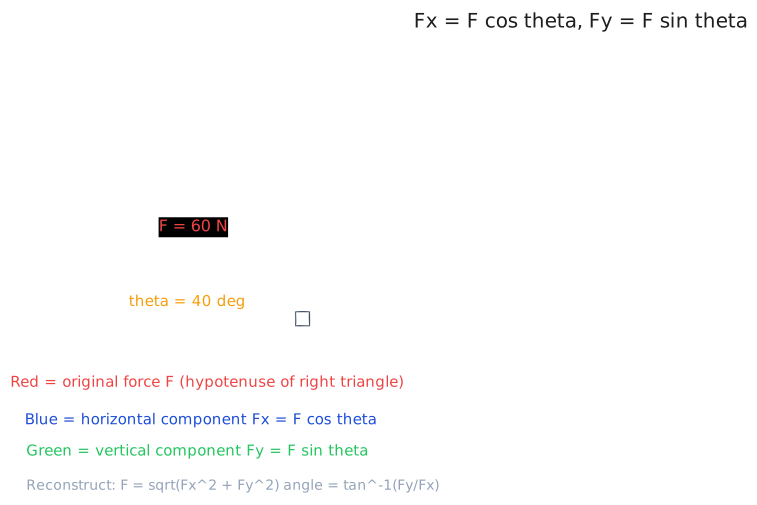
Component Resolution — Fₓ = F cosθ, F_y = F sinθ
Vector Protocol
Step 1 — Positive direction defined: rightward = +x, upward = +y
Step 2 — Right-angle triangle drawn with F, Fx, Fy and angle θ labelled
Step 3 — Both components calculated and signs checked before combining

Common Misconceptions

Fx always uses cos and Fy always uses sin.
Cos applies to the component adjacent to the angle — whichever direction that is. If the angle is measured from vertical instead of horizontal, cos gives the vertical component and sin gives the horizontal one. Always sketch the triangle first.
A larger force always has larger components.
A 100 N force at 89° to the horizontal has a horizontal component of only 1.7 N. The angle determines what fraction of the force acts in each direction — a near-vertical force has almost no horizontal component regardless of its magnitude.
The resultant is found by adding Fx + Fy directly.
Fx and Fy are perpendicular components — they cannot be added arithmetically. Use Pythagoras: F = sqrt(Fx² + Fy²). Adding them directly gives a value larger than the actual resultant.
Interactive: Vector Resolver
Interactive: Vector Addition — Tip-to-Tail (3D)

✏️ Worked Examples

Worked Example 1 Type 1: Static Equilibrium

Problem Setup

Problem type: Type 1 — Static Equilibrium. Object stationary, so ΣFx = 0 and ΣFy = 0.

Scenario: Three forces act on a hook: 50 N upward, 30 N to the right, and an unknown force F at unknown angle θ below-left. The hook is in equilibrium. Find F and θ.

Solution

1
Positive direction defined: rightward = +x, upward = +y
Always define this first. Every sign in the calculation depends on this choice.
2
x-direction: 30 + F3x = 0, so F3x = -30 N
Equilibrium in x means all x-components sum to zero. F3x must cancel the 30 N rightward force, so it points left (negative).
3
y-direction: 50 + F3y = 0, so F3y = -50 N
Equilibrium in y means all y-components sum to zero. F3y must cancel the 50 N upward force, so it points downward (negative).
4
F3 = sqrt(30² + 50²) = sqrt(900 + 2500) = sqrt(3400) = 58.3 N
Use Pythagoras to find the magnitude from the two components. Never add components directly.
5
θ = tan⁻¹(50 / 30) = tan⁻¹(1.667) = 59.0° below horizontal to the left
Use inverse tangent of (vertical component / horizontal component). State direction clearly — the angle alone is incomplete without a reference direction.

What would change if...

What if the upward force increased from 50 N to 60 N while the rightward force stayed at 30 N? Would the magnitude of F3 increase or decrease? Would the angle become larger or smaller? Try the calculation.

Worked Example 2 Type 1: Static Equilibrium

Problem Setup

Problem type: Type 1 — Static Equilibrium with symmetry. Two cables, equal angles.

Scenario: A 20 N sign hangs from two cables, each making 35° with the horizontal. Find the tension T in each cable.

Solution

1
Draw FBD: weight 20 N downward, two tension forces T at 35° above horizontal left and right
Free body diagram first. The sign is the object — draw only forces acting on it.
2
x-direction: T cos35° (left) + T cos35° (right) cancel. ΣFx = 0 automatically by symmetry.
Symmetric setup means horizontal components cancel without calculation. Confirm this before proceeding.
3
y-direction: T sin35° + T sin35° - 20 = 0
Both vertical components point upward (+y). Weight points downward (-y). Sum must equal zero for equilibrium.
4
2T sin35° = 20, so T = 20 / (2 × sin35°) = 20 / (2 × 0.574) = 17.4 N
Rearrange to isolate T. Each cable carries 17.4 N of tension — together they support the 20 N sign.

What would change if...

What would happen to the tension T if the cables were repositioned to make a smaller angle with the horizontal — say 15° instead of 35°? Would T increase or decrease? What does this tell you about the design of suspension systems?

Visual Break

Forces given Are all forces parallel? Acting along the same straight line Yes Add / subtract No Are forces already at right angles? One horizontal, one vertical Yes Use Pythagoras No Forces at arbitrary angles? Resolve: Fx = F cosθ, Fy = F sinθ Yes Is the object in equilibrium? Constant velocity or stationary No Find resultant Yes Sum Fx=0 Sum Fy=0

Copy into your books

1D Net Force

  • Define positive direction first — always
  • Forces opposing positive direction are negative
  • Fnet = algebraic sum of all forces
  • Equilibrium: Fnet = 0 (object at rest or constant velocity)

Component Resolution

  • Fx = F cos θ (component along reference axis)
  • Fy = F sin θ (component perpendicular to reference axis)
  • θ measured from reference axis (usually horizontal)
  • Resultant: F = sqrt(Fx² + Fy²), angle = tan⁻¹(Fy / Fx)

2D Equilibrium

  • Resolve ALL forces into x and y components
  • ΣFx = 0 (x-direction balance)
  • ΣFy = 0 (y-direction balance)
  • Both conditions must hold simultaneously

Key Vocabulary

  • Resultant: single force equivalent to all forces combined
  • Component: the part of a force in one direction
  • Resolution: splitting a force into perpendicular components
  • Equilibrium: net force = 0 in all directions

🏃 Activities

Activity 01 — Pattern B

Component Calculation Table

Apply the Vector Protocol to calculate Fx, Fy, and resultant for each scenario. Determine whether each object is in equilibrium.

For each row, apply the Vector Protocol. Define positive direction, draw a quick FBD, then calculate. Show all working beside the table.

#Force(s) GivenFx (N)Fy (N)Resultant (N)Equilibrium?
1Single force: 80 N at 0° (horizontal)
2Single force: 80 N at 90° (vertical)
3Single force: 50 N at 30° above horizontal
4Single force: 100 N at 60° above horizontal
5Two forces: 40 N east + 40 N west
6Two forces: 60 N at 45° above horizontal + 60 N at 45° above horizontal (symmetric, both upward-angled)

Record your working and answers in the table above and below.

Complete this table in your book with full working beside each row.

Complete the table in your book with full working
Saved
Activity 02 — Pattern B (Error-spot)

Find and Fix the Errors

A student's worked solution to a 2D equilibrium problem contains four deliberate errors. Identify each one, explain why it is wrong, and write the correct working.

Problem: A 10 kg traffic light hangs from two cables, each at 50° above horizontal. Find the tension in each cable.

Student's working (contains 4 errors):

"Positive direction: upward = positive.
Weight: W = 10 × 9.8 = 98 N
Each cable tension = T
y-direction: T sin50° + T sin50° = 98
so: 2T × 0.766 = 98
T = 98 / 0.766 = 127.9 N

Resultant of tensions: T_total = T + T = 255.8 N
Angle of resultant = sin⁻¹(T_total / W) = sin⁻¹(255.8 / 98) = error"

For each error: (a) identify what the student did wrong, (b) explain why it is incorrect using physics reasoning, (c) write the correct line of working.

Type your error analysis below. Aim to find all four errors.

Write your error analysis in your book — aim to find all four.

Write your error analysis in your book — find all four errors
Saved

✅ Check Your Understanding

Revisit Your Thinking

Earlier you were asked: Two pit crew members push a V8 Supercar from different angles. What direction will the car actually move?

The full answer: the car moves in the direction of the resultant force — found by resolving each push into x and y components, summing the components separately, then combining them using Pythagoras. The direction of movement is determined by the angle of the resultant: θ = tan⁻¹(total Fy / total Fx). Neither person's individual direction predicts this. The car does not move in the average direction between the two pushes — it moves in the direction of the vector sum.

This is why engineers decompose forces into components before analysing any structure. Adding force magnitudes without accounting for direction gives the wrong answer every time.

Look back at your initial prediction. What did you get right? What are you now thinking differently about?

Look back at your prediction in your book. Annotate it with what you now understand differently.

Annotate your initial prediction in your book
Saved
Revisit Your Initial Thinking

Look back at what you wrote in the Think First section. What has changed? What did you get right? What surprised you?

MC

Multiple Choice

5 random questions from a replayable lesson bank — feedback shown immediately

Comprehensive Answers

Activity 02 — Four Errors Identified

Error 1 — Missing positive direction for x: The student defined upward = positive but never defined a horizontal positive direction. In any 2D equilibrium problem, both x and y positive directions must be explicitly stated.

Error 2 — Forgot to divide by 2: The student wrote "2T × 0.766 = 98" then solved T = 98 / 0.766 = 127.9 N — dividing by sin50° only, not by 2 × sin50°. Correct: T = 98 / (2 × 0.766) = 64.0 N.

Error 3 — Added tensions arithmetically: "T_total = T + T = 255.8 N" treats tensions as scalars. The two tension vectors point in different directions and cannot simply be added. The y-components sum to support the weight — already used in the equilibrium equation.

Error 4 — Impossible inverse sine: sin⁻¹(255.8 / 98) requires sin⁻¹(2.61) which is undefined — sine cannot exceed 1. This error arose from Error 3. The tensions do not need to be combined after the equilibrium equations are solved.

Multiple Choice

1. C — 50 N. Forces at right angles: F = sqrt(40² + 30²) = sqrt(1600 + 900) = sqrt(2500) = 50 N. Adding 40 + 30 = 70 N is incorrect — scalar addition only works for parallel forces.

2. B — 51.96 N. Fx = F cos θ = 60 × cos30° = 60 × 0.866 = 51.96 N. Option A (30 N) results from using sin instead of cos. Option D uses tan.

3. D. 2D equilibrium requires both ΣFx = 0 AND ΣFy = 0. Option A is wrong — dynamic equilibrium (constant velocity) also satisfies the conditions. Option B only checks one direction.

4. C. When two forces act at arbitrary angles (25° and 60° — neither parallel nor at 90° to each other), component resolution is required. Option B (east + north) is already perpendicular — Pythagoras suffices. Option A is 1D.

5. A — 28.3 N at 45°. F = sqrt(20² + 20²) = sqrt(800) = 28.3 N. Angle = tan⁻¹(20/20) = 45°. Option B (40 N) comes from adding 20 + 20 directly — the classic Pythagoras error.

6. B. At a shallower angle (30°), sin30° = 0.5 is smaller than sin60° = 0.866. The vertical component of tension is T sin θ — to provide the same vertical support (50 N), a smaller sin θ requires a larger T. The shallower cable works harder.

Short Answer — Model Answers

Q7 (3 marks): Two forces of equal magnitude do not always produce the same resultant because the resultant depends on the angle between the forces, not just their magnitudes. Diagram 1: two 50 N forces acting in the same direction — resultant = 100 N in that direction. Diagram 2: two 50 N forces acting at 90° to each other — resultant = sqrt(50² + 50²) = 70.7 N at 45° between them. The angle between the forces determines the resultant magnitude and direction.

Q8 (3 marks):

Positive direction: rightward = +x, upward = +y
Fx = F cos θ = 100 × cos50° = 100 × 0.643 = 64.3 N (rightward)
Fy = F sin θ = 100 × sin50° = 100 × 0.766 = 76.6 N (upward)

Both components are positive — the force points up and to the right, consistent with 50° above horizontal.

Q9 (4 marks) — Vector Protocol model answer:

Step 1: Positive direction — upward = +y, rightward = +x
Step 2: FBD — weight W = 12 × 9.8 = 117.6 N downward. Left cable: tension T at 40° above horizontal to the left. Right cable: tension T at 40° above horizontal to the right. Symmetric system.
Step 3: ΣFy = 0: T sin40° + T sin40° - 117.6 = 0. 2T sin40° = 117.6. T = 117.6 / (2 × 0.643) = 117.6 / 1.286 = 91.4 N

Explanation of shallower angle: The vertical component of each cable tension is T sinθ. If the angle θ decreases (shallower cable), sinθ decreases. To still satisfy 2T sinθ = 117.6 N, T must increase. A nearly horizontal cable provides very little vertical support per Newton of tension — so extremely large tensions are required. This is why suspension cables are never horizontal.

🏎️
Speed Race

Vector Forces

Answer questions on vector addition, force resolution and equilibrium conditions before your opponents cross the line. Fast answers = faster car. Pool: lessons 1–2.

Mark lesson as complete

Tick when you have finished all activities and checked your answers.