Inclined Planes
The trolley did not need a push. The slope itself did it — by redirecting gravity into a force along the surface. Here is exactly how.
Download this lesson's worksheet
Use the PDF for classwork, homework or revision. It includes key ideas, activities, questions, an extend task and success-criteria proof.
A block sits on a ramp. As the angle increases, at some point the block starts sliding on its own. What force causes it to slide — and why does the angle matter?
You can test your prediction by adjusting the ramp angle in the interactive Force Explorer below.
Type your initial thinking below.
Write your initial thinking in your book.
Come back to this at the end of the lesson.
Formula Reference — This Lesson
Formula Reference — Inclined Plane Forces
▼Know
- W// = mg sin theta — force down slope
- Wperp = mg cos theta — force into slope
- N = mg cos theta on an inclined plane
- f = mu x mg cos theta on a slope
Understand
- Why objects accelerate on slopes without a push
- Why steeper slopes produce greater acceleration
- Why mass does not affect acceleration on a frictionless slope
- How friction can prevent motion on a slope
Can Do
- Draw a full FBD for a block on an inclined plane
- Resolve weight into parallel and perpendicular components
- Calculate acceleration with and without friction
- Design and conduct the inclined plane investigation
Misconceptions to Fix
Wrong: An object moving at constant velocity has no forces acting on it.
Right: An object at constant velocity has BALANCED forces (net force = 0), not necessarily no forces.
📚 Core Content
Why Objects Move on Slopes
The slope does not create a new force. Gravity still pulls straight down — but the surface redirects part of that gravitational force along its surface.
Every time a trolley rolls away in a Woolworths car park, or a ball rolls down a ramp, the same physics is at work. Gravity acts vertically downward. When a surface is tilted, it cannot fully oppose that vertical force — so part of gravity acts along the surface, driving motion. The steeper the slope, the larger this component.
This is why angles matter: increasing the slope angle increases the component of gravity along the surface. At some critical angle, this component exceeds the maximum static friction, and the object starts to slide.
Resolving Forces on an Inclined Plane
Weight cannot be directly opposed by the slope — so we split it into two components: one pressing into the slope, and one running along it.
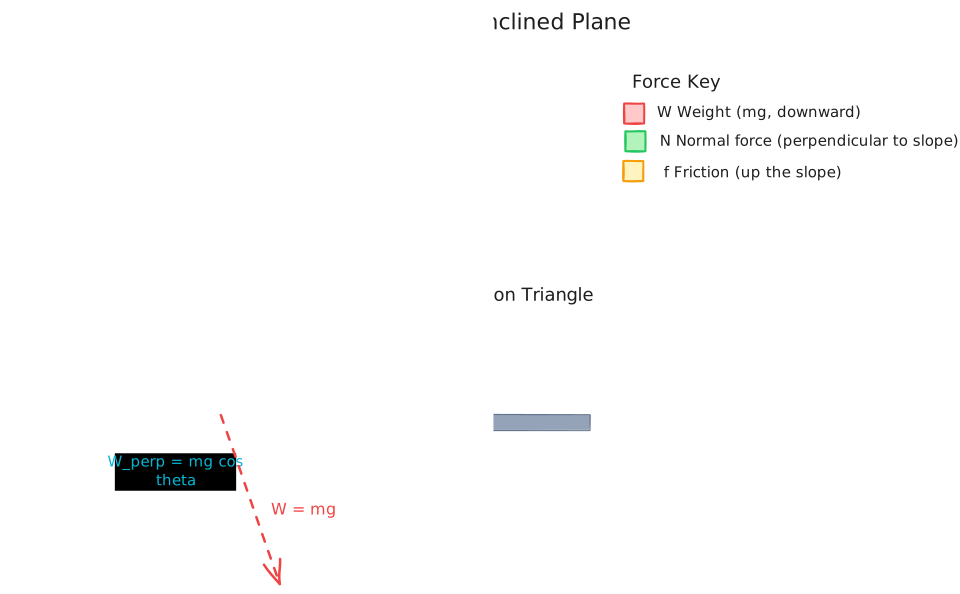
The key step in any inclined plane problem is choosing a reference frame aligned with the slope — not with horizontal and vertical. By setting our positive direction along and perpendicular to the slope, the component resolution becomes straightforward.

Common Misconceptions
Friction on Inclined Planes
Friction on a slope depends on the normal force — which is reduced by the tilt. The steeper the slope, the less friction force is available.
This creates the critical angle — the slope angle at which W// exactly equals maximum static friction. Above this angle, the object slides. Below it, the object stays put. At the critical angle: mg sin theta = mu x mg cos theta, which simplifies to tan theta = mu. This is a powerful result: you can measure the coefficient of friction simply by finding the angle at which an object just starts to slide.
✏️ Worked Examples
Problem Setup
Problem type: Type 2 — Kinetic Single Object. One object accelerating on a frictionless inclined surface.
Scenario: A 5 kg block slides down a frictionless ramp at 30° to the horizontal. Find its acceleration.
- m = 5 kg, theta = 30 deg, g = 9.8 m/s²
- Frictionless surface: f = 0
- Positive direction: down the slope
Solution
What would change if...
What if the mass were doubled to 10 kg? Would the acceleration change? Use the formula a = g sin theta to predict the answer before checking algebraically.
Problem Setup
Problem type: Type 2 — Kinetic Single Object with friction.
Scenario: A 4 kg box slides down a ramp at 40° with a coefficient of kinetic friction mu = 0.3. Find the acceleration.
- m = 4 kg, theta = 40 deg, mu = 0.3, g = 9.8 m/s²
- Positive direction: down the slope
- Friction acts up the slope (opposing motion)
Solution
What would change if...
What if mu increased to 0.6 — would the box still slide? At what value of mu would the box be on the verge of not sliding at all at 40°?
Visual Break — Decision Flowchart
Practical Investigation
Inclined Plane — Predicting Motion
Aim
To investigate how the angle of an inclined plane affects the acceleration of a sliding object, and to compare experimental results with theoretical predictions using Fnet = ma.
Hypothesis
Write your hypothesis below before conducting the investigation. Format: "As the angle of the inclined plane increases, the acceleration of the object will [increase/decrease/stay the same] because..."
Type your hypothesis below.
Write your hypothesis in your book.
Variables
Equipment
- Smooth plank or ramp (at least 60 cm long)
- Protractor and ruler
- Block or trolley of known mass
- Timer, motion sensor, or video analysis app
- Retort stand or books to prop the ramp
Method
- Set the ramp to theta = 10° and measure the angle with a protractor.
- Mark a starting position 50 cm from the bottom of the ramp.
- Release the block from the marked position and record the time to reach the bottom. Repeat three times.
- Calculate average time. Use s = ut + ½at² with u = 0 to find acceleration.
- Record the theoretical prediction: a = g sin theta (frictionless) or a = g sin theta - mu g cos theta (with friction).
- Repeat for theta = 20°, 30°, 40°, 50°.
Results Table
| Angle theta (deg) | Time t1 (s) | Time t2 (s) | Time t3 (s) | Average t (s) | Measured a (m/s²) | Predicted a = g sin theta (m/s²) | % Difference |
|---|---|---|---|---|---|---|---|
| 10 | 1.70 | ||||||
| 20 | 3.35 | ||||||
| 30 | 4.90 | ||||||
| 40 | 6.30 | ||||||
| 50 | 7.51 |
Predicted values assume frictionless surface. Your measured values will be lower if friction is present — this is expected.
Analysis Questions
Answer these questions below.
Answer in your book.
Copy into your books
▼Weight Components on Slope
- W// = mg sin theta — along slope, drives motion
- Wperp = mg cos theta — into slope, determines N
- Normal force: N = mg cos theta (NOT mg)
- These are components of the same weight vector W
Friction on an Inclined Plane
- f = mu x N = mu x mg cos theta
- Critical angle: tan theta = mu (object on verge of sliding)
- Object slides when W// > f_max
- Object stationary when W// is less than or equal to f_max
Net Force and Acceleration
- Fnet = W// - f = mg sin theta - mu x mg cos theta
- a = Fnet/m = g sin theta - mu x g cos theta
- Mass cancels — acceleration is independent of mass
- Frictionless: a = g sin theta only
Key Vocabulary
- Inclined plane: a flat surface tilted at angle theta
- Normal force: perpendicular to slope surface, N = mg cos theta
- Critical angle: angle at which object just begins to slide
- tan(theta_critical) = mu (coefficient of friction)
🏃 Activities
Frictionless vs Friction Slope Comparison
A 3 kg block slides on a 35° ramp. Surface A is frictionless. Surface B has mu = 0.25. For each surface, apply the Vector Protocol, then complete the comparison table.
Type your working and comparison conclusion below.
Complete the table in your book with full working for each column.
Novel Scenario — Car on a Banked Road
A road is banked at 12° to help cars navigate a curve. A 1200 kg car is stationary on the banked section while parked.
- Draw a free body diagram for the car on the banked road. Label W, N, and any friction force needed to keep it stationary.
- Calculate the component of the car's weight directed down the banked slope (W//).
- Calculate the normal force the road exerts on the car.
- What minimum coefficient of static friction is needed to keep the car stationary? Show your working using the Vector Protocol.
- Is this scenario similar to or different from the inclined plane problems in this lesson? Explain what is the same and what is different.
Type your answers below — draw the FBD in your book.
Complete in your book. Draw the FBD, show all working, answer Q5 in full sentences.
✅ Check Your Understanding
Earlier you were asked: A block sits on a ramp. As the angle increases, at some point the block starts sliding. What force causes it to slide — and why does the angle matter?
The full answer: gravity still pulls the block straight down. On a slope, this weight vector is resolved into two components. W// = mg sin theta acts along the slope — this is the force that drives sliding. Wperp = mg cos theta acts into the slope — this determines the normal force, and therefore the maximum friction. As the angle increases, W// increases (sin theta gets larger) and the maximum friction force decreases (cos theta gets smaller, so N and f both decrease). At the critical angle, W// exceeds maximum static friction, and the block starts to slide. This is why angle matters: both effects compound.
The key insight you should now have is that the slope does not create a new force — it redirects gravity into a component along its surface. The steeper the slope, the larger that component.
Look back at your initial thinking. What did you get right? What are you now thinking differently?
Annotate your initial answer in your book.
Look back at what you wrote in the Think First section. What has changed? What did you get right? What surprised you?
Multiple Choice
5 random questions from a replayable lesson bank — feedback shown immediately
7. A 3 kg block rests on a frictionless inclined plane at 20° to the horizontal. Draw a labelled free body diagram and calculate the acceleration of the block. Show all working. 3 MARKS
8. A 7 kg block slides down a 35° ramp with a coefficient of kinetic friction of 0.20. Calculate the net force on the block and its acceleration. Apply the Vector Protocol and show every step. 3 MARKS
9. A physics student claims: "A heavier block will slide down a rough slope faster than a lighter block at the same angle." Evaluate this claim using the inclined plane equations. Is it correct? Under what conditions, if any, would mass affect the motion? 4 MARKS
Comprehensive Answers
▼Activity 01 — Comparison Table
Surface A (frictionless): W// = 3 x 9.8 x sin35 = 16.87 N | N = 3 x 9.8 x cos35 = 24.09 N | f = 0 | Fnet = 16.87 N | a = 5.62 m/s²
Surface B (mu = 0.25): W// = 16.87 N | N = 24.09 N | f = 0.25 x 24.09 = 6.02 N | Fnet = 16.87 - 6.02 = 10.85 N | a = 10.85/3 = 3.62 m/s²
Conclusion: Friction reduces the net force and therefore the acceleration. The driving force (W//) is identical on both surfaces — only friction changes. The block slides on both surfaces because W// (16.87 N) exceeds f_max on Surface B (6.02 N).
Multiple Choice
1. B — 4.9 m/s². a = g sin 30 = 9.8 x 0.5 = 4.9 m/s². Option A (9.8) would only apply on a vertical drop. Option C is g cos 30, confusing parallel and perpendicular components.
2. C — 53.3 N. N = mg cos 25 = 6 x 9.8 x 0.906 = 53.3 N. Option A (58.8 N) incorrectly uses N = mg on a slope.
3. A. a = g sin theta — mass cancels. Both blocks accelerate at g sin theta regardless of mass. This is the inclined plane analogy of Galileo's falling bodies result.
4. D. The correct friction force uses N = mg cos 40, not mg. Option A is wrong (uses full mg). Option B swaps sin and cos. Option C adds friction instead of subtracting.
5. B — 0.532. At critical angle: tan theta = mu. mu = tan 28 = 0.532. This is the direct application of the critical angle formula.
6. C. As theta increases: sin theta increases (W// grows larger) AND cos theta decreases (N shrinks, so friction shrinks). Both effects push the net force up simultaneously, compounding the acceleration increase. Option B is wrong — normal force decreases at steeper angles, not increases.
Short Answer — Model Answers
Q7 (3 marks):
Q8 (3 marks):
Q9 (4 marks): The student's claim is incorrect. Using the formula a = g sin theta - mu x g cos theta, mass (m) does not appear — it cancels when applying F = ma to Fnet = mg sin theta - mu x mg cos theta. Therefore acceleration is independent of mass on a rough slope, just as on a frictionless slope. A heavier and lighter block on identical rough slopes accelerate at exactly the same rate. A condition where mass WOULD matter: if the slope had a constant friction force (not proportional to N), then Fnet = mg sin theta - f_constant, and a = g sin theta - f_constant/m — in this case, the heavier block would accelerate faster. However, standard friction (f = mu x N) always cancels mass on a uniform slope.
Blast the Correct Answer
Defend your ship by blasting the correct answers for Inclined Planes. Scores count toward the Asteroid Blaster leaderboard.
Play Asteroid Blaster →Consolidation Game
Inclined Planes
Mark lesson as complete
Tick when you have finished all activities and checked your answers.