Newton's Laws and Friction
The packages kept moving. The van stopped. Two different objects, one moment — and Newton's Laws explain exactly why.
Download this lesson's worksheet
Use the PDF for classwork, homework or revision. It includes key ideas, activities, questions, an extend task and success-criteria proof.
A delivery driver brakes suddenly at 60 km/h. The van stops. The packages in the back fly forward and slam into the cabin. What force caused the packages to move forward — and why didn't the same thing happen to the driver?
Type your initial thinking below — you will revisit this at the end.
Write your initial thinking in your book. You will revisit it at the end.
Come back to this at the end of the lesson.
Formula Reference — This Lesson
Formula Reference — Newton's Laws and Friction
▼Know
- Newton's First Law — formal statement
- Newton's Second Law — Fnet = ma
- f = μFN and what μ represents
- Difference between static and kinetic friction
Understand
- Why packages fly forward when a van brakes
- Why F in F = ma is always the net force
- Why μs > μk and what this means practically
- Why constant velocity ≠ no forces
Can Do
- Draw a FBD for a braking or accelerating object
- Calculate Fnet including friction
- Find acceleration using Fnet = ma
- Distinguish Newton 1 from Newton 2 scenarios
Misconceptions to Fix
Wrong: Friction always opposes motion and is always unwanted.
Right: Friction can be static and enable motion (walking, driving); it is essential for many everyday activities.
📚 Core Content
Newton's First Law — Inertia Revisited
An object does not change what it is doing unless something forces it to.
In L01 we met Newton's First Law conceptually. Now we apply it to the delivery van scenario. When the driver brakes, a friction force from the road acts on the van — decelerating it. But the packages? Nothing horizontal acts on them. No seatbelt, no harness. So by Newton's First Law, they continue at the van's original velocity — forward — while the van slows beneath them.
The driver does not fly forward because the seatbelt exerts a backward force on them — providing the net force needed to decelerate with the van. The packages have no such force. They are not "thrown" forward — they simply continue moving forward while the van stops around them.
Van
Packages
Driver (belted)
Newton's Second Law — Fnet = ma
The harder you push, the faster it accelerates — and the heavier it is, the less it responds to the same push.
Formal statement: The acceleration of an object is directly proportional to the net force acting on it and inversely proportional to its mass. The direction of acceleration is always the same as the direction of the net force.
| Scenario | Mass (kg) | Fnet (N) | Acceleration (m/s²) |
|---|---|---|---|
| Small car braking | 900 | −5400 | −6.0 |
| Delivery van braking | 1800 | −5400 | −3.0 |
| Delivery van, harder braking | 1800 | −10800 | −6.0 |
Notice: same force on double the mass gives half the acceleration. Same mass with double the force gives double the acceleration. Fnet = ma captures both relationships simultaneously.
Free Body Diagram — Braking Van
The Excalidraw diagram below shows all forces on the braking van. Note that weight and normal force cancel vertically — the only unbalanced force is friction, acting backward.
Friction — Static vs Kinetic
It takes more force to get something moving than to keep it moving — because static friction is stronger than kinetic friction.
Friction arises from microscopic interactions between surfaces. There are two types relevant to this module:
Static friction (fs)
Kinetic friction (fk)
For any given surface pair, μs > μk always. The maximum static friction is always greater than kinetic friction. This is why a parked van on a slope stays put — but once it starts rolling, it is harder to stop again.
Common Misconceptions
✏️ Worked Examples
Problem Setup
Problem type: Type 2 — Kinetic Single Object. One object decelerating under a constant net force (friction only, horizontal surface).
Scenario: A 1200 kg delivery van decelerates from 60 km/h to rest. The braking friction force is 8000 N. Find the deceleration and the coefficient of kinetic friction.
- m = 1200 kg
- vi = 60 km/h = 16.67 m/s, vf = 0
- f = 8000 N (friction, opposing motion)
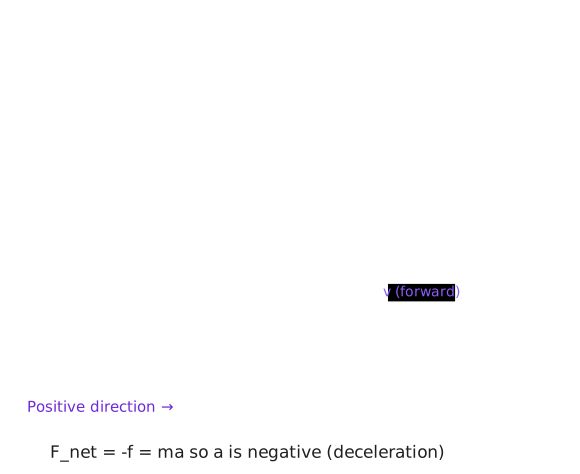
- Positive direction: forward (direction of initial motion)
Solution
What would change if...
The van were fully loaded to 2000 kg with the same braking force of 8000 N. Would the deceleration change? Would μk change? Calculate the new deceleration and explain the difference in stopping distance.
Problem Setup
Problem type: Type 2 — Kinetic Single Object. Horizontal push with kinetic friction opposing motion.
Scenario: A 15 kg box is pushed across a warehouse floor with a horizontal applied force of 80 N. The coefficient of kinetic friction is μk = 0.35. Find the acceleration of the box.
- m = 15 kg
- Fapplied = 80 N (forward, horizontal)
- μk = 0.35
- Positive direction: forward (direction of applied force)
Solution
What would change if...
At what applied force would the box move at constant velocity? Set up the equation and solve. What does this tell you about the relationship between applied force and friction at constant velocity?
Visual Break
Copy into your books
▼Newton's First Law
- Object stays at rest or constant velocity unless acted on by a net force
- Inertia = resistance to change in motion (proportional to mass)
- Packages fly forward in a braking van — no horizontal force acts on them
- Constant velocity ≠ no forces — forces are balanced (Fnet = 0)
Newton's Second Law
- Fnet = ma — net force, not applied force alone
- Direction of acceleration = direction of net force
- Always subtract friction before applying F = ma
- Larger mass → smaller acceleration for same net force
Friction
- f = μFN — friction depends on surface type (μ) and normal force
- Static friction (μs): resists motion up to a maximum
- Kinetic friction (μk): constant once sliding begins
- μs > μk always — harder to start than to maintain motion
Key Vocabulary
- Net force: vector sum of all forces on one object
- Coefficient of friction (μ): dimensionless measure of surface interaction
- Static friction: friction on a stationary object
- Kinetic friction: friction on a sliding object
🏃 Activities
Free Body Diagrams and Law Classification
- A delivery van cruising at constant 80 km/h on a flat road (driving force = friction).
- The same van braking hard to a stop (friction only, no driving force).
- A 20 kg box being pushed across a floor at constant velocity (applied force = friction).
- The same box being pushed with a larger force, accelerating across the floor.
For each: (a) draw and label the FBD, (b) apply the Vector Protocol checklist, (c) state which Newton's Law applies and why, (d) identify whether friction is static or kinetic.
Type notes here — draw your FBDs in your book.
Complete all four FBDs in your book using the Vector Protocol.
Newton's Law Scenario Classification
| # | Scenario | Newton 1 or 2? | Friction direction | Equilibrium? |
|---|---|---|---|---|
| 1 | Skateboarder coasting at constant speed on flat ground | |||
| 2 | Rocket accelerating upward from launch pad | |||
| 3 | Book sliding off a tilted table, accelerating down the slope | |||
| 4 | Car travelling at constant speed around a bend | |||
| 5 | A package at rest on the floor of a van moving at constant velocity | |||
| 6 | A cyclist pedalling harder to accelerate from 20 km/h to 30 km/h |
Type any working or explanations here.
Complete the table in your book with justifications for each answer.
✅ Check Your Understanding
Earlier you were asked: What force caused the packages to fly forward when the van braked — and why didn't the same thing happen to the driver?
The full answer: no force caused the packages to fly forward. That is the key insight. The packages simply continued moving forward at the van's original velocity because no horizontal force acted on them — Newton's First Law. The van decelerated around them.
The driver did not fly forward because the seatbelt exerted a backward (negative) force on them, providing the net force needed to decelerate with the van — Newton's Second Law. The seatbelt is the difference between following Newton's First Law (packages) and being subject to Newton's Second Law (belted driver).
Look back at your initial response. What did you get right? What are you now thinking differently about?
Annotate your initial response in your book with what you now understand differently.
Look back at what you wrote in the Think First section. What has changed? What did you get right? What surprised you?
Multiple Choice
5 random questions from a replayable lesson bank — feedback shown immediately
7. Explain why a heavier vehicle takes longer to stop than a lighter vehicle travelling at the same speed, even when both vehicles brake with the same coefficient of kinetic friction. Use Newton's Second Law in your answer. 3 MARKS
8. A 20 kg box is pushed with a force of 120 N directed at 25° below the horizontal across a flat floor. The coefficient of kinetic friction is μk = 0.3. Apply the Vector Protocol and calculate the acceleration of the box. 3 MARKS
9. A 1500 kg car accelerates from rest to 100 km/h in 8.2 s on a flat road. The engine driving force is 6500 N. Calculate: (a) the acceleration, (b) the friction force opposing motion, (c) the coefficient of kinetic friction, (d) explain what would happen to the acceleration if the road became wet, reducing μk from 0.30 to 0.15. 4 MARKS
Comprehensive Answers
▼Activity 02 — Scenario Classification
- Newton 1 — friction acts backward (opposing tendency to slide), equilibrium (Fnet = 0)
- Newton 2 — air resistance and gravity act (for atmospheric flight), not in equilibrium
- Newton 2 — friction acts up the slope (opposing sliding direction), not in equilibrium
- Newton 2 — centripetal acceleration toward centre of bend, not in equilibrium (direction changing)
- Newton 1 — package moves with van at constant velocity, static friction from van floor keeps it in place, equilibrium
- Newton 2 — friction from road acts backward, net forward force accelerates cyclist, not in equilibrium
Multiple Choice
1. C — Constant velocity means Fnet = 0. The driving force must exactly equal friction. There are forces present — they are balanced. Option A is wrong: friction and driving force both act.
2. B — 39.2 N. FN = mg = 10 × 9.8 = 98 N. fk = μk × FN = 0.4 × 98 = 39.2 N. Option A (4 N) multiplies μ by m only, forgetting g.
3. D — a = Fnet/m. If Fnet doubles and m is constant, a doubles. Direct proportionality.
4. A — 246 N. The applied force at 30° below horizontal has a downward component = 100 sin30° = 50 N, which adds to weight. FN = mg + F sin30° = 20×9.8 + 50 = 196 + 50 = 246 N. Option B ignores the applied force component.
5. C — 40 m. a = Fnet/m = −5000/1000 = −5 m/s². Using v² = u² + 2as: 0 = 400 + 2(−5)s → s = 400/10 = 40 m.
6. B — Net force on system = weight of B (driving) minus friction on A (opposing). Friction on A = μk × FN(A) = 0.2 × 5 × 9.8. Total mass = 5 + 3. Option A ignores friction entirely. Option C uses B's mass for friction on A.
Short Answer — Model Answers
Q7 (3 marks): A heavier vehicle has a greater friction force during braking (f = μmg — larger m means larger f). However, it also has greater mass resisting deceleration. Applying Newton's Second Law: a = Fnet/m = μmg/m = μg. The mass cancels, so the deceleration is the same for both vehicles on the same surface. However, since both start at the same speed, the stopping distance depends on deceleration alone — which is identical. The heavier vehicle does NOT take longer to stop if the friction coefficient is the same. If the question implies the same braking force (not coefficient), then the heavier vehicle has smaller deceleration (a = F/m, larger m gives smaller a) and takes longer to stop.
Q8 (3 marks) — Vector Protocol:
Q9 (4 marks):
Consolidation Game
Newton's Laws and Friction
Mark lesson as complete
Tick when you have finished all activities and checked your answers.