Acceleration and Graphical Analysis
A graph is not just a picture of data — it is a proof. The gradient of a force vs acceleration graph is a measurement of mass, and from that single line Newton's Second Law emerges.
Download this lesson's worksheet
Use the PDF for classwork, homework or revision. It includes key ideas, activities, questions, an extend task and success-criteria proof.
A student pushes a trolley with a constant force and measures how fast it accelerates. She repeats the experiment with the trolley carrying more and more mass. She plots force on the y-axis and acceleration on the x-axis. What shape will the graph be — and what physical quantity does the gradient represent?
Type your prediction below — you will revisit it at the end.
Write your prediction in your book. You will revisit it at the end.
Come back to this at the end of the lesson.
Formula Reference — This Lesson
Formula Reference — Newton's Second Law and Graphical Analysis
▼Know
- What a v-t graph gradient and area represent
- What an F vs a graph gradient represents
- Fnet = ma as derived from graphical data
- What uniform acceleration looks like on graphs
Understand
- Why gradient of F vs a graph = mass
- Why a straight line through origin proves direct proportionality
- How experimental data derives Fnet = ma rather than assumes it
- Why line of best fit is used — not data points — for gradient
Can Do
- Draw and label a v-t graph for uniform acceleration
- Calculate gradient of F vs a graph and interpret in physics terms
- Describe what a straight line through origin means physically
- Write a NESA-standard gradient interpretation sentence
Misconceptions to Fix
Wrong: Vectors and scalars are just different ways of writing the same thing.
Right: Vectors have magnitude and direction; scalars have magnitude only. They follow different mathematical rules.
📚 Core Content
Qualitative Description of Accelerated Motion
Acceleration is a change in velocity — if an object is speeding up, slowing down, or changing direction, it is accelerating.
A student in a trolley experiment applies a constant net force and observes the trolley accelerate uniformly. Qualitatively, we can describe this as: the velocity increases steadily over time; the rate of change of velocity is constant; and doubling the force doubles the rate of acceleration.
| Observation | Qualitative description | What it tells us |
|---|---|---|
| Trolley speeds up steadily | Velocity increases uniformly with time | Acceleration is constant — uniform acceleration |
| Heavier trolley speeds up more slowly | Same force, larger mass → smaller acceleration | a inversely proportional to m (at constant F) |
| Harder push → faster acceleration | Larger force, same mass → larger acceleration | a directly proportional to F (at constant m) |
Graphs and Vectors — Representing Accelerated Motion
A velocity-time graph turns invisible motion into a visible shape — and the shape contains more information than the numbers alone.
Velocity-Time Graph for Uniform Acceleration
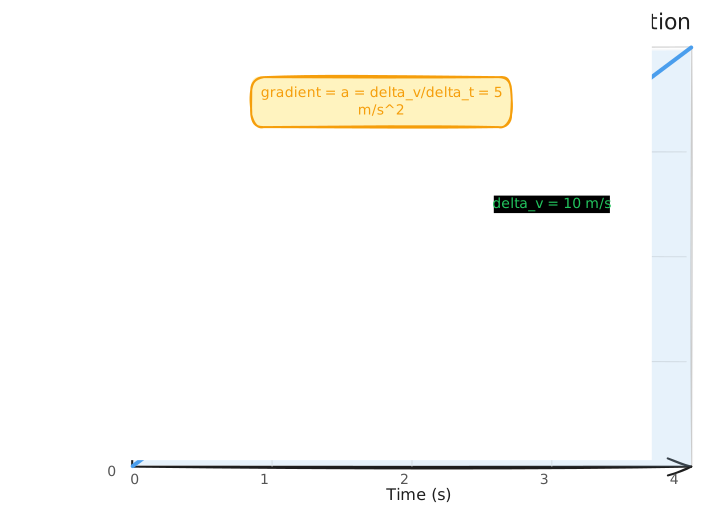
For an object under constant net force (uniform acceleration), the v-t graph is a straight line. The gradient of this line equals the acceleration, and the area under the line equals displacement.
Vector Representation
Acceleration is a vector — it has both magnitude and direction. For an object accelerating in the positive direction, the acceleration vector points in the same direction as the net force. For a decelerating object, the acceleration vector points opposite to the velocity vector.
Deriving Fnet = ma from Graphical Data
Newton didn't write F = ma on a whiteboard. Scientists measured it from data — and you can too.
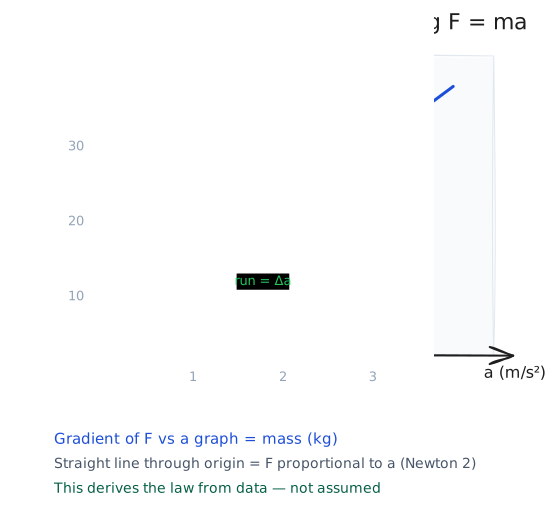
In the trolley experiment, a constant force F is applied to a trolley of mass m. The acceleration a is measured for several different values of F (keeping m constant). The results are plotted as F on the y-axis and a on the x-axis.
The Four-Step Graphing Scaffold
Graph-to-Physics Interpretation — use every time
Common Misconceptions
✏️ Worked Examples
Problem Setup
Problem type: Type 2 — Kinetic Single Object. Constant net force, finding acceleration from F = ma.
Scenario: A 4 kg trolley is pushed with a constant net force of 12 N on a frictionless surface. Find the acceleration and describe the motion qualitatively and using vectors.
- m = 4 kg
- Fnet = 12 N (forward)
- Surface frictionless — no opposing force
- Positive direction: forward
Solution
What would change if...
The surface were not frictionless — instead μk = 0.2. What would the new acceleration be? Draw the new FBD and recalculate Fnet before applying F = ma.
Problem Setup
Problem type: Type 2 — Graphical Analysis. Derive F = ma from an F vs a graph.
Scenario: An F vs a graph for a trolley produces a straight line through the origin. Two points on the line are (1.0 m/s², 8 N) and (4.0 m/s², 32 N). Find the mass of the trolley and write the relationship in words.
- Point 1 on line: a = 1.0 m/s², F = 8 N
- Point 2 on line: a = 4.0 m/s², F = 32 N
- Graph passes through origin — direct proportionality
Solution
What would change if...
A second trolley of mass 16 kg were used in the same experiment. Sketch what the new F vs a graph would look like alongside the first — steeper or shallower? At a = 2 m/s², what F would be required for each trolley?
Visual Break
Copy into your books
▼v-t Graph Interpretation
- Gradient of v-t graph = acceleration (m/s²)
- Area under v-t graph = displacement (m)
- Straight line = uniform (constant) acceleration
- Horizontal line = constant velocity (a = 0)
F vs a Graph
- Straight line through origin = F ∝ a (direct proportionality)
- Gradient = ΔF / Δa = mass (kg)
- Units check: N ÷ m/s² = kg
- Steeper line = greater mass
Graphing Protocol
- Step 1: Labelled axes (variable, symbol, unit)
- Step 2: Plot points, draw line of best fit
- Step 3: Gradient = rise/run from line (not data points)
- Step 4: Interpret gradient in physics terms — NESA language
NESA Gradient Statement Template
- "The gradient of the [F] vs [a] graph represents [mass]..."
- "...because F = ma can be rearranged to F = m × a..."
- "...which has the form y = mx, where gradient = m (mass)"
- Always include units in the interpretation
🏃 Activities
Data Table and Graph Analysis
A student applies different net forces to a trolley and measures the resulting acceleration. Results are shown below.
| Trial | Net Force Fnet (N) | Acceleration a (m/s²) | F/a ratio (kg) |
|---|---|---|---|
| 1 | 4.0 | 0.80 | |
| 2 | 8.0 | 1.62 | |
| 3 | 12.0 | 2.40 | |
| 4 | 16.0 | 3.18 | |
| 5 | 20.0 | 4.05 |
- Complete the F/a ratio column. What do you notice about these values?
- Plot F (y-axis) vs a (x-axis) in your book. Draw a line of best fit.
- Calculate the gradient using two points on your line of best fit. Show rise/run working.
- Write a NESA-standard sentence interpreting the gradient in physics terms.
- Does the line pass through the origin? What does this indicate about the relationship between F and a?
Type your gradient calculation and interpretation below. Draw the graph in your book.
Complete the table, draw the graph, and write your answers in your book.
Find and Fix the Errors
"I plotted my F vs a data and drew a line of best fit. To find the gradient I used the first and last data points: gradient = (20 − 4) / (4.05 − 0.80) = 16 / 3.25 = 4.9.
The gradient of the graph is 4.9 m/s² — this represents the acceleration of the trolley.
Since the graph is a straight line, this proves F = ma is correct.
The area under the F vs a graph equals the displacement of the trolley."
For each error: (a) state what is wrong, (b) explain why using physics reasoning, (c) write the correct version.
Type your error analysis below — aim to find all four.
Write your error analysis in your book — aim to find all four errors.
✅ Check Your Understanding
Earlier you were asked: What shape will the F vs a graph be — and what physical quantity does the gradient represent?
The full answer: the graph is a straight line through the origin, reflecting the direct proportionality between net force and acceleration when mass is constant. The gradient equals mass — specifically, gradient = ΔF/Δa with units of N ÷ m/s² = kg.
The deeper point: this is not just a calculation. The straight line through the origin is experimental evidence for Newton's Second Law. When students measure this in a trolley experiment, they are not verifying a formula — they are deriving it. The law emerges from the data.
Look back at your initial prediction. What did you get right? What is clearer now?
Annotate your prediction in your book with what you now understand differently.
Look back at what you wrote in the Think First section. What has changed? What did you get right? What surprised you?
Multiple Choice
5 random questions from a replayable lesson bank — feedback shown immediately
7. A v-t graph for a moving object shows a straight line with a positive gradient starting from the origin. Describe the motion of the object and state what the gradient and area under the line each represent. 3 MARKS
8. An F vs a graph for a 5 kg trolley is expected to be a straight line through the origin. However the student's line has a y-intercept of +2 N. Suggest two possible reasons for this and explain what each would mean physically. 3 MARKS
9. A student investigates Newton's Second Law by applying different net forces to a trolley and measuring the resulting acceleration. The F vs a graph produces a straight line through the origin with a gradient of 2.4 kg. (a) State the mass of the trolley. (b) The student repeats the experiment with an additional 1.2 kg mass placed on the trolley. Predict the gradient of the new F vs a graph. (c) On the same set of axes, sketch both lines and label them. (d) Write a conclusion in NESA-standard language that includes the relationship between gradient, mass, and Newton's Second Law. 4 MARKS
Comprehensive Answers
▼Activity 01 — Data Table and Graph
F/a ratios: Trial 1: 4.0/0.80 = 5.0 | Trial 2: 8.0/1.62 = 4.94 | Trial 3: 12.0/2.40 = 5.0 | Trial 4: 16.0/3.18 = 5.03 | Trial 5: 20.0/4.05 = 4.94. All approximately 5 — this is the mass of the trolley (5 kg).
Gradient: Using points on the line of best fit at a = 1.0 and a = 4.0: gradient ≈ (20 − 4) / (4.0 − 0.8) ≈ 5.0 kg.
NESA interpretation: The gradient of the F vs a graph represents the mass of the trolley (5 kg), as Fnet = ma can be rearranged to F = m × a, which has the form y = mx where the gradient m equals mass.
Line through origin: Yes — confirming that Fnet is directly proportional to a when mass is constant. This is consistent with Newton's Second Law.
Activity 02 — Four Errors
Error 1 — Used data points instead of line of best fit: The gradient must be calculated from two points on the line of best fit, not from data points. Data points include experimental error; the line of best fit minimises this error. Using data points gives an unreliable gradient.
Error 2 — Wrong units and interpretation (gradient called "m/s²"): The gradient of an F vs a graph has units of N ÷ m/s² = kg. It represents mass, not acceleration. The student stated "4.9 m/s²" — this is both wrong units and wrong physical interpretation.
Error 3 — Incorrect claim that straight line "proves" F = ma: A straight line through the origin is consistent with F ∝ a — it supports Newton's Second Law but does not prove it. Scientific language requires "consistent with" or "supports" rather than "proves".
Error 4 — Area under F vs a graph equals displacement: The area under a v-t graph equals displacement. The area under an F vs a graph has units of N × m/s² which equals W (watts, power per unit time) — it has no simple kinematic meaning. This is a confusion between graph types.
Multiple Choice
1. B — Gradient of v-t graph = Δv/Δt = acceleration. Area under v-t graph = displacement (common confusion).
2. C — Straight line through origin means y ∝ x, i.e. F ∝ a — Newton's Second Law at constant mass.
3. A — 5 kg. Gradient = ΔF/Δa = (30 − 10)/(6 − 2) = 20/4 = 5 kg.
4. D — Data points have random experimental error. Using them instead of the line of best fit introduces that error into the gradient. The error could be in either direction depending on which data points are high or low.
5. B — 9 N. a = Δv/Δt = (14 − 2)/4 = 3 m/s². Fnet = ma = 3 × 3 = 9 N.
6. C — The 6 kg trolley requires more force to achieve the same acceleration (F = ma — larger m, same a → larger F). On an F vs a graph, this means a steeper line (larger gradient = larger mass).
Short Answer — Model Answers
Q7 (3 marks): The object is moving in the positive direction with uniform (constant) acceleration from rest. The velocity increases linearly with time — equal increases in velocity for equal time intervals. The gradient of the v-t graph represents the acceleration of the object (a = Δv/Δt, units m/s²). The area under the v-t graph represents the displacement of the object (units m).
Q8 (3 marks): Reason 1 — A constant friction force is present that was not subtracted from the applied force. If a constant friction force f acts on the trolley, then Fapplied = Fnet + f, shifting the line upward by f and producing a positive y-intercept equal to the friction force. Reason 2 — A systematic measurement error in the force sensor (zero offset). If the force sensor was not zeroed before the experiment, all force readings would be consistently too high by a fixed amount, producing a y-intercept equal to the offset error. In this case the gradient (mass) would still be correct, but the y-intercept would not be zero.
Q9 (4 marks):
Acceleration and Graphical Analysis
Put your knowledge of kinematics graphs, acceleration and motion analysis to the test. Answer correctly to deal damage — get it wrong and the boss hits back. Pool: lessons 1–5.
Mark lesson as complete
Tick when you have finished all activities and checked your answers.