Work and Kinetic Energy
Work is a deposit of energy. Kinetic energy is the balance. The work-energy theorem says the deposit always equals the change in balance — exactly.
Download this lesson's worksheet
Use the PDF for classwork, homework or revision. It includes key ideas, activities, questions, an extend task and success-criteria proof.
A waiter carries a tray of food horizontally across a restaurant at constant height and constant speed. He exerts an upward force on the tray the entire time. Has he done any work on the tray? Predict your answer and explain your reasoning.
Type your prediction below — you will revisit it at the end.
Write your prediction in your book. You will revisit it at the end.
Come back to this at the end of the lesson.
Formula Reference — This Lesson
Formula Reference — Work, Kinetic Energy and the Work-Energy Theorem
▼Know
- Definition of work in physics (W = Fs cosθ)
- Definition of kinetic energy (KE = ½mv²)
- The work-energy theorem: Wnet = ΔKE
- ΔU = mgΔh for gravitational PE
Understand
- Why a perpendicular force does zero work
- Why KE scales with v² not v
- Why net work (not applied force alone) determines ΔKE
- How work, KE and PE are connected through energy conservation
Can Do
- Calculate work done by a force at any angle θ
- Calculate KE and ΔKE for moving objects
- Apply Wnet = ΔKE to find unknown speed or force
- Calculate ΔU = mgΔh for height changes
Misconceptions to Fix
Wrong: Zero acceleration means an object is stationary.
Right: Zero acceleration means constant velocity — the object could be moving at constant speed in a straight line.
📚 Core Content
Work — W = Fs cosθ
Work is done on an object when a force moves it — but only the component of force in the direction of motion counts.
In physics, work is the transfer of energy by a force acting through a displacement. It is not effort, tiredness, or time — it is specifically a force causing a displacement. Work has the unit of joules (J), the same unit as energy.
When a force F acts at angle θ to the direction of displacement s, only the component F cosθ contributes to work done — the perpendicular component does nothing useful:
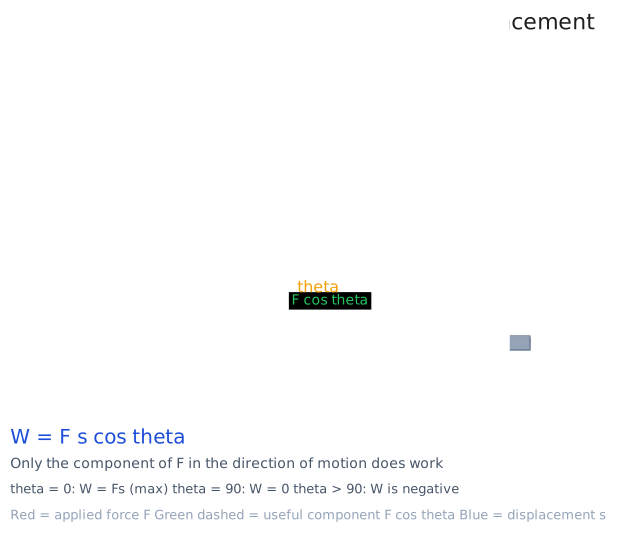
Horizontal push on a box (force and motion same direction)
Rope pull at 30° above horizontal
Normal force on a sliding box
Friction opposing motion
Kinetic Energy — KE = ½mv²
Kinetic energy is the energy an object has because it is moving — and it grows with the square of speed, not linearly.
Kinetic energy (KE) is the energy stored in an object due to its motion. A stationary object has zero KE regardless of its mass. A moving object always has KE, and that KE increases rapidly as speed increases — because of the v² relationship.
| Object | Mass (kg) | Speed (m/s) | KE (J) | Note |
|---|---|---|---|---|
| Cyclist | 80 | 5 | 1 000 | Baseline |
| Cyclist | 80 | 10 | 4 000 | 2× speed → 4× KE |
| Cyclist | 80 | 20 | 16 000 | 4× speed → 16× KE |
| Car | 1200 | 10 | 60 000 | 15× mass → 15× KE (same speed) |
| Car | 1200 | 20 | 240 000 | 2× speed → 4× KE |
The Work-Energy Theorem — Wnet = ΔKE
The net work done on an object equals exactly the change in its kinetic energy — no more, no less.
This is not a coincidence — it is a fundamental relationship derived from Newton's Second Law. When a net force acts on an object over a displacement, it both does work AND changes the object's kinetic energy, and the two are always equal:
Negative $W_{net}$ → object slows down (KE decreases)
Zero $W_{net}$ → constant speed (KE unchanged)
| Situation | Wnet | ΔKE | Effect on motion |
|---|---|---|---|
| Engine force > friction | Positive | Positive (KE increases) | Object accelerates |
| Brakes applied | Negative | Negative (KE decreases) | Object decelerates |
| Constant velocity cruise | Zero | Zero (KE unchanged) | No acceleration |
| Object falling freely | Positive (gravity) | Positive (KE increases) | Speeds up, PE converts to KE |
Common Misconceptions
✏️ Worked Examples
Problem Setup
Problem type: Type 3 — Energy Transformation. Flat surface, no height change. Verify Wnet = ΔKE.
Scenario: A 1200 kg car accelerates from rest to 25 m/s. The engine exerts a constant driving force of 4000 N over a distance of 93.75 m on a flat road. Calculate: (a) work done by the engine, (b) the change in KE, (c) verify Wnet = ΔKE.
- m = 1200 kg | vi = 0 m/s | vf = 25 m/s
- F = 4000 N (horizontal, θ = 0°)
- s = 93.75 m | flat road (no height change)
- Assume frictionless for this example
Solution
What would change if...
The same car braked from 25 m/s to rest over 62.5 m. What was the braking force? Is the work done positive or negative — and why? Use Wnet = ΔKE to find the answer.
Problem Setup
Problem type: Type 3 — Energy Transformation. Force at angle, friction present, find final speed.
Scenario: A 15 kg box starts from rest and is pulled 8 m across a floor by a rope at 30° above horizontal. Applied force = 60 N, μk = 0.2. Find the final speed.
- m = 15 kg | vi = 0 | s = 8 m
- Fapplied = 60 N at θ = 30° above horizontal
- μk = 0.2
- Positive direction: forward (direction of motion)
Solution
What would change if...
The rope were horizontal (θ = 0°) instead of at 30°. Would the final speed be higher or lower? Consider both the change in Wapplied and the change in FN (and therefore friction) — both change when the angle changes.
Visual Break
Copy into your books
▼Work Done
- W = Fs cosθ — θ is angle between F and displacement
- θ = 0°: W = Fs (maximum, force parallel to motion)
- θ = 90°: W = 0 (force perpendicular, e.g. normal force)
- θ = 180°: W = −Fs (force opposes motion, e.g. friction)
Kinetic Energy
- KE = ½mv² — depends on v², not v
- Doubling speed → 4× KE (not 2×)
- Unit: joule (J) = kg m² s⁻²
- KE = 0 for any stationary object regardless of mass
Work-Energy Theorem
- Wnet = ΔKE = KEf − KEi
- Must use NET work — include all forces
- Positive Wnet → object speeds up
- Negative Wnet → object slows down
Gravitational PE
- ΔU = mgΔh — height change in uniform field
- Moving up: Δh positive → ΔU positive (PE increases)
- Moving down: Δh negative → ΔU negative (PE decreases)
- Work done by gravity = −ΔU = mg × drop in height
🏃 Activities
Compare: Horizontal Push vs Angled Pull
A 1000 kg car starts from rest and is moved 50 m. In both cases F = 2000 N and μk = 0.2.
- Complete the table for both scenarios. Show all working beside the table.
- Which scenario produces the higher final speed? Explain why in terms of work and energy.
- Why does the angled pull change the normal force — and what effect does this have on friction?
Type your comparison and explanation below. Complete the table in your book.
Complete the table and answer questions in your book.
Apply: Cyclist Down a Hill
A 70 kg cyclist freewheels from rest at the top of a 12 m hill to the bottom. The road distance is 40 m.
- Part A — No friction: Assume no friction or air resistance. Use ΔU = mgΔh to find the work done by gravity. Then apply Wnet = ΔKE to find the speed at the bottom.
- Part B — With friction: Now assume a constant friction force of 80 N over the 40 m road distance. Recalculate the final speed.
- Part C — Comparison: How much speed does friction cost the cyclist? Express your answer in m/s and as a percentage reduction.
- Part D — Extend: If the hill were twice as tall (24 m) but the road distance stayed at 40 m with the same friction force of 80 N, predict qualitatively whether the percentage speed loss would increase or decrease compared to Part C. Explain your reasoning.
Type your working and answers below.
Complete all four parts in your book showing full working.
✅ Check Your Understanding
Earlier you were asked: A waiter carries a tray horizontally at constant height and speed. He exerts an upward force the entire time. Has he done any work on the tray?
The full answer: No — the waiter does zero work on the tray in the physics sense. The force he exerts is upward; the tray's displacement is horizontal. The angle between force and displacement is 90°, so W = Fs cos90° = 0 J. No energy is transferred to the tray by this force. This surprises most people because the waiter clearly expends effort — but physical work requires a force component in the direction of motion. The waiter's upward force has zero component in the horizontal direction.
This is one of the most important conceptual distinctions in the energy topic: everyday effort and physics work are not the same thing.
Look back at your initial prediction. What did you get right? What changed?
Annotate your initial response in your book with what you now understand differently.
Look back at what you wrote in the Think First section. What has changed? What did you get right? What surprised you?
Multiple Choice
5 random questions from a replayable lesson bank — feedback shown immediately
7. Define work in physics and explain why a normal force does zero work on a box sliding horizontally across a floor, even though the normal force is large. 3 MARKS
8. A 20 kg box starts from rest and is pulled 10 m across a flat floor by a rope at 25° above horizontal. The applied force is 100 N and μk = 0.25. Apply the Vector Protocol. Calculate the net work done and the final speed of the box. 3 MARKS
9. A car of mass m brakes from initial speed vi to rest. Using Wnet = ΔKE, derive an expression for the braking distance s in terms of m, vi, and braking force Fb. Use your expression to show that doubling the initial speed requires four times the braking distance. Explain why this relationship makes road speed limits so critical to safety. 4 MARKS
Comprehensive Answers
▼Activity 01 — Comparison Table
Scenario A (θ = 0°): Wapplied = 2000 × 50 × 1 = 100 000 J | FN = 1000 × 9.8 = 9800 N | fk = 0.2 × 9800 = 1960 N | Wfriction = −1960 × 50 = −98 000 J | Wnet = 100 000 − 98 000 = 2000 J | vf = √(2 × 2000/1000) = 2.0 m/s
Scenario B (θ = 20°): Wapplied = 2000 × 50 × cos20° = 93 969 J | FN = 9800 − 2000 sin20° = 9800 − 684 = 9116 N | fk = 0.2 × 9116 = 1823 N | Wfriction = −1823 × 50 = −91 150 J | Wnet = 93 969 − 91 150 = 2819 J | vf = √(2 × 2819/1000) = 2.37 m/s
Scenario B is faster despite applying less work — because the angled pull lifts some of the box's weight off the surface, reducing the normal force, which reduces friction more than the reduction in applied work. The net result is higher Wnet and a higher final speed.
Activity 02 — Cyclist Down a Hill
Part A: Wgravity = mgΔh = 70 × 9.8 × 12 = 8232 J. Wnet = 8232 J. vf = √(2 × 8232/70) = √235.2 = 15.3 m/s
Part B: Wfriction = −80 × 40 = −3200 J. Wnet = 8232 − 3200 = 5032 J. vf = √(2 × 5032/70) = √143.8 = 12.0 m/s
Part C: Speed reduction = 15.3 − 12.0 = 3.3 m/s. As a percentage: 3.3/15.3 × 100 = 21.6% reduction.
Part D: With a 24 m hill: Wgravity = 70 × 9.8 × 24 = 16 464 J. Wfriction stays at −3200 J (same road, same force). Wnet = 13 264 J. The friction work is a smaller fraction of the total work — so the percentage speed loss would decrease. Taller hills reduce the relative impact of friction because gravity does more work.
Multiple Choice
1. C — 2000 J. W = Fs cosθ = 500 × 4 × cos0° = 2000 J. Force is horizontal, motion is horizontal, θ = 0°.
2. D — Normal force acts vertically upward; displacement is horizontal. θ = 90°, cos90° = 0, W = 0.
3. B — 36 J. KE = ½mv² = ½ × 2 × 36 = 36 J. Common error: forgetting to square v — ½ × 2 × 6 = 6 J is wrong.
4. A — 207 J. Wapplied = 80 × 5 × cos40° = 306.4 J. Wfriction = −20 × 5 = −100 J. Wnet = 206.4 J ≈ 207 J. Option B (400 J) ignores friction. Option D (307 J) ignores the cosθ reduction.
5. C — 4×. KE ∝ v². Doubling v → (2v)² = 4v² → 4× KE. This is the v² relationship — KE grows with the square of speed.
6. B. From Wnet = ½mv²: v = √(2W/m). For A: vA = √(2W/2) = √W. For B: vB = √(2W/8) = √(W/4) = ½√W. So vA/vB = √W / (½√W) = 2. Object A is twice as fast. Option D (4×) confuses the mass ratio with the speed ratio — must take the square root.
Short Answer — Model Answers
Q7 (3 marks): Work is defined as the transfer of energy by a force acting through a displacement in the direction of the force — expressed as W = Fs cosθ, where θ is the angle between the force and the displacement. The normal force acts vertically upward on a horizontally sliding box. The displacement of the box is horizontal. The angle between the normal force and the displacement is θ = 90°. Since cos90° = 0, the work done by the normal force is W = Fs × 0 = 0 J, regardless of the magnitude of the force or the distance travelled.
Q8 (3 marks):
Q9 (4 marks) — Band 6 derivation:
Road safety implication: A car travelling at 60 km/h requires 4× the braking distance of the same car at 30 km/h — not 2× as many drivers assume. At 60 km/h, a car has 4× the KE of a car at 30 km/h. All of this KE must be removed by the brakes over the stopping distance. Since braking force is limited by the friction between tyres and road, the only way to dissipate 4× the energy is over 4× the distance. This is the physics basis for lower urban speed limits — small increases in speed lead to disproportionately large increases in stopping distance and crash energy.
Work and Kinetic Energy
Climb platforms, hit checkpoints, and answer questions on work done by a force, kinetic energy and the work-energy theorem. Quick recall from lessons 1–6.
Mark lesson as complete
Tick when you have finished all activities and checked your answers.