Gravitational PE and Energy Conservation
A rollercoaster car released from rest at the top of a 40 m drop arrives at the bottom at nearly 90 km/h. No engine. No push. The energy was always there — stored in position, waiting to become motion.

Download this lesson's worksheet
Use the PDF for classwork, homework or revision. It includes key ideas, activities, questions, an extend task and success-criteria proof.
A rollercoaster car starts from rest at the top of a 40 m drop. At the bottom it is travelling at 28 m/s. A second car — twice as heavy — starts from rest at the same point. Predict: is the heavier car faster, slower, or the same speed at the bottom? Explain your reasoning before you read on.
Type your prediction below — you will revisit it at the end.
Write your prediction in your book. You will revisit it at the end.
Come back to this at the end of the lesson.
Formula Reference — This Lesson
Formula Reference — Gravitational PE and Energy Conservation
▼Know
- ΔU = mgΔh for gravitational PE
- Conservation of mechanical energy: KE₁ + U₁ = KE₂ + U₂
- When mechanical energy IS and IS NOT conserved
- v = √(2gΔh) for frictionless drop from rest
Understand
- Why mass cancels from the conservation equation
- Why speed at the bottom depends only on height — not mass
- Why friction breaks conservation of mechanical energy
- What "energy lost" to friction actually means physically
Can Do
- Calculate PE at different heights along a track
- Find speed at any point using KE₁ + U₁ = KE₂ + U₂
- Calculate energy lost to friction from before/after data
- Classify whether a scenario conserves mechanical energy
Misconceptions to Fix
Wrong: Heavier objects fall faster than lighter ones.
Right: In a vacuum, all objects fall at the same rate regardless of mass; air resistance causes differences in real situations.
📚 Core Content
Gravitational Potential Energy — ΔU = mgΔh
Gravitational potential energy is energy stored by position — the higher something is, the more energy it has available to convert into motion.
Gravitational potential energy (PE or U) is the energy stored in an object due to its height above a reference level. It is not a property of the object alone — it is a property of the object-Earth system. When an object is lifted, work is done against gravity and this energy is stored as PE.
The reference level (h = 0) is arbitrary — only changes in PE matter. You can set h = 0 at the ground, at the bottom of a drop, or at any convenient point. The change ΔU = mgΔh is always the same regardless of where you set zero.
Rollercoaster car
Rollercoaster car
Rollercoaster car
Water in Snowy Hydro dam
Conservation of Mechanical Energy
In a frictionless system, energy does not disappear — it just changes form. The total stays exactly the same at every point.
When only gravity acts on an object (no friction, no air resistance), the total mechanical energy — kinetic plus potential — remains constant throughout the motion. Energy sloshes between KE and PE but never leaks out:
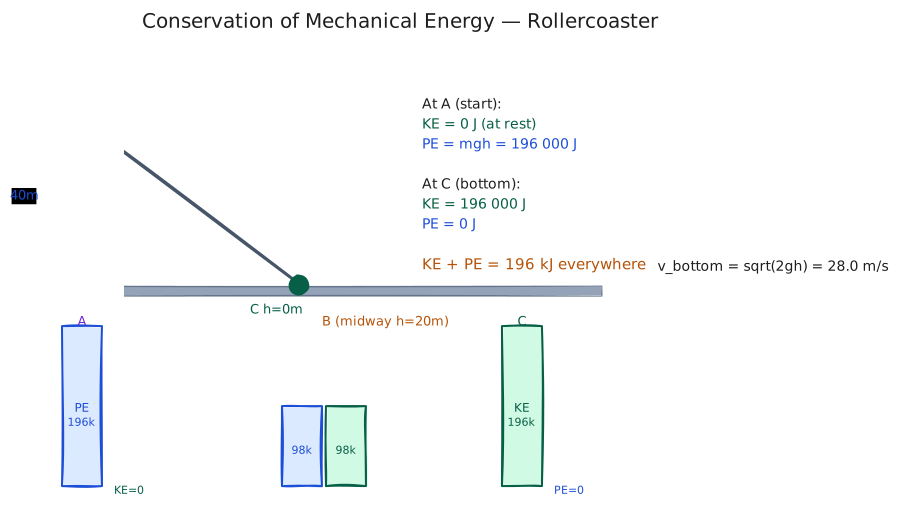
Why Mass Cancels
Starting from rest at height h and dropping to the reference level (h = 0):
Real Systems — Where Does the Energy Go?
Energy is always conserved — but mechanical energy is not. Friction converts it to heat and sound, which cannot be recovered as motion.
In a real rollercoaster, the car arrives at the bottom with less KE than the ideal prediction. The "missing" energy was converted to thermal energy (heat in the wheels and track) and sound energy by friction and air resistance. These are non-conservative forces — they permanently convert mechanical energy into forms that cannot be easily recovered.
The energy budget for a real system:
Where Elost = energy converted to heat and sound by friction and air resistance.
Elost = (KE₁ + U₁) − (KE₂ + U₂)
Common Misconceptions
✏️ Worked Examples
Problem Setup
Problem type: Type 3 — Energy Transformation. Frictionless — use conservation of mechanical energy.
Scenario: A rollercoaster car starts from rest at the top of a 35 m drop on a frictionless track. Find the speed at the bottom.
- v₁ = 0 m/s (starts from rest)
- h₁ = 35 m (reference level: bottom = h = 0)
- h₂ = 0 m (bottom)
- Frictionless — conservation applies
- Mass not given — check if it cancels
Solution
What would change if...
What would the speed be at a point halfway down (h = 17.5 m above the bottom)? Is it exactly half of 26.2 m/s — or more, or less? Use the full conservation equation to find out, then explain why.
Problem Setup
Problem type: Type 3 — Energy Transformation. Friction present — find energy lost and average friction force.
Scenario: A 500 kg rollercoaster car starts from rest at the top of a 30 m drop. It arrives at the bottom at 20 m/s. How much energy was lost to friction and air resistance? What was the average resistance force over the 30 m path?
- m = 500 kg | v₁ = 0 | h₁ = 30 m | v₂ = 20 m/s | h₂ = 0
- Path distance along track = 30 m (assume slope is steep)
- Friction present — mechanical energy NOT conserved
Solution
What would change if...
The car's mass were doubled to 1000 kg but everything else remained the same (same height, same final speed, same path length). Would the energy lost to friction be larger, smaller, or the same? Would the average friction force change? Think about it before calculating.
Visual Break
Copy into your books
▼Gravitational PE
- ΔU = mgΔh — vertical height only, not path length
- PE = 0 at reference level (chosen for convenience)
- Moving up: Δh positive → ΔU positive (PE increases)
- Moving down: Δh negative → ΔU negative (PE decreases)
Conservation of Mechanical Energy
- KE₁ + U₁ = KE₂ + U₂ (frictionless only)
- Mass cancels → v = √(2gΔh) from rest
- Speed at bottom depends only on height — not mass
- Total mechanical energy is constant at every point
Real Systems with Friction
- KE₁ + U₁ = KE₂ + U₂ + Elost
- Elost = heat + sound (not destroyed)
- Find Elost: initial Emech − final Emech
- Find friction force: F = Elost / s (W = Fs)
When to Use Which Formula
- No friction → use KE₁ + U₁ = KE₂ + U₂
- Friction present → use Wnet = ΔKE or find Elost
- From rest, frictionless → v = √(2gΔh)
- Always define h = 0 reference level first
🏃 Activities
Energy Bar Diagram — Rollercoaster Track
A 600 kg rollercoaster car starts from rest at the top of a 50 m drop. The track has the following profile (heights above the bottom):
| Point | Height (m) | PE (J) | KE (J) | Speed (m/s) |
|---|---|---|---|---|
| A — Start | 50 | |||
| B — Quarter way down | 37.5 | |||
| C — Bottom of drop | 0 | |||
| D — Top of next hill | 30 | |||
| E — Bottom of next valley | 10 |
- Complete the table. Use conservation of mechanical energy (frictionless).
- Draw side-by-side PE (blue) and KE (green) bar diagrams for each point. Total bar height should be constant.
- At which point is the car travelling fastest? At which is it slowest? Explain using energy.
- Could the car make it over a hill that is 55 m high? Explain using energy conservation.
Type your answers and table values here. Draw bar diagrams in your book.
Complete the table, draw bar diagrams, and answer all questions in your book.
Classify: Does Mechanical Energy Conserve?
| # | Scenario | Emech conserved? | Formula to use | Reason |
|---|---|---|---|---|
| 1 | Pendulum swinging in vacuum | |||
| 2 | Ball rolling down a rough ramp | |||
| 3 | Skier on a frictionless icy slope | |||
| 4 | Sky diver reaching terminal velocity | |||
| 5 | Rollercoaster with friction forces | |||
| 6 | Ball thrown vertically upward (no air resistance) | |||
| 7 | Car coasting to a stop on flat road | |||
| 8 | Water falling over a waterfall into a pool |
Type your justifications here. Complete the table in your book.
Complete the table with full justifications in your book.
✅ Check Your Understanding
Earlier you were asked: A heavier rollercoaster car starts from rest at the same height. Is it faster, slower, or the same speed at the bottom?
The full answer: exactly the same speed. From KE₁ + U₁ = KE₂ + U₂ starting from rest: mgh = ½mv² → mass cancels → v = √(2gh). Speed at the bottom depends only on the height of the drop — not on the mass of the car.
The intuition that heavier should mean faster is understandable — heavier cars do have more PE at the top. But they also have more mass to accelerate. These two effects cancel exactly. This is one of the most elegant results in classical mechanics — and it is why Galileo's famous (possibly apocryphal) Leaning Tower of Pisa experiment would have worked even if he had used a rollercoaster instead of cannon balls.
Look back at your initial prediction. What did you get right? What changed in your thinking?
Annotate your initial prediction in your book with what you now understand.
Look back at what you wrote in the Think First section. What has changed? What did you get right? What surprised you?