Power
An athlete and a walker climb the same stairs. They do the same work. But the athlete does it in 4 seconds — the walker takes 40. Same energy, very different power.
Download this lesson's worksheet
Use the PDF for classwork, homework or revision. It includes key ideas, activities, questions, an extend task and success-criteria proof.
A 70 kg athlete sprints up a 5 m staircase in 4 seconds. A 70 kg person walks up the same staircase in 40 seconds. Who does more work? Who is more powerful? Are the answers to these two questions the same?
Type your predictions below — you will revisit them at the end.
Write your predictions in your book. You will revisit them at the end.
Come back to this at the end of the lesson.
Formula Reference — This Lesson
Formula Reference — Power
▼Know
- P = ΔE/Δt — average power definition
- P = Fv cosθ — power from force and velocity
- P = mgh/Δt — shortcut for vertical lifting
- Unit: watt (W) = joule per second (J/s)
Understand
- Why power and work are different quantities
- Why P = Fv at constant velocity uses driving force = resistance force
- Why power increases as speed increases at constant force
- Why the same work can be done at different power levels
Can Do
- Calculate average power from work and time
- Calculate power at constant velocity using P = Fv
- Calculate power lifting against gravity
- Identify which power formula applies in a given context
Misconceptions to Fix
Wrong: Action and reaction forces cancel each other out on the same object.
Right: Action-reaction pairs act on DIFFERENT objects, so they never cancel; this is why motion occurs.
📚 Core Content
Power — P = ΔE/Δt
Power is not about how much energy you use — it is about how fast you use it. A slow engine and a fast engine can do the same work; the fast one is more powerful.
Power is the rate of energy transfer — the amount of energy transferred per unit time. Its SI unit is the watt (W), where 1 W = 1 J/s.
Back to the staircase: both the athlete and the walker climb the same 5 m height at 70 kg. Both do W = mgh = 70 × 9.8 × 5 = 3430 J of work against gravity. But:
Walker P = ΔE/Δt = 3430/40 = 85.75 W
Same work done. Athlete is 10× more powerful — because they do it 10× faster.
Power from Force and Velocity — P = Fv cosθ
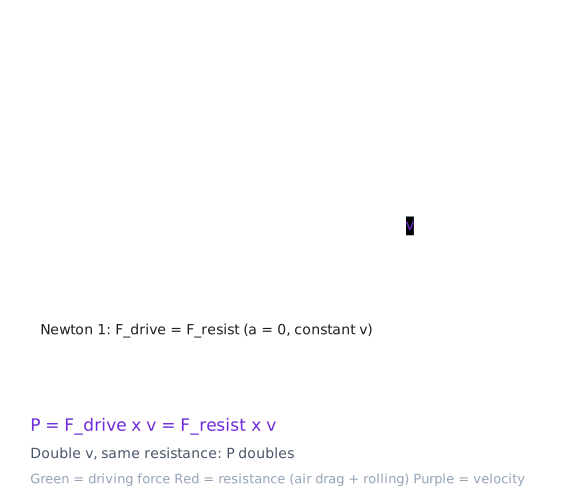
At constant velocity, the engine's power output tells you exactly how hard it is fighting all the resistances — because the driving force exactly equals the total resistance.
Derivation
Starting from P = W/Δt and W = Fs cosθ:
Power vs Speed at Constant Resistance
| Speed (m/s) | Resistance force (N) | Power required (W) | Power in kW |
|---|---|---|---|
| 10 | 800 | 8 000 | 8 kW |
| 20 | 800 | 16 000 | 16 kW |
| 30 | 800 | 24 000 | 24 kW |
| 40 | 800 | 32 000 | 32 kW |
Notice: doubling speed doubles the power required to maintain constant velocity against the same resistance. This is why highway driving consumes significantly more fuel than city driving even at constant speed.
Power in Real-World Contexts
Every time something moves against a resistive force — gravity, friction, air resistance — energy is being transferred at a rate measured in watts.
Uniformly accelerated motion
Lifting against gravity
Against air resistance and rolling resistance
Common Misconceptions
✏️ Worked Examples
Problem Setup
Problem type: Type 4 — Power. Vertical lifting against gravity.
Scenario: A 65 kg athlete runs up a 4 m high flight of stairs in 3.2 s. Calculate the average power output against gravity.
- m = 65 kg | h = 4 m | Δt = 3.2 s
- Work against gravity only (as stated)
- Use P = mgh/Δt
Solution
What would change if...
The athlete's actual total power output is greater than 796 W — why? Name at least two other forms of energy expenditure not accounted for in this calculation.
Problem Setup
Problem type: Type 4 — Power at constant velocity. Find driving force from Newton 1, then apply P = Fv.
Scenario: A car travels at constant 30 m/s. The total resistive force is 800 N. Calculate: (a) the engine's driving force, (b) the engine's power at this speed, (c) the power output if speed increased to 40 m/s with the same resistive force.
- v = 30 m/s (constant)
- Fresistance = 800 N
- Constant velocity → Newton 1 applies
Solution
What would change if...
If the car accelerates from 30 m/s to 40 m/s with the engine still supplying the same 800 N driving force, is the power output constant, increasing, or decreasing during the acceleration? Use P = Fv to explain what happens as v changes.
Visual Break
Copy into your books
▼Power Formulae
- P = ΔE/Δt — average power from energy and time
- P = Fv cosθ — instantaneous power from force and velocity
- P = mgh/Δt — lifting against gravity (vertical only)
- Unit: watt (W) = joule per second (J/s)
Constant Velocity Key Step
- Constant v → Newton 1 → Fdrive = Fresistance
- Then P = Fdrive × v
- Doubling v doubles P (if Fresist unchanged)
- θ = 0° for horizontal force and horizontal motion
Power During Acceleration
- If F is constant and v increases: P = Fv increases
- Power is NOT constant during acceleration
- Use P = W/Δt for average power over an interval
- Use P = Fv for instantaneous power at a given speed
Key Vocabulary
- Power: rate of energy transfer (W = J/s)
- Work: total energy transferred (J) — not a rate
- Average power: total energy ÷ total time
- Instantaneous power: power at a specific moment
🏃 Activities
Power Comparison Table
| # | Scenario | Formula | Working | Power (W or kW) |
|---|---|---|---|---|
| 1 | Person runs up stairs: m = 70 kg, h = 3 m, Δt = 2.5 s | |||
| 2 | Crane lifts 800 kg load 15 m in 60 s | |||
| 3 | Car at constant 25 m/s, Fresistance = 600 N | |||
| 4 | Cyclist at constant 12 m/s, Fdrag = 90 N | |||
| 5 | Motor does 50 000 J of work in 25 s | |||
| 6 | Pump lifts 200 kg of water 8 m per minute |
Type your working for each row here. Complete the table in your book.
Complete the table in your book showing the formula and full working for each row.
Find and Fix the Errors
Student's working (contains 4 errors):
"The car is at constant speed, so it is in equilibrium.
The driving force equals the car's weight: Fdrive = mg = 1200 × 9.8 = 11 760 N
Power = F × v = 11 760 × 20 = 235 200 W
Converting to kW: 235 200 W ÷ 100 = 2352 kW
Therefore the engine's power output is 2352 kW."
For each error: (a) identify what is wrong, (b) explain why using physics reasoning, (c) write the correct version.
Type your error analysis below — find all four.
Write your error analysis in your book.
✅ Check Your Understanding
Earlier you were asked: Who does more work — the athlete or the walker? Who is more powerful? Are these the same question?
The answers: both do exactly the same work — W = mgh = 70 × 9.8 × 5 = 3430 J. Work depends only on force and displacement, not time. But the athlete is 10× more powerful — Pathlete = 3430/4 = 857.5 W vs Pwalker = 3430/40 = 85.75 W.
The two questions have different answers because work and power are fundamentally different quantities. Work measures the total energy transferred. Power measures the rate. You can do the same work at any power level — it just takes longer at lower power. This distinction matters enormously in engineering: a 100 W motor and a 10 000 W motor can both lift the same load to the same height, but the powerful one does it 100 times faster.
Look back at your initial prediction. What did you get right? What changed?
Annotate your initial prediction in your book with what you now understand.
Look back at what you wrote in the Think First section. What has changed? What did you get right? What surprised you?
Multiple Choice
5 random questions from a replayable lesson bank — feedback shown immediately
7. Explain the difference between work and power, using the staircase example from the lesson. Include numerical values in your explanation. 3 MARKS
8. A cyclist travels at constant 8 m/s against a total resistance of 120 N. (a) Calculate the cyclist's power output. (b) Using the same power output, calculate how long it would take the cyclist to climb a 60 m vertical hill (assume all power goes against gravity, m = 75 kg). 3 MARKS
9. A car engine has a maximum power output of 150 kW. At a constant highway speed of 110 km/h, the total resistive force acting on the car is 1200 N. (a) Calculate the engine's power output at this speed. (b) Calculate the reserve power available. (c) If the driver uses the full engine power at 110 km/h, explain what would happen to the car's motion and why — use Newton's Second Law in your answer. 4 MARKS
Comprehensive Answers
▼Activity 01 — Power Table
- P = mgh/Δt = 70×9.8×3/2.5 = 2058/2.5 = 823.2 W
- P = mgh/Δt = 800×9.8×15/60 = 117 600/60 = 1960 W = 1.96 kW
- Constant v → Fdrive = 600 N. P = Fv = 600×25 = 15 000 W = 15 kW
- Constant v → Fdrive = 90 N. P = Fv = 90×12 = 1080 W = 1.08 kW
- P = ΔE/Δt = 50 000/25 = 2000 W = 2 kW
- 200 kg per 60 s, h = 8 m. P = mgh/Δt = 200×9.8×8/60 = 15 680/60 = 261.3 W
Activity 02 — Four Errors
Error 1 — Used weight instead of resistance force: At constant velocity, the driving force equals the resistance force (500 N) — not the weight. Newton 1 states Fnet = 0, so Fdrive = Fresistance = 500 N. The car's weight acts vertically and is irrelevant to horizontal power calculations on a flat road.
Error 2 — Correct power calculation using wrong force: P = F × v = 500 × 20 = 10 000 W = 10 kW. The student's P = 235 200 W is wrong because Fdrive was wrongly taken as mg.
Error 3 — Wrong conversion to kW: The student divided by 100 instead of 1000. 1 kW = 1000 W, not 100 W. Correct conversion: 10 000 W ÷ 1000 = 10 kW.
Error 4 — Stated conclusion using incorrect value: The final answer of 2352 kW flows from all previous errors. The correct answer is 10 kW — a 150 kW car engine provides ample reserve power above this at 20 m/s.
Multiple Choice
1. B — 300 W. P = ΔE/Δt = 6000/20 = 300 W. Option A (120 000 W) multiplies instead of dividing.
2. C — 25 000 W. P = Fv = 1000 × 25 = 25 000 W = 25 kW.
3. A — 1 watt = 1 joule per second. Option D (1000 J/s) describes a kilowatt, not a watt.
4. D — 1058.4 W. P = mgh/Δt = 90×9.8×6/5 = 5292/5 = 1058.4 W. Option C (882 W) uses g = 9.8 but Δt incorrectly. Option B (540 W) uses incorrect formula.
5. B — P = Fv. If F is constant and v increases, P increases proportionally. A constant force does NOT produce constant power during acceleration.
6. C — Work done by both = mgh = 100×9.8×10 = 9800 J. Motor A: P = 9800/20 = 490 W. Motor B: P = 9800/5 = 1960 W = 4× Motor A. Same work, different power, different time. Option A is wrong — work done is the same for both (only energy transferred depends on force and displacement, not time).
Short Answer — Model Answers
Q7 (3 marks): Work is the total energy transferred by a force through a displacement — it depends only on the force and the distance moved, not on time. Power is the rate of doing work — the amount of energy transferred per second. In the staircase example, both the athlete and walker climb the same 5 m at 70 kg, doing the same work: W = mgh = 70 × 9.8 × 5 = 3430 J. However the athlete (Δt = 4 s) has power P = 3430/4 = 857.5 W, while the walker (Δt = 40 s) has P = 3430/40 = 85.75 W — 10× less. Same work, very different power.
Q8 (3 marks):
Q9 (4 marks):
Blast the Correct Answer
Defend your ship by blasting the correct answers for Power. Scores count toward the Asteroid Blaster leaderboard.
Play Asteroid Blaster →Consolidation Game
Power
Mark lesson as complete
Tick when you have finished all activities and checked your answers.