Energy Synthesis
A car on a hill. Six formulae. One coherent picture. This lesson connects every energy concept from Phase 2 into a single chain — and shows how each calculation feeds the next.
Download this lesson's worksheet
Use the PDF for classwork, homework or revision. It includes key ideas, activities, questions, an extend task and success-criteria proof.
A 1200 kg car starts from rest at the top of a 20 m hill. It rolls to the bottom (frictionless), then continues along a flat road. The engine outputs 45 kW and total resistance is 900 N.
Before calculating anything: how many different Phase 2 energy concepts can you identify in this scenario? List every formula you think will be needed and explain what each one does in this situation.
Type your concept inventory below.
Write your concept inventory in your book.
Come back to this at the end of the lesson.
Formula Reference — This Lesson
Phase 2 Master Formula Reference — All Six Formulae
▼Know
- All six Phase 2 formulae and their conditions
- Three energy categories: stored, transferred, lost
- How each formula connects to adjacent formulae
- When NOT to use each formula
Understand
- Why each calculation in a chain feeds the next
- How to identify which formula applies before calculating
- Why energy accounting always balances
- The difference between ideal and real energy systems
Can Do
- Draw an energy flow diagram for any scenario
- Solve multi-step problems using two or more formulae in sequence
- Identify errors in multi-step energy solutions
- Select the correct formula from context without being told which to use
Misconceptions to Fix
Wrong: An object moving at constant velocity has no forces acting on it.
Right: An object at constant velocity has BALANCED forces (net force = 0), not necessarily no forces.
📚 Core Content
Card 1 — Map the Energy First
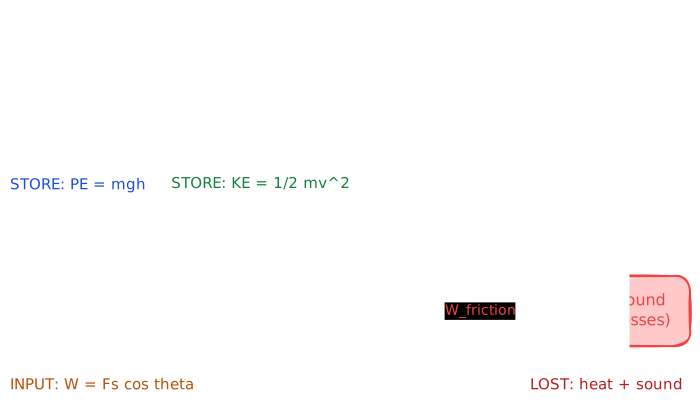
Before calculating anything, draw the energy flow. Every joule that enters a system must either be stored, converted, or transferred — accounting for energy is the foundation of every dynamics problem.
Every energy problem in Phase 2 involves some combination of three categories. Train yourself to classify each energy transfer before touching a formula:
| Category | What it means | Formula | In the car scenario |
|---|---|---|---|
| Stored energy | Energy an object possesses due to position or motion | PE = mgh, KE = ½mv² | PE at top of hill; KE at bottom; KE on flat road |
| Energy transferred by a force | Work done — energy moving into or out of the system | W = Fs cosθ, Wnet = ΔKE | Work by engine; work done against friction/drag |
| Energy lost to environment | Mechanical energy converted to heat and sound — not recoverable | Elost = initial − final Emech | Friction on flat road converts KE to heat in tyres and road |
Card 2 — Quantitative Synthesis
The formulae are not separate tools — they are different views of the same energy accounting system. Each answer feeds the next question.
Here is the full calculation chain for the car scenario. Notice how the output of each step becomes the input of the next:
Card 3 — How the Formulae Connect
If you understand how the formulae connect, you can solve any problem — even ones you have never seen before.
✏️ Worked Examples
Problem Setup
Key insight: The speed from conservation is NOT the speed on the flat — the cyclist must slow down because their power cannot sustain the hill speed against drag.
Scenario: A 500 kg cyclist + bike system starts from rest at the top of a 15 m frictionless hill. At the bottom they travel along a flat road. Drag force = 60 N. Cyclist power output = 300 W. Find: (a) speed at bottom of hill, (b) constant speed on flat road, (c) time to travel 500 m along flat at this speed.
- m = 500 kg | h = 15 m | frictionless hill
- Fdrag = 60 N (flat road) | P = 300 W
Solution
What would change if...
The cyclist's power output increased to 1200 W. Would they now be able to maintain 17.1 m/s on the flat? What would their new constant cruise speed be? What is the key check you must do before assuming conservation speed = cruise speed?
Problem Setup
Key insight: Start with the known (constant speed → P = Fv gives starting v), then use Wnet = ΔKE for the hill.
Scenario: A 900 kg car cruises at constant highway speed with engine power 60 kW and resistance 1500 N. The car then descends a 10 m hill (road distance 80 m, μk = 0.1, engine off). Find the speed at the bottom.
- m = 900 kg | P = 60 kW | Fresist = 1500 N (highway)
- Hill: h = 10 m | road distance = 80 m | μk = 0.1 | engine off
Solution
What would change if...
The friction coefficient increased to μk = 0.3. Predict qualitatively whether the car would be faster, slower, or the same speed at the bottom compared to μk = 0.1 — then calculate to check.
🏃 Activities
Diagram and Calculate — Motorcycle on a Road
A 300 kg motorcycle starts from rest on a flat road. The engine applies 1800 N for 100 m against a friction force of 300 N. At the end of this section the engine cuts out, and the motorcycle travels up a 25 m frictionless hill.
- Draw an energy flow diagram showing all inputs (stored, transferred, lost) for both sections. Label each arrow with the formula used.
- Calculate the net work done over the flat section and hence the speed at the end of the flat.
- Using conservation, calculate the maximum height the motorcycle can reach on the hill (engine is off).
- Explain why the motorcycle cannot reach the full 25 m height — what would need to be true for it to just reach the top?
Type your working below. Draw the energy flow diagram in your book.
Complete all four parts in your book, including the energy flow diagram.
True or False — Classify and Connect
✅ Check Your Understanding
Earlier you were asked: how many Phase 2 energy concepts can you identify in the car scenario — and which formulae will you need?
The full answer: all six. PE at the top (ΔU = mgΔh), conservation on the frictionless hill (KE₁+U₁=KE₂+U₂), KE at the bottom (KE = ½mv²), power to maintain constant speed (P = Fv), the work-energy theorem to find acceleration time (Wnet = ΔKE), and power = energy/time to connect the reserve power to the KE increase (P = ΔE/Δt).
The deeper insight: these are not six separate formulas. They are one idea — energy accounting — viewed from six different angles. Work is the mechanism of transfer. KE and PE are the forms of storage. The work-energy theorem is the accounting rule. Conservation is the special case when nothing leaks. Power is the rate. If you can see that one picture, you can solve any problem in Phase 2.
Look back at your initial inventory. How many did you identify? What connections were you missing?
Annotate your initial inventory in your book — add any connections you missed.
Look back at what you wrote in the Think First section. What has changed? What did you get right? What surprised you?
Multiple Choice
5 random questions from a replayable lesson bank — feedback shown immediately
7. Draw and label a complete energy flow diagram for the following scenario: a 400 kg object slides from rest down a rough 20 m ramp, then travels along a flat surface until it stops. Include all energy inputs, stores, transfers, and losses. State which formula applies at each stage. 3 MARKS
8. A 750 kg car starts from rest at the top of a frictionless 25 m hill. At the bottom it travels along a flat road at constant speed with engine power 30 kW. (a) Find the speed at the bottom of the hill. (b) Find the total resistance force on the flat road. (c) How long does the car take to travel 1.2 km along the flat road at this speed? 3 MARKS
9. A 60 kg skateboarder starts from rest at the top of a 4 m high half-pipe ramp. (a) Using conservation, find the speed at the bottom. (b) In reality, the skateboarder arrives at the bottom at 7 m/s. Calculate the energy lost and identify at least two physical mechanisms responsible. (c) On the next run, the skateboarder pushes off the top edge with an initial speed of 2 m/s. Find the new speed at the bottom (assume the same 30% energy loss as in part b). (d) Explain why the same percentage energy loss applies even at this higher initial speed — what physical insight does this reveal? 4 MARKS
Comprehensive Answers
▼Activity 01 — Motorcycle on a Road
Part 2 — Flat section: Wengine = 1800 × 100 × cos0° = 180 000 J. Wfriction = −300 × 100 = −30 000 J. Wnet = 150 000 J. v = √(2 × 150 000/300) = √1000 = 31.6 m/s.
Part 3 — Frictionless hill: KE at base = 150 000 J. Use conservation: mgh = KE → h = KE/mg = 150 000/(300 × 9.8) = 51.0 m. The motorcycle can reach 51 m — well above the 25 m hill, so it makes it over with energy to spare.
Note: If the hill were 51 m exactly, the motorcycle would just reach the top with zero speed. It can reach the full 25 m because 150 kJ > mgh(25m) = 300 × 9.8 × 25 = 73 500 J.
Part 4: If the hill were higher than 51 m, the motorcycle could not reach the top — its KE at the base would be less than the PE needed. It would decelerate, stop, and slide back. For it to just reach the top: KE at base = mghtop, which requires enough net work done on the flat.
Activity 02 — True/False Answers
- True — KE = ½mv². If v doubles, v² quadruples, so KE quadruples.
- False — W = Fs cos90° = 0. Normal force is perpendicular to horizontal motion — zero work done.
- False — When friction is present, conservation of mechanical energy does NOT apply. Use Wnet = ΔKE instead. The total energy (including heat) is conserved, but mechanical energy is not.
- False — P = Fv cosθ gives instantaneous power at any speed — not just constant velocity. At constant velocity it is most useful because Newton 1 gives Fdrive.
- True — From ½mv² = mgh, mass cancels to give v = √(2gh). Speed depends only on height dropped.
- True — Wnet = ΔKE. Using only applied force ignores friction and gives wrong ΔKE.
- False — ΔU = mgΔh uses the vertical height change — not the slope distance. Δh = h, never the road/ramp length.
- True — P = ΔE/Δt. Same work (ΔE the same), smaller Δt → larger P. The faster motor is more powerful.
- False — KE = ½mv². A stationary truck has v = 0, so KE = 0. A bullet at 900 m/s: KE = ½ × 0.009 × 810 000 = 3645 J. The bullet has more KE.
- True — W = Fs cos90° = 0. Any force perpendicular to displacement does zero work, regardless of F or s.
Multiple Choice
1. B — Flat surface, constant speed → Newton 1 → Fapplied = Ffriction. P = Fv. Option A (mgh/Δt) is for vertical lifting only.
2. C — Frictionless ramp: PE → KE (conservation). Rough flat: KE → heat (friction does negative work — Wnet = ΔKE).
3. D — 18.8 m/s. v = √(2gh) = √(2 × 9.8 × 18) = √352.8 = 18.8 m/s. Option A is wrong — mass is included but cancels. Option C divides by 2 instead of multiplying.
4. A — 40 m/s. Cruise speed from P = Fv: v = P/F = 20 000/500 = 40 m/s. The hill speed (v = √(2 × 9.8 × 30) = 24.2 m/s) is irrelevant to the cruise speed on the flat — this is a common synthesis error.
5. B — With friction, energy is lost to heat. Final KE must be less than initial PE. The student applied conservation (which ignores friction losses) rather than Wnet = ΔKE.
6. C — Friction present + engine on → cannot use conservation or v = √(2gh). Must use Wnet = ΔKE with all three work terms: Wengine (positive), Wgravity (positive, going up = negative, wait — descending is positive → going UP means gravity does negative work), Wfriction (negative). Start from cruise speed via P = Fv.
Short Answer — Model Answers
Q7 (3 marks): Stage 1 (ramp): Gravitational PE stored at top → converts to KE + heat as object descends rough ramp. Formula: Wnet = ΔKE (friction present — cannot use conservation). Wnet = Wgravity + Wfriction = mgh − fks. Stage 2 (flat): KE at base → all KE converts to heat (friction decelerates object to rest). Formula: Wnet = ΔKE (Wnet = −fks = −KE, object stops).
Q8 (3 marks):
Q9 (4 marks):
(d) Physical insight: assuming the same percentage energy loss means the resistive forces (friction, air resistance) scale with the total energy being transferred. In reality, the same percentage loss is an approximation — but it captures the idea that energy dissipation is proportional to the forces acting over the path length, and those forces remain roughly the same regardless of initial speed. The insight: adding more initial KE does not change the physical environment — the same fraction of energy is "taxed" by friction each run.
Consolidation Game
Energy Synthesis
Mark lesson as complete
Tick when you have finished all activities and checked your answers.