Year 11 Physics Module 2: Dynamics 40 min Lesson 11 of 15

Momentum and Impulse

A cricket ball and a tennis ball hit at the same speed have similar momentums. But the cricket ball breaks the window and the tennis ball does not. The difference is impulse — and how quickly the momentum changes.

Printable worksheet

Download this lesson's worksheet

Use the PDF for classwork, homework or revision. It includes key ideas, activities, questions, an extend task and success-criteria proof.

Think First

A 1500 kg car travelling at 20 m/s brakes gently to rest in 8 seconds. The same car hits a wall and stops in 0.08 seconds. In both cases the change in momentum is identical. Why does hitting the wall cause so much more damage?

Type your prediction below — you will revisit it at the end.

Write your prediction in your book. You will revisit it at the end.

Write your prediction in your book
Saved

Come back to this at the end of the lesson.

📐

Formula Reference — This Lesson

$p = mv$
p = momentum (kg m/s) | m = mass (kg) | v = velocity (m/s) — vector in direction of v
$J = F\Delta t = \Delta p$
J = impulse (N s = kg m/s) | F = average force (N) | Δt = time of contact (s) | Δp = change in momentum
Find average force: $F = \Delta p/\Delta t = m(v-u)/\Delta t$  |  Find Δp: $\Delta p = mv - mu$ (always define positive direction first)

p=mv
Formula Reference — Momentum and Impulse

$p = mv$
Momentum
p = momentum (kg m/s) | m = mass (kg) | v = velocity (m/s) — vector in direction of velocity
Applies when: calculating the quantity of motion of an object. Momentum is a vector — always state direction.
Common trap: Momentum is a vector. Two objects with equal speed but opposite directions have momenta that add to zero — not 2mv. Always define positive direction first.
$J = F\Delta t$
Impulse
J = impulse (N s) | F = average net force (N) | Δt = time of contact (s)
Applies when: calculating the total effect of a force acting over time. Unit: N s = kg m/s (same as momentum).
Common trap: F must be the average net force during contact — not just the applied force. Include all forces acting during the collision interval.
$J = \Delta p = mv_f - mv_i$
Impulse-Momentum Theorem
J = impulse (N s) | Δp = change in momentum (kg m/s) | vf = final velocity | vi = initial velocity
Applies when: relating the net impulse to the resulting change in momentum. These are always equal.
Common trap: When an object bounces back, Δv = vf − vi includes a direction reversal. If initial = +40 m/s and final = −35 m/s, then Δv = −35 − 40 = −75 m/s — NOT 5 m/s.
$F = \Delta p/\Delta t$
Average Force from Impulse
F = average net force during collision (N) | Δp = change in momentum (kg m/s) | Δt = contact time (s)
Applies when: finding the average force during a collision, given the momentum change and contact time
Common trap: Converting contact time to seconds. Contact times in collisions are often given in milliseconds (ms) — multiply by 10⁻³ to convert.

Know

  • p = mv — momentum definition and unit
  • J = FΔt — impulse definition and unit
  • J = Δp — the impulse-momentum theorem
  • F = Δp/Δt — average force from impulse

Understand

  • Why momentum is a vector (direction matters)
  • Why extending contact time reduces force
  • Why bouncing produces larger Δp than sticking
  • How safety devices exploit the impulse-momentum theorem

Can Do

  • Calculate momentum with correct sign convention
  • Calculate impulse from force and time
  • Apply J = Δp for direction reversals
  • Find average force from Δp and contact time

Choose how you work — type your answers below or write in your book.

Misconceptions to Fix

Wrong: Vectors and scalars are just different ways of writing the same thing.

Right: Vectors have magnitude and direction; scalars have magnitude only. They follow different mathematical rules.

Key Terms
ForceA push or pull acting on an object that can cause it to accelerate.
NewtonThe SI unit of force; 1 N = 1 kg·m/s².
WeightThe force due to gravity acting on a mass; W = mg.
Normal ForceThe perpendicular contact force exerted by a surface on an object.
FrictionA force that opposes relative motion between two surfaces in contact.
Net ForceThe vector sum of all forces acting on an object.
01Momentum — p = mv

Momentum — p = mv

Momentum is not just speed — it is the product of mass and velocity. A slow-moving truck and a fast-moving bullet can have the same momentum, but they got there very differently.

Momentum is a vector quantity that measures the quantity of motion of an object. It is defined as the product of mass and velocity, and it points in the same direction as the velocity.

ObjectMass (kg)Speed (m/s)Momentum (kg m/s)Direction
Walking person701.498Forward
Car at highway speed15002842 000Forward
Cricket ball (bowled)0.16406.4Toward batsman
Bullet0.0099008.1Forward
Supertanker at sea500 000 00052 500 000 000Forward

Sign Convention

Because momentum is a vector, direction must be specified. Always define a positive direction before substituting values. Objects moving in the positive direction have positive momentum; objects moving in the negative direction have negative momentum.

Example Define east = positive. A 2 kg ball moving east at 5 m/s has p = +10 kg m/s. The same ball moving west at 5 m/s has p = −10 kg m/s. If both balls collide and stick together, their total momentum = +10 + (−10) = 0 kg m/s — the combined object is stationary.
Vector Protocol — momentum problems
Step 1 — Define positive direction explicitly before writing any values
Step 2 — Assign correct signs to all velocities and momenta based on direction
Step 3 — State the direction of the final answer, not just the magnitude
02Impulse — J = FΔt

Impulse — J = FΔt

Impulse is the product of force and time — it tells you how much momentum was transferred. The same impulse can be delivered with a large force for a short time, or a small force for a long time.

Impulse (J) is the product of the average net force and the contact time. It has the same unit as momentum (N s = kg m/s) and the same direction as the net force. Two very different scenarios can produce the same impulse:

Cricket bat striking ball

Force (N): 1000
Time (s): 0.001
Impulse (N s): 1.0

Hand gently pushing box

Force (N): 1
Time (s): 1.0
Impulse (N s): 1.0

Car engine accelerating

Force (N): 2000
Time (s): 5
Impulse (N s): 10 000

Airbag stopping occupant

Force (N): 2000
Time (s): 0.05
Impulse (N s): 100

Same occupant hitting dashboard

Force (N): 50 000
Time (s): 0.002
Impulse (N s): 100

The last two rows illustrate the key insight: the airbag and the dashboard deliver the same impulse (same Δp), but the airbag extends the contact time by a factor of 25 — reducing the force by a factor of 25.
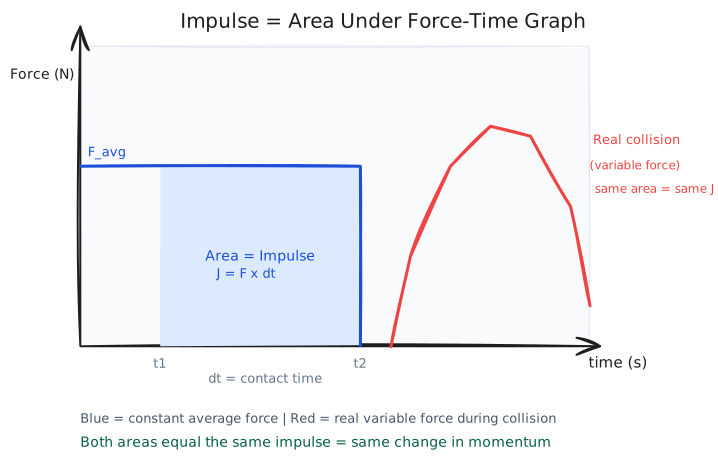
Impulse = Area Under Force-Time Graph
Area under the force-time graph = impulse. For a constant force, the area is a rectangle (J = FΔt). For a real collision, the force varies — but the area under the curve still equals the total impulse delivered, and the total impulse still equals Δp.
03The Impulse-Momentum Theorem — J = Δp

The Impulse-Momentum Theorem — J = Δp

Every change in momentum requires an impulse — and the same change in momentum can be achieved with less force if you allow more time.

Derivation from Newton's Second Law

$$F = ma = m\frac{\Delta v}{\Delta t}$$ $$F\Delta t = m\Delta v = m(v_f - v_i) = \Delta p$$ $$\boxed{J = F\Delta t = \Delta p}$$ Rearranged for force: $F = \Delta p/\Delta t$ — if $\Delta t$ decreases (shorter collision), $F$ increases for the same $\Delta p$.

Safety Applications

How Safety Devices Use the Impulse-Momentum Theorem

Airbag
Inflates rapidly to extend contact time between occupant and car interior from ~2 ms to ~50 ms
Force reduced by factor of ~25 — same Δp, much longer Δt
Helmet (foam liner)
Crushable foam compresses over several centimetres, extending the time for the head to decelerate
Peak force on skull reduced dramatically — essential for preventing brain injury
Crumple zones
Front/rear of car designed to deform progressively, extending the stopping time from ~100 ms to ~200 ms
Halves the average deceleration force — crumple zones are deliberately weak to save lives
Catching a ball
Pulling hands back during catch extends the contact time as the ball decelerates
Stinging force on hands reduced — same impulse received by ball, longer Δt means smaller F
Gymnastics mat
Thick foam extends the stopping time for a falling gymnast from ~10 ms (concrete) to ~500 ms
Force on body reduced by factor of ~50 — same momentum change, dramatically less peak force

Common Misconceptions

A heavier object always has more momentum than a lighter one.
Momentum = mass × velocity. A 9 g bullet at 900 m/s has p = 8.1 kg m/s. A 70 kg person walking at 0.1 m/s has p = 7 kg m/s. The bullet has more momentum despite being nearly 8000 times lighter. Momentum depends on both mass AND velocity.
Impulse and force are the same thing.
Impulse = force × time. A large force for a tiny time can produce less impulse than a small force sustained for a long time. A gentle push held for 10 s delivers far more impulse than a sharp tap lasting 0.001 s, even if the tap's peak force is 100× larger.
When a ball bounces, Δv = final speed − initial speed.
Δv = v_f − v_i using signed values. If a ball hits a wall at +40 m/s and bounces back at −35 m/s, then Δv = −35 − (+40) = −75 m/s — not 5 m/s. The reversal of direction must be captured by the sign change. Using magnitudes only is wrong and will always underestimate Δp for bouncing objects.
Interactive: Collision Momentum Calculator
Interactive: Momentum and Collisions (3D)
Interactive: Impulse F–t Graph

✏️ Worked Examples

Worked Example 1 Type 5 — Momentum / Impulse

Problem Setup

Problem type: Type 5 — Impulse with direction reversal. Apply Vector Protocol carefully.

Scenario: A 0.16 kg cricket ball travelling at 40 m/s is struck by a bat and returns at 35 m/s in the opposite direction. Contact time = 0.002 s. Find: (a) change in momentum, (b) impulse, (c) average force.

  • m = 0.16 kg
  • vi = +40 m/s (toward bat = positive)
  • vf = −35 m/s (away from bat = negative)
  • Δt = 0.002 s

Solution

1
Positive direction: toward bat = positive
Vector Protocol Step 1. Define positive direction before any calculation. Ball initially moves toward bat — that is positive.
2
(a) Δp = mvf − mvi = 0.16 × (−35) − 0.16 × 40 = −5.6 − 6.4 = −12 N s
Direction reversal: vf is negative (ball moves away from bat). Δp = −12 N s means momentum decreased by 12 N s in the positive direction — the bat pushed the ball back.
3
(b) J = Δp = −12 N s
Impulse equals change in momentum — by the impulse-momentum theorem. The bat delivered 12 N s of impulse in the negative direction (pushing the ball back).
4
(c) F = J/Δt = −12/0.002 = −6000 N
Average force during contact = 6000 N in the negative direction (bat pushes ball backward). This is roughly 600 times the ball's weight — enormous force, tiny time.

What would change if...

The same bat delivered the same impulse (−12 N s) but took twice as long (Δt = 0.004 s). What would the average force be? What does this tell you about the design of cricket bat grips?

Worked Example 2 Type 5 — Impulse: Braking vs Collision

Problem Setup

Problem type: Type 5 — Compare impulse scenarios. Same Δp, different Δt → different force.

Scenario: A 1200 kg car travels at 25 m/s. (a) It brakes to rest in 4 s — find Δp and average braking force. (b) It hits a wall and stops in 0.1 s — find the force. (c) Discuss the safety implication.

  • m = 1200 kg | vi = +25 m/s | vf = 0
  • Braking: Δt = 4 s | Wall: Δt = 0.1 s
  • Positive direction: direction of travel = positive

Solution

1
Δp = m(vf − vi) = 1200 × (0 − 25) = −30 000 N s
Same change in momentum in both scenarios — the car goes from 25 m/s to rest regardless of how it stops.
2
(a) Fbrakes = Δp/Δt = −30 000/4 = −7500 N
Gentle braking — 4 seconds of contact time. 7500 N is about 0.6× the car's weight. Manageable deceleration.
3
(b) Fwall = Δp/Δt = −30 000/0.1 = −300 000 N
Wall collision — 0.1 s contact time. 300 000 N is 40× the car's weight. Fatal for occupants without crumple zones and airbags.
4
Ratio: Fwall/Fbrakes = 300 000/7500 = 40×
Same Δp — 40× different force, because Δt is 40× shorter. Crumple zones extend the wall collision from ~0.1 s to ~0.2 s, halving the force.

What would change if...

A modern car's crumple zones extend the wall collision time to 0.2 s. What would the average force become? Express as a fraction of the no-crumple-zone force and explain why this halving of force is the difference between survival and fatality.

Visual Break

Momentum or impulse problem? What is being asked? State of motion p = mv momentum How it changed Is force and time given? Yes J = F·Δt impulse No — use Δp J = Δp = mv_f − mv_i Always define positive direction first Need force F = Δp/Δt avg. force

Copy into your books

Momentum

  • p = mv — vector in direction of v
  • Unit: kg m/s
  • Define positive direction before substituting
  • Opposite direction → negative sign

Impulse

  • J = FΔt — same unit as momentum (N s)
  • Area under F-t graph = impulse
  • Same impulse: large F short Δt = small F long Δt
  • Extending Δt reduces F for same J

Impulse-Momentum Theorem

  • J = FΔt = Δp = mvf − mvi
  • Derived from Newton 2: FΔt = mΔv
  • Bouncing: Δv = vf − vi (use signs!)
  • F = Δp/Δt — shorter Δt → larger F

Safety Devices

  • All work by extending Δt to reduce F
  • Airbag: 2 ms → 50 ms (25× less force)
  • Crumple zone: 100 ms → 200 ms (half force)
  • Same Δp — longer time = smaller force

🏃 Activities

Activity 01 — Pattern B

Momentum and Impulse Table

Complete the table for six scenarios. Apply the Vector Protocol — define positive direction for each.

Scenariom (kg)vi (m/s)vf (m/s)pi (N s)pf (N s)Δp (N s)Δt (s)F_avg (N)
Tennis serve (ball)0.0580+600.004
Car braking1000+2005
Ball bouncing off wall0.4+8−60.01
Rocket thrust (30 s)20000+30030
Baseball catch0.145+4000.05
Soccer kick0.430+250.008

Type your calculated values here. Complete the table in your book first.

Complete the full table in your book showing working for each row.

Complete the table in your book
Saved
Activity 02 — Pattern B (Error-spot)

Find and Fix the Errors

A student's impulse calculation contains four deliberate errors. Find each, explain why it is wrong, and write the correct version.

Problem A 0.16 kg cricket ball travelling at 40 m/s is struck and returns at 35 m/s in the opposite direction. Contact time = 2 ms. Find the average force on the ball.

Student's working:

"I do not need to define a positive direction because I will use magnitudes only.
Δv = 40 − 35 = 5 m/s (the speeds just subtract).
Δp = mΔv = 0.16 × 5 = 0.8 N s.
Contact time = 2 ms.
F = Δp/Δt = 0.8/2 = 0.4 N."

For each of the four errors: (a) identify what is wrong, (b) explain using physics reasoning, (c) write the correct version.

Type your error analysis below — find all four.

Write your error analysis in your book.

Write your error analysis in your book
Saved

✅ Check Your Understanding

Revisit Your Thinking

Earlier you were asked: A car brakes gently to rest in 8 s. The same car hits a wall and stops in 0.08 s. The change in momentum is identical. Why does hitting the wall cause so much more damage?

The full answer: because F = Δp/Δt — and Δt for the wall is 100× shorter than for braking. With the same Δp, a 100× shorter contact time produces a 100× larger average force on the occupants.

Braking: F = 1500 × 20 / 8 = 3750 N. Wall: F = 1500 × 20 / 0.08 = 375 000 N. The wall force is equivalent to 375 000/9.8 ≈ 38 tonnes pressing on the car — no structure survives that without crumple zones dramatically extending the contact time.

Look back at your initial prediction. What did you get right? What changed?

Annotate your initial prediction in your book with what you now understand.

Annotate your initial prediction in your book
Saved
Revisit Your Initial Thinking

Look back at what you wrote in the Think First section. What has changed? What did you get right? What surprised you?

MC

Multiple Choice

5 random questions from a replayable lesson bank — feedback shown immediately

UnderstandBand 3

7. Define momentum and impulse and explain the relationship between them using the impulse-momentum theorem. Include the unit of each quantity and state one way the two units are equivalent. 3 MARKS

Answer in your book
Saved
ApplyBand 5

8. A 0.057 kg tennis ball is hit by a racquet and changes velocity from 0 to +62 m/s in a contact time of 0.004 s. Apply the Vector Protocol. Calculate: (a) the change in momentum, (b) the impulse delivered by the racquet, (c) the average force exerted by the racquet on the ball. 3 MARKS

Answer in your book — apply Vector Protocol
Saved
EvaluateBand 6

9. A 75 kg person falls from a height of 3 m and lands on a surface that brings them to rest. On concrete the stopping time is 0.01 s; on a gymnastics mat it is 0.5 s. (a) Calculate the speed just before impact using energy conservation. (b) Calculate the average force on the person in each case. (c) Explain why landing technique (bending knees, rolling) reduces injury, using the impulse-momentum theorem. 4 MARKS

Answer in your book — show all three parts
Saved

Comprehensive Answers

Activity 01 — Table

Tennis serve: p_i = 0, p_f = 0.058×60 = 3.48, Δp = +3.48 N s, F = 3.48/0.004 = 870 N

Car braking: p_i = +20 000, p_f = 0, Δp = −20 000 N s, F = −20 000/5 = −4000 N

Ball bouncing: p_i = +3.2, p_f = −2.4, Δp = −2.4 − 3.2 = −5.6 N s, F = −5.6/0.01 = −560 N

Rocket: p_i = 0, p_f = 2000×300 = 600 000, Δp = +600 000 N s, F = 600 000/30 = 20 000 N

Baseball catch: p_i = +5.8, p_f = 0, Δp = −5.8 N s, F = −5.8/0.05 = −116 N

Soccer kick: p_i = 0, p_f = 0.43×25 = 10.75, Δp = +10.75 N s, F = 10.75/0.008 = 1344 N

Activity 02 — Four Errors

Error 1 — Did not define positive direction: Momentum is a vector. Without a defined positive direction, signs cannot be assigned correctly to velocities. The student admitted using magnitudes only — this is fundamentally incorrect for any vector calculation.

Error 2 — Subtracted speeds instead of using signed velocities: Δv = v_f − v_i. If ball initially moves at +40 m/s and returns at −35 m/s: Δv = −35 − 40 = −75 m/s. The student used |40 − 35| = 5 m/s — this ignores the direction reversal and underestimates Δp by a factor of 15.

Error 3 — Contact time not converted to seconds: 2 ms = 2 × 10⁻³ s = 0.002 s. The student divided by 2 (milliseconds) instead of 0.002 (seconds), giving a force 1000× too small.

Error 4 — Force reported without direction: F = −6000 N (opposing the initial direction of ball travel). The student reported 0.4 N with no direction — even if the magnitude were correct, omitting direction loses a mark in any vector quantity question.

Correct working: Positive = initial direction of ball. Δp = 0.16 × (−35) − 0.16 × 40 = −5.6 − 6.4 = −12 N s. F = −12/0.002 = −6000 N (opposing initial motion).

Multiple Choice

1. C — +12 kg m/s. p = mv = 2 × 6 = 12. East = positive, so p = +12 kg m/s. Option B (3 kg m/s) divides instead of multiplying.

2. B — kg m/s. J = FΔt → units: N × s = (kg m/s²) × s = kg m/s. Same as momentum unit.

3. D — −10 kg m/s. Define toward wall = positive. v_i = +10, v_f = −10 (bounces back). Δp = m(v_f − v_i) = 0.5 × (−10 − 10) = 0.5 × (−20) = −10 kg m/s. Option A (0) is wrong — speed is unchanged but velocity changed direction, so Δp ≠ 0.

4. A — −1000 N. Δp = m(v_f − v_i) = 0.2 × (−10 − 15) = 0.2 × (−25) = −5 N s. F = Δp/Δt = −5/0.005 = −1000 N. Option B uses |15 − 10| = 5 m/s (ignores direction reversal).

5. C. The airbag increases contact time (Δt). Since J = FΔt = Δp is constant (same Δp), increasing Δt decreases F. Option A is wrong — Δp is the same with or without airbag. Option D is wrong — the airbag does not prevent force; it reduces it.

6. B. Object A: J = mΔv = 2 × 8 = 16 N s. Object B: J = mΔv = 4 × 4 = 16 N s. Equal impulse. Force A: F = J/Δt = 16/0.5 = 32 N. Force B: F = 16/2 = 8 N. Object A has greater force (shorter Δt), but both have equal impulse.

Short Answer — Model Answers

Q7 (3 marks): Momentum is the product of an object's mass and velocity (p = mv). It is a vector quantity with the unit kilogram metre per second (kg m/s). Impulse is the product of the average net force and the contact time during which it acts (J = FΔt). It has the unit newton second (N s). The impulse-momentum theorem states that impulse equals the change in momentum: J = Δp = mv_f − mv_i. This follows from Newton's Second Law: F = mΔv/Δt → FΔt = mΔv = Δp. Unit equivalence: N s = (kg m/s²) × s = kg m/s — the units are the same because impulse and momentum are equivalent quantities.

Q8 (3 marks):

Step 1 — Positive direction: direction of final ball motion = positive
(a) delta p = mv_f - mv_i = 0.057 x 62 - 0 = 3.534 N s
(b) J = delta p = 3.534 N s (in positive direction)
(c) F = J / delta t = 3.534 / 0.004 = 883.5 N (in direction of motion)

Q9 (4 marks):

(a) v = sqrt(2gh) = sqrt(2 x 9.8 x 3) = sqrt(58.8) = 7.67 m/s (downward)
(b) delta p = m(v_f - v_i) = 75 x (0 - (-7.67)) = 75 x 7.67 = 575 N s (upward)
F_concrete = delta p / delta t = 575 / 0.01 = 57 500 N upward
F_mat = 575 / 0.5 = 1150 N upward

(c) The change in momentum is the same in both cases (same mass, same impact speed, same final speed of zero). By the impulse-momentum theorem J = FΔt = Δp — if Δp is fixed, increasing Δt decreases F. Landing technique (bending knees, rolling) increases the contact time by allowing the body to decelerate gradually over a larger distance. This extends Δt and therefore reduces the average force on bones, joints, and organs. The mat example shows a 50× reduction in force (57 500 N → 1150 N) by extending contact time 50× (0.01 s → 0.5 s). Technique achieves a similar result with no equipment — bending knees on concrete can extend stopping time from ~10 ms to ~100 ms, reducing force by 10×.

Science Jump

Momentum and Impulse

Climb platforms, hit checkpoints, and answer questions on momentum, impulse and the impulse-momentum theorem. Quick recall from lessons 1–11.

Mark lesson as complete

Tick when you have finished all activities and checked your answers.