Conservation of Momentum
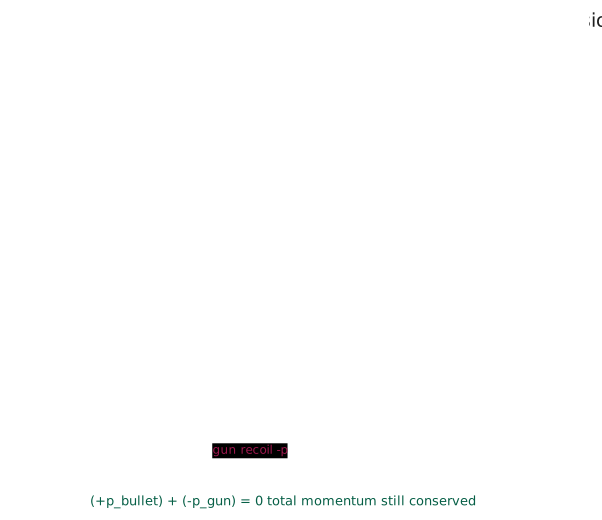
Before a gun fires, the total momentum of the gun-bullet system is zero. After — the bullet races forward and the gun kicks back. Add them together: still zero. Momentum was conserved.
Download this lesson's worksheet
Use the PDF for classwork, homework or revision. It includes key ideas, activities, questions, an extend task and success-criteria proof.
An astronaut floating in space (no gravity, no air resistance) throws a 2 kg wrench forward at 4 m/s. The astronaut has a mass of 80 kg. What happens to the astronaut — and how fast do they move? Write your prediction before reading on.
Type your prediction below — you will revisit it at the end.
Write your prediction in your book. You will revisit it at the end.
Come back to this at the end of the lesson.
Formula Reference — This Lesson
Formula Reference — Conservation of Momentum
▼Know
- Law of conservation of momentum
- Condition: closed system, no net external force
- Elastic, inelastic, perfectly inelastic definitions
- Explosion from rest: m₁v₁' = −m₂v₂'
Understand
- Why Newton's Third Law leads to conservation
- Why KE is not conserved in most collisions
- Why a small-mass object gets a higher recoil speed
- How to identify collision type from the scenario
Can Do
- Solve perfectly inelastic collisions for v_f
- Solve explosion-from-rest for recoil velocity
- Calculate KE before and after and find KE lost
- Classify a collision as elastic, inelastic, or perfectly inelastic
Misconceptions to Fix
Wrong: Zero acceleration means an object is stationary.
Right: Zero acceleration means constant velocity — the object could be moving at constant speed in a straight line.
📚 Core Content
The Law of Conservation of Momentum
In a closed system with no net external force, the total momentum before any interaction equals the total momentum after — exactly.
This law emerges directly from Newton's Third Law. When object A exerts a force on object B, object B exerts an equal and opposite force on A. Both forces act for the same time Δt. By the impulse-momentum theorem, the impulse on each object equals its change in momentum — so A's momentum change is equal and opposite to B's momentum change. The total change in momentum of the system is zero.
F_AB = −F_BA (Newton 3)
F_AB × Δt = −F_BA × Δt (same contact time)
J_AB = −J_BA (equal and opposite impulses)
Δp_A = −Δp_B (equal and opposite momentum changes)
Therefore: Δp_A + Δp_B = 0 → total momentum is conserved
| Scenario type | Example | Total p before | Total p after | Conserved? |
|---|---|---|---|---|
| Collision — same direction | Car rear-ends another car | m₁v₁ + m₂v₂ | m₁v₁' + m₂v₂' | Yes (closed system) |
| Collision — opposite directions | Head-on crash | m₁v₁ + (−m₂v₂) | Depends on outcome | Yes |
| Perfectly inelastic | Objects lock together | m₁v₁ + m₂v₂ | (m₁ + m₂)v_f | Yes |
| Explosion from rest | Gun fires bullet | 0 | m₁v₁' + m₂v₂' = 0 | Yes |
| Elastic | Billiard ball collision | m₁v₁ + m₂v₂ | m₁v₁' + m₂v₂' | Yes (and KE too) |
Applying Conservation in One Dimension
Conservation of momentum is an equation. Set up the left side (total p before) equal to the right side (total p after) — then solve for the unknown.
Three Scenario Setups
General collisionObjects separate after
Perfectly inelasticObjects stick together
Explosion from restSystem starts at rest
Elastic vs Inelastic Collisions
All collisions conserve momentum. Only elastic collisions also conserve kinetic energy — in real life, most collisions lose some KE to heat, sound, and deformation.
Elastic
Inelastic
Perfectly inelastic
Common Misconceptions
✏️ Worked Examples
Problem Setup
Problem type: Type 5 — Perfectly inelastic collision. Objects stick together.
Scenario: A 1200 kg car travelling at +15 m/s collides with a stationary 800 kg car. They lock together. Find: (a) their common velocity after the collision, (b) the KE lost.
- m₁ = 1200 kg, v₁ = +15 m/s
- m₂ = 800 kg, v₂ = 0
- Perfectly inelastic: v₁' = v₂' = v_f
- Positive direction: direction of initial motion = positive
Solution
What would change if...
The stationary car were also 1200 kg instead of 800 kg. Would the final speed be higher or lower? Would the KE lost as a percentage of initial KE be higher or lower? Calculate to check your intuition.
Problem Setup
Problem type: Type 5 — Explosion from rest. Total p = 0 before and after.
Scenario: A 70 kg astronaut at rest pushes off a 1000 kg spacecraft. The astronaut moves away at +3 m/s. Find the recoil velocity of the spacecraft.
- m_ast = 70 kg, v_ast' = +3 m/s
- m_sc = 1000 kg, v_sc' = ?
- Both at rest initially: p_total = 0
- Positive direction: direction astronaut moves = positive
Solution
What would change if...
The astronaut pushed harder and reached +6 m/s instead. What would the spacecraft's recoil velocity be? Does doubling the astronaut's speed double the spacecraft's recoil speed — and does doubling the astronaut's speed double their KE?
Visual Break
Copy into your books
▼Conservation Law
- Σp_before = Σp_after (closed system)
- Derived from Newton's Third Law
- Always define positive direction first
- Momentum is a vector — signs matter
Collision Types
- Elastic: momentum AND KE conserved
- Inelastic: momentum conserved, KE lost
- Perfectly inelastic: objects stick, max KE lost
- Check by calculating KE before and after
Perfectly Inelastic Setup
- m₁v₁ + m₂v₂ = (m₁ + m₂)v_f
- One unknown: v_f (combined velocity)
- KE lost = KE_initial − KE_final
- v_f may still be non-zero — KE not all lost
Explosion from Rest
- Total p = 0 before → 0 = m₁v₁' + m₂v₂'
- Therefore m₁v₁' = −m₂v₂' (opposite directions)
- Smaller mass → larger speed (same momentum)
- Gun/bullet, rocket, astronaut pushing off spacecraft
🏃 Activities
Classify and Draw Momentum Diagrams
| # | Scenario | Type | KE conserved? |
|---|---|---|---|
| 1 | Pool cue ball hits 8-ball — 8-ball moves, cue ball stops | ||
| 2 | 1000 kg car at 20 m/s hits stationary 1000 kg car — they lock bumpers | ||
| 3 | 10 g bullet fired from 3 kg rifle at rest — bullet leaves at 300 m/s | ||
| 4 | 400 g clay ball hits 600 g stationary clay ball — they merge | ||
| 5 | Astronaut (80 kg) pushes off 500 kg space station from rest | ||
| 6 | 0.5 kg ball at +6 m/s hits 0.5 kg ball — first ball stops, second moves at +6 m/s |
Type your classification and KE answers here. Draw diagrams in your book.
Complete the table and draw momentum vector diagrams in your book.
Classify and Calculate
- A 2 kg ball at +5 m/s hits a stationary 3 kg ball. They stick together. Find v_f.
- A 0.008 kg bullet is fired from a 4 kg rifle initially at rest. The bullet leaves at +380 m/s. Find the rifle's recoil velocity.
- A 600 kg car at +12 m/s collides with a 400 kg car at −8 m/s (opposite direction). They stick together. Find v_f and state the direction.
- A student claims that after a collision, a 2 kg object has velocity +8 m/s and a 3 kg object has velocity +4 m/s. Before the collision, the 2 kg object was at +10 m/s and the 3 kg object was at rest. Is this outcome physically possible? Show working to justify.
Type your working for all four parts below.
Complete all four parts in your book — show full working and collision classification.
✅ Check Your Understanding
Earlier you were asked: An astronaut throws a 2 kg wrench forward at 4 m/s. What happens to the astronaut?
The full answer: the astronaut moves backward. Before the throw, total p = 0 (both at rest). After: p_wrench = 2 × 4 = +8 N s (forward). By conservation: p_astronaut = −8 N s. The astronaut (80 kg) therefore moves at v = −8/80 = −0.1 m/s (backward at 0.1 m/s).
This is how astronauts manoeuvre in the void — by throwing objects (or expelling gas from thrusters). The same principle governs rocket propulsion: the rocket expels gas backward at high speed, and the rocket itself is pushed forward. There is no external surface to push against — only the conservation of momentum.
Look back at your initial prediction. What did you get right? What changed?
Annotate your initial prediction in your book with what you now understand.
Look back at what you wrote in the Think First section. What has changed? What did you get right? What surprised you?
Multiple Choice
5 random questions from a replayable lesson bank — feedback shown immediately
7. State the law of conservation of momentum and the condition required for it to apply. Use Newton's Third Law to explain why momentum is conserved in a collision between two objects. 3 MARKS
8. A 1500 kg car travelling at +20 m/s collides with a stationary 1000 kg car. They lock together after the collision. (a) Calculate the final velocity. (b) Calculate the kinetic energy before and after. (c) Calculate the KE lost and express as a percentage of initial KE. 3 MARKS
9. A 0.5 kg ball travelling at +8 m/s collides with a stationary 1.5 kg ball. After the collision the 0.5 kg ball travels at −2 m/s. (a) Apply the Vector Protocol and find the final velocity of the 1.5 kg ball. (b) Calculate the KE before and after the collision. (c) Classify the collision type with full justification. 4 MARKS
Comprehensive Answers
▼Activity 01 — Classification
1. Elastic — cue ball stops, 8-ball takes all momentum. Check: both have same mass, same speed → KE conserved. Yes, KE conserved.
2. Perfectly inelastic — lock bumpers. KE not conserved. p_before = 1000 × 20 = 20 000 N s. v_f = 20 000/2000 = +10 m/s. KE_i = 200 000 J, KE_f = 100 000 J. 50% lost.
3. Explosion from rest. KE increases — chemical energy of gunpowder converts to KE. Total p = 0. Rifle: 0 = 0.01 × 300 + 3 × v_rifle → v_rifle = −1 m/s.
4. Perfectly inelastic (merge). KE not conserved. v_f = (0.4 × v₁)/(0.4 + 0.6) — need v₁ of first ball to complete.
5. Explosion from rest. 0 = 80 × v_ast + 500 × v_station → momenta equal and opposite.
6. Elastic — first ball stops, second takes all momentum, same speed. KE conserved (identical masses, speed transfer). Check: KE_before = ½ × 0.5 × 36 = 9 J. KE_after = ½ × 0.5 × 36 = 9 J. ✓
Activity 02 — Calculate
Multiple Choice
1. C — +2 N s. p_total = 3×4 + 5×(−2) = 12 − 10 = +2 N s. Objects moving in opposite directions have opposite signs.
2. B — +4 m/s. m₁v₁ + m₂v₂ = (m₁+m₂)v_f: 4×6 + 0 = 6×v_f → v_f = 24/6 = +4 m/s.
3. A — −1.67 m/s. Explosion from rest: 0 = 0.01×500 + 3×v_rifle → v_rifle = −5/3 = −1.67 m/s. Negative sign = recoil backward.
4. D. Elastic collision, equal masses: first ball stops completely, second takes all the momentum at +8 m/s. This is a special result of elastic collisions between equal masses. Option A gives the same total momentum but wrong distribution; option C fails both conservation laws.
5. C. KE lost = KE_initial − KE_final. If the combined object is still moving (v_f ≠ 0), it still has KE — so not all KE is lost. Only if v_f = 0 is all KE lost.
6. B. p_before = 2×10 = 20 N s. p_after = 2×4 + 3×4 = 8 + 12 = 20 N s. Momentum IS conserved — this outcome is physically possible. However, KE_before = ½×2×100 = 100 J; KE_after = ½×2×16 + ½×3×16 = 16 + 24 = 40 J. KE decreased — this is an inelastic collision, not elastic. The outcome is possible, but not elastic.
Short Answer — Model Answers
Q7 (3 marks): The law of conservation of momentum states that the total momentum of a closed system remains constant — the total momentum before any interaction equals the total momentum after. The condition required is that no net external force acts on the system (a closed system). By Newton's Third Law, when object A collides with object B, A exerts a force F on B and B simultaneously exerts an equal and opposite force −F on A. Both forces act for the same contact time Δt. By the impulse-momentum theorem, the impulse on A equals its change in momentum: FΔt = Δp_A. The impulse on B is equal and opposite: −FΔt = Δp_B. Therefore Δp_A + Δp_B = 0 — the total change in momentum of the system is zero — momentum is conserved.
Q8 (3 marks):
Q9 (4 marks):
Conservation of Momentum
Answer questions on conservation of momentum in collisions and explosions before your opponents cross the line. Fast answers = faster car. Pool: lessons 1–12.
Mark lesson as complete
Tick when you have finished all activities and checked your answers.