Year 11 Physics Module 4 ⏱ ~35 min 5 MC · 3 Short Answer Lesson 11 of 17

Electrical Energy & Power Bills

Average Sydney household (AGL data, 2023): 18 kWh/day at 30.2 c/kWh, annual electricity bill $1,984. A 6.6 kW rooftop solar system generates 26.4 kWh/day (average), fully offsetting consumption with 8.4 kWh exported to the grid each day at the feed-in tariff. Physics on the bill: E = Pt, billed in kWh = kW × h.

Today's hook: AGL's 2023 data for average Sydney households: 18 kWh consumed per day at 30.2 c/kWh, an annual electricity bill of $1,984. A 6.6 kW rooftop solar system generates 26.4 kWh/day on average, completely offsetting that consumption and exporting the surplus. Your electricity bill shows kilowatt-hours, not joules. Why, and how do you convert between them?
0/5TASKS
1
You’re here

Warm up first

Warm up first

Three quick questions from earlier lessons. Pulling old material back to mind before you learn something new makes the new material stick better, so this is not busywork.

Before you read, predict

A 2500 W electric hot water system runs for 3 hours per day.

Predict 1: How many kWh of electricity does it use per day?

Predict 2: If electricity costs 32 c/kWh, what is the daily running cost?

1 kilowatt-hour (kWh) is equal to:
2
You’re here

Learning Intentions

Learning Intentions

Know

  • $E\ (\text{kWh}) = P\ (\text{kW}) \times t\ (\text{h})$
  • $\text{Cost} = E\ (\text{kWh}) \times \text{tariff}\ (\$/\text{kWh})$
  • 1 kWh = 3.6 × 10⁶ J = 3.6 MJ
  • Power bills use kWh because joules are impractically small

Understand

  • Why electricity is billed in kWh rather than joules
  • How to compare the running costs of different appliances
  • How solar PV reduces net energy consumption and bills

Can Do

  • Calculate electricity cost for any appliance given power, time, and tariff
  • Convert between kWh and joules
  • Estimate and compare annual household energy bills
3
You’re here

Key Terms

Key Terms
Kilowatt-hour (kWh)Unit of electrical energy used for billing. 1 kWh = 1000 W × 3600 s = 3.6 × 10⁶ J.
Electricity tariffThe price charged per kWh of electrical energy consumed, typically expressed in cents per kWh.
Feed-in tariffA payment made to households for surplus solar electricity exported to the grid, expressed in cents per kWh.
Standing chargeA fixed daily charge on electricity bills for connection to the network, paid regardless of energy used.
Cross-lesson links: L09 introduced P = IV and E = Pt in joules. L11 applies the same physics to billing, the kilowatt-hour is just E = Pt with P in kW and t in hours. The AGL 2023 Sydney household benchmark (18 kWh/day, 30.2 c/kWh, $1,984/year) makes the abstract formula financially concrete.
4
You’re here

Calculating Electricity Bills

1
Calculating Electricity Bills
+5 XP

Open an electricity bill and look at the usage section. It shows how many kilowatt-hours (kWh) you used in the quarter, multiplied by the tariff (cents per kWh), plus a fixed daily supply charge. The metre in your home's switchboard literally counts kWh, it records how many kilowatts of demand you drew, multiplied by how many hours you drew it for. A 2 kW electric jug running for 0.05 hours uses exactly 0.1 kWh = 360,000 J. The formulae below translate that reading into a dollar figure.

Electricity billing

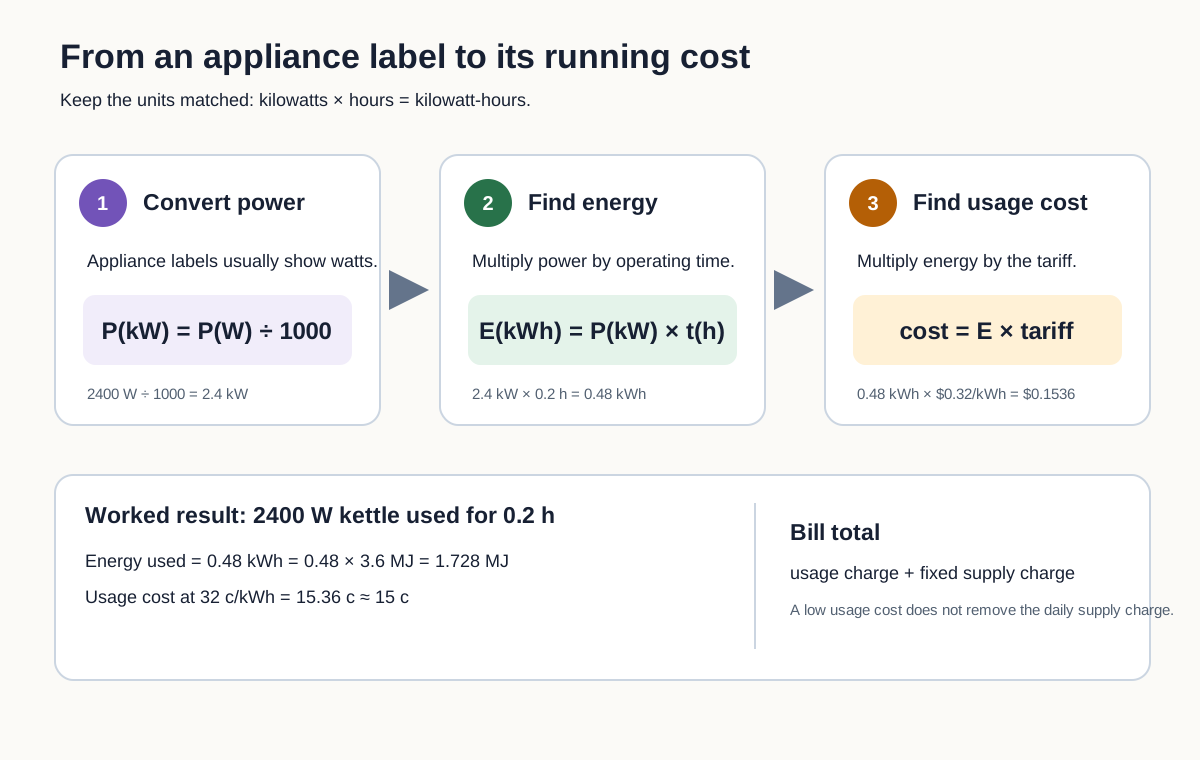
$E\ (\text{kWh}) = P\ (\text{kW}) \times t\ (\text{hours})$

$\text{Cost} (\$) = E\ (\text{kWh}) \times \text{tariff}\ (\$/\text{kWh})$

Note: $P$ must be in kilowatts and $t$ must be in hours for the kWh formula to work.

Three-step electricity cost calculation: convert watts to kilowatts, multiply by hours to obtain kilowatt-hours, then multiply by the tariff. A 2400 watt kettle used for 0.2 hours consumes 0.48 kilowatt-hours and costs about 15 cents at 32 cents per kilowatt-hour.
Power is a rate; the bill charges for energy. Convert W → kW before multiplying by time in hours.
Worked example, monthly electricity cost

A household uses: 1800 W TV for 4 h/day, 2400 W kettle for 0.2 h/day, 200 W fridge for 24 h/day. Tariff = $0.32/kWh. Find the monthly cost (30 days).

  1. TV: $E = 1.8 \times 4 = 7.2\ \text{kWh/day}$
  2. Kettle: $E = 2.4 \times 0.2 = 0.48\ \text{kWh/day}$
  3. Fridge: $E = 0.2 \times 24 = 4.8\ \text{kWh/day}$
  4. Total/day = 12.48 kWh/day; Monthly = $12.48 \times 30 = 374.4\ \text{kWh}$
  5. Cost = $374.4 \times 0.32 = \$119.81/\text{month}$

Electrical energy in billing units: $E\ (\text{kWh}) = P\ (\text{kW}) \times t\ (\text{h})$; cost = $E \times \text{tariff}\ (\$/\text{kWh})$. Note: $P$ must be in kilowatts and $t$ in hours; $1\ \text{kWh} = 3.6 \times 10^6\ \text{J}$.

Pause, copy the highlighted formulas into your book before moving on.

To calculate energy in kWh, you multiply power in watts by time in hours.

A 500 W appliance running for 2 hours uses 1 kWh of electrical energy.

5
You’re here

Activity 1, Running Cost Calculations

Activity 1, Running Cost Calculations
ApplyBand 3

Electricity tariff = 32 c/kWh. Calculate the daily running cost of each appliance:

  1. A 1500 W electric hot water system running 2 hours per day
  2. A 100 W LED TV running 5 hours per day
  3. A 4500 W air conditioner running 3 hours per day

A 3000 W spa heater runs for 2.5 hours. At 32 c/kWh, the cost is:

6
You’re here

Activity 2, Solar PV Offset

Activity 2, Solar PV Offset
AnalyseBand 4

A Sydney home uses 20 kWh/day. A 5 kW solar system generates 18 kWh/day. Import tariff = 32 c/kWh, feed-in tariff = 7 c/kWh.

  1. Without solar: calculate the annual electricity bill.
  2. With solar: the house self-consumes 18 kWh and imports 2 kWh. Calculate the annual cost of imported electricity.
  3. Calculate the annual savings compared to having no solar.

Three of these correctly describe kilowatt-hours. Pick the odd one out.

A 2000 W appliance running for 3 hours uses _____ kWh of electrical energy.

A household uses 30 kWh per day. The electricity tariff is 30 c/kWh. The quarterly bill (90 days) before any rebates is:

Show what you have learned

Quick recall, electricity bills
+5 XP
Short Answer, 10 marks
+5 XP

ApplyBand 3(3 marks) 3. A household uses: a 2400 W electric oven for 1 hour per day, a 250 W refrigerator for 24 hours per day, and a 1000 W washing machine for 1.5 hours per day. The electricity tariff is 32 c/kWh. Calculate the daily energy use in kWh and the daily cost.

AnalyseBand 4(3 marks) 4. A 60 W incandescent globe is replaced by a 10 W LED globe that produces the same light output. Both run for 8 hours per day at 32 c/kWh. (a) Calculate the daily energy saving in kWh. (b) Calculate the daily cost saving in cents. (c) Calculate the annual saving and comment on whether the switch is cost-effective.

EvaluateBand 6(4 marks) 5. A student claims: "Solar panels reduce your electricity bill to zero." Using the concepts of energy consumption, solar generation, feed-in tariffs, and standing charges, evaluate this claim for an average Sydney household consuming 18 kWh/day with a 6.6 kW solar system generating 24 kWh/day (summer).

Show all answers

Activity 1, Model Answers

  1. $E = 1.5 \times 2 = 3.0\ \text{kWh}$; cost = $3.0 \times 32 = 96\ \text{c} = \$0.96$
  2. $E = 0.1 \times 5 = 0.5\ \text{kWh}$; cost = $0.5 \times 32 = 16\ \text{c}$
  3. $E = 4.5 \times 3 = 13.5\ \text{kWh}$; cost = $13.5 \times 32 = 432\ \text{c} = \$4.32$

Activity 2, Model Answers

  1. Without solar: $20 \times 365 = 7300\ \text{kWh/year}$; $7300 \times 0.32 = \$2336/\text{year}$
  2. With solar: imports $2\ \text{kWh/day} \times 365 = 730\ \text{kWh/year}$; $730 \times 0.32 = \$233.60/\text{year}$
  3. Savings = $2336 - 234 = \$2102/\text{year}$ (plus any feed-in credit if excess is exported)

Short Answer, Model Answers

Q3 (3 marks): Oven: $2.4 \times 1 = 2.4\ \text{kWh}$. Fridge: $0.25 \times 24 = 6.0\ \text{kWh}$. Washer: $1.0 \times 1.5 = 1.5\ \text{kWh}$. Total = 9.9 kWh/day. Cost = $9.9 \times 0.32 = \$3.17/\text{day}$.

Q4 (3 marks): (a) Saving per day: $(60 - 10)/1000 \times 8 = 0.4\ \text{kWh}$. (b) $0.4 \times 32 = 12.8\ \text{c/day}$. (c) Annual: $12.8 \times 365/100 = \$46.72/\text{year}$. An LED globe costs ~$5–10; payback is only 2–3 months, highly cost-effective.

Q5 (4 marks): The claim is an overstatement. In summer, a 6.6 kW system generating 24 kWh/day exceeds the 18 kWh consumption; the excess 6 kWh is exported at a low feed-in tariff (~7 c/kWh). However: (1) Standing charges ($0.80–1.20/day) are paid regardless of solar generation. (2) In winter, solar generation drops significantly (e.g. 10 kWh/day), requiring 8 kWh of imports daily. (3) Overnight consumption requires full grid import. Net result: solar can reduce the annual bill by 60–80% but rarely reaches zero due to standing charges and seasonal/daily variability. The claim ignores these factors.

Retrieve, reflect and finish

Check what actually stuck
Take the full module quiz
quiz

A full module quiz covering every lesson in this module, not just this one. Set aside a decent block of time and treat it like a real assessment.

Start the module quiz →
How did your thinking change?

AGL's 2023 data shows the average Sydney household uses 18 kWh/day at 30.2 c/kWh, an annual bill of 18 × 365 × $0.302 = $1,984. A 6.6 kW solar system generates 26.4 kWh/day on average, fully covering that 18 kWh and exporting 8.4 kWh to the grid each day. Without solar, that household spends nearly $2,000 per year; with solar, the consumption cost falls to near zero (though standing charges remain). This is E = Pt applied to a real household.

Now check your Think First answers: a 2500 W hot water system running 3 h/day uses E = 2.5 kW × 3 h = 7.5 kWh/day. At 32 c/kWh, daily cost = 7.5 × $0.32 = $2.40.