Year 12 Physics Module 6 ⏱ ~45 min 5 MC · 2 Short Answer Lesson 8 of 21 IQ2: The Motor Effect

The Motor Effect

In 1821, Michael Faraday demonstrated continuous electromagnetic rotation: a current-carrying wire moved around a magnet. The same interaction between conventional current and a magnetic field produces the conductor force studied in this lesson and underpins modern electromagnetic actuators.

Today's hook: In Faraday's 1821 electromagnetic rotation experiment, a current-carrying wire moved continuously around a fixed magnet. If you reversed the current direction, what would happen to the rotation, and which modern device repeatedly reverses current to create vibration?
0/5TASKS
Your guided path0 of 8 done · keep going
1
You’re here

Orient and predict

Connect moving charges to a current-carrying wire and predict when its magnetic force is greatest.

Warm up first

Three quick questions from earlier lessons. Pulling old material back to mind before you learn something new makes the new material stick better, so this is not busywork.

Worksheets

Practise this lesson

Use the available foundations worksheet for guided practice on this lesson.

Before you read, predict

A straight copper wire carries current from west to east, placed between the poles of a horseshoe magnet with the north pole above and south pole below (magnetic field points downward).

Before reading on, answer:

  1. Use the right-hand palm rule to predict the direction of the force on the wire.
  2. If you reverse the current direction, what happens to the force?
  3. If you double both the current and the magnetic field strength, by what factor does the force change?

Warm-up, the motor effect force on a current-carrying conductor is MAXIMUM when the angle between the current and the magnetic field is…

Learning Intentions
goals

Know, The Motor Effect Equation

  • $F = BIl\sin\theta$ gives the force on a current-carrying conductor
  • Maximum force when conductor is perpendicular to B ($\theta = 90°$)
  • Zero force when conductor is parallel to B ($\theta = 0°$)

Understand, Direction and Microscopic Origin

  • Right-hand palm rule: thumb = current, fingers = B, palm = force
  • Connection to $F = qvB$ via drift velocity of charge carriers
  • Why reversing current or B reverses force direction

Can Do, Solve Motor Effect Problems

  • Calculate force magnitude for any B, I, l, and angle
  • Determine force direction using the right-hand palm rule
  • Analyse how changing one variable affects the force
Scan these before reading
vocab
Motor effectThe force experienced by a current-carrying conductor placed in a magnetic field.
Right-hand palm ruleThumb = current direction, fingers = magnetic field direction, palm = force direction on a positive conventional current.
Drift velocityThe average velocity of charge carriers moving through a conductor under an applied electric field.
LoudspeakerDevice using motor effect: current in coil interacts with permanent magnet to move cone and produce sound.
Cross-lesson links: L06 applied $\vec F=q(\vec v\times\vec B)$ to single charges. L07 sums that interaction across the charge carriers in the active conductor length to obtain $F=BIl\sin\theta$. Faraday's 1821 experiment provides the historical bridge to later motor lessons.
2

Model force magnitude and direction

Build the motor-effect equation from moving charges, define every symbol and apply the right-hand rule.

1
The Force Equation
+5 XP

From moving charges to current-carrying wires

Hang a horizontal copper wire between the poles of a horseshoe magnet and connect it to a battery. The wire jumps sideways, pushed by the interaction between the current and the magnetic field. This is the motor effect: a current-carrying conductor in a magnetic field experiences a measurable mechanical force. Electrons drifting along the wire each experience the magnetic force $\vec F=q(\vec v_d\times\vec B)$; summed across the charge carriers in the active length, those forces produce the conductor force below.

If a wire of length $l$ carries current $I$, the total charge passing through in time $t$ is $Q = It$. These charges move at average drift velocity $v_d$, so $l = v_d t$. The force on all moving charges in the wire becomes:

Motor Effect Force

$F = BIl\sin\theta$

F = force (N), B = magnetic field (T), I = conventional current (A), l = active conductor length inside the field (m), $\theta$ = angle between current and B

$F_{\max} = BIl$   when $\theta = 90°$ (perpendicular)

$F = 0$   when $\theta = 0°$ (parallel)

A straight wire carries conventional current to the right through a magnetic field into the page, shown by crosses. The motor-effect force points upward.

Figure 1. One consistent right-hand-rule case: thumb points with conventional current $I$ to the right, fingers point with $\vec B$ into the page, and the palm faces in the upward force direction. A cross means into the page; a dot would mean out of the page.

Stop & Check

A student argues: "Since $F = BIl\sin\theta$, the force depends on the type of metal in the wire because different metals have different numbers of free electrons." Is this argument correct? Explain why or why not.

Motor effect force: $F=BIl\sin\theta$, where $l$ is only the active conductor length in the field and $\theta$ is between conventional current and $\vec B$. Maximum at $90°$, zero at $0°$. The right-hand rule follows conventional current; electron drift is opposite, while the negative electron charge reverses the individual force so the same conductor-force direction is obtained.

Pause, copy the highlighted formula and right-hand rule into your book before moving on.

A wire of length 0.30 m carries 4.0 A perpendicular to a 0.050 T field. What is the force?

3

Reason with variables and angle

Predict how field, current, active length and angle change the conductor force.

2
Factors and Applications
+5 XP

What controls the motor effect force

We just saw that $F = BIl\sin\theta$ describes the motor effect force. That raises a question: which variables can we practically control to increase or decrease the force in a real device? This card answers it → $B$, $I$, $l$, and $\theta$ all contribute; multi-turn coils effectively multiply $l$ by the number of turns.

The motor effect force depends on four variables. Understanding how each one affects the force is essential for both problem-solving and real-world design.

  • Magnetic field strength (B): Stronger magnets produce larger forces. High-performance motors use rare-earth magnets.
  • Current (I): More current means more charge carriers moving, so more force. But higher current means more heating ($P = I^2R$).
  • Wire length (l): Longer wires experience more force. In motors, this is achieved by coiling the wire into many turns.
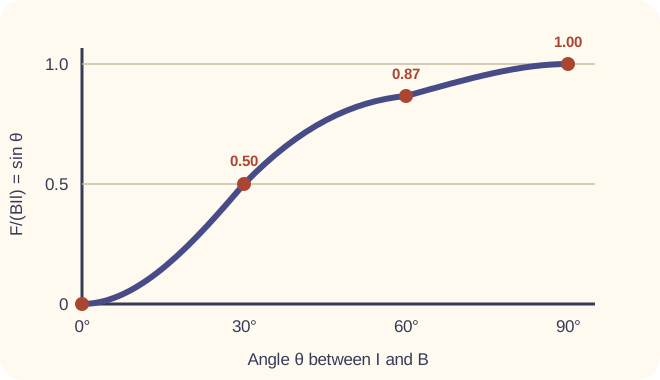
  • Angle ($\theta$): Maximum force at 90°, zero at 0°. The $\sin\theta$ dependence means small angles near 90° don't change the force much, but near 0° the force drops rapidly.
Graph of force divided by B I l against the angle between current and magnetic field. It rises as sine theta from zero at zero degrees to one at ninety degrees.

Figure 2. The normalised force is $F/(BIl)=\sin\theta$: 0 at 0°, 0.50 at 30°, 0.87 at 60° and 1.00 at 90°.

Applications and enrichment examples:

  • Loudspeakers: A coil attached to a paper cone sits in a permanent magnet's field. Audio current varies in direction and magnitude, making the cone vibrate and produce sound waves.
  • Galvanometers: A coil in a magnetic field deflects proportionally to current. Used in analog meters.
  • Electromagnetic pumps: Used to pump liquid metals (like sodium coolant in nuclear reactors) without moving parts.
  • Maglev trains: Electromagnets create lift and propulsion forces using variations of the motor effect.
Stop & Check

A loudspeaker coil has 50 turns of wire, each of effective length 8.0 cm, in a magnetic field of 0.30 T. What current is needed to produce a total force of 0.48 N on the coil? Assume the coil is always perpendicular to the field.

$F\propto B$, $I$, active length $l$, and $\sin\theta$. For a voice coil, count only wire length inside the radial field; alternating current reverses the axial force and vibrates the cone. Galvanometers and maglev systems are enrichment examples here; coil torque belongs to L09.

Add the highlighted factors and device applications to your notes before the check below.

The motor effect force is maximum when the current is parallel to the magnetic field.

In a loudspeaker, the cone vibrates because the alternating current reverses the direction of the motor effect force.

4

Solve a loudspeaker force problem

Find total active conductor length, calculate force and explain why the voice coil moves axially.

3
Worked Example: Loudspeaker Force
+5 XP

Calculating force on a voice coil

We just saw how B, I, l, and θ each affect the motor effect force. That raises a question: in a real loudspeaker with 80 turns of wire, how do we compute the total force? This card answers it → multiply circumference by turn count to get total effective length, then apply $F = BIl$.

Real-world motor effect problems often involve multi-turn coils. The trick is to find the total effective length of wire in the field, then apply $F = BIl\sin\theta$.

Problem, Loudspeaker voice coil

A loudspeaker voice coil consists of 80 turns of wire wrapped around a cylinder of diameter 2.0 cm. In this ideal model, the full circumference of every turn lies in a uniform radial magnetic field of strength 0.40 T. When a current of 0.50 A flows through the coil:

  1. Calculate the total length of wire in the coil.
  2. Calculate the force on the coil when the current is perpendicular to the magnetic field.
  3. Explain why the force is always directed along the axis of the coil regardless of the coil's position.
Solution

Step 1: Total wire length

Circumference of one turn: $C = \pi d = \pi \times 0.020 = 0.0628 \text{ m}$

Total length: $l = 80 \times 0.0628 = 5.03 \text{ m}$

Step 2: Force calculation

$F = BIl\sin\theta = (0.40)(0.50)(5.03)(1) = 1.01 \text{ N} \approx 1.0 \text{ N}$ to two significant figures.

Step 3: Direction

In a loudspeaker, the magnetic field is radial (pointing outward from the centre like spokes on a wheel). At every point around the coil, the current is perpendicular to the local B-field. By the right-hand palm rule, the force on each segment points along the coil axis. Because the field is radially symmetric, all these axial forces add up in the same direction, pushing the coil (and attached cone) forward or backward depending on current direction.

Stop & Check

If the current in the above loudspeaker is reversed, what changes and what stays the same regarding the force?

HSC Tip: Angle Confusion

Students often confuse what $\theta$ represents in $F = BIl\sin\theta$. It is the angle between the current direction and the magnetic field direction not the angle between the wire and the horizontal, or the angle between the wire and some surface. Always identify the direction of current flow and the direction of B first, then find the angle between those two vectors.

Model limit

Using $l_{\text{total}}=N\pi d$ assumes the full circumference of every turn is inside the useful radial field and that the field is uniform. In a real loudspeaker, use only the wire length inside the air gap and allow for field variation and mechanical losses.

For an $N$-turn coil: $l_\text{total} = N \times \pi d$. In a radial field $\theta = 90°$ at every point → $\sin\theta = 1$ always. Reversing current reverses force direction but keeps magnitude the same. Step order: circumference → total length → $F = BIl$.

Pause, write the highlighted coil worked-example method into your book before moving on.

A horizontal wire carries current eastward. The magnetic field points vertically upward. In which direction does the force on the wire act?

5

Investigate force patterns

Use the straight-wire mode to test the equation, then verify every result by hand.

Use the Motor Effect tool. If you double the current AND double the magnetic field, the force on the wire changes by a factor of…

Activity 1, Motor Effect Calculator
ApplyBand 4

Use the interactive above and verify results by hand

  1. Set B = 100 mT, I = 2.0 A, l = 10 cm, $\theta = 90°$. Record the force. Verify by hand using $F = BIl\sin\theta$.
  2. Keeping B, I, and l constant, decrease the angle from 90° to 30° in 15° steps. Record the force at each angle. What is the ratio $F(30°)/F(90°)$? Does it match $\sin(30°)/\sin(90°)$?
  3. Set $\theta = 90°$ again. Predict what happens if you double the current and halve the magnetic field. Test your prediction.
  4. Reverse the conventional-current direction. What changes and what stays the same?
6

Apply and consolidate

Design a voice-coil response, reject common misconceptions and keep later motor topics inside their lesson boundaries.

Activity 2, Loudspeaker Design
UnderstandBand 5

Connect the motor effect to real-world audio engineering

A loudspeaker voice coil has 50 turns of wire wound on a cylinder of diameter 2.5 cm, sitting in a radial magnetic field of 0.35 T. For this ideal calculation, assume the full circumference of each turn is inside the uniform field.

  1. Calculate the total wire length in the magnetic field region.
  2. What current is needed to produce a force of 0.50 N on the coil?
  3. Explain why the cone moves back and forth when an alternating audio current is supplied.

Three of these statements about the motor effect are correct. Pick the odd one out (the incorrect statement).

Lesson boundary

This lesson owns force on an active straight conductor and the loudspeaker application. Forces between two current-carrying wires belong to L08; torque and radial-field geometry belong to L09; commutation and complete motor operation belong to L10 and L17.

Wrap-up, Misconceptions & Summary

Misconceptions, final check

✗ "The motor effect force depends on the metal the wire is made of."
✓ The formula $F = BIl\sin\theta$ contains no material property, only the current, field, length, and angle. Different metals have different conductivities but the same current through the same length in the same field gives the same force.
✗ "θ is the angle between the wire and the horizontal."
✓ θ is the angle between the current direction and the B-field direction. Always identify these two vectors first, then find the angle between them regardless of orientation in the room.

Copy into your books

Key Formula

  • $F = BIl\sin\theta$
  • $F_{\max} = BIl$ (at 90°)
  • $F = 0$ (at 0°, parallel)

Right-Hand Palm Rule

  • Thumb → current I
  • Fingers → field B
  • Palm → force F

Multi-turn Coils

  • $l_{total} = N \times$ (circumference)
  • Ideal radial-field model: θ = 90°
  • Coil force = $BIl_{total}$

Applications

  • Loudspeaker: AC current → vibration
  • Galvanometer: deflection ∝ I
  • Electric motor: continuous rotation
7
Independent practice

Show what you can do without prompts

Complete a shuffled question-bank set, then explain the force equation in HSC-style responses.

Quick recall, motor effect
+5 XP

A fresh five-question set drawn from this lesson's bank, feedback shown immediately. +5 XP per correct · +25 XP all correct

Pick your answer, then rate your confidence, that tells the system what to drill next.

Short Answer, 7 marks
+5 XP

ApplyBand 4(3 marks) 1. A straight wire has an active length of 0.25 m inside a uniform magnetic field of 0.080 T and carries a current of 3.0 A. (a) Calculate the maximum force on the wire. (b) Calculate the force when the conventional-current direction makes an angle of 45° with the field. (c) Explain why no force is experienced when the current is parallel to the field.

1 mark: correct $F_{\max}$ · 1 mark: correct $F(45°)$ · 1 mark: explanation using $\sin 0° = 0$

AnalyseBand 6(4 marks) 2. A wire carrying current experiences a force $F$ in a magnetic field. If the current is doubled and the angle between wire and field is changed from 90° to 30°, calculate the new force as a multiple of $F$. Explain what this reveals about how angle and current interact in the motor effect equation.

1 mark: $F' = B(2I)l\sin30°$ · 1 mark: correct numerical evaluation ($F' = F$) · 2 marks: clear explanation of the trade-off between increased I and decreased $\sin\theta$

Show all answers

Multiple choice

MC answers and full explanations are shown inline as you complete each question. Use the retry button to attempt a fresh set drawn from the lesson bank.

Short Answer, Model Answers

Q1 (3 marks): (a) $F_{\max} = BIl = 0.080 \times 3.0 \times 0.25 = 0.060 \text{ N}$ (1 mark). (b) $F(45°) = BIl\sin45° = 0.060 \times 0.707 = 0.042 \text{ N}$ (1 mark). (c) When the wire is parallel to the field, $\theta = 0°$ so $\sin 0° = 0$, giving $F = 0$. Physically, the magnetic force on individual charge carriers ($F = qv_dB\sin\theta$) is zero because the velocity of the carriers is parallel to B, no perpendicular component exists to deflect them (1 mark).

Q2 (4 marks): $F' = B(2I)l\sin(30°) = 2BIl \times 0.5 = BIl = F$ (2 marks for method and evaluation). The result equals the original force because the factor-of-2 increase in current is exactly cancelled by halving the sine factor ($\sin30° = 0.5$ versus $\sin90° = 1.0$). This illustrates that the motor effect force depends on the product $I\sin\theta$, individually changing either variable has a predictable effect, but the two together can cancel, equal, or multiply the overall force (2 marks).

8
Final step

Retrieve, reflect and finish

Check what stuck, revisit your opening prediction and record the rule you will use next time.

Check what actually stuck
How did your thinking change?

At the start you were asked about Faraday's 1821 electromagnetic rotation experiment at the Royal Institution, if you reversed the current in the rotating wire, what happens?

The answer: reversing conventional current reverses the cross-product direction in $\vec F=I\vec l\times\vec B$, while the force magnitude is unchanged if $B$, $|I|$, $l$ and $\theta$ are unchanged. In Faraday's apparatus this would reverse the rotation direction. A loudspeaker applies the same principle: alternating current in the voice coil produces alternating forces that vibrate the cone at the signal frequency.

  • Was your right-hand palm rule prediction for the force direction correct? If not, what was the error in your finger/thumb alignment?
  • The force scales as $F \propto BI$. Did you predict that doubling both B and I quadruples the force ($2 \times 2 = 4$)?
Take the full module quiz
quiz

A full module quiz covering every lesson in this module, not just this one. Set aside a decent block of time and treat it like a real assessment.

Start the module quiz →