Evidence-Based Argumentation in Chemistry
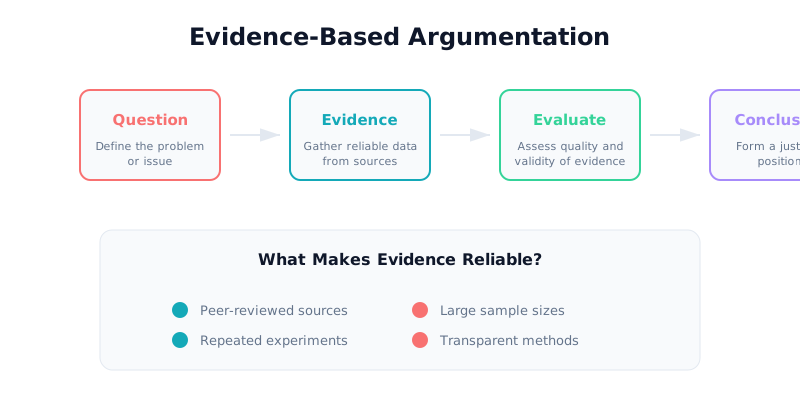
In 2019, CSIRO researchers presented 3 data points claiming a new catalyst doubled reaction rate, peer reviewers rejected the paper because a minimum of 5 trials is required to establish a pattern.
Printable Worksheets
Print or save as PDF, or build a custom worksheet from any module's questions.
Q1 · If someone says "My grandmother smoked all her life and lived to 95, so smoking can't be that dangerous", what is wrong with using this as evidence?
Q2 · What do you think makes a scientific source trustworthy? List at least two features and explain why they matter.
● Know
- The claim-evidence-reasoning (CER) framework for scientific arguments
- Criteria for evaluating the reliability and bias of scientific sources
- The structure and expectations of a depth study
● Understand
- That scientific claims must be supported by valid evidence and logical reasoning
- How bias, funding sources and publication methods affect source reliability
- That scientific argumentation is a process of building, testing and refining claims
● Can do
- Construct a scientific argument using claim, evidence and reasoning
- Evaluate sources for reliability, bias and scientific validity
- Communicate conclusions using appropriate scientific language and terminology
A student drops magnesium ribbon into two beakers of HCl, one at 20°C, one at 40°C, and times 47 s versus 23 s respectively. Without a framework to connect those numbers to a claim and a mechanistic explanation, the data is just two stopwatch readings. Scientific argumentation in chemistry follows the CER framework:
Claim: A clear, specific statement that answers the question. It should be testable and precise. Bad claim: "The reaction was faster." Good claim: "Doubling the HCl concentration from 1M to 2M halves the reaction time with magnesium, indicating a direct proportional relationship between concentration and rate."
Evidence: Quantitative data from valid experiments. Evidence must be relevant, sufficient, and reliable. Include numbers with units, sample sizes, and measures of variability (ranges, standard deviations).
Reasoning: Explanation of how and why the evidence supports the claim. Connect the data to chemical principles (collision theory, activation energy, bond energies). Explain the mechanism behind the observed pattern.
A convincing argument requires all three components. Data without interpretation is just a list of numbers. Claims without evidence are opinions. Evidence without reasoning leaves the reader wondering why it matters.
Claim: Temperature increases reaction rate because it increases the proportion of molecules with energy exceeding the activation energy.
Evidence: At 20C, the reaction time was 120 +/- 3s (n=3). At 30C, it was 58 +/- 2s (n=3). At 40C, it was 31 +/- 2s (n=3). Rate approximately doubles for each 10C increase.
Reasoning: According to collision theory, reactions require collisions with energy greater than the activation energy. Temperature is a measure of average kinetic energy. As temperature increases, the Boltzmann distribution shifts to higher energies, so a greater fraction of molecules have E > Ea. The approximately doubling of rate per 10C matches the quantitative prediction from the Arrhenius equation. This evidence strongly supports the claim.
Australian science communication: The Australian Science Media Centre (AusSMC) helps scientists communicate evidence-based arguments to the public and journalists. Their briefings on controversial topics (vaccines, climate change, GMOs) emphasise CER-style reasoning: state the claim clearly, present the evidence transparently, and explain the scientific reasoning. This approach builds public trust in science and counteracts misinformation. Australian science education increasingly incorporates argumentation and evidence evaluation skills.
A single experiment proves a scientific claim. This is false. Single experiments can support or refute claims, but they cannot prove them definitively. Scientific knowledge is provisional and subject to revision. A claim becomes accepted when multiple independent studies, using different methods, consistently produce supporting evidence. Even then, new evidence can overturn established conclusions. This is not a weakness of science but its strength - it is self-correcting.
A student claims: "Acid concentration has no effect on reaction rate." Read the paragraph and highlight the evidence that would refute this claim.
Evaluating scientific claims requires critical thinking and attention to quality of evidence.
Peer review: Before publication in scientific journals, research is evaluated by independent experts who assess methodology, data analysis, and conclusions. Peer review catches errors and biases but is not perfect - fraudulent or flawed research occasionally slips through.
Replication: The most important validation is independent replication. When different research groups, using different equipment and methods, obtain the same result, confidence in the claim increases dramatically.
Conflicts of interest: Scientists funded by industry may unconsciously bias their interpretations. Disclosure of funding sources is mandatory in reputable journals. Claims from sources with financial stakes should be evaluated extra carefully.
Scientific consensus: When the vast majority of experts in a field agree on a conclusion based on converging evidence from multiple independent studies, that consensus represents our best current understanding. Consensus can change with new evidence, but it is the most reliable guide we have.
In 2011, a paper claimed that a bacterium could incorporate arsenic into its DNA instead of phosphorus. This would have been revolutionary, suggesting life could use alternative biochemistries. The claim was published in a prestigious journal after peer review. However, other scientists quickly identified methodological flaws: the growth medium contained enough phosphorus to explain the results, and the DNA purification method did not rule out arsenate contamination. Within months, multiple groups published rebuttals. The original claim was effectively refuted. This case shows how peer review, replication, and open scientific debate correct errors, even in high-profile publications.
Australian research integrity: The Australian Research Integrity Committee oversees research misconduct investigations across Australian universities. Australia Code for the Responsible Conduct of Research sets standards for data management, authorship, and conflict of interest disclosure. Australian scientists are held to high ethical standards, and breaches can end careers. This integrity framework ensures that Australian research findings are trustworthy and reproducible.
Scientific consensus means the science is settled and cannot change. This is false. Consensus represents the best current understanding based on available evidence. It is always provisional. Newtonian physics was consensus for centuries until Einstein relativity showed it was an approximation. The germ theory of disease was revolutionary but is now consensus. Science progresses by challenging and refining consensus, not by treating it as dogma. But challenging consensus requires extraordinary evidence, not just opinion.
Strong scientific arguments anticipate weaknesses and address them proactively.
Limitations: Every experiment has limitations. Acknowledge them honestly. Common limitations include: small sample size, limited range of conditions tested, measurement uncertainty, uncontrolled variables, and assumptions made. Discussing limitations does not weaken your argument - it shows scientific maturity.
Alternative explanations: Consider whether other factors could explain your results. If you investigated concentration but temperature varied slightly, could temperature explain some of the observed effect? Addressing alternatives strengthens your conclusion.
Correlation vs causation: Just because two variables change together does not mean one causes the other. A third variable might affect both. Controlled experiments are needed to establish causation.
Scope: Be careful not to overgeneralise. Results from one reaction under specific conditions may not apply to all reactions. Specify the conditions under which your conclusion is valid.
A student finds that adding a copper coin speeds up the reaction between zinc and sulfuric acid. They conclude that copper is a catalyst for all metal-acid reactions. This argument has multiple flaws: (1) they tested only one reaction, (2) copper may be participating in a displacement reaction rather than catalysing, (3) the effect might be specific to the zinc-copper-acid system, (4) they did not test whether copper is recovered unchanged. A better argument would be: "In the zinc-sulfuric acid system, copper appears to increase the rate. Further experiments are needed to determine whether this is catalysis or a galvanic effect, and whether it generalises to other metals."
Australian critical thinking education: The Foundation for Young Australians and other organisations promote critical thinking skills in schools. Science teachers explicitly teach students to evaluate claims, identify logical fallacies, and distinguish correlation from causation. The NSW HSC Science Extension course includes a research project where students must defend their methodology and conclusions against peer critique. These skills prepare students to navigate a world of misinformation and make evidence-based decisions.
Scientists should never admit uncertainty or limitations. This is false and dangerous. Science is inherently probabilistic. All measurements have uncertainty. All conclusions have scope conditions. Scientists who pretend to absolute certainty are either misinformed or dishonest. The strength of science is that it quantifies uncertainty and refines conclusions as evidence accumulates. Acknowledging what we do not know is as important as stating what we do know.
Find the logical flaw in this argument.
- The student tested only one reaction.
- The student only tested two temperatures.
- The conclusion generalises beyond the evidence.
- The experiment was not repeated, so the result might be unreliable.
Wrong: "If a scientist says it, it must be true." No � scientists can be wrong, biased or working with incomplete data. Science is a process of testing and refinement, not a collection of absolute truths.
Right: Scientific claims must always be supported by evidence and evaluated critically, even when made by experts. Scientists can be mistaken, biased by funding sources, or working from incomplete data, which is why peer review and replication matter.
Wrong: "Natural always means safe and synthetic always means dangerous." No � many natural substances are toxic (e.g., botulinum toxin, arsenic), and many synthetic substances are safe and beneficial (e.g., purified water treatment chemicals, medical drugs).
Right: Safety depends on dose and context, not on whether a substance is natural or synthetic. Many natural compounds are highly toxic (arsenic, cyanide, botulinum toxin), while many synthetic chemicals have excellent safety profiles when used correctly.
Wrong: "Anecdotes are a form of evidence." No � personal stories can suggest questions for investigation, but they are not scientific evidence because they lack controls, replication and systematic data collection.
Right: Anecdotes and personal stories can inspire research questions, but they are not scientific evidence. Without controls, replication and systematic measurement, a single story cannot establish cause and effect or reliably represent the broader population.
CSIRO and Scientific Integrity in Australia
The Commonwealth Scientific and Industrial Research Organisation (CSIRO) is Australia's national science agency. CSIRO researchers conduct peer-reviewed studies on topics from bushfire chemistry to marine plastics. When CSIRO publishes findings, the data has been reviewed by independent experts, making it a highly reliable source for Australian scientific evidence.
In contrast, claims made in advertising, such as "our cleaning product is 100% chemical-free", should be treated with scepticism. All matter is made of chemicals, including water and air. Understanding chemistry helps you spot misleading claims and demand better evidence.
Aboriginal and Torres Strait Islander knowledge systems also use evidence-based reasoning built from generations of observation and testing on Country. This knowledge is validated through its successful application over thousands of years and deserves respectful recognition in scientific discourse.
✍ Copy Into Your Books
▾CER Framework
- Claim: a testable answer to the question
- Evidence: valid, reliable, relevant data
- Reasoning: explains why evidence supports claim
Source Evaluation
- Who wrote it? What are their qualifications?
- Is there evidence and methodology?
- What biases might exist?
- Is it peer-reviewed?
Depth Study Tips
- Choose a specific, feasible question
- Plan variables, method and risk assessment
- Communicate using CER and scientific language
Build a CER Argument
Evaluate the Source
At the start of this lesson, the hook gave you the statement "My grandmother smoked all her life and lived to 95", and asked why that single story convinces people more than statistics. What did you think was the problem with that kind of reasoning before you started?
Now that you understand the CER framework and what actually counts as scientific evidence, can you formally identify what's wrong with the grandmother argument? How has your ability to distinguish anecdote from data changed from your initial instinct at the start of this lesson?
Q1. 1. Explain the difference between claim, evidence and reasoning in a scientific argument. Use a simple chemistry example to illustrate each component. 4 MARKS
Q2. 2. You are researching whether biodegradable plastic bags are better for the environment than conventional plastic bags. Describe TWO factors you would consider when evaluating sources for this topic, and explain why each factor matters. 4 MARKS
Q3. 3. A celebrity posts on social media: "I only use chemical-free products because chemicals are dangerous." Analyse this statement using your chemistry knowledge. Identify at least TWO scientific errors or logical flaws in the claim, and explain how you would respond using evidence-based reasoning. 4 MARKS
Revisit Your Thinking
Go back to your Think First answer. Has your understanding changed?
- How would you now evaluate the social media post about "natural chemicals"?
- What CER argument could you construct in response?
Model answers (click to reveal)
Answers
▾MCQ 1
C Reasoning explains the logical and scientific connection between the evidence and the claim. It uses scientific principles to show why the evidence supports the conclusion.
MCQ 2
B Peer-reviewed articles in scientific journals are the most reliable because they have been checked by independent experts for methodology, accuracy and bias.
MCQ 3
D Funding bias is a real concern. The funder may influence study design, data interpretation or publication decisions to favour their interests. This does not automatically make the study wrong, but it means extra scrutiny is needed.
MCQ 4
A Scientific reasoning connects observations to theory. Option A explains the faster reaction by referring to collision theory, particles move faster and collide more frequently at higher temperatures. The other options rely on authority, procedure or emotion rather than scientific principles.
MCQ 5
C A single investigation cannot prove a universal claim. The student tested specific catalysts under specific conditions. The conclusion should be more cautious: "My results suggest that [specific catalyst] increases the rate of [specific reaction] under these conditions."
Short Answer 1
Model answer: A claim is a testable statement that answers a question. For example: "Increasing the concentration of acid increases the rate of reaction with magnesium." Evidence is the data that supports or refutes the claim. For example: "At 1.0 mol/L acid, 45 mL of gas was produced in 60 seconds; at 0.5 mol/L, only 22 mL was produced." Reasoning is the explanation of why the evidence supports the claim using scientific theory. For example: "This supports the claim because collision theory states that higher concentration means more particles per unit volume, leading to more frequent collisions and therefore a faster reaction."
Short Answer 2
Model answer: Factor 1: Whether the source is peer-reviewed. Peer-reviewed studies have been checked by independent experts, making them more reliable than blog posts or company websites. This matters because unreviewed claims may contain errors or bias. Factor 2: Whether the source declares funding or conflicts of interest. A study funded by a biodegradable bag company may be biased toward showing those bags are better. This matters because financial interests can influence study design and interpretation, so evidence from independent sources is more trustworthy.
Short Answer 3
Model answer: Error 1: "Chemical-free" is scientifically meaningless, all matter is made of chemicals, including water, air and every natural substance. The celebrity is confusing "chemical" with "synthetic" or "toxic." Error 2: The claim that "chemicals are dangerous" is an overgeneralisation. Whether a substance is dangerous depends on dose, context and exposure, not on whether it is natural or synthetic. Water is essential for life but can be fatal in excessive amounts. Evidence-based response: I would ask the celebrity to define "chemical" and provide evidence for which specific chemicals they are concerned about, at what doses, and from what sources. I would explain that scientific evaluation requires comparing specific substances under specific conditions, not making blanket statements about all chemicals.