Living Systems and Levels of Organisation
In 2022, CSIRO researchers catalogued over 37 trillion cells in the human body, and each one belongs to at least one level of organised living structure.
Printable Worksheets
Print or save as PDF, or build a custom worksheet from any module's questions.
Q1 · Q1: If a body system is made of organs, what are organs made of, and what are those made of?
Q2 · Q2: If you cut your finger, what levels of organisation are affected?
● Know
- living things are organised into levels
- cells are the basic unit of living things
- cells, tissues, organs and organ systems are not interchangeable words
● Understand
- each level builds on the one before it
- living systems work because components interact, not because parts exist separately
- plants and animals both show organisation, even if their structures differ
● Can do
- put levels of organisation in the correct order
- match examples to the correct level
- explain why organised levels are useful in living things
A living system works because its parts are arranged in a useful way and interact with one another.
Science uses the idea of organisation to explain how living things are built. A cell does not do the same job as an organ, and an organ does not do the same job as a whole system. Each level has its own role, and together the levels allow the organism to survive.
Each level is made from the previous level, so the order is not arbitrary, it shows how living things are built.
A useful way to think about this is that each level is made from the previous level. Cells form tissues, tissues form organs, and organs work together in systems. This does not mean every cell is identical or every organ system looks the same. It means living things have organised structure.
- Cell
- Tissue
- Organ
- Organ system
- A group of organs working together
- The basic unit of life
- A group of similar cells working together
- A structure made of different tissues
Put these in order from smallest level to largest level: organ system, cell, organ, tissue. Then explain why that order makes sense.
Seeing real examples makes the abstract levels concrete and memorable.
Cell and tissue
- a muscle cell is one cell
- muscle tissue is many similar muscle cells working together
Organ
- the heart is an organ
- it contains different tissues working together
Organ system
- the circulatory system includes the heart, blood and blood vessels
- its parts work together as a system
Rank these levels from smallest to largest.
- Organ system
- Cell
- Organ
- Tissue
A student says: "The heart is an organ system because it pumps blood." This answer is weak. Use the Claim-Evidence-Reasoning frame below to fix it.
Claim-Evidence-Reasoning Frame
Claim: State what the heart actually is.
Evidence: Use facts from the lesson about organs and organ systems.
Reasoning: Explain how the evidence supports your claim.
Wrong: "Organs and organ systems are the same thing."
Right: An organ is one structure made of tissues. An organ system is a group of organs working together. The heart is an organ; the circulatory system is the organ system.
Wrong: "All living things have the same systems."
Right: Plants do not have circulatory systems like animals do, but they still show organisation. They have cells, tissues and organs such as roots, stems and leaves.
Wrong: Cells, tissues and organs are basically the same thing, just different names for body parts.
Right: They have different structures and roles. A cell is the basic unit, a tissue is similar cells working together, and an organ is different tissues working together.
Wrong: Only animals have organs and tissues; plants are simple structures with no real systems.
Right: Plants also have organised systems. Their root system and shoot system are made of organs, tissues and cells that work together.
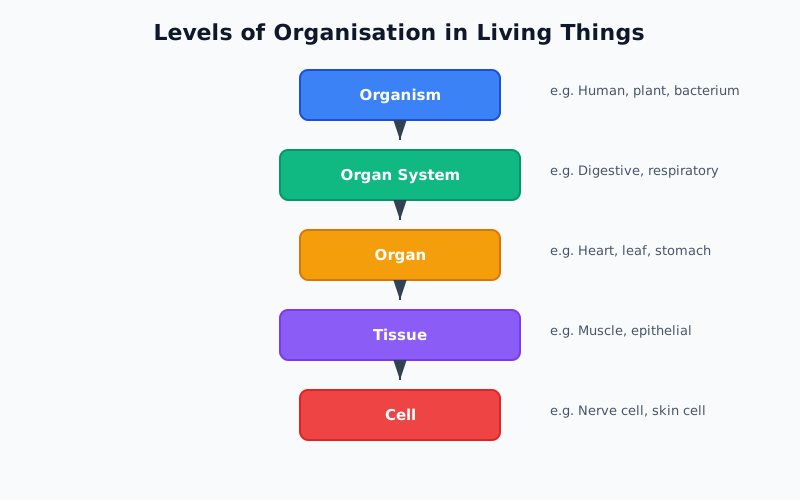
Diagram 2: Plant vs Animal Organisation
Side-by-side comparison showing a leaf cross-section (plant cell → photosynthetic tissue → leaf organ) and a muscle cross-section (animal cell → muscle tissue → heart organ), highlighting that both use the same levels.
At the start of this lesson you were introduced to the idea that your body contains roughly 37 trillion cells, and that every single one belongs to at least four layers of organisation above it. That five-level staircase from cells all the way up to organ systems was today's big idea.
Now that you've worked through the lesson, how has your thinking about that staircase changed? Can you now name all five levels in the correct order and explain what each one actually means?
Q1. Explain the difference between a tissue and an organ.
1 mark for defining a tissue, 1 mark for defining an organ, 1 mark for stating the distinction.Q2. Use the terms cell, tissue, organ and organ system in one correct explanation.
1 mark for each term used correctly in sequence, 1 mark for logical connection between the levels.Q3. Why is it useful for scientists to describe living things as organised systems instead of just listing their parts?
2 marks for explaining how organisation shows connections between parts, 2 marks for linking this to function or survival, 1 mark for a concrete example.Model answers (click to reveal)
Model Answers
+Multiple Choice
1: A. The cell is the basic unit of living things. Organs, organ systems and tissues are all built from cells.
2: C. The correct order is cell, tissue, organ, organ system. Each level is built from the previous one.
3: B. The heart is one organ made of tissues, not a whole system of organs. An organ system needs multiple organs.
4: D. A living system is made of interacting parts that work together in an organised way. The other options describe incorrect or incomplete ideas.
5: A. Plants and animals both show organisation, even though their structures differ. Plants have cells, tissues and organs too.
Short Answer 1 (3 marks)
Sample answer: A tissue is a group of similar cells working together to do a particular job (1 mark). An organ is a larger structure made of different tissues working together (1 mark). The difference is that a tissue is made of one type of cell, while an organ is made of different tissues combined (1 mark).
Short Answer 2 (4 marks)
Sample answer: Cells are the basic units of living things (1 mark). Similar cells group together to form tissues (1 mark). Different tissues work together to make an organ (1 mark). Organs work together in an organ system to carry out a major function for the organism (1 mark).
Short Answer 3 (5 marks)
Sample answer: Describing living things as organised systems is useful because it shows how every part is connected to other parts (1 mark) and how damage at one level can affect other levels (1 mark). This helps scientists understand function and not just structure (1 mark), which matters for explaining how organisms survive (1 mark). For example, if heart tissue is damaged, the heart organ cannot pump properly, and the whole circulatory system is affected (1 mark).
Revisit Your Thinking
Return to the opening questions. Can you now describe the chain from cells to organ systems and explain why the levels matter? How did your answer to the finger-cut question change?
Model answers (click to reveal)
Model Answers
+Multiple Choice
1: A. The cell is the basic unit of living things. Organs, organ systems and tissues are all built from cells.
2: C. The correct order is cell, tissue, organ, organ system. Each level is built from the previous one.
3: B. The heart is one organ made of tissues, not a whole system of organs. An organ system needs multiple organs.
4: D. A living system is made of interacting parts that work together in an organised way. The other options describe incorrect or incomplete ideas.
5: A. Plants and animals both show organisation, even though their structures differ. Plants have cells, tissues and organs too.
Short Answer 1 (3 marks)
Sample answer: A tissue is a group of similar cells working together to do a particular job (1 mark). An organ is a larger structure made of different tissues working together (1 mark). The difference is that a tissue is made of one type of cell, while an organ is made of different tissues combined (1 mark).
Short Answer 2 (4 marks)
Sample answer: Cells are the basic units of living things (1 mark). Similar cells group together to form tissues (1 mark). Different tissues work together to make an organ (1 mark). Organs work together in an organ system to carry out a major function for the organism (1 mark).
Short Answer 3 (5 marks)
Sample answer: Describing living things as organised systems is useful because it shows how every part is connected to other parts (1 mark) and how damage at one level can affect other levels (1 mark). This helps scientists understand function and not just structure (1 mark), which matters for explaining how organisms survive (1 mark). For example, if heart tissue is damaged, the heart organ cannot pump properly, and the whole circulatory system is affected (1 mark).
● Organisation
Living things are organised systems, not random collections of parts.
● Levels
The key order is cells, tissues, organs, then organ systems.
● Interaction
Levels matter because parts work together to keep the organism functioning.
● Bridge Forward
Next lesson deepens the difference between cells, tissues and organs using more examples.