Cells, Tissues and Organs in Context
In 2018, Melbourne researchers identified at least 4 distinct tissue layers packed into a single leaf just 0.3 mm thick.
Printable Worksheets
Print or save as PDF, or build a custom worksheet from any module's questions.
Q1 · Q1: Is a leaf a tissue or an organ? Is muscle a cell, a tissue or an organ?
Q2 · Q2: When you cut your finger, what level of organisation is actually repairing itself?
● Know
- cells, tissues and organs are different levels of organisation
- tissues are made from similar cells
- organs are made from different tissues working together
● Understand
- structure helps explain function
- familiar examples can belong to different levels depending on what they are
- an organ is not just "lots of cells" but an organised structure of tissues
● Can do
- classify examples accurately as cell, tissue or organ
- use plant and animal examples correctly
- justify answers using structure and function language
The easiest mistake is to treat these as three words for "body part". Science uses them much more precisely.
Cell
- one basic living unit
- may be specialised for a job
- example: a muscle cell
Tissue
- many similar cells together
- cells work together on one broad job
- example: muscle tissue
Organ
- different tissues together
- works as one larger structure
- example: the heart or a leaf
Classify each as a cell, tissue or organ: leaf, muscle tissue, muscle cell, heart. Explain one of your choices fully.
Explore the cell in the interactive. Name three organelles you found and state what each one does.
A muscle cell is one cell. Many muscle cells together form muscle tissue. Different tissues can then be part of an organ such as the heart.
A plant also has cells, tissues and organs. A leaf is an organ because it contains different tissues working together in one structure.
If you can point to one specialised living unit, you are likely dealing with a cell. If it is many similar cells, think tissue. If it is different tissues working together, think organ.
Match each organelle to its function. Which organelle did you find hardest to match? Why?
- Nucleus
- Mitochondria
- Cell membrane
- Ribosomes
- Controls cell activities
- Controls what enters and leaves
- Releases energy
- Make proteins
Science does not just label parts. It explains why they suit their jobs. A specialised cell has features that help it do a particular function. A tissue combines many similar cells to do that job more effectively. An organ combines different tissues so a more complex function can happen.
Science uses to explain what a part is like and to explain what job it does.
A student wrote: "An organ is just a large tissue." Explain why this answer is incomplete and rewrite it using the correct definitions from the lesson.
Claim-Evidence-Reasoning Frame
Claim: State whether the student's answer is correct or incorrect.
Evidence: Use the definitions of tissue and organ from the lesson.
Reasoning: Explain how the evidence shows why the student's answer is weak.
Wrong: A tissue is just any group of cells grouped together.
Right: A tissue is a group of similar cells working together on a shared job. Random cells together do not make a tissue.
Wrong: An organ is just a very large tissue.
Right: An organ contains different tissues working together. Size is not what defines an organ; variety of tissues with a combined function is.

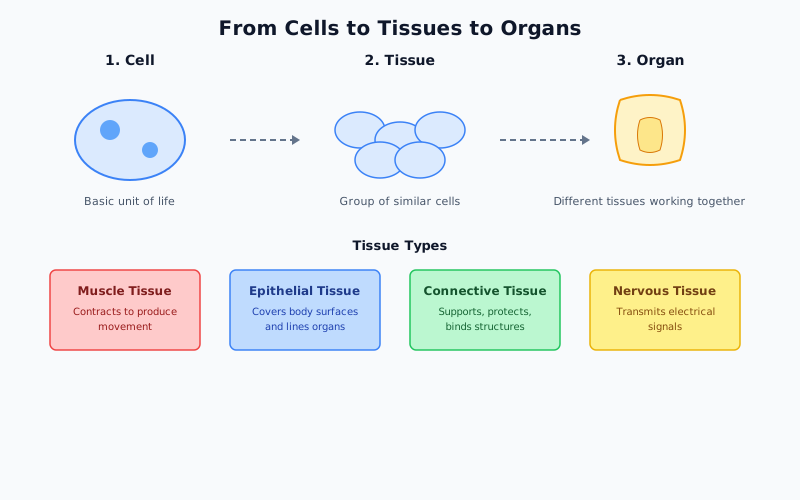
Diagram 2: Cross-Section of a Leaf
Labelled diagram showing different tissues inside a leaf (epidermis, palisade tissue, spongy tissue, vascular tissue) to demonstrate why a leaf is an organ, not a tissue.
At the start of this lesson, you were asked whether a leaf is a tissue or an organ, and whether muscle is a cell, a tissue or an organ. The hook pointed out that a leaf packs four different tissue types into a flat sheet just a fraction of a millimetre thick, which is the clue to answering those questions.
Now that you've worked through the lesson, go back to those two questions. Can you explain your answers using the words "structure" and "function"? What surprised you about the leaf?
Q1. Explain the difference between a specialised cell and a tissue.
1 mark for defining a specialised cell, 1 mark for defining a tissue, 1 mark for stating the key distinction.Q2. Use one plant example and one animal example to show the difference between a tissue and an organ.
1 mark for a correct plant example with explanation, 1 mark for a correct animal example with explanation, 1 mark for distinguishing tissue level, 1 mark for distinguishing organ level.Q3. Why is it scientifically stronger to explain structure and function together when describing cells, tissues and organs?
1 mark for identifying that science explains how parts work, 1 mark for linking structure to what a part is like, 1 mark for linking function to the job it does, 1 mark for a concrete example.Model answers (click to reveal)
Model Answers
+Multiple Choice
1: B. A tissue is a group of similar cells working together.
2: D. A leaf is an organ because different tissues work together in one structure.
3: A. A muscle cell is correctly matched as a cell.
4: C. An organ is more complex because it contains different tissues working together.
5: B. The strongest explanation links both structure and function.
Short Answer 1 (3 marks)
A specialised cell is one cell with features suited to a particular job. A tissue is a group of similar cells working together. The difference is that one is a single living unit and the other is many similar cells acting together.
1 mark for defining a specialised cell. 1 mark for defining a tissue. 1 mark for stating the key distinction (single unit vs many similar cells).
Short Answer 2 (4 marks)
A plant example is a leaf, which is an organ because different tissues work together in one structure. An animal example is muscle tissue, which is a tissue because it is made of many similar muscle cells working together.
1 mark for a correct plant example with explanation. 1 mark for a correct animal example with explanation. 1 mark for distinguishing tissue level. 1 mark for distinguishing organ level.
Short Answer 3 (4 marks)
It is stronger because science is not just naming parts. Structure helps explain what a part is like, and function explains what job it does. Together they show why a cell, tissue or organ is suited to its role.
1 mark for identifying that science explains how parts work. 1 mark for linking structure to what a part is like. 1 mark for linking function to the job it does. 1 mark for a concrete example or clear synthesis.
Revisit Your Thinking
Return to the opening question. Can you now explain clearly why a leaf can be an organ and why muscle can mean different things depending on the context?
Model answers (click to reveal)
Model Answers
+Multiple Choice
1: B. A tissue is a group of similar cells working together.
2: D. A leaf is an organ because different tissues work together in one structure.
3: A. A muscle cell is correctly matched as a cell.
4: C. An organ is more complex because it contains different tissues working together.
5: B. The strongest explanation links both structure and function.
Short Answer 1 (3 marks)
A specialised cell is one cell with features suited to a particular job. A tissue is a group of similar cells working together. The difference is that one is a single living unit and the other is many similar cells acting together.
1 mark for defining a specialised cell. 1 mark for defining a tissue. 1 mark for stating the key distinction (single unit vs many similar cells).
Short Answer 2 (4 marks)
A plant example is a leaf, which is an organ because different tissues work together in one structure. An animal example is muscle tissue, which is a tissue because it is made of many similar muscle cells working together.
1 mark for a correct plant example with explanation. 1 mark for a correct animal example with explanation. 1 mark for distinguishing tissue level. 1 mark for distinguishing organ level.
Short Answer 3 (4 marks)
It is stronger because science is not just naming parts. Structure helps explain what a part is like, and function explains what job it does. Together they show why a cell, tissue or organ is suited to its role.
1 mark for identifying that science explains how parts work. 1 mark for linking structure to what a part is like. 1 mark for linking function to the job it does. 1 mark for a concrete example or clear synthesis.
● Cell
A cell is one basic living unit, and some cells are specialised.
● Tissue
A tissue is many similar cells working together.
● Organ
An organ is made of different tissues working together in one larger structure.
● Bridge Forward
Next lesson steps up to organs working together in organ systems.