What Happens When One Component Fails?
In 2019, doctors at Sydney Children's Hospital found that 1 blocked artery in a young patient triggered failure responses across 4 separate organ systems within 12 hours.
Printable Worksheets
Print or save as PDF, or build a custom worksheet from any module's questions.
Q1 · If one part of a living system stops doing its job properly, why can the effect spread beyond that one part?
Q2 · Q2: If a farmer accidentally cuts through the roots of a young fruit tree while digging, why might the leaves start wilting days later?
Q3 · Q2: If a farmer accidentally cuts through the roots of a young fruit tree while digging, why might the leaves start wilting days later?
● Know
- living systems depend on interacting components
- damage to one part can affect wider function
- both plant and animal examples can show system disruption
● Understand
- the effect is often indirect, not just local
- good explanations follow a cause to a wider consequence
- this prepares for the investigation and synthesis lessons ahead
● Can do
- explain disruption using cause-and-effect language
- trace how a problem in one part affects the whole system
- compare plant and animal system disruption clearly
A component does not work in isolation. If it stops doing its role, other parts may no longer get what they need.
Across this unit, we have looked at roots, leaves, stems, digestive structures, circulatory transport and gas exchange. None of these parts matter only on their own. Their roles connect. That means a problem in one component can interrupt intake, transport, exchange or removal processes across the wider organism.
A student writes: “If roots are damaged, only the roots are affected.” Rewrite this into a stronger systems explanation.
Claim-Evidence-Reasoning Frame
Claim: State your position.
Evidence: Use facts from the lesson.
Reasoning: Explain how the evidence supports your claim.
Put these stages of system disruption in the correct logical order.
- The usual movement or exchange of materials is disrupted
- Wider system function is affected
- Other parts receive less of what they need
- One component is damaged or cannot do its role
At this level, we do not need advanced medical or agricultural detail. We only need defensible examples that show the system principle clearly.
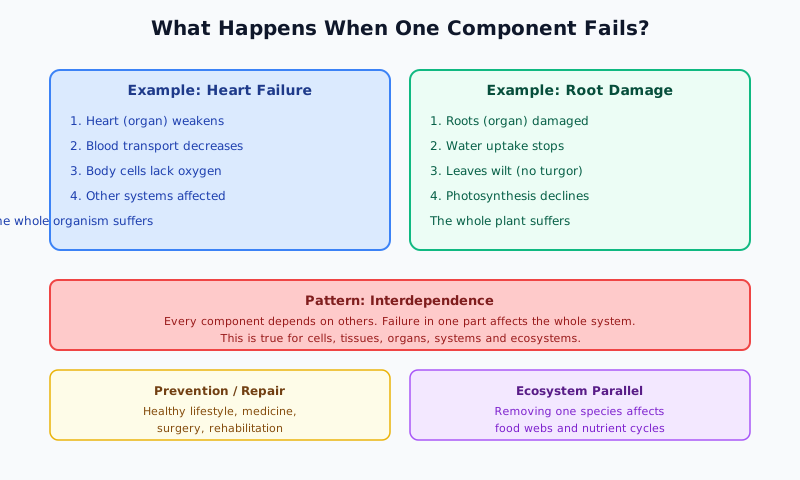
Plant example: damaged roots
- roots take in water and minerals
- if roots are badly damaged, intake drops
- stems and leaves are then affected because less useful material is available
- the whole plant may wilt or grow poorly
Animal example: reduced gas exchange
- respiratory structures help gases move into the body
- if gas exchange is reduced, less oxygen reaches the circulatory system
- body cells then receive less of what they need
- wider body function is affected
- Damaged roots
- Reduced gas exchange
- System effect
- Less oxygen reaches body cells
- Wider impact caused by change in one component
- Reduced water and mineral intake
Choose either the plant example or animal example from the lesson and write a four-step cause-and-effect chain.
This lesson is about system disruption, not about disease treatment or diagnosis. The key job here is to explain how a change in one component affects other components.
That reasoning prepares you for the next block on investigating living systems and explaining them with evidence. Before you can do that well, you need to understand that systems are connected and that disruption can spread.
Wrong: You often think damage to one part only affects that part.
Right: Living systems depend on interacting components, so a problem in one part can disrupt wider system function.
Wrong: You think plants do not show system effects because they have no organs.
Right: If roots are damaged, the whole plant can wilt because water and mineral intake is reduced.
Wrong: If something disrupts one part of a system, the effect is always immediate and obvious.
Right: Some effects are delayed or indirect, spreading through the system over time.
Plant Root Damage Example
Diagram showing healthy roots vs damaged roots and the resulting effect on leaf turgor.
Today's hook told you about the 2019 case at Sydney Children's Hospital where one blocked artery started affecting four different organ systems, a real example of why a fault in one component of a living system almost never stays contained.
Now that you've worked through the lesson, can you explain the chain reaction that starts when one component fails? Use the idea of interdependence to explain why the effect can spread so far, and connect it to the hospital case from the hook.
Q1. Explain why one damaged component can affect more than one part of a living system.
1 mark for stating components interact, 1 mark for explaining disrupted movement/exchange, 1 mark for linking to wider effect.Q2. Use the damaged roots example to explain a plant system effect.
1 mark for identifying root role, 1 mark for explaining reduced intake, 1 mark for describing effect on stems/leaves, 1 mark for linking to whole plant.Q3. Compare how disruption in one component could affect a plant and an animal system.
1 mark for describing plant disruption example, 1 mark for describing animal disruption example, 1 mark for comparing the patterns, 1 mark for linking to system principle.Model answers (click to reveal)
Model Answers
+Multiple Choice
1: B. Living systems are made of interacting parts.
2: C. That option traces the effect beyond the roots themselves.
3: A. This shows a wider system effect clearly.
4: D. That is the strongest cause-and-effect reasoning pattern.
5: B. The lesson is about system interaction, not later disease depth.
Short Answer 1 (3 marks)
One damaged component can affect more than one part because living systems are made of interacting structures. If one part cannot do its role properly, the movement, exchange or removal of materials can be disrupted for other parts too.
1 mark for stating components interact. 1 mark for explaining disrupted movement/exchange. 1 mark for linking to wider effect.
Short Answer 2 (4 marks)
If roots are damaged, the plant may take in less water and fewer minerals. That means stems and leaves receive less of what they need, so transport and wider plant function are affected. The whole plant may grow poorly or wilt.
1 mark for identifying root role. 1 mark for explaining reduced intake. 1 mark for describing effect on stems/leaves. 1 mark for linking to whole plant.
Short Answer 3 (4 marks)
In plants, damage to roots can reduce intake of useful materials and affect the rest of the plant. In animals, reduced gas exchange can mean less oxygen reaches body cells through the circulatory system. Both show that when one component is disrupted, wider system function can be affected.
1 mark for describing plant disruption example. 1 mark for describing animal disruption example. 1 mark for comparing the patterns. 1 mark for linking to system principle.
Revisit Your Thinking
Return to your opening explanation. Can you now explain the wider effect of disruption more clearly using a cause-and-effect chain?
Model answers (click to reveal)
Model Answers
+Multiple Choice
1: B. Living systems are made of interacting parts.
2: C. That option traces the effect beyond the roots themselves.
3: A. This shows a wider system effect clearly.
4: D. That is the strongest cause-and-effect reasoning pattern.
5: B. The lesson is about system interaction, not later disease depth.
Short Answer 1 (3 marks)
One damaged component can affect more than one part because living systems are made of interacting structures. If one part cannot do its role properly, the movement, exchange or removal of materials can be disrupted for other parts too.
1 mark for stating components interact. 1 mark for explaining disrupted movement/exchange. 1 mark for linking to wider effect.
Short Answer 2 (4 marks)
If roots are damaged, the plant may take in less water and fewer minerals. That means stems and leaves receive less of what they need, so transport and wider plant function are affected. The whole plant may grow poorly or wilt.
1 mark for identifying root role. 1 mark for explaining reduced intake. 1 mark for describing effect on stems/leaves. 1 mark for linking to whole plant.
Short Answer 3 (4 marks)
In plants, damage to roots can reduce intake of useful materials and affect the rest of the plant. In animals, reduced gas exchange can mean less oxygen reaches body cells through the circulatory system. Both show that when one component is disrupted, wider system function can be affected.
1 mark for describing plant disruption example. 1 mark for describing animal disruption example. 1 mark for comparing the patterns. 1 mark for linking to system principle.
● Key Principle
One problem can spread because living systems depend on interacting components.
● Plant Example
Damaged roots can reduce intake and affect the wider plant.
● Animal Example
Reduced gas exchange can affect the transport of useful gases to body cells.
● Bridge Forward
Checkpoint 3 now pulls together digestion, waste, plant inputs, comparison and disruption.