Comparing Plant and Animal Living Systems
In 2022, Australian Museum biologists noted that a kangaroo and a eucalyptus tree share the same paddock yet solve the challenge of staying alive using entirely different structures across their 5 levels of organisation.
Printable Worksheets
Print or save as PDF, or build a custom worksheet from any module's questions.
Q1 · How are plant and animal living systems similar, and how are they different?
Q2 · Q2: A kangaroo and a eucalyptus tree both live in the same Australian bush. How does each one get the materials it needs?
Q3 · Q2: A kangaroo and a eucalyptus tree both live in the same Australian bush. How does each one get the materials it needs?
● Know
- plants and animals both have organised living systems
- their structures and systems are not identical
- both rely on structure-function relationships
● Understand
- similar jobs can be achieved by different structures
- comparison means using both similarities and differences
- systems language applies to plants as well as animals
● Can do
- compare plant and animal systems clearly
- use structure -> role -> function language
- avoid claiming that plants and animals work in exactly the same way
A strong comparison starts with what both groups share: organised parts, useful inputs, outputs, transport or exchange, and structures with specific roles.
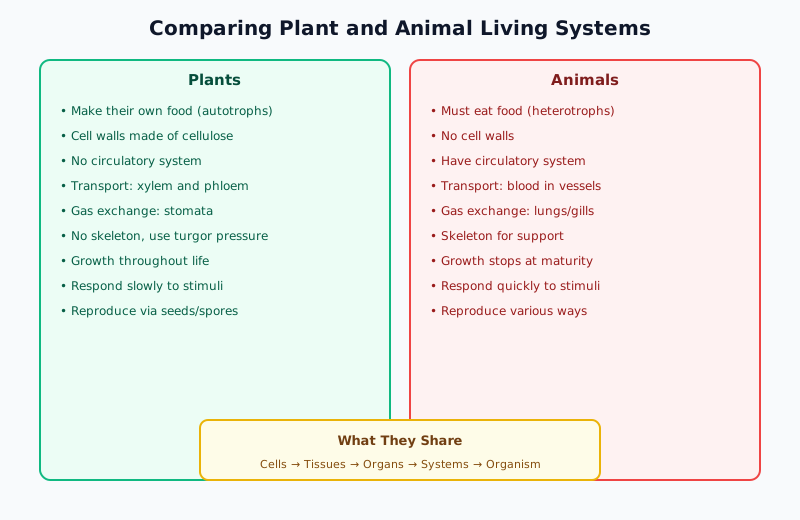
Plants and animals are not the same type of organism, but both are made of components that work together. Both need materials from the environment. Both have structures that help move materials, exchange substances and support survival. This is why science uses systems language for both groups.
Plant focus
- roots, stems and leaves are major structures
- water, minerals and light are key inputs
- transport and gas exchange happen through plant structures
Both have organised parts with roles that support life.
Animal focus
- organs and organ systems are often more obvious to identify
- food, water and gases are key inputs
- circulation, respiration and digestion support survival
Write one similarity and two differences between plant and animal living systems. Use structure-role-function language.
Put these steps for building a strong plant-animal comparison in the correct order.
- Find the plant structure that performs this function
- Compare roles and functions, not just appearance
- Find the animal structure that performs this function
- Identify the life function being compared (e.g. transport, intake)
Good scientific comparison does not mean forcing plant parts to match animal parts one-to-one. Instead, compare the role or function, then explain which structure helps carry it out.
- Plant structures (roots, stems, leaves)
- Animal structures (heart, vessels, blood)
- Both plants and animals
- Circulatory transport structures
- Have organised parts with roles supporting life
- Transport and exchange structures
Plants and animals both solve life problems such as intake, transport and waste handling, but they do not use the same body plan. This matters because you often assume that if plants do not have obvious organs like animals, then plants do not really have systems. That is incorrect.
Strong explanations therefore compare at the level of role and function. For example, both plants and animals need transport, but plants use structures such as roots, stems and leaves, while animals use structures such as the heart, blood vessels and blood.
A student writes: “Animals have systems but plants just have parts.” Rewrite this into a stronger scientific comparison.
Claim-Evidence-Reasoning Frame
Claim: State your position.
Evidence: Use facts from the lesson.
Reasoning: Explain how the evidence supports your claim.
Wrong: You often think plants and animals have exactly the same systems.
Right: Both are living systems with interacting parts, but they use different structures to carry out similar life functions.
Wrong: You think plants are not really living systems because they lack organs.
Right: Plants have organised structures such as roots, stems and leaves that work together as a system.
Wrong: Comparing two systems means listing what they have in common, differences aren't part of a comparison.
Right: Good comparison uses both similarity and difference language to show how roles and functions relate.
Venn Diagram Template
Venn diagram showing shared needs (inputs, transport, outputs) and different structures.
Today's hook asked you how a kangaroo and a eucalyptus tree, sharing the same paddock, can both stay alive when one has a heart and the other doesn't. That puzzle is at the heart of this lesson's comparison of plant and animal living systems.
Now that you've worked through the lesson, answer the hook's question: what surprising similarities do plant and animal systems share despite looking so different? What key difference explains why the eucalyptus doesn't need a heart?
Q1. State one similarity and one difference between plant and animal living systems.
1 mark for stating one valid similarity, 1 mark for explaining the similarity, 1 mark for stating one valid difference.Q2. Explain why it is stronger to compare plant and animal systems using role and function rather than saying they are “the same” or “completely different”.
1 mark for explaining role/function comparison, 1 mark for why "same" is wrong, 1 mark for why "completely different" is wrong, 1 mark for linking to structure-function reasoning.Q3. Compare how a plant and an animal each meet the need to take in and move useful materials .
1 mark for describing plant intake/transport, 1 mark for describing animal intake/transport, 1 mark for comparing the two, 1 mark for linking to system needs.Model answers (click to reveal)
Model Answers
+Multiple Choice
1: B. Both plants and animals are organised living systems.
2: D. That option gives a real difference in structures used.
3: A. Similar functions can be carried out by different structures.
4: C. This is the most accurate comparison statement.
5: D. A problem in one component can affect wider system function.
Short Answer 1 (3 marks)
One similarity is that both plants and animals are living systems made of interacting parts. One difference is that plants use structures such as roots, stems and leaves, while animals use different organs and organ systems.
1 mark for stating one valid similarity. 1 mark for explaining the similarity. 1 mark for stating one valid difference.
Short Answer 2 (4 marks)
It is stronger because plants and animals can carry out similar life jobs using different structures. Saying they are exactly the same ignores important structural differences, while saying they are completely different ignores the fact that both are organised living systems with components and functions.
1 mark for explaining role/function comparison. 1 mark for why "same" is wrong. 1 mark for why "completely different" is wrong. 1 mark for linking to structure-function reasoning.
Short Answer 3 (4 marks)
In plants, roots take in water and minerals and structures such as stems and leaves help transport or exchange materials. In animals, systems such as digestion, respiration and circulation help bring in and move useful materials. Both depend on organised structures working together, but the structures are not identical.
1 mark for describing plant intake/transport. 1 mark for describing animal intake/transport. 1 mark for comparing the two. 1 mark for linking to system needs.
Revisit Your Thinking
Return to your opening comparison. Can you now use more precise comparison language and clearer structure-role-function links?
Model answers (click to reveal)
Model Answers
+Multiple Choice
1: B. Both plants and animals are organised living systems.
2: D. That option gives a real difference in structures used.
3: A. Similar functions can be carried out by different structures.
4: C. This is the most accurate comparison statement.
5: D. A problem in one component can affect wider system function.
Short Answer 1 (3 marks)
One similarity is that both plants and animals are living systems made of interacting parts. One difference is that plants use structures such as roots, stems and leaves, while animals use different organs and organ systems.
1 mark for stating one valid similarity. 1 mark for explaining the similarity. 1 mark for stating one valid difference.
Short Answer 2 (4 marks)
It is stronger because plants and animals can carry out similar life jobs using different structures. Saying they are exactly the same ignores important structural differences, while saying they are completely different ignores the fact that both are organised living systems with components and functions.
1 mark for explaining role/function comparison. 1 mark for why "same" is wrong. 1 mark for why "completely different" is wrong. 1 mark for linking to structure-function reasoning.
Short Answer 3 (4 marks)
In plants, roots take in water and minerals and structures such as stems and leaves help transport or exchange materials. In animals, systems such as digestion, respiration and circulation help bring in and move useful materials. Both depend on organised structures working together, but the structures are not identical.
1 mark for describing plant intake/transport. 1 mark for describing animal intake/transport. 1 mark for comparing the two. 1 mark for linking to system needs.
● Shared Idea
Plants and animals are both living systems with interacting components.
● Important Difference
They use different structures to carry out life functions.
● Best Comparison Method
Compare role and function, not just appearance or labels.
● Bridge Forward
Next lesson looks at what happens when one component in a living system fails.