Investigating Living Systems
In 2020, CSIRO plant biologists used a 6-step investigation process to show that cells exposed to 40 °C for just 2 hours lose 30% of their membrane function.
Printable Worksheets
Print or save as PDF, or build a custom worksheet from any module's questions.
Q1 · Q1: If you wanted to investigate a question about a living system, what would you need besides just a guess?
Q2 · Q2: Have you ever measured your pulse after running? What did you notice, and how is that like a scientific investigation?
● Know
- living-systems investigations need a question, method, data and conclusion
- safe and fair procedures matter
- conclusions should come from evidence
● Understand
- investigation is more than just observing once
- patterns in data help explain system behaviour
- secondary-source data can also support investigation
● Can do
- identify the parts of a simple investigation
- process and interpret data from a living-systems question
- write evidence-based explanations and conclusions
Good scientific investigation is structured. It does not jump straight from a question to a claim.
At this level, you should be able to recognise the core sequence of a simple investigation: ask a question, make a prediction, plan a safe method, collect data, find patterns and then write a conclusion supported by the evidence.
Question and prediction
- start with a testable living-systems question
- make a reasoned prediction
Method
- use safe, fair and clear steps
- collect useful information
Data and pattern
- record observations or measurements
- look for trends, changes or relationships
Conclusion
- use evidence from the data
- explain what the data suggests about the living system
Write a simple living-systems question and a prediction for an investigation about breathing rate, pulse rate or plant water movement.
One example is investigating how exercise affects breathing rate or pulse rate using safe classroom procedures. Another example is using secondary-source data about plant water uptake or transpiration. In both cases, the key is the same: process data and use it to explain system behaviour.
| Condition | Breathing rate (breaths/min) | Pattern |
|---|---|---|
| Resting | 14 | Lowest recorded rate |
| After short exercise | 24 | Rate increased |
| After recovery | 17 | Rate dropped toward resting value |
A conclusion should answer the investigation question using the evidence collected. At this level, that means referring to patterns in the table, graph or observations, and linking them back to the living-system idea being studied.
This is why Working Scientifically matters in this unit. Learning about living systems is stronger when you can ask questions, process information, identify patterns and justify conclusions with evidence.
Click two steps to swap them. Get them in the right order.
- Ask a testable living-systems question
- Write an evidence-based conclusion
- Plan a safe and fair method
- Identify patterns in the data
- Collect data through observation or measurement
- Make a reasoned prediction
Using the example table in the lesson, write one pattern and one evidence-based conclusion.
Claim-Evidence-Reasoning Frame
Claim: State what the data shows about the living system.
Evidence: Quote specific numbers or trends from the table.
Reasoning: Explain why those numbers support your claim about how the system responds.
Wrong: A conclusion should always agree with the prediction no matter what the data shows.
Right: A scientific conclusion must come from the data, even if the result is different from what was predicted.
Wrong: Only laboratory experiments count as scientific investigations.
Right: Investigations can use primary data you collect yourself or secondary data from published sources.
Wrong: If your data doesn't match what you expected, the experiment failed and the results should be thrown out.
Right: Unexpected data is still valuable. It can lead to new questions and deeper understanding of the living system.
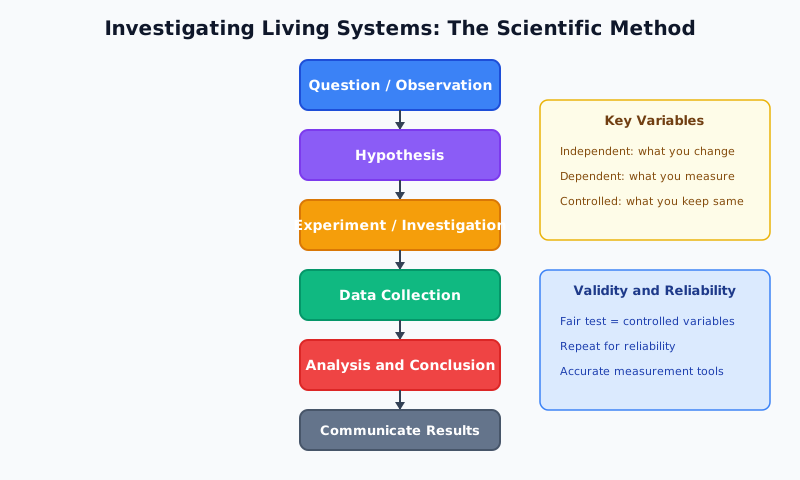
Diagram 2: Data Table Example
Annotated table showing breathing rate data with highlighted patterns and trends.
Today's hook pointed out that CSIRO researchers investigating heat stress in plant cells don't just look and guess, they collect data, find patterns, and link evidence to explanations. Today's lesson put you through those same steps using a question you could test yourself.
Now that you've worked through the lesson, name the full sequence of steps a good scientific investigation follows. What is the difference between a guess and a proper prediction, and why does the evidence step matter?
Q1. Name the main parts of a simple scientific investigation.
1 mark for question/prediction, 1 mark for method/data, 1 mark for pattern/conclusion.Q2. Use the example table to describe one pattern and one conclusion about the living system.
1 mark for identifying a correct pattern, 1 mark for describing it with numbers, 1 mark for a conclusion linked to the data, 1 mark for linking to system behaviour.Q3. Why is it stronger to base a conclusion on data instead of only on a prediction ?
1 mark for saying data shows what happened, 1 mark for saying prediction is only an expectation, 1 mark for explaining evidence-based reasoning, 1 mark for giving an example.Model answers (click to reveal)
Model Answers
+Multiple Choice
1: C. This is the clearest investigation sequence.
2: A. Safe and fair methods matter because they help produce useful evidence.
3: D. Data is the information collected or provided for analysis.
4: B. The breathing rate rose after exercise and then moved back toward resting level.
5: A. Scientific conclusions must use evidence from the data.
6: C. Published results used for analysis are secondary-source data.
7: D. Patterns help explain what the evidence suggests.
8: B. A useful prediction includes a reason linked to the system.
9: A. Conclusions should come from data, not just expectation.
10: C. This captures the core investigation understanding of the lesson.
Short Answer 1 (3 marks)
The main parts are a question, a prediction, a method, data and a conclusion. A strong investigation also identifies patterns in the data before the conclusion is written.
1 mark for question/prediction. 1 mark for method/data. 1 mark for pattern/conclusion.
Short Answer 2 (4 marks)
One pattern is that breathing rate increased after exercise and then dropped back toward the resting value during recovery. One conclusion is that the body responded to exercise by changing breathing rate, then moved back toward its earlier level afterward.
1 mark for identifying a correct pattern. 1 mark for describing it with numbers. 1 mark for a conclusion linked to the data. 1 mark for linking to system behaviour.
Short Answer 3 (4 marks)
It is stronger because data shows what actually happened in the investigation. A prediction is only an expectation. Scientific conclusions should be based on evidence collected, even if the result is different from what was predicted.
1 mark for saying data shows what happened. 1 mark for saying prediction is only an expectation. 1 mark for explaining evidence-based reasoning. 1 mark for giving an example.
Revisit Your Thinking
Return to your opening answer. Can you now explain more clearly why investigations need method, data and evidence-based conclusions?
Model answers (click to reveal)
Model Answers
+Multiple Choice
1: C. This is the clearest investigation sequence.
2: A. Safe and fair methods matter because they help produce useful evidence.
3: D. Data is the information collected or provided for analysis.
4: B. The breathing rate rose after exercise and then moved back toward resting level.
5: A. Scientific conclusions must use evidence from the data.
6: C. Published results used for analysis are secondary-source data.
7: D. Patterns help explain what the evidence suggests.
8: B. A useful prediction includes a reason linked to the system.
9: A. Conclusions should come from data, not just expectation.
10: C. This captures the core investigation understanding of the lesson.
Short Answer 1 (3 marks)
The main parts are a question, a prediction, a method, data and a conclusion. A strong investigation also identifies patterns in the data before the conclusion is written.
1 mark for question/prediction. 1 mark for method/data. 1 mark for pattern/conclusion.
Short Answer 2 (4 marks)
One pattern is that breathing rate increased after exercise and then dropped back toward the resting value during recovery. One conclusion is that the body responded to exercise by changing breathing rate, then moved back toward its earlier level afterward.
1 mark for identifying a correct pattern. 1 mark for describing it with numbers. 1 mark for a conclusion linked to the data. 1 mark for linking to system behaviour.
Short Answer 3 (4 marks)
It is stronger because data shows what actually happened in the investigation. A prediction is only an expectation. Scientific conclusions should be based on evidence collected, even if the result is different from what was predicted.
1 mark for saying data shows what happened. 1 mark for saying prediction is only an expectation. 1 mark for explaining evidence-based reasoning. 1 mark for giving an example.
● Investigation Flow
Question, prediction, method, data, pattern and conclusion all matter.
● Evidence Use
Patterns in the data help explain how a living system behaves.
● Scientific Conclusion
A conclusion should be based on the evidence, not just on what was expected.
● Bridge Forward
Next lesson focuses on evidence-based explanations using data, tables and diagrams.