Evidence-Based Explanations in Living Systems
In 2022, NESA examiners reported that 40% of Year 8 science answers lost marks not from wrong facts, but from missing the evidence-to-explanation link entirely.
Printable Worksheets
Print or save as PDF, or build a custom worksheet from any module's questions.
Q1 · What makes one science explanation stronger than another when both are about the same living system?
Q2 · Q2: Two you write about the same breathing-rate table. One writes "The numbers are 14, 24 and 17." The other writes "Breathing rate increased after exercise." Which is stronger and why?
Q3 · Q2: Two you write about the same breathing-rate table. One writes "The numbers are 14, 24 and 17." The other writes "Breathing rate increased after exercise." Which is stronger and why?
● Know
- evidence can come from tables, diagrams or case studies
- strong explanations use structure, role, function and effect
- interpreting evidence is more than copying it
● Understand
- scientific communication is stronger when each claim is linked to evidence
- patterns and labelled structures can support a living-systems explanation
- clear explanation frames improve accuracy
● Can do
- interpret tables, diagrams and case-study evidence
- write structured explanations using a scientific reasoning frame
- justify claims with evidence instead of vague wording
A strong scientific explanation can use more than one type of evidence, but the key skill is always the same: interpret what the evidence means.
You may be given a table of results, a labelled diagram of a system, or a short case study about system disruption or response. In each case, the job is to connect the evidence to a scientific explanation of how the living system works.
Tables
- show values, comparisons or trends
- help identify patterns in system behaviour
Diagrams
- show structures and labels
- help explain role and function visually
Case studies
- show a specific example or disruption
- help explain effect and wider system impact
Explanation
- links evidence to meaning
- answers the question with justified reasoning
One of the strongest ways to explain a living system is to move step by step through the structure involved, the job it does, how that supports the system, and what effect follows. This keeps scientific writing clear and evidence based.
| Evidence | Interpretation |
|---|---|
| Damaged roots are shown in a case study | Roots are the structure. Their role is intake of water and minerals. If that role is disrupted, wider plant function is affected. |
| Breathing rate increases after exercise in a table | The evidence suggests the body responds to changing demand, such as breathing faster during exercise. |
Choose either the damaged-roots example or the breathing-rate table example and write a short explanation using `structure -> role -> function -> effect`.
In the damaged- case study, the [blank] are the structure. Their [blank] is to take in water and minerals. If that is disrupted, wider plant [blank] is affected, which shows the [blank] of root damage.
A weak science response might simply repeat numbers from a table or labels from a diagram. That is not enough. You need to interpret what those numbers or labels mean for living-system structure, function and effect.
This matters because the final lessons and assessments in the unit require more than recall. You need to communicate clearly, defend their reasoning and connect evidence to scientific ideas.
A student writes: "The table shows 14, 24 and 17." Rewrite this into a stronger scientific explanation.
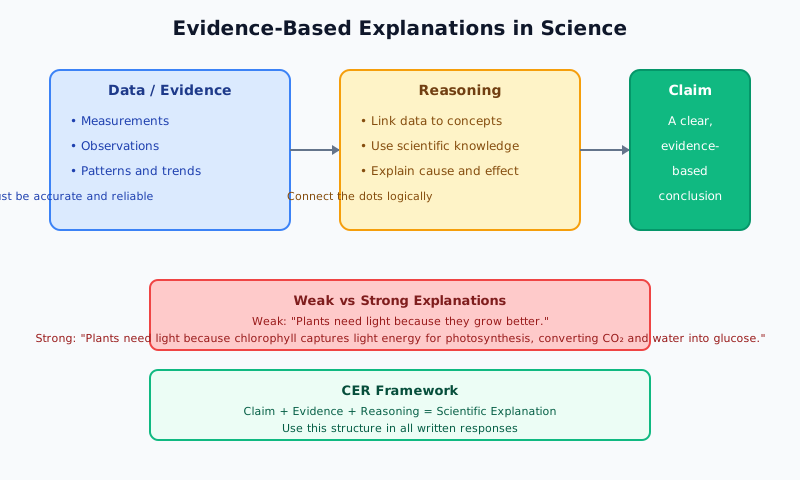
Claim-Evidence-Reasoning Frame
Claim: State your position.
Evidence: Use facts from the lesson.
Reasoning: Explain how the evidence supports your claim.
Wrong: You often think copying numbers from a table is enough.
Right: Scientific explanation requires interpreting what the evidence means, not just repeating it.
Wrong: You think diagrams are just decorations.
Right: Diagrams show structures and labels that help explain role and function in a living system.
Wrong: A strong opinion or a confident statement counts as scientific evidence.
Right: Evidence must come from data, diagrams or case studies that can be observed and checked.
Structure-Role-Function-Effect Frame
Visual flowchart showing the explanation frame with an example applied to a living system.
Today's hook gave you two students describing the same breathing-rate data, one listed raw numbers, the other drew a conclusion from the pattern. The lesson's challenge was to understand why one answer scores marks in a real exam and the other doesn't.
Now that you've worked through the lesson, explain what makes the second student's explanation stronger. Use the words "claim," "evidence" and "reasoning" in your answer, and describe what each one adds.
Q1. What makes an explanation evidence based ?
1 mark for mentioning data/diagrams/case studies, 1 mark for linking evidence to claims, 1 mark for explaining why it is stronger than opinion alone.Q2. Use the `structure -> role -> function -> effect` frame to explain the damaged-roots case study.
1 mark for identifying structure, 1 mark for stating role, 1 mark for explaining function, 1 mark for describing wider effect.Q3. Why is it stronger to interpret a table or diagram than to simply copy what it shows?
1 mark for saying copying is just repetition, 1 mark for saying interpretation shows understanding, 1 mark for linking to scientific reasoning, 1 mark for giving a concrete example.Model answers (click to reveal)
Model Answers
+Multiple Choice
1: B. Tables, diagrams and case studies can all provide evidence.
2: D. Interpreting evidence means explaining what it suggests.
3: A. This is the explanation frame used in the lesson.
4: C. Diagrams help show structures and their roles clearly.
5: B. Simply reading out values is the weakest response.
6: D. A strong case-study explanation includes structure, role and wider effect.
7: A. Scientific claims are stronger when supported by evidence.
8: C. This is the best evidence-based explanation of the table.
9: B. Copying evidence is weaker than interpreting what it means.
10: D. This captures the core communication standard of the lesson.
Short Answer 1 (3 marks)
An explanation is evidence based when it uses information from data, diagrams or case studies to support its claims. It does not rely only on opinion or vague description.
1 mark for mentioning data/diagrams/case studies. 1 mark for linking evidence to claims. 1 mark for explaining why it is stronger than opinion alone.
Short Answer 2 (4 marks)
Structure: roots. Role: roots take in water and minerals. Function: this supports transport and wider plant survival. Effect: if roots are damaged, intake is reduced and the rest of the plant can be affected.
1 mark for identifying structure. 1 mark for stating role. 1 mark for explaining function. 1 mark for describing wider effect.
Short Answer 3 (4 marks)
It is stronger because interpretation explains what the evidence means for the living system. Simply copying the evidence does not show understanding. Scientific explanation needs reasoning, not just repetition.
1 mark for saying copying is just repetition. 1 mark for saying interpretation shows understanding. 1 mark for linking to scientific reasoning. 1 mark for giving a concrete example.
Revisit Your Thinking
Return to your opening answer. Can you now explain more clearly what makes one scientific explanation stronger than another?
Model answers (click to reveal)
Model Answers
+Multiple Choice
1: B. Tables, diagrams and case studies can all provide evidence.
2: D. Interpreting evidence means explaining what it suggests.
3: A. This is the explanation frame used in the lesson.
4: C. Diagrams help show structures and their roles clearly.
5: B. Simply reading out values is the weakest response.
6: D. A strong case-study explanation includes structure, role and wider effect.
7: A. Scientific claims are stronger when supported by evidence.
8: C. This is the best evidence-based explanation of the table.
9: B. Copying evidence is weaker than interpreting what it means.
10: D. This captures the core communication standard of the lesson.
Short Answer 1 (3 marks)
An explanation is evidence based when it uses information from data, diagrams or case studies to support its claims. It does not rely only on opinion or vague description.
1 mark for mentioning data/diagrams/case studies. 1 mark for linking evidence to claims. 1 mark for explaining why it is stronger than opinion alone.
Short Answer 2 (4 marks)
Structure: roots. Role: roots take in water and minerals. Function: this supports transport and wider plant survival. Effect: if roots are damaged, intake is reduced and the rest of the plant can be affected.
1 mark for identifying structure. 1 mark for stating role. 1 mark for explaining function. 1 mark for describing wider effect.
Short Answer 3 (4 marks)
It is stronger because interpretation explains what the evidence means for the living system. Simply copying the evidence does not show understanding. Scientific explanation needs reasoning, not just repetition.
1 mark for saying copying is just repetition. 1 mark for saying interpretation shows understanding. 1 mark for linking to scientific reasoning. 1 mark for giving a concrete example.
● Evidence Types
Tables, diagrams and case studies can all support scientific explanation.
● Explanation Frame
Structure -> role -> function -> effect helps keep living-systems explanations clear.
● Interpretation
Scientific communication is stronger when evidence is interpreted, not just copied.
● Bridge Forward
Next lesson is the final synthesis and preparation lesson for the end of the unit.