Final Living Systems Synthesis and Depth Study Preparation
In 2023, NESA Year 8 assessors identified 6 core living-systems concepts that appear in over 80% of all exam questions, and today's lesson connects every one of them.
Printable Worksheets
Print or save as PDF, or build a custom worksheet from any module's questions.
Q1 · Q1: If you had to explain the whole unit in one short answer, which ideas would you have to connect together?
Q2 · Q2: If someone asked you to prove that living systems are connected, what kind of evidence would you look for?
● Know
- the unit connects organisation, transport, exchange, disruption, investigation and evidence
- strong full-unit answers combine several ideas rather than repeating one fact
- problem solving in biology requires explicit reasoning
● Understand
- living-systems problems can be solved by linking structure, role, function and effect
- evidence-based explanation builds on earlier ideas about structure, interaction and disruption
- depth-study style thinking uses evidence and planning, not just recall
● Can do
- synthesise the major ideas of the whole unit
- solve living-systems problems using clear reasoning
- prepare for the final checkpoint and quiz with stronger explanation frames
The strongest understanding of living systems is not a list of separate topics. It is a connected explanation of how organised parts support life.
This unit has moved from levels of organisation to plant and animal systems, transport and exchange, inputs and outputs, disruption, investigation and evidence-based explanation. These are not separate islands. They are all part of the same larger systems idea.
Organisation
- cells, tissues, organs and systems build on each other
- plants and animals are both organised living systems
Transport and exchange
- living things need inputs, transport and removal of wastes
- systems interact to move materials where needed
System interaction and disruption
- wider function depends on systems working together
- disruption in one component can affect wider function
Evidence and reasoning
- claims should be supported with data, diagrams or case-study evidence
- structured explanation strengthens communication
In one paragraph, explain what the unit has taught you about how living systems work.
Claim-Evidence-Reasoning Frame
Claim: State how living systems work as a whole.
Evidence: Use facts from at least two earlier lessons in the unit.
Reasoning: Explain how the evidence connects to your claim about living systems.
When a question gives a living-systems scenario, do not jump straight to a short answer. Work through the problem in steps so your explanation stays accurate and comprehensive.
When solving a living-systems problem, first identify the [blank] involved, then state its [blank], explain how that supports transport or stability, describe the wider [blank] if conditions change, and support your answer with [blank].
Write a short explanation of how a problem in one living-system component could affect transport and wider function.
If this unit launches or concludes a depth-study style investigation, the important preparation is not just content recall. It is being able to ask a living-systems question, choose useful evidence and explain findings clearly.
This is why the final checkpoint and unit quiz matter. They test whether you can bring the unit together coherently, not just remember isolated notes from individual lessons.
Wrong: Memorising definitions is enough to understand the whole unit.
Right: Strong understanding comes from connecting ideas and using them to solve problems, not just recalling definitions.
Wrong: The final lesson is only about revision of earlier lessons.
Right: The capstone task is to synthesise definitions, system ideas and evidence together to solve new problems.
Wrong: Evidence is only needed in formal reports, class discussions and quizzes don't need it.
Right: Evidence should support scientific claims in every explanation, whether it is a depth study, a quiz or a classroom discussion.
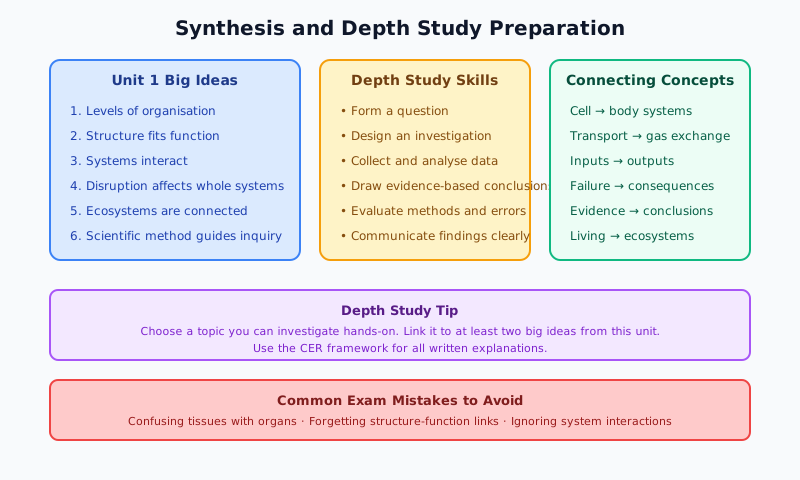
Diagram 2: Problem-Solving Frame
Annotated flowchart showing the five-step capstone reasoning strategy with a worked example.
Today's hook challenged you to connect every concept from the unit, from a single cell to a whole ecosystem, into one big picture about how living things are organised. That synthesis is exactly what this final lesson is asking you to do.
Now that you've worked through the lesson, write that big-picture explanation. Start with cells and levels of organisation, trace through transport and exchange systems, bring in system interaction and disruption, and finish with how investigation and evidence tie it all together. Which connection surprised you most?
Q1. Explain how at least three major ideas from the unit connect together.
1 mark for each major idea identified (max 3), 1 mark for showing explicit connections between them.Q2. Use the capstone problem-solving frame to explain how disruption in one component could affect a wider living system.
1 mark for structure/role, 1 mark for support, 1 mark for wider effect, 1 mark for evidence.Q3. Why is it stronger to solve living-systems questions using synthesis and evidence instead of isolated memorisation?
1 mark for saying synthesis connects ideas, 1 mark for saying evidence supports claims, 1 mark for explaining why memorisation alone is weak, 1 mark for linking to problem solving, 1 mark for a concrete example.Model answers (click to reveal)
Model Answers
+Multiple Choice
1: C. The lesson is a capstone that pulls the unit together.
2: A. That set best captures the connected ideas of the whole unit.
3: D. Problem solving starts by identifying the structure or system involved.
4: B. A scientific claim is stronger when it is supported by data and clear reasoning.
5: A. This is the strongest full-unit synthesis statement.
6: C. Evidence supports and justifies scientific reasoning.
7: D. This is the recommended capstone reasoning frame.
8: B. Depth-study preparation uses questions, evidence and explanation together.
9: A. Definitions matter, but the unit also requires synthesis and reasoning.
10: C. This captures the strongest overall understanding of the capstone lesson.
Short Answer 1 (4 marks)
One major idea is organisation, because living things are built from cells, tissues, organs and systems. This connects to transport and exchange, because organised systems are needed to move useful materials and remove wastes. These ideas then connect to system interaction, because a problem in one system can affect the others that depend on it.
1 mark for each major idea identified (max 3). 1 mark for showing explicit connections between them.
Short Answer 2 (4 marks)
Structure: roots. Role: take in water and minerals. Support: this helps transport and wider plant function. Wider effect: if roots are damaged, less water and fewer minerals are taken in, so the rest of the plant may be affected. Evidence: a case study or diagram showing damaged roots and reduced plant health supports this explanation.
1 mark for structure/role. 1 mark for support. 1 mark for wider effect. 1 mark for evidence.
Short Answer 3 (5 marks)
It is stronger because living-systems questions usually depend on more than one idea. You need to connect structure, role, transport, disruption and evidence to explain what is happening. Isolated memorisation may help with definitions, but synthesis and evidence lead to clearer, more accurate scientific reasoning.
1 mark for saying synthesis connects ideas. 1 mark for saying evidence supports claims. 1 mark for explaining why memorisation alone is weak. 1 mark for linking to problem solving. 1 mark for a concrete example.
Revisit Your Thinking
Return to your opening response. Can you now explain the whole unit more clearly as one connected living-systems story?
Model answers (click to reveal)
Model Answers
+Multiple Choice
1: C. The lesson is a capstone that pulls the unit together.
2: A. That set best captures the connected ideas of the whole unit.
3: D. Problem solving starts by identifying the structure or system involved.
4: B. A scientific claim is stronger when it is supported by data and clear reasoning.
5: A. This is the strongest full-unit synthesis statement.
6: C. Evidence supports and justifies scientific reasoning.
7: D. This is the recommended capstone reasoning frame.
8: B. Depth-study preparation uses questions, evidence and explanation together.
9: A. Definitions matter, but the unit also requires synthesis and reasoning.
10: C. This captures the strongest overall understanding of the capstone lesson.
Short Answer 1 (4 marks)
One major idea is organisation, because living things are built from cells, tissues, organs and systems. This connects to transport and exchange, because organised systems are needed to move useful materials and remove wastes. These ideas then connect to system interaction, because a problem in one system can affect the others that depend on it.
1 mark for each major idea identified (max 3). 1 mark for showing explicit connections between them.
Short Answer 2 (4 marks)
Structure: roots. Role: take in water and minerals. Support: this helps transport and wider plant function. Wider effect: if roots are damaged, less water and fewer minerals are taken in, so the rest of the plant may be affected. Evidence: a case study or diagram showing damaged roots and reduced plant health supports this explanation.
1 mark for structure/role. 1 mark for support. 1 mark for wider effect. 1 mark for evidence.
Short Answer 3 (5 marks)
It is stronger because living-systems questions usually depend on more than one idea. You need to connect structure, role, transport, disruption and evidence to explain what is happening. Isolated memorisation may help with definitions, but synthesis and evidence lead to clearer, more accurate scientific reasoning.
1 mark for saying synthesis connects ideas. 1 mark for saying evidence supports claims. 1 mark for explaining why memorisation alone is weak. 1 mark for linking to problem solving. 1 mark for a concrete example.
● Whole Unit View
Organisation, transport, exchange, disruption, investigation and evidence are all part of one living-systems story.
● Problem Solving
Strong answers use explicit reasoning from structure to wider effect.
● Depth Study Link
Good scientific work combines questions, evidence, planning and explanation.
● Bridge Forward
Checkpoint 4 now tests investigation, evidence and full-unit synthesis.