What Is an Ecosystem?
In 2021, CSIRO ecologists counted over 1,200 species in a single hectare of Sydney bushland, including soil microbes, fungi and invertebrates that most visitors never notice.
Printable Worksheets
Print or save as PDF, or build a custom worksheet from any module's questions.
Q1 · Q1: When you look at a pond or a patch of bush, what counts as "alive" and what doesn't?
Q2 · Q2: If you took all the animals out of a forest, would the forest still be an ecosystem?
● Know
- an ecosystem includes both living and non-living things
- biotic factors are living and abiotic factors are non-living
- producers, consumers and decomposers each have a role
● Understand
- living things depend on non-living factors in their environment
- organisms interact with each other and their surroundings
- removing one part of an ecosystem can affect the whole system
● Can do
- classify factors as biotic or abiotic
- identify producers, consumers and decomposers in an example
- explain why abiotic factors matter for survival
Walk through a patch of Sydney bushland and you will step on soil that is teeming with bacteria, fungi and tiny invertebrates you cannot see, each of them feeding on dead leaves, releasing minerals and pumping carbon dioxide back into the air. Everything you see and cannot see, the living organisms and the non-living soil, water and sunlight, forms one interconnected system where each part affects all the others.
When scientists study an ecosystem, they look at everything in an area and how it connects. A creek in your local park is an ecosystem. It contains water, rocks, sunlight and air, these are the non-living parts. It also contains algae, water bugs, fish, birds and bacteria, these are the living parts. All of these parts interact. The algae use sunlight to grow, the water bugs eat the algae, the fish eat the water bugs, and bacteria break down anything that dies.
Scientists divide the parts of an ecosystem into two groups: biotic (living) and abiotic (non-living). Both groups shape what can survive there.
Biotic factors are all the living things in an ecosystem. This includes obvious organisms like kangaroos and gum trees, but also less obvious ones like fungi, bacteria and plankton. Abiotic factors are the non-living parts. These include sunlight, temperature, rainfall, soil type, pH, wind and the availability of water.
Abiotic factors determine which organisms can live in an ecosystem. A desert has little water and high temperatures, so only organisms that can survive those conditions live there. A rainforest has high rainfall and humidity, so it supports different plants and animals. Even in your local park, the amount of shade, the type of soil and how much it rains will affect which plants grow and which animals visit.
Look at the list below and classify each factor as biotic or abiotic. For each one, explain why you chose that classification.
List: sunlight, eucalyptus tree, earthworm, temperature, soil pH, magpie, rainfall, mushroom
Every organism in an ecosystem has a role. The three main roles are producers, consumers and decomposers.
Producers make their own food. Most producers are plants, algae or some bacteria that use photosynthesis to turn sunlight, carbon dioxide and water into glucose. They are the foundation of every ecosystem because they create the energy that everything else depends on.
Consumers cannot make their own food, so they eat other organisms. A grasshopper eating grass is a consumer. A kookaburra eating a lizard is also a consumer. Consumers can be herbivores, carnivores or omnivores, but they all rely on other organisms for energy.
Decomposers break down dead plants and animals. Bacteria and fungi are the main decomposers. They return nutrients to the soil so producers can use them again. Without decomposers, dead matter would pile up and nutrients would be locked away.
A student says: "A rock pool isn't an ecosystem because it has no soil." Use the Claim-Evidence-Reasoning frame below to evaluate this claim.
Claim-Evidence-Reasoning Frame
Claim: State whether the student is correct or incorrect.
Evidence: Use facts from the lesson about what an ecosystem needs.
Reasoning: Explain how the evidence supports your claim.
Wrong: "An ecosystem is just the animals."
Right: An ecosystem includes plants, microorganisms, air, water, soil and temperature. All of these parts interact.
Wrong: "Abiotic factors don't matter."
Right: Abiotic factors determine which organisms can survive. Sunlight, water and soil type control what lives where.
Wrong: Only green plants count as producers, algae and bacteria are too small to count.
Right: A producer is any organism that makes its own food. Most are plants, but algae and some bacteria are producers too.
Wrong: Decomposers just clean up dead things; they don't really affect the rest of the ecosystem.
Right: Decomposers recycle nutrients back into the soil. Without them, ecosystems would run out of the materials producers need to grow.
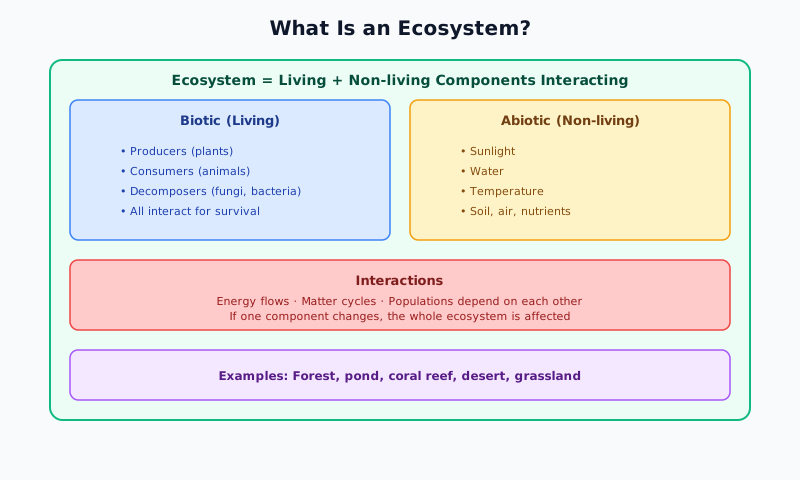
Diagram 2: Roles in an Ecosystem
Flow diagram showing producers making food through photosynthesis, consumers eating other organisms, and decomposers recycling nutrients back to the soil.
Today's hook pointed out that a patch of bush with no animals is still a fully functioning ecosystem, the soil microbes, plants, water and sunlight are all the "living" parts it needs. That idea challenges the common view that ecosystems are just about animals.
Now that you've worked through the lesson, answer with confidence: when you look at a pond or a patch of bush, what counts as "alive" (biotic) and what doesn't (abiotic)? Why do both types of factors matter equally for the ecosystem to function?
Q1. Explain the difference between a biotic factor and an abiotic factor. Give one example of each from a local park.
1 mark for defining biotic, 1 mark for defining abiotic, 1 mark for a correct example of each.Q2. Use the terms producer, consumer and decomposer to describe what would happen in a schoolyard ecosystem if all the decomposers disappeared.
1 mark for each term used correctly, 1 mark for explaining the consequence for the ecosystem.Q3. A new housing development is planned next to a patch of bushland. Builders will remove trees, compact the soil and reduce water flow into the area. Explain how each of these three changes could affect the ecosystem, using at least two key terms from the lesson.
1 mark for each change explained, 2 marks for using key terms correctly, 1 mark for linking the changes to the whole ecosystem.Model answers (click to reveal)
Model Answers
+Multiple Choice
1: C. Sunlight is an abiotic factor because it is non-living. The other options are all living organisms.
2: B. Producers make their own food using sunlight through photosynthesis. This is their defining role in an ecosystem.
3: D. A drought changes an abiotic factor (water availability), which will affect the biotic community because organisms depend on water to survive.
4: A. Decomposers break down dead matter and return nutrients to the soil so producers can use them again. This recycling is essential.
5: B. Abiotic factors like temperature and rainfall determine which organisms can live in an area. Biotic factors like plants can also change abiotic factors by shading soil or adding organic matter.
Short Answer 1 (3 marks)
Sample answer: A biotic factor is a living part of an ecosystem, such as a plant or animal (1 mark). An abiotic factor is a non-living part, such as sunlight, water or soil (1 mark). In a local park, a magpie is a biotic factor and rainfall is an abiotic factor (1 mark).
Short Answer 2 (4 marks)
Sample answer: Producers make their own food using sunlight (1 mark). Consumers eat other organisms for energy (1 mark). Decomposers break down dead matter and return nutrients to the soil (1 mark). If decomposers disappeared, dead matter would pile up and nutrients would not be recycled, so producers would not have the materials they need to grow, and the whole ecosystem would break down (1 mark).
Short Answer 3 (5 marks)
Sample answer: Removing trees would reduce shade and change the temperature of the area, affecting which plants and animals can survive (1 mark). Compacting soil would change the abiotic factor of soil structure, making it harder for roots to grow and for water to drain (1 mark). Reducing water flow would mean less water for producers, which would then affect consumers that rely on those producers (1 mark). Two key terms used correctly: producers and abiotic factors (2 marks).
Revisit Your Thinking
Look back at what you wrote in the Think First section. How has your understanding changed? Can you now explain why a forest with no animals is still an ecosystem?
Model answers (click to reveal)
Model Answers
+Multiple Choice
1: C. Sunlight is an abiotic factor because it is non-living. The other options are all living organisms.
2: B. Producers make their own food using sunlight through photosynthesis. This is their defining role in an ecosystem.
3: D. A drought changes an abiotic factor (water availability), which will affect the biotic community because organisms depend on water to survive.
4: A. Decomposers break down dead matter and return nutrients to the soil so producers can use them again. This recycling is essential.
5: B. Abiotic factors like temperature and rainfall determine which organisms can live in an area. Biotic factors like plants can also change abiotic factors by shading soil or adding organic matter.
Short Answer 1 (3 marks)
Sample answer: A biotic factor is a living part of an ecosystem, such as a plant or animal (1 mark). An abiotic factor is a non-living part, such as sunlight, water or soil (1 mark). In a local park, a magpie is a biotic factor and rainfall is an abiotic factor (1 mark).
Short Answer 2 (4 marks)
Sample answer: Producers make their own food using sunlight (1 mark). Consumers eat other organisms for energy (1 mark). Decomposers break down dead matter and return nutrients to the soil (1 mark). If decomposers disappeared, dead matter would pile up and nutrients would not be recycled, so producers would not have the materials they need to grow, and the whole ecosystem would break down (1 mark).
Short Answer 3 (5 marks)
Sample answer: Removing trees would reduce shade and change the temperature of the area, affecting which plants and animals can survive (1 mark). Compacting soil would change the abiotic factor of soil structure, making it harder for roots to grow and for water to drain (1 mark). Reducing water flow would mean less water for producers, which would then affect consumers that rely on those producers (1 mark). Two key terms used correctly: producers and abiotic factors (2 marks).
● Big Idea
An ecosystem is a community of living and non-living things that interact in a particular area.
● Key Process
Producers make food, consumers eat other organisms, and decomposers recycle nutrients.
● Why It Matters
Understanding ecosystems helps us protect local bushland, parks and waterways.
● Bridge Forward
Next lesson explores how energy moves through ecosystems using food chains and food webs.