Food Webs and Energy Flow
In 2019, Australian Museum researchers calculated that only 10% of energy transfers from one level of a food web to the next, meaning a top predator like a wedge-tailed eagle needs roughly 1,000 kg of grass to sustain just 1 kg of its own body.
Printable Worksheets
Print or save as PDF, or build a custom worksheet from any module's questions.
Q1 · Q1: Where does the energy in a kangaroo's muscles come from? Trace it back as far as you can.
Q2 · Q2: Why do ecosystems need more grass than lions?
● Know
- food chains show the flow of energy from one organism to another
- food webs are made of many connected food chains
- energy pyramids show that energy is lost at each level
● Understand
- the arrow in a food chain shows the direction of energy flow
- most energy is lost as heat, movement and waste at each level
- food webs are more realistic than food chains because organisms eat many things
● Can do
- construct a simple food chain and food web
- interpret an energy pyramid
- explain why there are fewer top predators than producers
A food chain is a simple way to trace energy from its source through an ecosystem by following who eats whom.
A food chain always starts with a producer, usually a plant or algae, because producers capture energy from sunlight. The next organism is a primary consumer that eats the producer. The next is a secondary consumer that eats the primary consumer. The chain can keep going with tertiary consumers at the top.
The arrow in a food chain points from the organism that is eaten to the organism that eats it. This shows the direction of energy flow. For example, in grass → grasshopper → lizard → hawk, the arrow points from grass to grasshopper because energy moves from the grass into the grasshopper when it is eaten.
Use the organisms below to build a simple Australian food web. Draw arrows showing energy flow and label each organism with its trophic level.
Organisms: grass, grasshopper, lizard, hawk, caterpillar, magpie, nectar, bee
Real ecosystems are more complex than a single food chain. A food web shows the many feeding relationships that exist in the same place.
A grasshopper does not only eat grass. It might eat leaves from several plants. A lizard does not only eat grasshoppers. It might also eat caterpillars or spiders. A hawk might eat lizards, small birds or mice. When you draw all these connections together, you get a food web.
Food webs are more useful than food chains because they show what happens when one species changes. If a drought kills off the grasshoppers, a lizard that also eats caterpillars might survive. In a simple food chain, the lizard would have no other food source and would die out. Food webs show that ecosystems have some backup connections.

In an energy pyramid, only about [blank] percent of energy transfers to the next [blank]. The rest is lost as [blank], movement and waste. This is why there are fewer [blank] predators than producers.
Energy does not cycle through a food chain. It flows in one direction, and most of it is lost before it reaches the next level.
When a grasshopper eats grass, it does not turn all the grass into grasshopper body mass. Some energy is used for movement, some is lost as heat, and some passes out as waste. On average, only about 10 percent of the energy from one level transfers to the next. This means producers must capture a huge amount of energy to support just a few top predators.
An energy pyramid shows this visually. The bottom level is wide because producers capture the most energy. Each level above is narrower because less energy is available. This is why there is more grass than grasshoppers, more grasshoppers than lizards, and more lizards than hawks.

A student says: "If there are more kangaroos, there will automatically be more dingoes." Use the Claim-Evidence-Reasoning frame below to evaluate this claim.
Claim-Evidence-Reasoning Frame
Claim: State whether the student is correct or incorrect.
Evidence: Use facts from the lesson about food webs and energy flow.
Reasoning: Explain how the evidence supports your claim.
Wrong: "Energy is recycled in a food chain."
Right: Energy flows through an ecosystem and is lost as heat at each level. Matter is recycled, but energy is not.
Wrong: "The arrow points from predator to prey."
Right: The arrow shows energy flow from prey to predator. It points to the organism that receives the energy.
Wrong: Top predators are at the bottom of the pyramid because they're the strongest and have the most energy.
Right: Producers are at the bottom of the energy pyramid. Top predators are at the top because they receive the least energy.
Wrong: Energy is passed up the food chain unchanged, what goes into a herbivore is what its predator gets.
Right: Only about 10 percent of energy transfers to the next level. The rest is lost as heat, movement and waste.
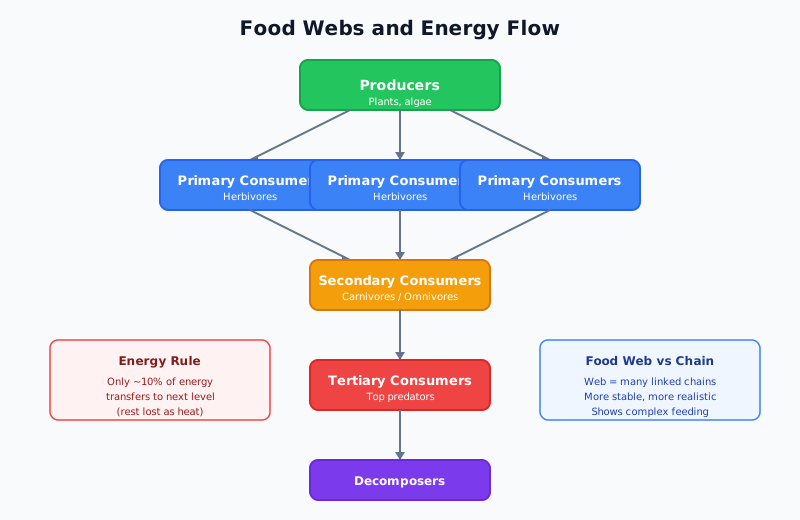
Diagram 2: Energy Pyramid
Stacked pyramid showing energy levels from producers at the wide base to top predators at the narrow peak, with approximate percentages labelled at each level.
Today's hook told you that every joule of energy in a kangaroo's muscles originally came from the sun, but only about 10% passes from one level of a food web to the next. That's why ecosystems need far more grass than lions.
Now that you've worked through the lesson, trace the energy in a kangaroo's muscles all the way back to the sun. Include at least two links in the food chain and explain why so little of the original energy makes it to the top predator level.
Q1. Explain the difference between a food chain and a food web.
1 mark for defining a food chain, 1 mark for defining a food web, 1 mark for explaining why a food web is more realistic.Q2. Use the terms producer, primary consumer, energy pyramid and trophic level to explain why a paddock can support many sheep but only a few wedge-tailed eagles.
1 mark for each term used correctly, 1 mark for logical explanation of energy loss.Q3. A farmer sprays insecticide that kills most of the grasshoppers in a paddock. Explain three ways this could affect the food web, using at least two key terms from the lesson.
1 mark for each effect explained, 2 marks for using key terms correctly, 1 mark for linking the effects to the whole ecosystem.Model answers (click to reveal)
Model Answers
+Multiple Choice
1: B. The arrow shows the direction of energy flow from the organism that is eaten to the organism that eats it.
2: C. Producers are always at the first trophic level because they capture energy from sunlight and make their own food.
3: A. A food web is better because most organisms eat more than one type of food, so a single chain is too simple.
4: D. Only a small fraction of energy reaches the top predator level because most energy is lost as heat, movement and waste at each trophic level.
5: B. If lizards are removed, grasshoppers would increase because one of their main predators has been removed. This is a direct effect on the food web.
Short Answer 1 (3 marks)
Sample answer: A food chain is a simple model showing one path of energy from producer to top predator (1 mark). A food web is a network of many interconnected food chains (1 mark). A food web is more realistic because most organisms eat more than one type of food and are eaten by more than one predator (1 mark).
Short Answer 2 (4 marks)
Sample answer: Grass in the paddock is the producer at the first trophic level (1 mark). Sheep are primary consumers that eat the grass (1 mark). The energy pyramid shows that only about 10 percent of energy transfers to the next level (1 mark). This means there is much less energy available for wedge-tailed eagles at a higher trophic level, so only a few can be supported (1 mark).
Short Answer 3 (5 marks)
Sample answer: Lizards that eat grasshoppers would have less food, so their population might decrease (1 mark). Plants that grasshoppers eat might increase because fewer grasshoppers are eating them (1 mark). Hawks or other predators that eat lizards might also be affected because their food source is reduced (1 mark). Key terms used: food web and trophic level (2 marks).
Revisit Your Thinking
Look back at what you wrote in the Think First section. Can you now trace the energy in a kangaroo's muscles all the way back to the sun? Can you explain why ecosystems need more grass than lions using the energy pyramid?
Model answers (click to reveal)
Model Answers
+Multiple Choice
1: B. The arrow shows the direction of energy flow from the organism that is eaten to the organism that eats it.
2: C. Producers are always at the first trophic level because they capture energy from sunlight and make their own food.
3: A. A food web is better because most organisms eat more than one type of food, so a single chain is too simple.
4: D. Only a small fraction of energy reaches the top predator level because most energy is lost as heat, movement and waste at each trophic level.
5: B. If lizards are removed, grasshoppers would increase because one of their main predators has been removed. This is a direct effect on the food web.
Short Answer 1 (3 marks)
Sample answer: A food chain is a simple model showing one path of energy from producer to top predator (1 mark). A food web is a network of many interconnected food chains (1 mark). A food web is more realistic because most organisms eat more than one type of food and are eaten by more than one predator (1 mark).
Short Answer 2 (4 marks)
Sample answer: Grass in the paddock is the producer at the first trophic level (1 mark). Sheep are primary consumers that eat the grass (1 mark). The energy pyramid shows that only about 10 percent of energy transfers to the next level (1 mark). This means there is much less energy available for wedge-tailed eagles at a higher trophic level, so only a few can be supported (1 mark).
Short Answer 3 (5 marks)
Sample answer: Lizards that eat grasshoppers would have less food, so their population might decrease (1 mark). Plants that grasshoppers eat might increase because fewer grasshoppers are eating them (1 mark). Hawks or other predators that eat lizards might also be affected because their food source is reduced (1 mark). Key terms used: food web and trophic level (2 marks).
● Big Idea
Energy flows through ecosystems in one direction, from producers through consumers.
● Key Process
Food webs show realistic feeding relationships. Energy pyramids show that only about 10 percent of energy transfers between levels.
● Why It Matters
Understanding energy flow helps explain why top predators are rare and why disrupting one species can affect many others.
● Bridge Forward
Future lessons will explore how human activities change ecosystems and what happens when food webs are disrupted.